Pangram AI Detector Review (2026): Accuracy and False Positives
Is Pangram's AI detector accurate? It claims 99%+ accuracy and a 1 in 10,000 false positive rate. See what independent studies found and how it compares.

Pangram is an AI detector from Pangram Labs, and the company says it's more than 99% accurate. It also says it wrongly flags about 1 in 10,000 human texts. Pangram points to outside studies from the University of Chicago and the University of Maryland that it says found similar results.
Below, we go through Pangram's own accuracy and false positive numbers, and what independent studies found. Then we cover how Pangram detects AI text, how it compares with GPTZero, Copyleaks and Turnitin, and its pricing and language support.
What Pangram does
Pangram is an AI detection tool built for schools, publishers, law firms and other organizations that need to tell human and AI writing apart. You paste in text or upload a file. Pangram returns a prediction of Human, AI-Generated or AI-Assisted, plus a score for how much of the document falls into each label.
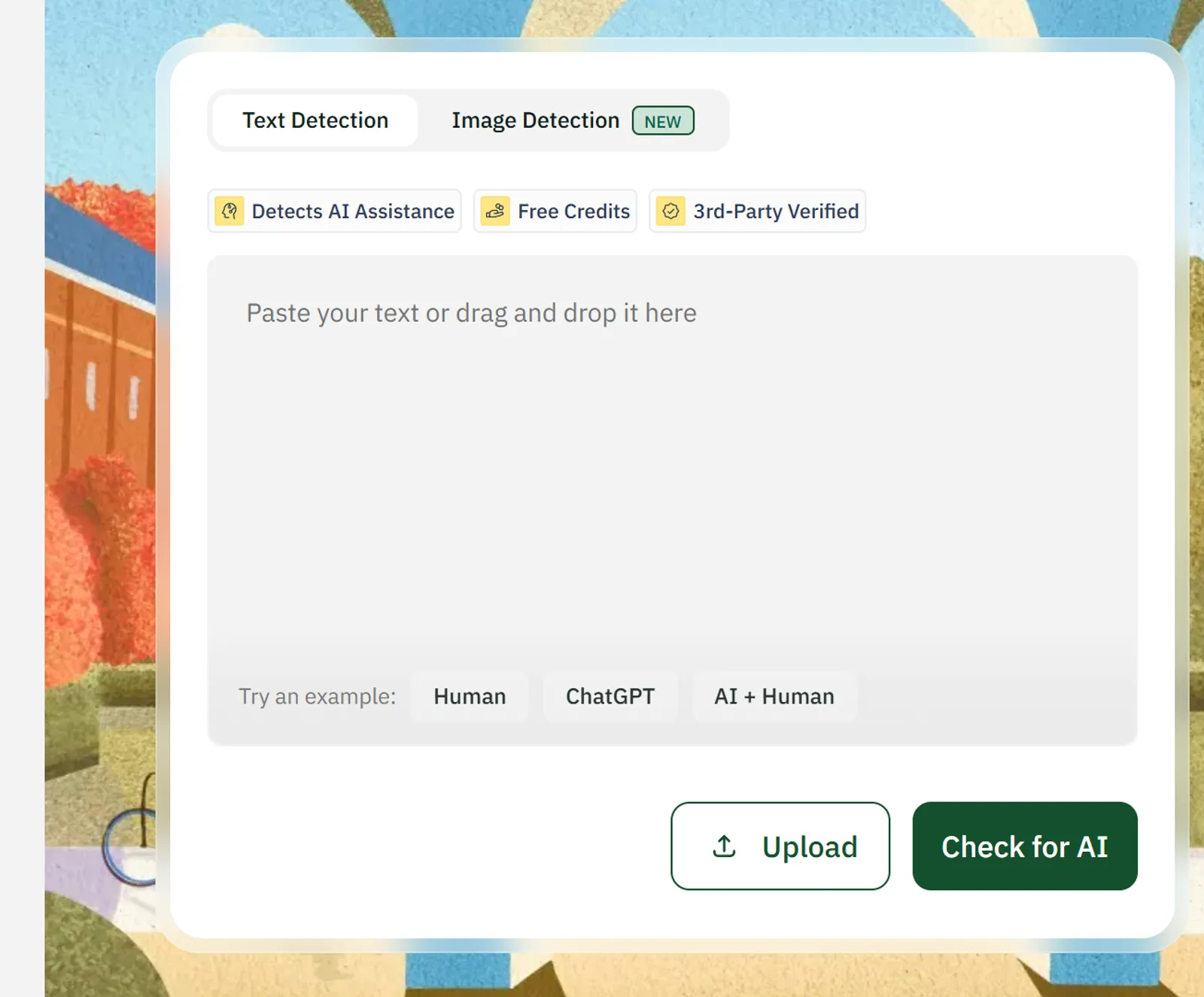
Pangram Labs started in Brooklyn, New York in 2023. Its founders worked on AI research at Tesla and Google before starting the company. The product line now includes a plagiarism checker bundled with the AI detector, an AI image detector and a browser extension. It also integrates with Gmail, Google Docs and learning management systems such as Canvas, Moodle, Google Classroom and Brightspace. An API is available too, for developers who want AI detection inside their own apps.
Pangram's latest model, Pangram 4, needs at least 50 words of input and works best on complete sentences. Short replies and bullet points give it less to work with. Each result includes a confidence level of High, Medium or Low for every segment, along with highlighted sections that mark which sentences the model labels AI-Generated, AI-Assisted or Human.
An AI-Assisted label means Pangram thinks AI edited or polished writing that a person started. If you used a grammar tool or an AI rewriter on parts of your text, that label can appear even when the ideas and structure are yours. Check what your school or employer allows for AI editing tools before you treat the label as a problem.
What Pangram claims about its accuracy
Pangram's FAQ states the detector is over 99% accurate, with a false positive rate of about 1 in 10,000. It says that figure is calculated across public datasets containing tens of millions of documents. Pangram also benchmarks its model against 26 AI systems and reports 99.7% accuracy on those AI-generated samples as a group, retesting after every major model release.
Pangram publishes accuracy figures for individual models too:
| AI model | Pangram's reported accuracy | Tested |
|---|---|---|
| Claude Opus 5 | 99.8% | July 2026 |
| GPT-5.6 | 99.6% | July 2026 |
| Gemini 3 | 99.5% | July 2026 |
| Grok 4.3 | 99.4% | July 2026 |
These are Pangram's own figures, measured on its own test sets. Its Pangram 4 model card breaks the number down further. On 519,993 English AI-generated samples from 26 models, Pangram 4 missed 0.34% of them, close to the 99.7% headline figure. The model card also lists a 1.24% miss rate on a multilingual set covering 18 languages, so Pangram detects AI text a little less reliably outside English.
Pangram's false positive rate, by domain and language
Pangram's FAQ gives a single overall false positive rate of 1 in 10,000. Its Pangram 4 model card reports a more specific number. Out of 1,000,000 English documents from the FineWeb dataset, Pangram 4 had 41 false positives, or 0.0041%, close to 1 in 24,000. On a multilingual set of 996,273 documents across 104 languages, it had 14 false positives, or 0.0014%.
The rate changes by domain. Pangram's model card lists these false positive rates:
| Domain | False positive rate |
|---|---|
| Academic writing (English) | 0.019% |
| News (multilingual) | 0.003% |
| Creative writing, long-form | 0.000% |
| Biomedical research papers | 0.002% |
| How-to articles (multilingual) | 0.016% |
| Movie scripts | 0.010% |
| Poetry | 0.078% |
| Recipes | 0.049% |
For academic writing in English, Pangram's model card lists a false positive rate of 0.019%, or about 1 in 5,000 documents. That's higher than its overall figure, and it's the number that matters most for students and researchers. Formal academic prose follows set patterns, and formulaic text is where Pangram's own data shows more false positives.
Pangram's own blog post on false positives says the rate rises on text that's short, not written in full sentences, or highly formulaic, such as recipes and poetry. It says the rate stays low on long, original prose such as essays, reviews and reports, because that kind of writing gives the model more to work with.
Language changes the rate too. Pangram's model card lists official support for 24 languages. They are English, Spanish, French, Portuguese, Arabic, Chinese, Japanese, Korean, Russian, Turkish, Hungarian, German, Dutch, Swedish, Romanian, Ukrainian, Polish, Italian, Czech, Greek, Hindi, Persian, Urdu and Vietnamese. Its measured false positive rate ranges from 0.0000% on languages like Arabic, Chinese and Japanese, up to 0.0078% on Portuguese and 0.0361% on Ukrainian. All of those are still far below 1 in 1,000. Pangram says it can also generalize to languages outside that list and invites requests to evaluate a new one.
Pangram also publishes comparisons with other detectors. On product reviews from the University of Chicago research, it reports false positive rates of 0.5% for itself, 1.7% for Originality.ai and 2.4% for GPTZero. These are Pangram's figures, from its own blog.
Outside studies Pangram cites
A 2025 University of Chicago Booth study found that leading AI detectors flagged more than 90% of unedited AI text. Most of them flagged fewer than half once the text went through a humanizer. Pangram was one of the four detectors tested, along with GPTZero, Originality.ai and the open-source detector RoBERTa. Pangram says it was the only one that kept its false positive rate under 0.5% while still detecting AI text.
Pangram also cites a June 2026 study from Vrije Universiteit Brussel. It tested Pangram, GPTZero, Turnitin and Copyleaks on 160 academic papers by non-native English speakers, split between human, AI-generated, hybrid and humanized text. Pangram says none of the four tools flagged the human-written papers in that study.
A 2025 study: Pangram against expert human readers
A 2025 paper by Jenna Russell, Marzena Karpinska and Mohit Iyyer was published at ACL 2025. It tested whether people who often use AI writing tools can detect AI-generated text as well as automatic detectors do. Five annotators who said they frequently used LLMs for their own writing read 300 non-fiction English articles. The set mixed human-written text with text from GPT-4o, Claude and o1-Pro, including some articles run through a humanizer. The majority vote of those five annotators misclassified only 1 of the 300 articles.
The paper compared that panel with five automatic detectors: Pangram, GPTZero, Binoculars, Fast-DetectGPT and RADAR. The researchers ran two Pangram models, its base detector and a separate model called Pangram Humanizers that's trained to detect text run through a humanizer. Pangram Humanizers was the only detector to match the expert panel, with an average true positive rate of 99.3% and a false positive rate of 2.7% across the test set. Pangram's base model reached a 98.0% average true positive rate with a 2% false positive rate in the same test.
A 2.7% false positive rate is higher than the 1 in 10,000 figure Pangram reports from its own evaluations. This test used a much smaller set of articles, 300 rather than the millions Pangram cites elsewhere. The paper also scored Pangram using only its Human and AI-Generated labels, without giving it credit for its neutral "Possibly AI" label. Pangram and GPTZero both gave the researchers API credits to run the test.
Rewrite the AI-flagged part in your own voice
Our academic humanizer rewrites AI-assisted sections while leaving citations, technical terms and numbers exactly as you wrote them.
Try ProofreaderPro.ai FreeHow Pangram detects AI writing
Pangram says it doesn't use perplexity or burstiness, the two signals most older AI detectors rely on. Perplexity measures how predictable each word is to a language model, and burstiness measures how much that predictability changes across a document. We explain both in our own post on perplexity in AI detection.
Pangram argues that perplexity-based detectors misfire on any text a language model has memorized during training, including the Declaration of Independence and large parts of Wikipedia. Models learn to predict memorized text with very low perplexity, regardless of who wrote it. Pangram also says perplexity-based methods have a higher false positive rate on non-native English writing, since simpler sentence structures are also more predictable. We cover that same false-positive pattern for non-native English writers in a post that looks at other detectors.
Instead, Pangram trains a deep learning model directly on large sets of human and AI text. It uses a method it calls hard negative mining to find human writing that happens to resemble AI output. Pangram processes full documents at the token level. It labels each segment Human, AI-Assisted or AI-Generated, with a continuous score for how much of the segment looks AI-written. Pangram says the model improves as it's trained on more data.
Pangram vs GPTZero, Copyleaks and Turnitin
Pangram, GPTZero and Copyleaks are open to anyone who signs up. Turnitin only works through a school or publisher account, and an individual test-taker typically sees a Turnitin score only if an instructor passes it along.
| Detector | Access | Vendor's own false positive claim | Free plan |
|---|---|---|---|
| Pangram | Open signup | About 1 in 10,000 overall | 2,000 words a day |
| GPTZero | Open signup | About 1% | 10,000 characters per scan |
| Copyleaks | Open signup | About 0.2% | Limited free scans |
| Turnitin | Schools and publishers only | 0.51% on academic writing | Not available to individuals |
We've covered each of these detectors separately: see is GPTZero accurate, does Copyleaks detect AI and can Turnitin detect humanized AI text. The false positive figures in the table are each company's own claims, as Pangram and the other vendors state them.
Pangram is a standalone detector. Grammarly and Scribbr offer AI detection as part of their writing tools, and we've looked at Grammarly's AI detector and Scribbr's AI detector separately.
Pricing and free plan limits
Pangram's Free plan needs no payment method. It covers 2,000 words of text scanning a day and 3 image detection scans a day. That includes file upload with OCR, the browser extension, Google Docs integration and API access, in more than 20 languages.
| Plan | Price | What it adds |
|---|---|---|
| Free | US$0 a month | 2,000 words a day, 3 image scans a day |
| Individual | US$20 a month, billed annually | 300,000 words a month, 100 image scans a month, plagiarism detection, Gmail integration |
| Professional | US$65 a month, billed annually | 5x the words and image scans of Individual, plus US$200 in monthly API credits |
The Individual plan has a 7-day free trial before the US$20 monthly charge starts, and billing annually saves US$60 a year against the monthly rate. The Professional plan is billed US$65 right away rather than through a trial, and saves US$240 a year billed annually. Pangram also lists separate Business pricing for teams, shown after choosing the Business tab on its pricing page.
Who uses Pangram
Schools and universities make up Pangram's largest customer base. Its LMS integrations connect directly to Canvas, Moodle, Google Classroom and Brightspace. A teacher can see a Pangram result next to a student's submission without leaving the platform they already use to grade.
Publishers, law firms and HR teams use Pangram for different reasons: checking submitted manuscripts, reviewing documents in a case, or screening applicant materials. The API lets any of these organizations build Pangram's detection into their own internal tools. The Gmail and Google Docs integrations let one person check text without leaving their inbox or a document.
For a student, this usually means a Pangram score appears inside the same dashboard your teacher already uses for grades and feedback. It isn't a separate report you request yourself. If your school runs Pangram through an LMS, ask your instructor or department what score counts as a concern and what happens next.
If a Pangram result does flag your writing, a record of your own drafting process counts for more than arguing about the score alone. We go into that in separate posts on building a record of your drafting process and the steps for a formal appeal.
If AI helped draft part of your paper, our academic humanizer rewrites that section in your own voice. Citations, technical terms and numbers stay exactly as you wrote them, and the tool is built to bring AI scores down on the sections it touches.
Frequently asked questions
Q: Is Pangram accurate?
Pangram says it's over 99% accurate, and it cites outside studies with similar results. Its own model card shows lower accuracy on texts under 50 words and on some languages other than English.
Q: What is Pangram's false positive rate?
Pangram's FAQ states an overall rate of about 1 in 10,000. Its Pangram 4 model card reports a more specific figure of 0.0041%, or about 1 in 24,000, measured on 1,000,000 English documents, with the rate varying by domain and language.
Q: How does Pangram compare to GPTZero?
Pangram says its false positive rate is about 1 in 10,000, and GPTZero says about 1% on the RAID benchmark. Both have free plans and open signup. We cover GPTZero's own numbers in our GPTZero accuracy review.
Q: How does Pangram compare to Turnitin?
Turnitin only works through a school or publisher account, while anyone can sign up for Pangram directly. Pangram cites a 0.51% false positive rate on academic writing from Turnitin's own whitepaper and reports a lower rate for itself.
Q: How does Pangram compare to Copyleaks?
Copyleaks says its false positive rate is about 0.2%, and Pangram reports a lower rate for itself. Both offer free scans, and we cover Copyleaks in does Copyleaks detect AI.
Q: How does Pangram detect AI writing?
Pangram uses a deep learning model trained on human and AI text. It doesn't use perplexity and burstiness, the measures many older detectors rely on. It labels each segment of a document Human, AI-Assisted or AI-Generated and gives a confidence level for the result.
Q: Is Pangram's AI detector free to use?
Yes, the Free plan needs no payment method and covers 2,000 words of text scanning a day plus 3 image scans. Paid plans start at US$20 a month billed annually for 300,000 words a month and plagiarism detection.
Q: Does Pangram detect text run through a humanizer?
Pangram says it does, and it points to the 2025 Chicago Booth study as support. Detectors and humanizers both update often, so results on humanized text can change over time.
Q: What did the University of Maryland study find about Pangram?
A 2025 University of Maryland paper found that Pangram's humanizer-aware model, Pangram Humanizers, was the only automatic detector to match a panel of five expert human readers. Both reached a 99.3% average true positive rate across 300 test articles. Pangram's false positive rate in that specific test was 2.7%, well above the 1 in 10,000 rate it reports from its own larger evaluations.
Q: Who makes Pangram?
Pangram Labs is the company behind Pangram, founded in Brooklyn, New York in 2023 by former AI researchers from Tesla and Google. The company also sells a plagiarism checker, an AI image detector and API access alongside its text detector.
Rewrites AI-assisted academic drafts in your own voice, leaving citations, technical terms and numbers exactly as you wrote them.

Dana is a content creator at ProofreaderPro, where she runs the daily blog and writing operations. She writes the articles on how the online editing platform works, and she handles customer messages every day, with a five-star satisfaction score to show for it.