Copyleaks AI Detector: Is It Accurate? What Studies Show
Does Copyleaks detect AI? Yes. See what four independent studies found, why it flags human writing, its free limits and pricing, and what to do if flagged.

Yes, Copyleaks detects AI, and it's one of the more accurate AI detectors on unedited text from ChatGPT, Claude and Gemini. Independent studies have also found that it rarely flags human writing. Its weak spots are newer AI models and AI text that has been edited or run through a humanizer. Copyleaks says its detector is more than 99% accurate, with a false-positive rate of 0.03%.
Below, we cover what Copyleaks is, how it decides whether text is AI, what four independent tests found between 2023 and 2026, and why it sometimes seems to flag everything. We also go through its free limits, its pricing, whether it keeps a copy of your work, and what to do if it flags you.
What is Copyleaks?
Copyleaks is a New York company that makes an AI detector, a plagiarism checker and a few related tools. It started with plagiarism detection and added AI detection as tools like ChatGPT spread. Schools, businesses and individual writers use it.
Schools usually run Copyleaks inside their learning platform. It connects with Canvas, D2L, Moodle, Blackboard, Schoology, Edsby and Sakai, so a teacher can see a Copyleaks report next to a submitted assignment. Anyone can also use the free detector on the Copyleaks website, and there's a Chrome and Edge extension and a Google Docs add-on.
How does Copyleaks detect AI?
Copyleaks compares your text with patterns from a very large set of human writing, and it flags text that looks different from how people usually write. Copyleaks says it trained the detector on trillions of human-written documents. It also says the model looks at a few specific things:
- Frequency ratios: how often your phrases appear in AI writing compared with human writing.
- Parts of speech: grammar and sentence structure patterns that are common in AI output.
- Syllable dispersion: the rhythm of syllables across your text.
- Hyphen usage: hyphen patterns that look mechanical.
The result shows what share of your text looks AI-generated, and a free account adds sentence-by-sentence highlights. Copyleaks says the report can separate human and AI parts when a document mixes both. Paid plans add a feature called AI Logic, which has two parts. AI Phrases shows which phrases appear far more often in AI writing than in human writing. AI Source Match shows when part of your text already appears somewhere else online.
Copyleaks says it detects text from GPT-5, GPT-4, ChatGPT, Claude, Gemini, DeepSeek, Llama, Bloom, Rytr and Jasper. Like most detectors, it doesn't need to know which tool you used. It looks at how the writing behaves, which is the same idea behind perplexity in AI detection.
What Copyleaks says about its accuracy
Copyleaks makes some of the strongest accuracy claims of any detector. On its AI detector page, Copyleaks puts its accuracy above 99%. It says it labels human writing as AI only 0.03% of the time, or about 3 in every 10,000 human texts.
Copyleaks also publishes results by language. Here's what its site showed in October 2026 for its most common languages.
| Language | Human texts labeled correctly | AI texts labeled correctly |
|---|---|---|
| English | 99.97% | 99.20% |
| French | 99.88% | 96.18% |
| German | 99.94% | 95.63% |
| Italian | 99.88% | 97.00% |
| Portuguese | 99.95% | 93.08% |
| Spanish | 99.85% | 98.02% |
These figures are from Copyleaks' own testing. They show the same pattern as most detectors: Copyleaks is very careful about human writing, and it misses more AI text outside English. In Portuguese, for example, its own figure means about 7 in 100 AI texts get through.
Copyleaks in independent studies, 2023 to 2026
Copyleaks has been included in several independent tests, and the results have changed as AI models have improved. Here's a summary of four of them, including our own.
| Study | What was tested | Copyleaks' result |
|---|---|---|
| Walters, Open Information Science, 2023 | 126 essays: 42 by ChatGPT-3.5, 42 by ChatGPT-4, 42 by students | One of three detectors with high accuracy on all three sets |
| Alshammari and Rao, arXiv, 2025 | 49 human answers, 49 DeepSeek-v3 answers, 196 paraphrased or humanized versions | Near-perfect on plain and paraphrased text, 71% on humanized text |
| ProofreaderPro test, 2026 | 50 texts, including 10 GPT-4o texts and 10 published journal articles | Flagged 8 of 10 AI texts and 1 of 10 human articles |
| Van Vlasselaer, Van Droogenbroeck and Spruyt, International Journal for Educational Integrity, 2026 | 160 academic papers: human, AI, hybrid and humanized | No human papers flagged, but AI content was often underestimated, especially from the newest model |
The 2023 study by William Walters tested 16 detectors on first-year composition essays. Most of them could tell GPT-3.5 essays from student essays, but they struggled with GPT-4. Copyleaks, Turnitin and Originality.ai were the three that stayed accurate on all three sets.
In a 2025 arXiv paper, Hulayyil Alshammari and Praveen Rao ran six detectors on DeepSeek-v3 answers. Copyleaks and QuillBot did best on the original and paraphrased answers. Humanized text was harder for every tool, and Copyleaks' accuracy on it fell to 71%. That was still the highest of the three detectors the paper named in that comparison.
The newest is a 2026 paper by researchers in Belgium, published in the International Journal for Educational Integrity. Researchers tested GPTZero, Pangram, Copyleaks and Turnitin on 160 academic papers. All four tools labeled the fully human papers correctly, and false positives were rare. Copyleaks, GPTZero and Turnitin often underestimated how much of a paper was AI-written, particularly with text from the most advanced model. The authors concluded that detection tools can give a useful first flag but shouldn't be the only evidence in a high-stakes decision.
Put together, the studies point the same way. Copyleaks rarely accuses human writers, which is what matters most to a student. It's also less sure of itself on edited text and on the newest AI models, so a low Copyleaks score doesn't prove a text is human either. You can compare these results with other detectors in our AI detector accuracy test, is GPTZero accurate and our Pangram AI detector review.
Why does Copyleaks say everything is AI?
If Copyleaks flags most of what you write, there's usually a reason you can check. These are the most common ones.
You used an AI writing assistant to edit
Copyleaks says Grammarly's AI rewriting features may trigger its detector, while basic grammar and spelling fixes usually don't. The same applies to other tools that rewrite whole sentences. If you accepted a lot of AI rewrites, those sentences now have AI patterns, even if the ideas were yours. Our post on Grammarly's AI detector explains the difference between corrections and generative rewrites.
Your text is very short
Copyleaks needs a minimum amount of text to give a reliable result. On its website the minimum is 255 characters, and in the browser extension it's 350 characters. A short paragraph near that minimum gives the model very little to work with, so check a full section if you can.
Your writing follows a fixed pattern
Methods sections, definitions, abstracts and literature reviews use the same phrases in thousands of papers. Phrases that appear often in AI writing also appear often in formal academic writing. AI Phrases can highlight these lines even when you wrote them yourself.
English is your second language
Copyleaks says it has low false-positive rates on non-native English text. Even so, careful and simple English can look predictable to any detector. If you write in a second language, keep your drafts and notes, and read our post on why AI detectors flag non-native writers.
Revise flagged passages without losing your citations
Our academic humanizer rewrites AI-assisted passages into natural academic prose. Your citations, technical terms and data stay as you wrote them.
Try ProofreaderPro.ai FreeIs the Copyleaks AI detector free? Limits and pricing
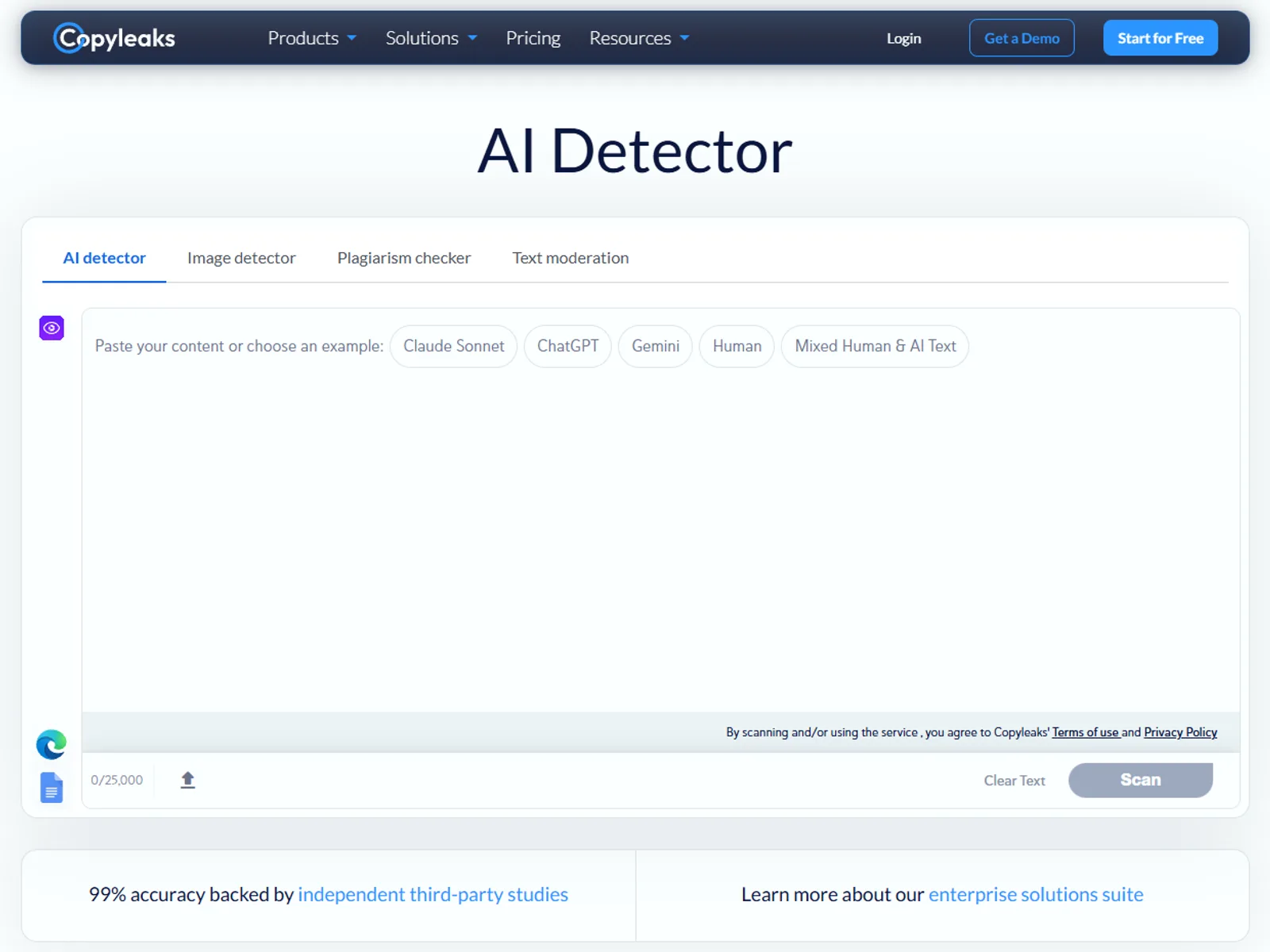
Yes, you can use the Copyleaks AI detector for free. Without logging in, you can paste up to 25,000 characters per scan, which is about 4,000 words. A free account adds a set of monthly credits, sentence-level highlights and more detail in the report. Paid plans add AI Logic, plagiarism checks in the same report, file uploads and the browser extension with saved scans.
Here are Copyleaks' individual plans as listed on its pricing page in October 2026, billed annually.
| Plan | Price | What you get |
|---|---|---|
| Free | US$0 | Up to 25,000 characters per scan without logging in, plus free credits with an account |
| Personal | US$13.99 a month (US$167.88 a year) | 1,200 credits: up to 300,000 words or 1,200 images, AI Logic, plagiarism checks |
| Pro | US$74.99 a month (US$899.88 a year) | 12,000 credits: up to 3,000,000 words or 12,000 images, 25 user seats |
Schools and businesses buy Copyleaks through separate education and enterprise plans. Those add LMS integration, API access and settings like custom detection sensitivity. If your school uses Copyleaks, you usually don't need your own plan to have your work checked.
Does Copyleaks save your work, and is it safe?
It depends on how a scan is set up. Copyleaks keeps two kinds of databases for plagiarism checks. The Shared Data Hub is a global database with millions of documents from institutions around the world. When a document is indexed there, other users' submissions can be compared against it. The Private Cloud Hub is a separate database that only one organization can use.
So if your school indexes submissions in the Shared Data Hub, your paper can be stored and used to check future papers for copying. If you're worried about this, ask your teacher or department which setting they use. On security, Copyleaks lists SOC 2 and SOC 3, GDPR, PCI DSS and NIST RMF certifications on its site.
Copyleaks vs Turnitin
Universities often choose between Copyleaks and Turnitin, and the two have a lot in common. Both offer AI detection and plagiarism checks, and both connect to learning platforms. In the 2026 study above, both labeled every human paper correctly and both underestimated AI content from the newest model.
The biggest difference for students is access. Anyone can run a free Copyleaks scan, while Turnitin is only available through a school or publisher. Turnitin also shows an asterisk in place of any AI score from 1% to 19%, as our Turnitin score guide explains. A Copyleaks score for your draft won't match your school's Turnitin report, because the two use different models.
What to do if Copyleaks flags your writing
A Copyleaks flag is a starting point for a conversation. Here's how to handle it.
- Open the full report. Look at which sentences are highlighted and, if you can see AI Logic, which phrases it lists. Formal phrases and lines you polished with an AI tool are the most common ones.
- Think about the tools you used. If you accepted AI rewrites from Grammarly or a similar tool, say so. Copyleaks itself says those rewrites can trigger its detector.
- Keep your evidence. Save earlier drafts, your notes and the document history from Word or Google Docs. Together they show how the text grew over time. We explain why that matters in process is the new proof.
- Ask for a review if the flag is wrong. Bring your drafts to your teacher or editor. The 2026 study's authors say detection results shouldn't be the only evidence in a high-stakes decision. The full process is in our appeal guide for false AI-detection flags.
- Rewrite AI-assisted parts in your own words. If you used AI for part of the draft, rebuild those parts from your own notes and examples. Follow your school's rules on disclosing AI use.
If you're revising an AI-assisted draft for a paper, our academic humanizer can help with the rewriting. It's designed to lower AI scores while your citations, technical terms and data stay as you wrote them. The same steps work on other detectors, including when you want to reduce your Originality.ai score.
Frequently asked questions
Q: Does Copyleaks detect ChatGPT?
Yes. ChatGPT is on Copyleaks' list of supported models, along with GPT-5, GPT-4, Claude, Gemini and DeepSeek. Independent studies have found it accurate on unedited ChatGPT text, and less sure on text that was edited or humanized.
Q: Is Copyleaks accurate?
It's one of the more accurate detectors on plain AI text, and independent studies have found it rarely flags human writing. A 2026 study of 160 academic papers found no false positives from Copyleaks, but it often underestimated AI content from the newest model. Copyleaks itself claims more than 99% accuracy.
Q: Why does Copyleaks say my writing is AI?
The usual reasons are AI rewriting tools, very short text, and formal writing with common academic phrases. Copyleaks says Grammarly's AI rewriting features can trigger its detector, while grammar and spelling fixes usually don't. Check the highlighted sentences in your report to see which reason applies.
Q: Is the Copyleaks AI detector free?
Yes. You can scan up to 25,000 characters at a time without logging in, and a free account adds monthly credits and more detail. Paid plans start at US$13.99 a month, billed annually, and add AI Logic and plagiarism checks.
Q: Does Copyleaks save your work?
It can. If a document is indexed in the Copyleaks Shared Data Hub, it's stored and other submissions can be compared against it. Organizations can use a Private Cloud Hub instead, so ask your school which setting it uses.
Q: Is Copyleaks safe to use?
Copyleaks lists SOC 2 and SOC 3, GDPR, PCI DSS and NIST RMF certifications on its website. If you're checking unpublished research, read how your submissions are stored before you upload them, and use your institution's account if it has one.
Q: Can Copyleaks detect humanized AI text?
Sometimes. In a 2025 study, Copyleaks' accuracy on humanized DeepSeek text was 71%, compared with near-perfect results on plain text. New detector versions and new humanizer versions keep appearing, so a result from one year may not apply the next.
Q: How do I lower my Copyleaks AI score?
Rewrite the highlighted parts from your own understanding, add your own examples and data, and remove filler phrases that appear in a lot of AI writing. Keep your citations and technical terms exactly as they are. If you used AI, follow your school's rules on disclosing it.
Q: Does Copyleaks work in other languages?
Yes, more than 30 of them, according to Copyleaks. The list includes French, German, Spanish, Portuguese, Italian, Japanese, Chinese and Russian. Its own figures show it labels AI text less accurately outside English.
Q: Is Copyleaks better than Turnitin?
In the 2026 study, the two performed in a similar way. Both labeled every human paper correctly and both underestimated AI content from the newest model. The main difference is access, since anyone can use Copyleaks for free and Turnitin is only available through schools and publishers.
Revise AI-assisted academic writing into natural prose while your citations, technical terms and data stay the same.

Moe is an NLP engineer with a PhD in natural language processing. His research covers computational linguistics, text analysis, and machine learning, and it fed directly into the editing and humanization models behind ProofreaderPro. He writes about the part of the process most people never see: how a language model reads a sentence, scores it, and decides what to change.