Grammarly AI Detector: What Its #1 RAID Ranking Means
Grammarly's AI detector ranks #1 on RAID, a published benchmark. See what RAID tests, what the rank means for your essay, and how Grammarly links its humanizer.

Grammarly's AI detector is accurate at flagging plain, unedited AI text. Grammarly says it reaches 99% accuracy and ranks #1 for quality on RAID, a published benchmark that tests detectors against shared data. A ranking like that reflects performance across one large, fixed set of writing samples. It doesn't guarantee a particular score on your own essay, your field's vocabulary, or a draft you've revised several times.
What Grammarly's AI detector checks
Grammarly's AI detector is a free scanning tool on grammarly.com. You paste text or upload a file and click Scan for AI. The tool returns a percentage score for how much of the text appears to be AI-generated, split into two categories, "Resembles AI text" and "No AI text patterns found". The overall percentage is the share of the document in the "Resembles AI text" category. Some people search for this tool as the "Grammarly AI checker," which is the same free detector.
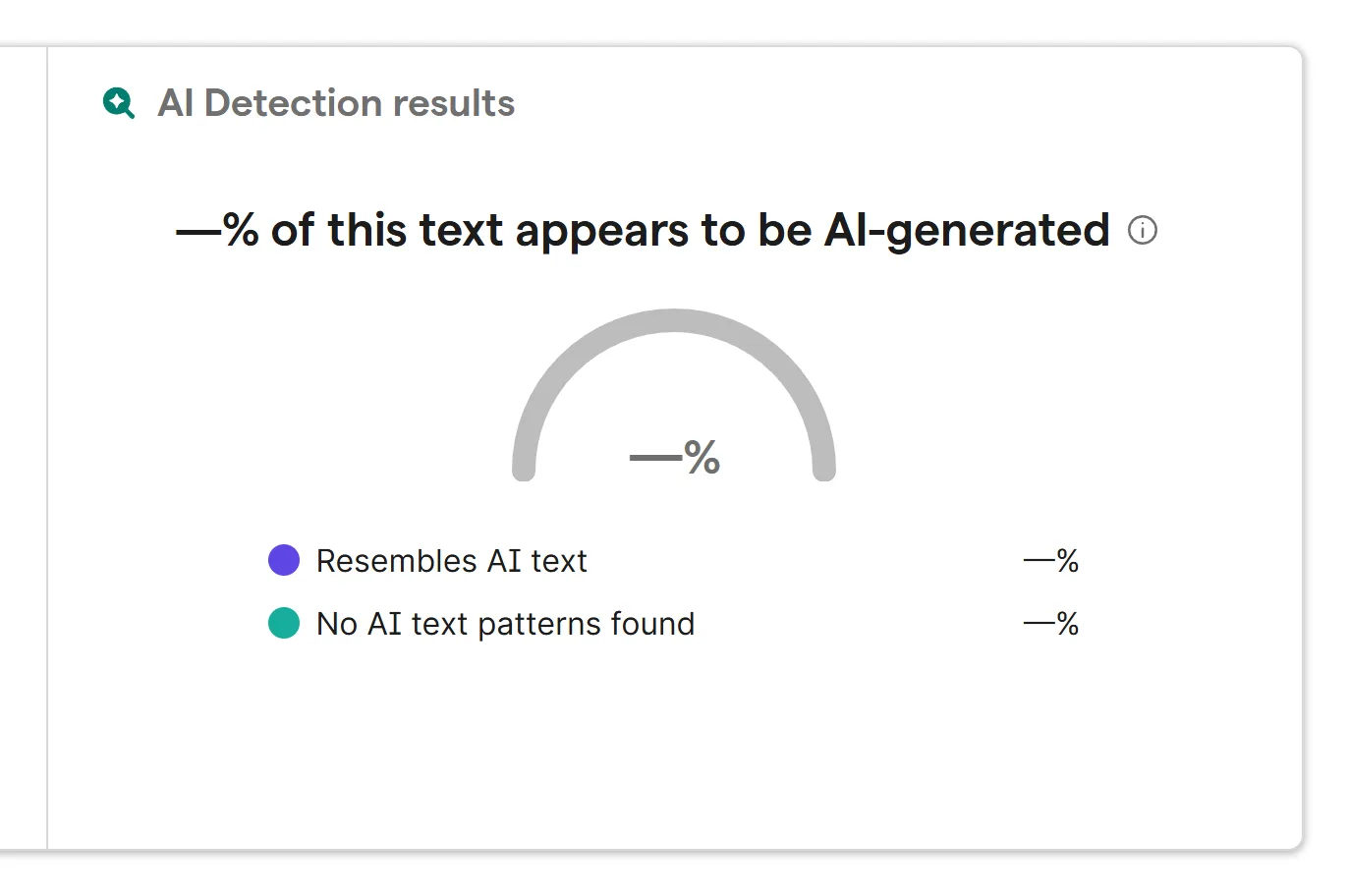
The detector is one tool inside Grammarly's writing suite, next to its grammar checker, plagiarism checker and AI humanizer. Grammarly says it identifies AI-generated text from Grammarly as well as from tools like ChatGPT, Gemini and Claude.
Grammarly Pro adds the AI Detector agent, which goes further than a single score. It marks the specific passages that look AI-generated, explains why a given phrase looks that way, and offers a one-click rewrite for that same passage through Grammarly's AI Rewriter.
Grammarly also says the detector is designed to avoid wrongly flagging human writing, and that its model updates on an ongoing basis as new AI models are released. Grammarly markets the tool across several kinds of writing, including research papers, reports, articles and school assignments, as a check to run before you submit any of them.
What RAID is, and what Grammarly's #1 ranking means
RAID is an academic benchmark, and Grammarly didn't build it. The underlying paper, led by researcher Liam Dugan and co-authors, was presented at the 2024 Association for Computational Linguistics conference. Its abstract makes a direct point. Many commercial and open-source detectors claim 99% accuracy or higher, but very few get tested on datasets built to be difficult.
The RAID dataset is large by design.
| What the RAID paper tested | Detail |
|---|---|
| Generations in the dataset | Over 6 million |
| Writing models covered | 11 |
| Writing domains | 8 |
| Adversarial attacks | 11 |
| Decoding strategies | 4 |
| Detectors evaluated | 12 (8 open-source, 4 closed-source) |
Across those 12 detectors, the paper's authors found a consistent weakness. Current detectors are easily fooled by adversarial attacks, by changes in sampling strategy, by repetition penalties, and by generative models the detector hadn't seen during training. The authors published their full dataset and a running leaderboard afterward, open for other detector companies to test against.
That public leaderboard is part of what makes a RAID rank checkable. Other researchers and detector companies can run the same dataset through their own tools and compare the result. That's different from an accuracy figure a single company reports with no outside way to confirm it.
The paper's authors describe their evaluation as a test of "out-of-domain and adversarial robustness". In plain terms, they didn't only check how a detector performs on text similar to what it was trained on. They also checked how each detector performs on domains, models and attacks it may not have been built to expect.
Grammarly's own blog says Grammarly ranked #1 for quality on that leaderboard. It describes RAID as a test against more than 670,000 texts, covering different writing styles, AI models and attempts to fool the detectors. Grammarly's blog also states plainly that no AI detector is 100% accurate, even its own top-ranked one.
A leaderboard rank is a relative score, measured once, against one shared, fixed set of texts. It tells you how a detector performed on that dataset.
It doesn't predict how the same detector will score your own essay. Your essay has its own field-specific vocabulary and your own writing habits, and it may have gone through several rounds of your own revision. RAID's dataset tests for patterns like that in a controlled way. It isn't built to replicate any one person's real essay, and no benchmark result, however large, substitutes for checking your own draft directly before you submit it.
Grammarly's own AI features and your AI score
Grammarly's AI detector doesn't only check text from other companies' AI tools. Its own page says it identifies AI-generated text from Grammarly as well as from tools like ChatGPT, Gemini and Claude. That line matters if you use Grammarly's own AI features while drafting.
Grammarly's plans page lists its features as separate lines. Grammar and spelling corrections are listed under "Write without mistakes," while its generative features are listed under "Generate text with AI prompts," available in different amounts depending on your plan. Those are two different kinds of help. Fixing a typo or a misplaced comma doesn't generate new sentences, while asking Grammarly to write or rewrite a passage does.
Heavy use of Grammarly's AI Rewriter or its generative prompts is the part of a draft that can show up in your AI score. That's especially true when you generate whole sentences or paragraphs instead of editing your own writing. A student who sticks to grammar and spelling corrections isn't using the part of Grammarly that generates new text. That use on its own isn't the likely source of a flag from Grammarly's own detector. For academic writing specifically, our review of Grammarly's AI humanizer for academic work looks at how Grammarly's generative features hold up around citations and technical terms. If you're weighing Grammarly against other tools for a research paper or thesis, our ProofreaderPro.ai vs Grammarly comparison covers that ground too.
Check your draft before you submit it
Our academic humanizer is built to bring a high AI score down, in your own voice, without touching your citations, technical terms or numbers.
Try ProofreaderPro.ai FreeAuthorship: a record of how you wrote
Grammarly's Authorship feature is separate from the AI detector, and it works more like a running record than a single score. It tracks a document as you write it and categorizes each section: typed by you, taken from an online source, or generated with AI. Authorship is part of the same suite as Grammarly's plagiarism checker and citation generator. A flagged AI score isn't the only record Grammarly's tools can produce for a piece of writing.
If an instructor or an editor ever questions an AI score on your work, Authorship gives you something to show them beyond your own word. It's the same idea behind keeping your own drafts and version history. We cover that approach in process is the new proof. A record of how a piece of writing developed is more convincing than a single percentage. If a flag turns into a formal dispute, our guide to appealing a false AI-detection flag covers the next steps.
How Grammarly links its detector and humanizer
Grammarly's AI detector and its AI humanizer are two separate tools in Grammarly's suite, each with its own page and its own FAQ. The detector is described as a model trained on AI and human text samples. The humanizer is described as a tool built by Grammarly's linguists and engineers. It rewrites AI text into one of four preset voices, or a custom voice you create from a writing sample.
Both pages link to each other under a "Go beyond" section. Grammarly's Authorship feature ties them together by showing which parts of a document were typed, sourced online, or generated with AI. Grammarly's humanizer FAQ asks directly whether the tool helps you get around AI detectors, and Grammarly's answer is that it isn't built for that. It describes the humanizer as a way to make AI-assisted writing sound clearer and more natural.
Grammarly and GPTZero
Grammarly and GPTZero share a parent company. Grammarly's site footer lists GPTZero under the same "Company" heading as Superhuman, and GPTZero's own site describes itself as part of the Superhuman family that also owns Grammarly. Neither company's detector page says the two tools share a detection model, so common ownership doesn't tell you whether their scores agree on the same text.
In practice, a Grammarly score and a GPTZero score on the same essay can still be different, since the two companies run and update their detectors separately. If you check one draft in both tools, compare the passages each one marks. The marked passages tell you more about your draft than the two percentages do. We looked at GPTZero's own numbers, including its own accuracy claims, in our GPTZero review.
Free vs Pro
Grammarly's AI detector scan is free on grammarly.com: paste or upload text, click Scan for AI, and get a percentage score. Grammarly Pro costs US$12 a month and unlocks the AI Detector agent, with passage-level flags and one-click rewrites through the AI Rewriter. Grammarly Enterprise, for larger organizations, uses a Contact Sales pricing model instead of a listed price.
| Plan | Price | AI detection |
|---|---|---|
| Free | US$0 a month | Scan for AI on grammarly.com |
| Pro | US$12 a month | AI Detector agent, passage-level flags, AI Rewriter, 7-day free trial |
Grammarly's AI prompt allowance also changes by plan: 100 a month on Free, 2,000 a month on Pro, and an unlimited allowance on Enterprise. Those limits apply to Grammarly's generative features, not to the detector scan itself, which has no stated limit on any plan. For a closer look at what Grammarly's free tier leaves out for research writing, see our review of the free Grammarly alternative for academic writing.
A high benchmark rank is useful information, but it isn't a promise about your own essay. If a draft you revised with AI help still scores high, our academic humanizer is built to bring that score down. It works in your own voice, and it leaves your citations, technical terms and numbers untouched.
Frequently asked questions
Q: Does Grammarly's AI humanizer use the same engine as its AI detector?
Grammarly describes the two as separate tools, each with its own page and its own explanation of how it works. The detector is described as a model trained on human and AI text samples, and the humanizer is described as a tool built by Grammarly's linguists and engineers. Neither page says they share a model.
Q: Is Grammarly's humanizer designed to work alongside its detector?
Yes. Grammarly's humanizer FAQ says the tool isn't meant to help people get around AI detectors. It recommends pairing the humanizer with the detector and with Grammarly's citation and Authorship features to keep AI use transparent.
Q: Does Grammarly market its humanizer and detector as a paired workflow?
Yes. Both pages link to each other under a "Go beyond" section. Grammarly's Authorship feature ties them together by showing which parts of a document were typed, sourced online, or generated with AI.
Q: Does using Grammarly make my writing look like AI?
It can, if you lean heavily on Grammarly's generative features. Grammarly's detector identifies output from Grammarly's own AI tools the same way it identifies output from ChatGPT, Gemini and Claude. Grammar and spelling corrections aren't part of that signal; text you generated or heavily rewrote with the AI Rewriter is.
Q: Is the Grammarly AI checker free?
Yes. The scanning tool on grammarly.com is free: paste or upload text and get a percentage score. The AI Detector agent, with passage-level flags and one-click rewrites, needs a Grammarly Pro subscription, which costs US$12 a month.
Q: How does Winston AI compare with Grammarly's AI detector?
Winston AI claims 99.98% accuracy, slightly higher than Grammarly's 99% claim. Outside testing has put Winston's real-world accuracy closer to 75% to 83%, according to our breakdown of Winston AI detector accuracy. Grammarly bases its own figure on a mix of internal testing and its RAID ranking.
Q: Is Grammarly connected to GPTZero?
Yes, through ownership. Grammarly's site lists GPTZero in its company footer next to Superhuman, and GPTZero's own site describes itself as part of the same Superhuman family that owns Grammarly. Grammarly doesn't say its detector uses GPTZero's technology.
Q: What does Grammarly's RAID ranking measure?
It measures how Grammarly's detector performed against RAID's published dataset, relative to the other detectors RAID evaluated. Grammarly's own blog describes that dataset as more than 670,000 texts across different writing styles and AI models, including deliberate attempts to fool the detectors. The academic paper behind RAID describes a larger dataset of over 6 million generations, used for the detector testing that underlies the public leaderboard. A RAID rank doesn't measure how the same detector performs on any one essay outside that dataset.
Rewrite AI-assisted drafts in your own voice, with citations, technical terms and numbers left as you wrote them.

Dana is a content creator at ProofreaderPro, where she runs the daily blog and writing operations. She writes the articles on how the online editing platform works, and she handles customer messages every day, with a five-star satisfaction score to show for it.