Scribbr AI Detector: Free or Premium for a Thesis?
Scribbr's free AI detector is QuillBot's detector, shown on Scribbr's site. See Scribbr's own 78%/84% test scores and how to check a thesis with either tier.

Scribbr's AI detector has a free version and a premium version, and the free one is QuillBot's AI detector, shown on Scribbr's site. In Scribbr's own test of 12 AI detectors, the free tool scored 78% and the premium tool scored 84%, both with no false positives in that test.
This post covers what that QuillBot connection means for your result. It also covers how Scribbr ran its 12-detector comparison and how to check a full thesis chapter by chapter with the free tool. Last, it covers when the premium option is worth paying for.
Scribbr's free detector is QuillBot's detector
Scribbr's AI detector page loads its detector from quillbot.scribbr.com/ai-content-detector, a QuillBot web address. The link has a partnerCompany=scribbr parameter attached to it. That embedded tool and QuillBot's own detector at quillbot.com/ai-content-detector share the same input box. Both use the same prompt: "add at least 40 words." The results panel on Scribbr's page also shows the QuillBot logo above the score.
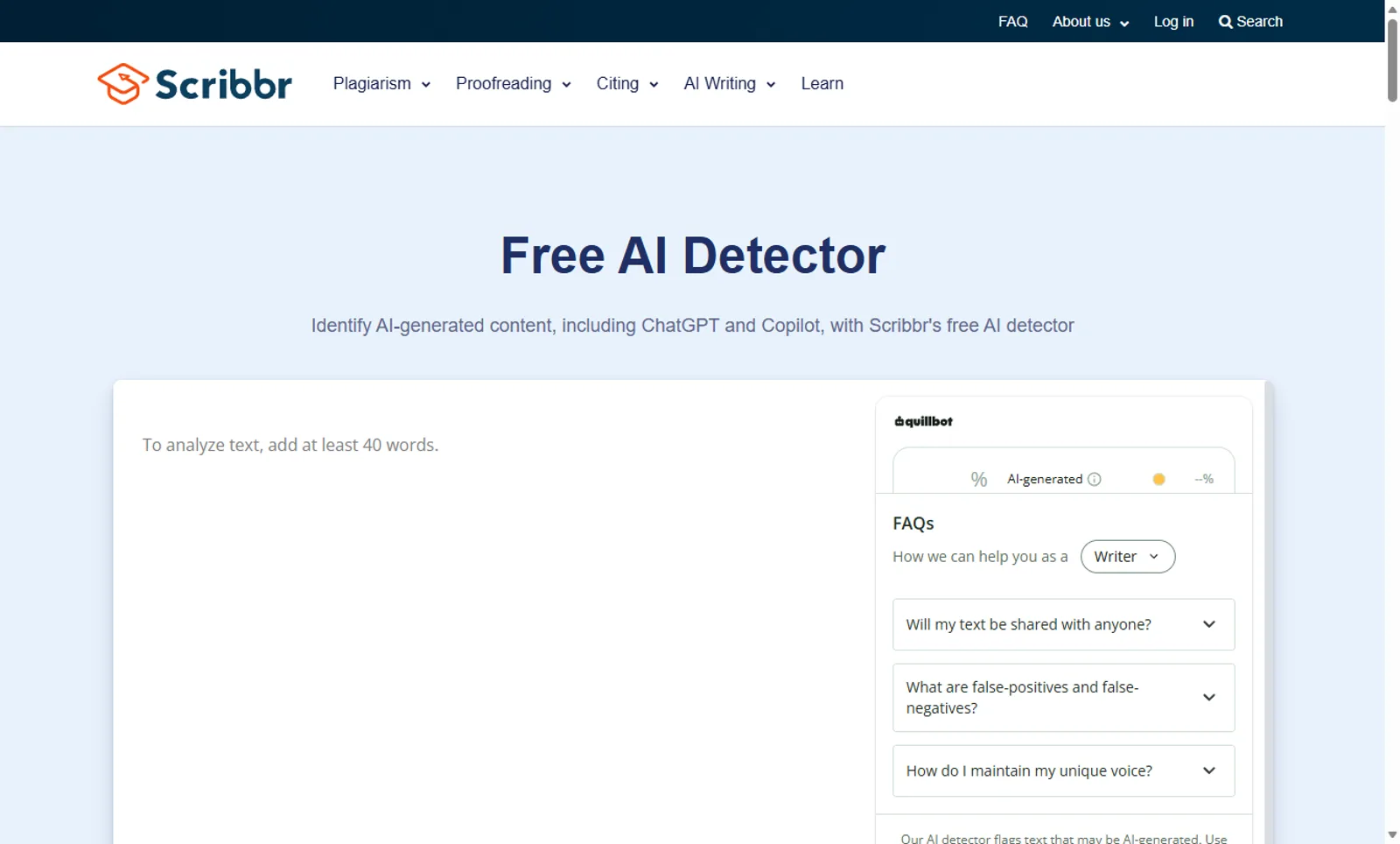
Scribbr's Terms of Use name Learneo, Inc. as the company that owns and operates Scribbr. QuillBot belongs to the same company. We found the same Learneo connection in our review of Scribbr's AI Humanizer: the free humanizer runs on QuillBot's rewriting engine too. In Scribbr's own 12-detector comparison, Scribbr's free detector and QuillBot's free detector both scored 78%, with no false positives on the human-written texts in that test.
One of the test categories in that same comparison was text paraphrased with QuillBot's own paraphrasing tool. So Scribbr's detector, running on QuillBot's model, was partly scored on its ability to flag writing produced by another tool from the same company. Put together, Scribbr's free detector is QuillBot's detector, shown on Scribbr's site under the Scribbr brand. Scribbr's premium detector is a separate product, bundled with a plagiarism check.
If you've already checked a paragraph with QuillBot's own detector, checking it again with Scribbr's free tool is unlikely to tell you anything new. The two use the same tool, so you should expect the same score from both. For a second opinion, use a detector from a different company. For more on how the underlying tool works on its own, including its accuracy claims and its free and Premium limits, see QuillBot's AI detector.
How Scribbr tested 12 AI detectors
Scribbr built its own comparison using 30 test texts. The set covered six categories: plain human writing, plain AI writing from GPT-3.5, and plain AI writing from GPT-4. It also covered writing that blended AI and human sentences, AI writing paraphrased with QuillBot, and human writing paraphrased with QuillBot. Each of the 12 tools was scored on how close its result was to the correct answer for each text, and Scribbr published the full results on its site.
The texts covered five topics, mixing technical subjects with general ones, and every tool in the comparison saw the same 30 texts under the same scoring rules. Scribbr says a result within 15% of the correct answer counted as fully right, a result within 40% counted as partly right, and anything further off counted as wrong. Scribbr also excluded one category, human writing run through a paraphraser, from the final percentages, since it says detectors aren't built to identify paraphrasing on text a person wrote.
| Scribbr's own test | Premium detector | Free detector |
|---|---|---|
| Overall accuracy | 84% | 78% |
| Mixed or paraphrased AI text detected | 60% | 50% |
| False positives on human texts | 0 | 0 |
| Word limit per check | None stated | 1,200 words |
These are Scribbr's own figures, from texts and a scoring method Scribbr chose. Scribbr first published the comparison in April 2026 and updated it in July 2026. Detectors change their models often, so results from a few months ago can differ from what the same tools show today.
Checking a thesis chapter with the free tool
A thesis chapter is almost always longer than 1,200 words, so the free detector needs several passes to cover one. An 8,000-word chapter needs seven checks at that cap, and a full 20,000-word thesis needs about seventeen. The free tool checks up to 1,200 words at a time, so a full chapter can't be checked in one go.
Split each check at a section break instead of a word count. A literature review, a methods section and a discussion are written differently from each other. A methods section tends to use short, repeated sentence patterns, while a discussion builds more like an argument. Checking them separately gives each section a result based on its own writing, instead of blending a formal section with a looser one into a single average score.
Here's one way to split a typical 8,000-word chapter:
- Introduction, about 1,000 words: one check.
- Literature review, about 3,000 words: three checks, split at its subheadings.
- Methods, about 1,500 words: two checks.
- Results and discussion, about 2,500 words: three checks.
That's nine checks, two more than the minimum, because each one stops at a section break. The free tool doesn't limit how many checks you run, so the extra checks cost nothing.
Leave out text that isn't your own prose. Long quotations, the reference list, tables and figure captions follow their own formatting patterns and don't show how you write. A reference list in particular is likely to score oddly on any AI detector. Citation formatting is repetitive by design, and that pattern has nothing to do with who wrote the surrounding chapter.
Run each section once and read the paragraph-level feedback before changing anything. Scribbr marks the specific paragraphs it thinks are AI-generated or AI-refined. If a section scores high, check which paragraphs are flagged before you rewrite anything. Your earlier drafts, saved in Word or Google Docs, are useful evidence of how the chapter was written. That evidence matters more than a single score from one free check.
Get your thesis chapter back into your own voice
Our academic humanizer is designed to score low on AI detectors, and it keeps your citations, data and technical terms exactly as you wrote them.
Try ProofreaderPro.ai FreeWhen the premium detector makes sense
The premium AI Detector isn't sold by itself. You get it for free when you buy a premium plagiarism check, priced per document rather than as a subscription. The check is a one-time purchase, not a recurring plan, so there's no ongoing fee once your chapter or thesis has been checked. Scribbr prices the check by the size of the document you upload.
| Plagiarism check size | Price (USD) |
|---|---|
| Up to 7,499 words | US$19.95 |
| 7,500 to 49,999 words | US$29.95 |
| 50,000 or more words | US$39.95 |
A full dissertation is the clearest case for paying. The premium detector has no stated word limit, so a 20,000-word thesis can be checked in a single pass instead of seventeen separate free checks. The plagiarism report included with it also covers the same document. One price buys both checks, instead of running a free AI check chapter by chapter and paying separately for plagiarism.
A single chapter under 7,499 words costs US$19.95 to check this way. That's more than most students would spend to see one AI score on one chapter. For a single chapter, the free tool split across a handful of checks usually makes more sense. Premium becomes worth it once you're assembling the complete thesis for submission. If you're unsure, run the free checks on one chapter first and see how many paragraphs get flagged. If cost is the deciding factor either way, our guide to the best Scribbr alternative for academic proofreading looks at other options.
What the AI-refined label means for an edited draft
The AI-refined label is Scribbr's hardest category to get right. In its own test, the premium detector correctly identified 60% of writing that blended AI and human sentences or had gone through a paraphraser. It's still well below its 84% overall score. The free detector matched half of these texts, at 50%.
This matters most for a chapter you drafted with AI help and then rewrote in your own words. That kind of mixed writing is exactly the category where Scribbr's own numbers drop. A methods section you wrote yourself, then asked an AI tool to tighten, falls into this same category. So does a paragraph you wrote first and then ran through a paraphraser to vary the wording.
A high AI-refined score on an edited chapter is a reason to check the specific paragraphs Scribbr flagged. One flagged section doesn't mean the whole chapter will be treated as AI-written. Scribbr's own numbers show this category is hard for every detector it tested, its own premium tool included, so one score on one section is weak evidence either way.
If Scribbr flags a chapter you wrote yourself, keep your drafts and version history. That record, covered in process is the new proof, counts for more than a single score. If your supervisor needs a formal response, our guide to contesting a false AI-detection flag sets out the steps. For a chapter you did draft with AI and are now revising, our academic humanizer is designed to score low on a detector like this one. It leaves your citations, data and technical terms exactly as you wrote them.
Frequently asked questions
Q: Is Scribbr's AI detector the same as QuillBot's?
For the free version, yes. Scribbr's AI detector page loads the free tool from a QuillBot web address, quillbot.scribbr.com/ai-content-detector. It uses the same input box and word-count prompt as QuillBot's own detector, and the results panel shows the QuillBot logo.
Q: How accurate is Scribbr's free AI detector?
Scribbr's own test scored its free detector at 78%, with no false positives on the human writing in that test. Scribbr says the free detector correctly flagged every GPT-3.5 and GPT-4 sample in that comparison. That's also the same 78% score Scribbr gave QuillBot's free detector, run through the same 30 texts.
Q: Can I check a whole thesis for free on Scribbr?
Not in one pass. The free detector caps each check at 1,200 words, so an 8,000-word chapter needs seven checks, and a full 20,000-word thesis needs about seventeen checks in total. Splitting at section breaks, rather than at a fixed word count, keeps each check focused on one complete section instead of half of two. Leaving out quotations, references and tables also keeps the result focused on your own writing.
Q: Is Scribbr's premium AI detector worth buying?
That depends on the length of what you're checking. A full dissertation is the clearest case, since the premium detector has no stated word limit and the plagiarism report included with it covers the same document for one price. It's a one-time purchase rather than a subscription, so you pay once for the document you're submitting rather than on a recurring basis. For a single chapter, the free tool split across a few checks is usually enough. Paying US$19.95 or more to see one AI score on one chapter rarely makes sense.
Q: Does Scribbr flag text I edited with AI?
Scribbr calls this result AI-refined, its label for writing that started as AI output and was then edited or paraphrased. In Scribbr's own test, the premium detector correctly identified 60% of this kind of writing and the free detector identified 50%, both well below the scores on plain AI text. A chapter you drafted with AI help and then rewrote in your own words falls into this same category. Scribbr's test doesn't separate lightly edited AI writing from heavily edited AI writing, so both get the same AI-refined label.
Q: What languages does Scribbr's AI detector support?
Scribbr says its free detector supports English, German, French and Spanish, and checks each at a high level of accuracy. Its 12-detector comparison test, though, used English-language texts only, so the 78% and 84% scores describe English writing specifically. A thesis written in one of the other three supported languages hasn't been scored in that same comparison.
Q: Does Scribbr's AI detector detect ChatGPT?
Yes. Scribbr says its AI detector detects text from ChatGPT, Gemini and Copilot, including GPT-4 output, at a high level of accuracy. Scribbr's own test shows the same result for GPT-3.5 and GPT-4 specifically. Both its free and premium detectors flagged every GPT-4 sample in that comparison.
Q: How much does Scribbr's premium AI detector cost?
Scribbr doesn't sell the premium AI Detector as a separate product. You get it for free with a premium plagiarism check, which is priced per document rather than as a subscription. A document up to 7,499 words costs US$19.95, one from 7,500 to 49,999 words costs US$29.95, and one of 50,000 words or more costs US$39.95.
Revise AI-assisted drafts into natural academic writing while keeping your citations, technical terms and meaning.

Dana is a content creator at ProofreaderPro, where she runs the daily blog and writing operations. She writes the articles on how the online editing platform works, and she handles customer messages every day, with a five-star satisfaction score to show for it.