Is GPTZero Accurate? What Independent Tests Show (2026)
Is GPTZero accurate? It detects AI text well but wrongly flags 6% to 18% of human writing in independent tests. See the data and what to do if you're flagged.

GPTZero is good at detecting text written by ChatGPT and other AI tools, but it often gets human writing wrong. The company says its detector is about 99% accurate. Independent tests found that it wrongly labels 6% to 18% of human writing as AI, depending on the test. We tested five AI detectors ourselves, and GPTZero detected all 10 of our AI texts. It also flagged more human writing than any of the other four.
So a GPTZero score is a useful first check, but it shouldn't decide anything on its own. GPTZero agrees with this. Its own FAQ says results shouldn't be used to punish anyone or treated as the final verdict. Below, we go through GPTZero's claims, what independent tests found, where it goes wrong, and the steps to take after a GPTZero flag.
What is GPTZero?
GPTZero is an AI detector that launched in January 2023. You paste in your text or upload a file, and it tells you how likely it is that AI wrote it. GPTZero says it has more than 17 million users, mostly teachers and students. It's now part of Superhuman, the company behind Grammarly.
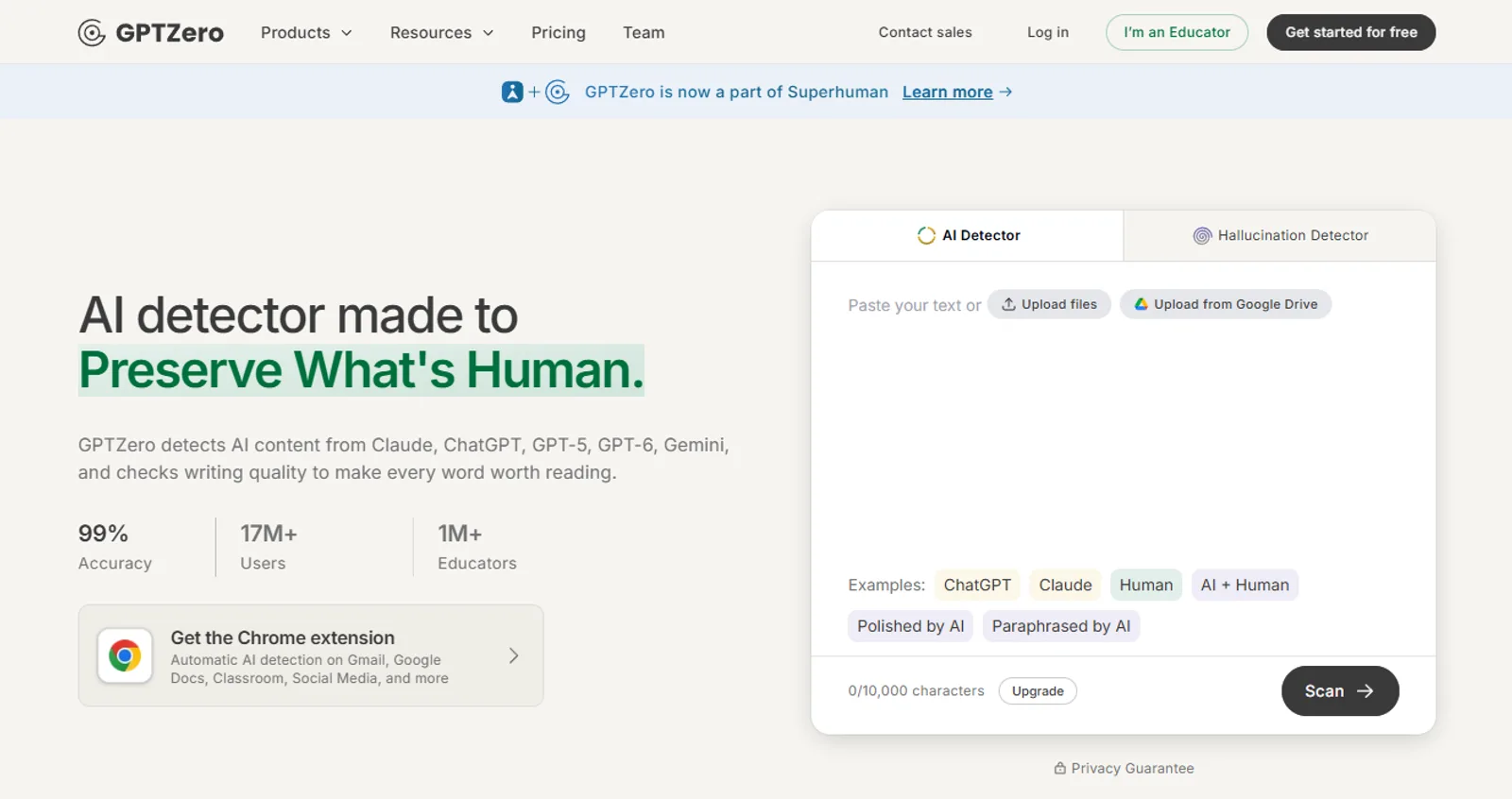
Each scan puts your text into one of three groups: written by a human, written by AI, or a mix of both. GPTZero also highlights the sentences it thinks are AI and tells you how confident it is in the result. You can scan up to 10,000 characters for free. The paid Premium plan covers 300,000 words a month and adds the Advanced Scan and paraphrase detection.
GPTZero started out with two measures, perplexity and burstiness. Perplexity is how predictable your word choices are, and burstiness is how much your sentence length changes from one sentence to the next. Today GPTZero uses its own deep learning model, which it says looks at hundreds of factors. Perplexity and burstiness are still two of the main signals AI detectors use. We explain both in our posts on perplexity in AI detection and burstiness in AI writing. You can also try our free perplexity checker to see how varied your wording is.
What GPTZero says about its accuracy
GPTZero publishes several accuracy figures on its FAQ and technology pages. Here's what it claimed as of October 2026.
| What GPTZero measured | GPTZero's figure |
|---|---|
| Overall accuracy, AI text vs human text | 99% |
| AI texts detected on RAID, a public benchmark | 95.7% |
| Human texts wrongly flagged on RAID | 1% |
| Accuracy on mixed human and AI documents | 96.5% |
| False positives on TOEFL essays by non-native writers | 1.1% |
| Error rate on "highly confident" results | under 1% |
Most of these figures are from GPTZero's own testing. The RAID results are from an outside benchmark, as reported by GPTZero.
GPTZero is also open about its limits. Its FAQ says no detector is 100% accurate, results are better on longer texts, and the model works best on English prose. It also says a score should start a conversation and shouldn't be the final verdict. That's good advice, and it's worth keeping in mind if a teacher or editor shows you a GPTZero report.
What independent tests found
Independent researchers have found more errors than GPTZero reports, mostly on human writing. Depending on the texts used, tests have put GPTZero's false-positive rate between 6% and 18%. At the high end, that's nearly one in five human texts labeled as AI.
A 2023 study in the International Journal for Educational Integrity tested 14 AI detection tools, including GPTZero and Turnitin. None of them was more than 80% accurate. The authors concluded that the tools weren't accurate or reliable enough to use as evidence that someone used AI.
If English is your second language, you're more likely to get a false positive. A 2023 study tested seven AI detectors on essays by non-native English speakers, and about 61% of those essays were labeled as AI. Only about 5% of essays by native speakers got the same result. This happens because detectors look for predictable wording, and simpler English is easier to predict.
GPTZero was one of the seven detectors in that study. GPTZero says it has worked on this problem since 2022 and now wrongly flags 1.1% of TOEFL essays. That figure is from its own testing. We cover the wider problem in why AI detectors flag non-native writers.
Edited AI text is another weak spot for detectors. A 2025 study from the University of Chicago Booth School of Business found that leading detectors flagged more than 90% of plain AI text. After the same texts went through a humanizer, most of them flagged fewer than half. GPTZero now has a feature it calls Paraphraser Shield, which it says detects paraphrased and altered AI text.
A 2025 study on research abstracts polished with AI
A 2025 study in PeerJ Computer Science tested GPTZero, ZeroGPT and DetectGPT on research abstracts. In the first test, the detectors had to tell human-written abstracts apart from abstracts written by ChatGPT o1 and Gemini 2.0 Pro. GPTZero did very well here. It was 97.22% accurate and didn't flag a single human abstract.
The second test is closer to how many researchers use AI. The author took human-written abstracts and asked the same AI models to make them easier to read. GPTZero then gave higher AI scores to the polished abstracts by non-native English authors. The median AI probability was 22.5% for non-native authors and 9.5% for native authors.
The study also measured how often GPTZero treated a polished abstract as if it were entirely AI-written. That happened to 25% of non-native authors and 11% of native authors. The model used for polishing mattered too. Abstracts improved with Gemini got a mean GPTZero score of 55.5%, compared with 19.8% for abstracts improved with ChatGPT.
If English is your second language and you use AI to tidy up an abstract, GPTZero is more likely to flag it. A native speaker who makes the same kind of edit is less likely to be flagged. Keep your original draft, so you can show what you wrote before the AI edit.
Our test: GPTZero and four other detectors
We ran 50 texts, each 500 to 800 words long, through five detectors. Ten were written by GPT-4o with no editing. Ten were journal articles published between 2018 and 2022, before ChatGPT was released. The other 30 were edited AI drafts, humanized AI drafts and published papers by non-native English writers. Here are the results for the first two groups.
| Detector | AI texts flagged (out of 10) | Human articles wrongly flagged (out of 10) |
|---|---|---|
| GPTZero | 10 | 4 |
| Turnitin | 9 | 3 |
| Originality.ai | 9 | 1 |
| Copyleaks | 8 | 1 |
| ZeroGPT | 7 | 3 |
GPTZero was the strictest of the five. It didn't miss a single AI text, but it wrongly flagged the most human writing. It flagged 5 of the 10 papers by non-native writers as mostly AI as well. Originality.ai and Copyleaks flagged far fewer human articles and missed one or two AI texts. Every detector makes this trade-off. A detector that flags more AI text usually flags more human text along with it.
You can see the full results in our AI detector accuracy test. We've also looked at how accurate ZeroGPT is, whether Copyleaks detects AI and how Winston AI did in testing.
Revise AI-assisted drafts in your own voice
Our academic humanizer is designed to lower AI scores while keeping your citations, technical terms and numbers the same.
Try ProofreaderPro.ai FreeWhere GPTZero gets it wrong
GPTZero's mistakes follow a few clear patterns. If your writing fits one of them, a high score is more likely to be a false positive.
Formal academic writing
Academic writing uses set phrases, steady sentence lengths and careful word choice. Those are the same patterns GPTZero links to AI. That's why 4 of the 10 journal articles in our test were flagged, even though people wrote them years before ChatGPT. If your text follows a fixed structure, like a methods section or a literature review, it will look more predictable to a detector.
Short texts
GPTZero says its results are better on longer texts, and that a whole document gets a more accurate result than a single paragraph or sentence. A short text gives the model much less to work with. If you're checking one paragraph, treat the score as a rough guess.
Mixed and edited drafts
A lot of writing today is mixed. You might write the argument yourself and use an AI tool to fix the grammar or reword a few lines. GPTZero has a "mixed" result for this and says it's 96.5% accurate on mixed documents. Still, a mixed result doesn't tell anyone how much AI you used or what you used it for, so it's hard to act on.
Languages other than English
GPTZero fully supports five languages: English, German, Portuguese, French and Spanish. You can scan text in other languages, but GPTZero says its results are strongest on English prose. If you write in Greek, Indonesian or another language outside that list, the result is less tested.
How to read a GPTZero result
A GPTZero result has three parts. The first is the classification: human, AI or mixed, with a percentage for each. The second is the confidence level, which GPTZero labels as uncertain, moderately confident or highly confident. The third is the sentence highlighting, which marks the sentences the model thinks are AI.
Pay the most attention to the confidence level. GPTZero says its error rate is under 1% on "highly confident" results. An "uncertain" result means the model can't tell, so it shouldn't count against you. A "moderately confident" result is somewhere in between.
The highlighted sentences tell you where to look first. If GPTZero marks your definitions, your method steps or your summary of other studies, those are the parts of academic writing that follow the most fixed patterns. On paid plans, the Advanced Scan also shows which sections had the biggest effect on the result.
Is GPTZero more accurate than Turnitin?
In our test, the two were close. GPTZero flagged all 10 AI texts and 4 human articles. Turnitin flagged 9 AI texts and 3 human articles. Turnitin also flagged 4 of the 10 papers by non-native writers, one fewer than GPTZero.
They differ more in how they show results and who can use them:
- Turnitin hides AI scores between 1% and 19% and shows an asterisk instead, because it says false positives are more common in that range. GPTZero shows a score for every text, including low ones.
- Both companies say they set their detectors to miss some AI text before they'll wrongly flag a person.
- Only schools and publishers can run Turnitin. Students usually see a Turnitin score only when a teacher shares it. Anyone can use GPTZero.
So GPTZero is an option for checking your own writing before you hand it in. Keep in mind that its score may not match what your school's Turnitin report shows. For more on Turnitin, see what an acceptable Turnitin score is and whether Turnitin can detect humanized AI.
What to do if GPTZero flags your writing
These steps work whether you wrote every word yourself or used AI for part of the draft. They apply to a class essay, a thesis chapter or a journal submission.
- Look at the highlighted sentences. Check which sentences GPTZero thinks are AI. If they're your most formal lines, like definitions or method descriptions, that's a common pattern in false positives.
- Collect proof of your writing process. Version history in Google Docs or Word, your notes, outlines and earlier drafts all show how the text was written. We explain why this kind of evidence matters in process is the new proof.
- Talk to your teacher or supervisor. Bring your drafts and stay calm. You can point out that GPTZero's own FAQ says results shouldn't be the final verdict. If you need to make a formal case, use our guide to appealing a false AI-detection flag and this appeal letter template.
- Revise any parts you drafted with AI. If you used AI for some of the text, rewrite those parts in your own words. Add your own examples and data. Our guide on how to lower your GPTZero score explains this step by step. Check whether your school wants you to disclose AI use, too.
Our academic humanizer helps with step 4. It's designed to lower AI scores on drafts you're revising, and it keeps your citations, technical terms and numbers the same. In our benchmark of 2,000 academic documents, 82.8% of texts revised on the Balanced setting scored low on GPTZero.
Frequently asked questions
Q: Is GPTZero reliable?
It's reliable on plain AI text and much less reliable on human writing. Independent tests have found that it wrongly flags 6% to 18% of human texts. Use a GPTZero score as one piece of information, alongside your drafts and notes.
Q: Is GPTZero better than Turnitin?
They were close in our test. GPTZero flagged all 10 AI texts and 4 of 10 human articles, while Turnitin flagged 9 AI texts and 3 human articles. The main difference is access, since anyone can use GPTZero and only schools and publishers can run Turnitin.
Q: Does Turnitin use GPTZero?
No. Turnitin has its own AI writing detector, and GPTZero is a separate company. GPTZero is now part of Superhuman, the company behind Grammarly. A GPTZero score and a Turnitin score for the same text can be different.
Q: Can GPTZero detect ChatGPT, Claude and Gemini?
Yes. GPTZero says it detects text from ChatGPT, GPT-5, Claude, Gemini, Llama, DeepSeek and tools built on them. It updates its training data when new AI models are released.
Q: Can GPTZero detect paraphrased or humanized text?
GPTZero says its Paraphraser Shield detects paraphrased text and the character swaps some tools use to hide AI writing. Independent results vary. A 2025 Chicago Booth study found that most leading detectors flagged fewer than half of humanized AI texts.
Q: Is GPTZero accurate for non-native English speakers?
It has had problems here. A 2023 study found that seven detectors, GPTZero among them, labeled about 61% of non-native English essays as AI. GPTZero says it has since cut its false-positive rate on TOEFL essays to 1.1%, based on its own testing.
Q: Is GPTZero free?
Yes, for short texts. You can scan up to 10,000 characters for free. The paid Premium plan covers 300,000 words a month, and the Professional plan covers 500,000 words a month.
Q: What languages does GPTZero support?
GPTZero fully supports English, German, Portuguese, French and Spanish. It can scan other languages too, but it says its results are strongest on English prose.
Q: Is GPTZero legit?
Yes. GPTZero is a real company that launched in January 2023, and it says more than 3,500 colleges use it. Being legit and being accurate are separate questions, though. It's a widely used tool that still makes mistakes on human writing.
Revise AI-assisted drafts into natural academic writing while keeping your citations, technical terms and meaning.

Dana is a content creator at ProofreaderPro, where she runs the daily blog and writing operations. She writes the articles on how the online editing platform works, and she handles customer messages every day, with a five-star satisfaction score to show for it.