MorphMind AI Humanizer Review (2026): A Free Skill for Papers
MorphMind AI Humanizer review: a free, open-source skill that edits papers in Claude Code or Codex, its grant mode, setup costs and ProofreaderPro compared.

MorphMind AI Humanizer is a free, open-source editing skill for AI-assisted research writing, and it suits researchers who already work in Claude Code, Codex or MorphMind's own agent. MorphMind calls it the Academic Humanizer. It edits papers, theses, rebuttals and grant proposals for clarity and voice, and its rules keep numbers and citations as they are.
The first thing a MorphMind AI humanizer review has to explain is that there's no website to paste into. The skill is a set of written instructions on GitHub that an AI agent follows. The agent does the rewriting, so you need a tool such as Claude Code or Codex, and you pay for that tool's usage.
What is MorphMind AI Humanizer?
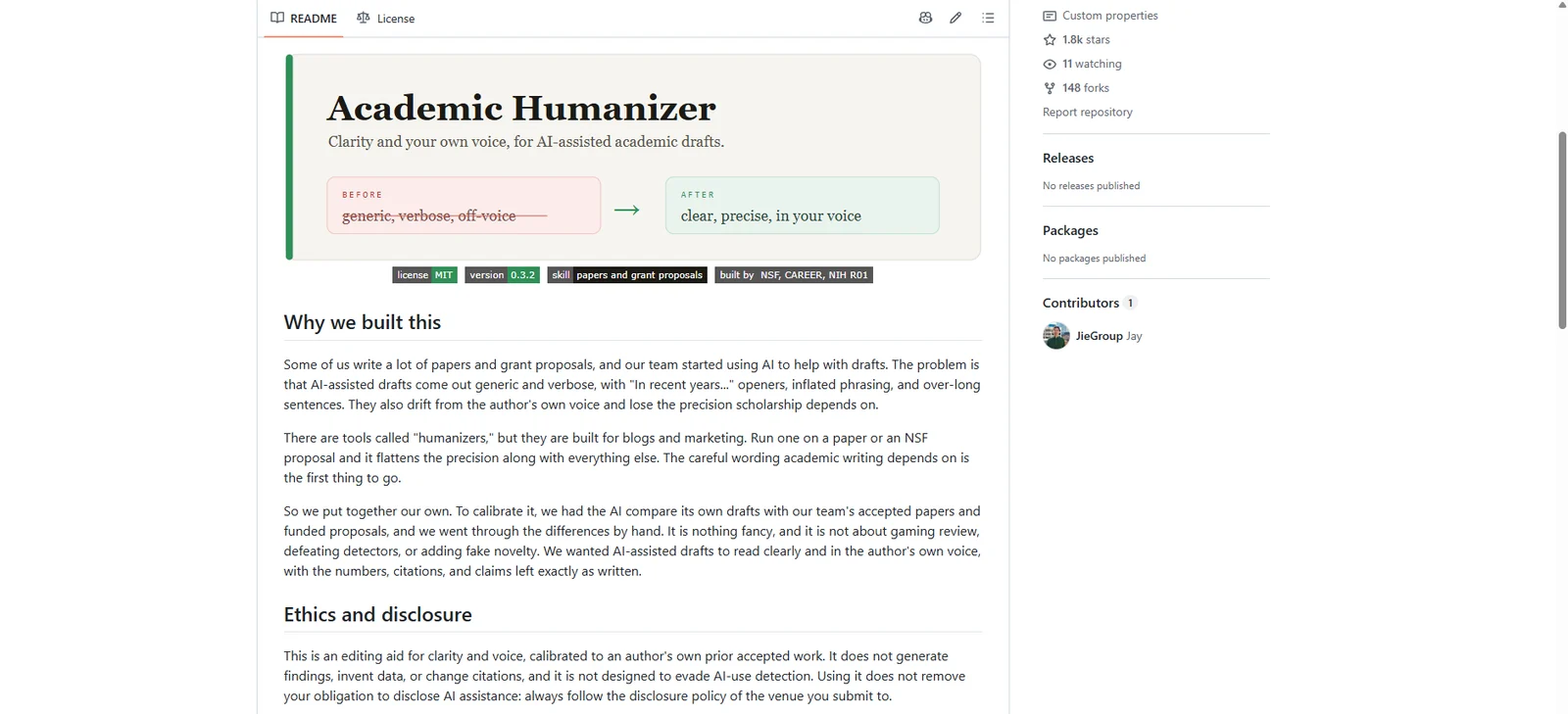
MorphMind AI Humanizer is an open-source skill file, published on GitHub as academic-humanizer, that tells an AI agent how to edit academic prose. A skill is a plain-text set of instructions, here a file called SKILL.md, that an agent loads before it works on your text.
MorphMind is a company that builds AI agents for research work. Its main product is AgentLab, a platform for building and running agents. It also makes Caliper, which automates data analysis in research labs, and MorphCore, an AI workstation that runs on your own hardware. The Academic Humanizer is one of several open-source projects it publishes, next to tools such as Loupe, an AI reviewer for scientific papers.
The skill is released under the MIT license, so anyone can use, copy and change it. On 3 October 2026, the repository had about 1,800 stars and 148 forks on GitHub, and the skill file was at version 0.3.3.
MorphMind says its team built the skill after AI-assisted drafts of their own papers and grant proposals came out generic and wordy. To calibrate the rules, they had the AI compare its drafts with the team's accepted papers and funded proposals, then checked the differences by hand. MorphMind describes the result as an editing aid for clarity and voice, and says it isn't designed to evade AI-use detection.
How MorphMind's academic humanizer skill edits a draft
The skill works in four steps: read, audit, rewrite and report. The agent goes through your manuscript and any writing sample you add, then lists every problem it finds before it changes a word.
Read, audit, rewrite, report
In the audit step, the agent lists each AI writing pattern with its location and a proposed fix. It also notes whether each empirical claim has evidence behind it. The rewrite keeps the same structure and content, so a section with five paragraphs comes back with five paragraphs.
The final report has the cleaned text and a short change log. The log names the patterns removed and the claims softened or given evidence pointers, and it confirms that no number, equation or citation changed. That log is useful when a co-author or supervisor asks what the AI changed, since each edit is listed in one place.
What the skill removes
The first two of its six layers target AI writing habits. Layer 1 covers general patterns, such as inflated significance, vague attributions, filler phrases, overlong sentences and em dashes. It also removes the stock vocabulary that turns up far more often in AI drafts than in human papers. Our article on removing AI words from research writing lists the most common ones with plain replacements.
Layer 2 is specific to academic writing. It targets over-claiming verbs such as "prove" and "demonstrate", hype phrases like "paves the way", and empty intensifiers such as "extensive experiments". It also fixes novelty padding, formulaic openers like "In recent years", citation dumping and vague hedges such as "somewhat".
You can run a quick version of this check without an agent. Our free AI word cleaner flags more than 900 words that AI models overuse and suggests academic replacements, in the browser.
What the skill keeps
Layer 3 protects the parts of academic style that a casual rewrite tends to flatten. Hedges tied to evidence, such as "suggests" and "is consistent with", stay in place. Passive voice stays where the actor doesn't matter, and so does the first-person "we".
Formal definitions, named methods, metrics, equations and symbols stay exactly as written, and the rules say every citation key must survive the rewrite. MorphMind's README shows the agent working on a LaTeX file such as main.tex. Our guide to proofreading a LaTeX paper in Overleaf covers the other checks a .tex file needs before submission.
Claims tied to evidence
Layer 4 checks each empirical claim against its evidence. For every claim, the agent asks whether a number, figure, table or citation backs it, and whether the verb matches the strength of that evidence.
An unsupported claim gets an evidence pointer or a softer verb. A vague phrase such as "a large improvement" becomes a range, attributed to its method, metric and baseline. Where the support is missing, the skill tells the agent to flag the gap for you to fill. It's close to the work a careful co-author does in a final pass, and the flags work as a to-do list for the authors.
Voice and venue matching
Layer 5 matches your style when you give the agent your own past papers. It notes your sentence rhythm, hedging habits, section openings and notation, then writes in that style. It also matches the venue, with terse, results-first prose for conferences such as ICLR or NeurIPS and more explanation for journals such as Nature or PNAS.
MorphMind's README says the rules reflect one research group's voice, and it suggests forking the project and adapting the rules to your field. If you draft with Claude, our guide to humanizing a Claude academic draft covers what to change in text from Claude's recent models.
Grant-proposal mode for NSF and NIH proposals
MorphMind's skill has a separate mode for funding proposals, including NSF Project Summaries and Descriptions, NIH Specific Aims pages, and fellowship and foundation proposals. The mode exists because a proposal follows different rules from a paper.
The paper layers would trim ambition language such as "long-term goal" or "transformative". In a proposal, the skill keeps that language when a credible plan backs it, since reviewers score vision as well as feasibility.
The first pages get the most attention
The skill puts most of its editing effort on the opening pages, because reviewers form a score there. For NSF, it checks that the one-page Project Summary has the Overview, Intellectual Merit and Broader Impacts sections, each self-contained. For an NIH R01, it treats the Specific Aims page as the whole proposal on one page.
A reviewer should know why the work matters, what's missing, your central idea, the aims and the payoff by the end of page 1 for NIH. For NSF, the same five points should be clear by pages 2 to 3. If one of those is missing or buried, the skill fixes that before it touches later sections.
Claims matched to feasibility
For every aim, the skill looks for a credible means, such as preliminary data, a prior method, a classical result, a collaborator or a staged plan. It flags aims that depend on each other, which reviewers see as fragile. It also rewrites aims that only name a technique so they state a question or an outcome.
If the support isn't there, the skill flags the gap for the principal investigator. Its rules forbid adding preliminary results, funding, partners or letters that the author didn't supply. Our guide to editing a grant proposal with AI covers NIH, NSF and Horizon Europe applications.
Is MorphMind AI Humanizer free? Setup and running costs
Yes, MorphMind AI Humanizer is free under the MIT license, with no account, plan or word cap. The cost is the agent that runs it, since every edit uses that agent's model and billing.
These were the ways to run the skill on 3 October 2026:
| Component | Cost | What it does |
|---|---|---|
| Academic Humanizer skill (SKILL.md and examples) | Free, MIT license | The editing rules the agent follows |
| Claude Code | Your Claude plan or API usage | Runs the skill with the /academic-humanizer command |
| Codex or OpenCode | Your plan or API usage for that tool | Runs SKILL.md as a skill or system prompt |
| MorphMind AgentLab | Free to try, with paid plans | MorphMind's own agent platform |
Setup takes one command in Claude Code. You clone the repository into your Claude skills folder, type /academic-humanizer, then paste a section or point the agent at a file. You can add an instruction such as matching your voice from a past paper and naming a target venue.
For a researcher who already pays for Claude Code or Codex, an edit costs whatever that session uses. A long manuscript uses more of your plan, since the agent goes through the text, writes the audit and then rewrites it. Every route runs through an AI agent, either in a terminal with Claude Code, Codex or OpenCode, or in MorphMind's AgentLab.
Humanize Your Paper in the Browser, Citations Kept
ProofreaderPro.ai's humanizer is designed to lower AI scores in passes of up to 1,000 words on Academic Plus, with APA, MLA, Chicago, IEEE and Turabian citations kept in format. Plans start at US$19 a month.
Humanize your paperWho MorphMind's skill suits
MorphMind's skill suits researchers who already use an AI coding agent and want a careful edit of a paper or proposal. It fits less well if you want a paste-and-go tool or a lower AI score.
Researchers who work in a terminal
If you write in LaTeX and use Claude Code or Codex already, setup is quick and the edit happens next to your files. The audit and change log suit a lab where co-authors review each other's changes. Computer science, statistics and other quantitative fields fit best, since the examples and venues come from those areas.
Grant writers
The proposal mode is the most distinctive feature. If you're writing an NSF CAREER proposal or an NIH R01, the first-page checks and the claim-to-feasibility rules follow how reviewers score those documents. MorphMind's examples include an NIH Specific Aims page and a funded NSF CAREER summary.
Rebuttals and responses to reviewers
The skill lists rebuttals among the documents it edits. A response letter needs the same evidence discipline as the paper, along with a calm tone. Our guide to writing a response-to-reviewers letter with AI covers the structure, and our article on editing defensive language out of a rebuttal covers the tone.
Students and writers outside a terminal
Students who write essays in Word or Google Docs will find the setup hard going, since it needs a terminal or an agent platform. The skill is written for papers and proposals, and it lists blogs, marketing and personal essays as out of scope.
Many universities ask you to disclose AI help, and MorphMind's README tells users to follow the disclosure policy of the venue they submit to. Our page on AI use and disclosure in academic writing explains why to disclose and how to cite the AI model.
MorphMind AI Humanizer vs. ProofreaderPro Humanizer
MorphMind AI Humanizer is a free editing skill for researchers who use AI agents, and ProofreaderPro.ai's humanizer is a browser tool for academic writing that's designed to lower AI scores. Both keep citations in place, so the choice depends on how you work and what you need from the edit.
| Feature | ProofreaderPro.ai | MorphMind AI Humanizer |
|---|---|---|
| What it is | A browser-based academic humanizer and editor | An open-source skill file for AI agents |
| Where you use it | In the browser | Claude Code, Codex, OpenCode or MorphMind's AgentLab |
| Price | US$19 or US$29 a month (US$169 or US$259 a year) | Free skill; you pay for the agent's usage |
| Words | 25,000 or 50,000 a month, 500 or 1,000 per pass | No cap in the skill; your agent's limits apply |
| Citations | Keeps APA, MLA, Chicago, IEEE and Turabian citations in format | Rules keep every number, equation and citation key |
| Claims and evidence | General academic rewrite | Audits each claim against its evidence |
| Grant proposals | General academic rewrite | Separate NSF and NIH proposal mode |
| Languages | 60+ languages on Academic Plus | None stated |
| Record of changes | Tracked changes view and .docx export on Academic Plus | A change log after each edit |
| AI scores | Designed to lower AI scores | Built for clarity and voice; MorphMind says it isn't designed to evade AI-use detection |
For a strict evidence check of a paper or grant inside Claude Code, MorphMind's skill is a good free option. It costs nothing beyond your agent, and the claim audit flags the gaps a reviewer would ask about.
ProofreaderPro.ai covers the rest of the academic workflow in a browser. Academic Plus humanizes 1,000 words per pass with citations kept in APA, MLA, Chicago, IEEE or Turabian format, across five modes and 60+ languages. It's designed to lower AI scores, and every change shows in a tracked changes view you can export to Word.
The two also work together. You can run MorphMind's audit to tighten your claims, then humanize the final draft in ProofreaderPro.ai, with frozen terms keeping method names exactly as written. A Word file with tracked changes lets a supervisor accept or reject each edit, as our DOCX tracked changes guide explains.
MorphMind AI Humanizer Alternatives
The right alternative depends on what you need from MorphMind's skill. Writers who want an academic editor without a terminal can use a browser or Word tool, and writers who need a humanizer can pick one built for academic text. For more options, our academic humanizer test for 2026 compares the main tools.
| Tool | Best for | Our write-up |
|---|---|---|
| ProofreaderPro.ai | Browser humanizing for papers, with citations kept and tracked changes | Academic AI humanizer |
| Writefull | Academic English feedback inside Overleaf | ProofreaderPro.ai vs Writefull |
| Paperpal | Manuscript editing with a Microsoft Word add-in | Paperpal alternative |
| Litero | A guided paper workflow with sources, citations and a humanizer | Litero AI Humanizer Review |
| Scribbr | A free humanizer from a well-known student writing brand | Scribbr AI Humanizer Review |
| GPTHuman | College and PhD tones with a content generator | GPTHuman AI Humanizer Review |
MorphMind and Writefull for LaTeX writers
Writefull is the closest match for researchers who write in LaTeX, since it works inside Overleaf. Writefull gives language suggestions as you write, and MorphMind's skill runs a full audit and rewrite of a section or file. Writefull suits steady editing while you draft, and MorphMind's audit suits a final pass before submission.
For a thesis chapter your committee will review in Word, a browser humanizer with tracked changes is the better fit. You can humanize the draft with citations kept and send your supervisor a Word file that shows every change.
Frequently asked questions
Q: Is the MorphMind AI humanizer free?
Yes. The Academic Humanizer skill is free and open source under the MIT license. You pay only for the AI agent that runs it, such as a Claude Code plan or API usage.
Q: Where can I download MorphMind's academic humanizer?
It's on GitHub as AIScientists-Dev/academic-humanizer. For Claude Code, you clone the repository into your skills folder, then run /academic-humanizer.
Q: Does the academic humanizer skill work with Codex?
Yes. MorphMind lists Claude Code, Codex, OpenCode and its own agent as compatible. In Codex, you point the agent at SKILL.md as a skill or system prompt.
Q: Does MorphMind's skill change citations or numbers?
Its rules tell the agent to keep every number, equation and citation key, and the report confirms none changed. Check the reference list yourself after any AI edit, since the agent follows written instructions. Our pre-submission citation audit covers what to check.
Q: What is grant-proposal mode in MorphMind's skill?
It's a separate set of rules for NSF and NIH proposals. It keeps ambition language that a credible plan supports, focuses on the first pages, and checks each aim for evidence of feasibility.
Q: Can MorphMind's humanizer match my writing voice?
Yes, if you give it your past papers. The agent notes your rhythm, hedging and notation, then matches them, and you can also name a target venue such as ICLR.
Q: Is MorphMind's academic humanizer designed to lower AI detection scores?
No. MorphMind describes it as an editing aid for clarity and voice, and says it isn't designed to evade AI-use detection. ProofreaderPro.ai's humanizer is designed to lower AI scores, with citations kept in format.
Q: Who makes the MorphMind AI humanizer?
MorphMind, a company that builds AI agents for research, including AgentLab, Caliper and MorphCore. It publishes the skill on GitHub under its AIScientists-Dev account.
Q: Can I use MorphMind's skill on a Word document?
The skill works on text the agent can open, such as a pasted section or a LaTeX file. For a Word document with tracked changes, a browser tool such as ProofreaderPro.ai is the simpler route.
Browser-based academic humanizing with citations kept in format, frozen terms and 60+ languages, plus tracked-changes export on Academic Plus.

Dana is a content creator at ProofreaderPro, where she runs the daily blog and writing operations. She writes the articles on how the online editing platform works, and she handles customer messages every day, with a five-star satisfaction score to show for it.