GPTHuman AI Humanizer Review (2026): Plans, Tones and Limits
GPTHuman AI Humanizer review: College and PhD tones, a content generator and an API, from US$99 a year. Word limits explained, refunds and academic picks.

GPTHuman is an AI humanizer and writing platform from a company in Montreal, Canada, and it suits students and content writers who want tone settings such as College and PhD. The free plan is a 300-word trial, and paid plans start at US$99 a year, which works out to US$8.25 a month.
Two limits shape every GPTHuman AI humanizer review: words per month and words per output. The monthly limit is your total allowance, from 25,000 words on Starter to unlimited on the top plan. The per-output limit is how much one run can return, from 300 words on the free trial to 2,500 on Unlimited. Get those two numbers right for your writing, and the plan choice is easy.
What is GPTHuman?
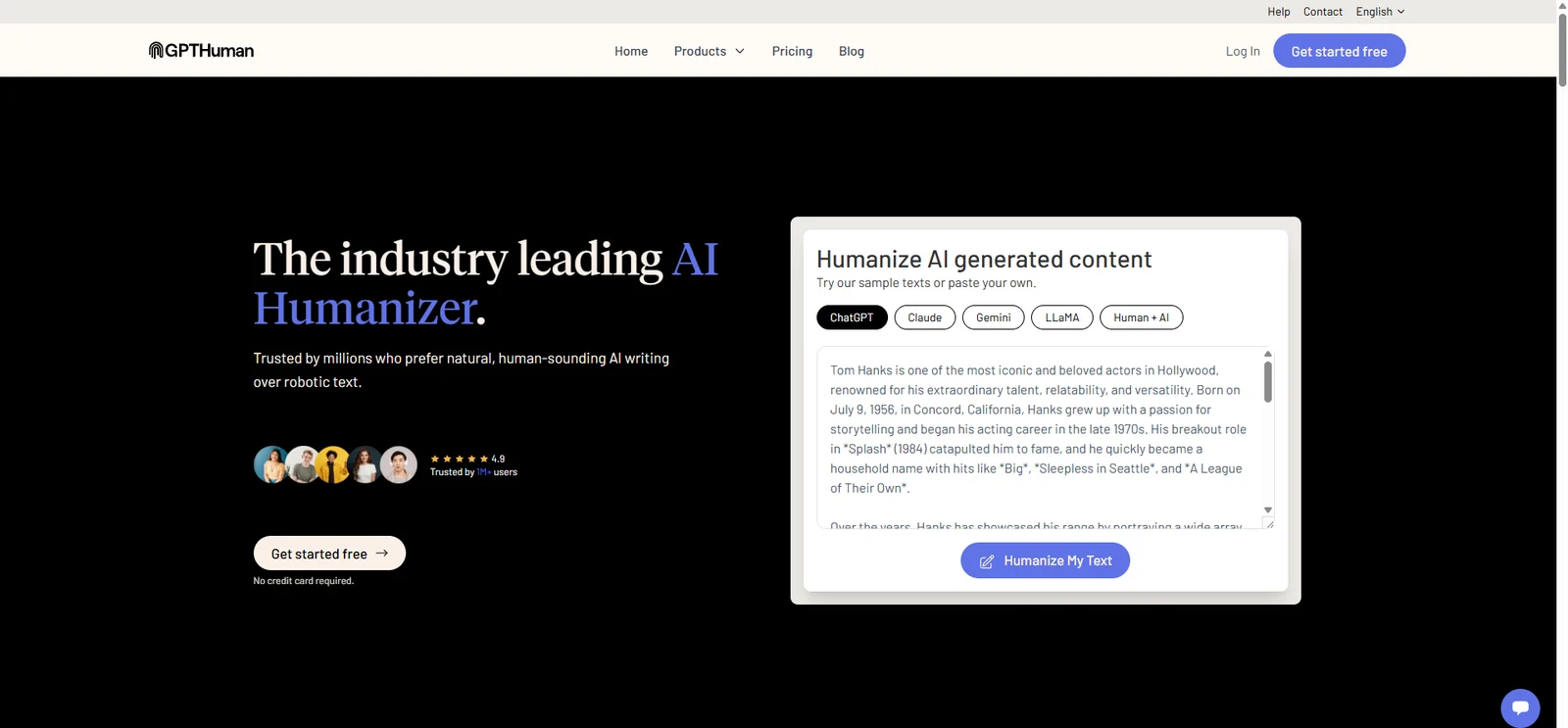
GPTHuman is a web platform with an AI humanizer, a Human Content Generator that writes new text from a prompt, a paraphraser, an AI detector and an API for developers. The company lists its address in Montreal, Quebec, and its site runs in English and French. It also has an affiliate program and publishes an Academic Integrity and Responsible Use policy, which is unusual among humanizer brands.
GPTHuman says millions of people use it. It works with text from ChatGPT, Claude, Gemini or any other large language model.
Is GPTHuman a legitimate company?
Yes. GPTHuman is a registered Canadian business with published Terms and Conditions, a Privacy Policy, a responsible-use policy and paid plans, and you can reach support at support@gpthuman.ai.
Inside GPTHuman's humanizer
You paste text from an AI tool, or enter a prompt to generate new text, then pick a tone and a mode. GPTHuman returns the rewrite, and you can run its AI detector on the result or humanize it again if you want a different version.
The homepage demo has sample texts for three kinds of writing: an academic piece, a creative story and SEO content. Trying the sample closest to your own work is a quick way to see what each tone changes before you paste anything of yours.
Tones and modes
The tone list includes Standard, College and PhD, and GPTHuman also mentions professional, casual, academic and creative tones. College and PhD are named after academic levels, so they're the obvious choices for coursework and graduate writing. The mode list includes Balanced and Enhanced, which set how strongly the text is rewritten. As the names suggest, Balanced suits a light edit that stays close to your draft, and Enhanced suits a heavier rewrite of stiff AI text. GPTHuman also offers several voice profiles, so you can match your personal or preferred writing style across different pieces.
A tone setting changes the register, and good academic style still comes from clear structure and precise wording. Our guide to improving your academic writing style covers the habits that matter more than any tone menu. If you're writing a dissertation, our PhD dissertation writing tips cover the longer-term work.
What to check after an academic-tone rewrite
The College and PhD tones change wording at the level where small shifts matter in academic work. After a rewrite, check three things. Defined terms should keep exactly the same wording every time they appear. Numbers, units and dates should be unchanged. Hedged claims such as "the results suggest" shouldn't have turned into stronger ones such as "the results prove", because a reviewer or marker treats that as a different claim.
Getting a rewrite out of GPTHuman
- Create a free account at app.gpthuman.ai.
- Paste your text, or switch to the generator and enter a prompt.
- Choose a tone, such as Standard, College or PhD, and a mode, such as Balanced or Enhanced.
- Run the humanizer and read the result.
- Check it with the built-in AI detector if you like, and re-humanize any part you want to change.
The Human Content Generator
The generator writes new content from a prompt instead of rewriting existing text. For content writers, that's the main draw: one prompt gives you a first draft in the tone you pick, which you then edit and fact-check like any AI draft. That makes GPTHuman a writing tool as well as a humanizer, and it's where GPTHuman's own responsible-use policy matters most for students. The policy says GPTHuman shouldn't be used to submit AI-written material as original work where AI help is prohibited, to hide unauthorized AI use or to get around AI-use policies. Our guide to AI tools for academic writing covers the uses most universities accept.
Watermark removal, the detector and the API
Claude and ChatGPT watermark removal
Every GPTHuman plan lists "Claude & ChatGPT watermark removal". GPTHuman describes this as removing or avoiding the patterns some AI tools embed to mark text as AI-generated. What a text watermark is, and what a watermark checker can and can't prove, varies by company, which our explainer on AI text watermarking from OpenAI, Google and Claude covers. If you only want to strip the hidden watermark characters from a Claude draft, our free Claude watermark remover does that one job.
The AI detector
The free plan includes limited use of GPTHuman's AI detector, and paid plans include it in full. Running a detector from the same company that rewrote your text gives you one view, and other detectors can score the same passage differently. If you'd like a different kind of signal, our free perplexity checker shows how predictable each sentence is, which is one of the measures detectors use.
The GPTHuman API
Developers can call the same humanizer engine through GPTHuman's API, with one endpoint, an API key from the dashboard and documentation at docs.gpthuman.ai. GPTHuman pitches it at products and workflows that need to humanize text at production volume, such as writing apps, content platforms and agencies that process many articles a day.
GPTHuman plans and word limits
GPTHuman has a free trial plan and three paid plans. On yearly billing, paid plans start at US$99 a year on Starter, and GPTHuman says yearly billing saves up to 45%. GPTHuman's yearly prices on 2 October 2026:
| Plan | Yearly billing | Words per month | Words per output |
|---|---|---|---|
| Free | US$0 | 300-word trial | 300 |
| Starter | US$99 a year (US$8.25 a month) | 25,000 | 1,000 |
| Plus | US$168 a year (US$14 a month) | 60,000 | 1,500 |
| Unlimited | US$312 a year (US$26 a month) | Unlimited, subject to abuse guardrails | 2,500 |
All plans list the Human Content Generator, the AI detector (limited on Free) and support for more than 50 languages on the pricing page. GPTHuman's homepage puts the number at 80 languages.
Here's how the two limits work on a 4,000-word paper. On Starter, it takes four outputs of up to 1,000 words and uses 4,000 of your 25,000 monthly words, so you could humanize about six papers that long each month. On Plus, it takes three outputs, and 60,000 words covers about 15 papers. I'd pick Plus for regular academic use, since the higher monthly allowance gives you room for revisions.
GPTHuman's no-refund rule
GPTHuman's Terms say all purchases are non-refundable. You can cancel whenever you like, from your account or by emailing support@gpthuman.ai, and your plan keeps working until the paid term runs out. Try the free 300-word trial before you buy, since there's no refund window afterwards.
PhD-Level Writing Needs Its Citations Intact
ProofreaderPro.ai's academic humanizer is designed to lower AI scores while citations, frozen terms and your argument stay exactly as written.
Humanize a thesis chapterWho GPTHuman suits
GPTHuman covers three quite different readers, and each should look at a different part of the product.
- Students should look at the College and PhD tones, the per-output limit and the responsible-use policy. Starter's 1,000 words per output fits most essays in a few runs. Plus suits a student who humanizes several long papers a month.
- Content writers and SEO teams should look at the generator, the SEO sample and the monthly allowance. GPTHuman pitches its output at Google's E-E-A-T idea of experience, expertise, authority and trust. A humanizer can change how a page sounds, though, and the experience and expertise still have to come from you. Our guide to humanizing SEO content covers what makes a rewrite useful for readers and search.
- Developers should look at the API. One endpoint and an API key are enough to add humanizing to a product, and GPTHuman says the engine is built for production volume.
GPTHuman AI Humanizer vs. ProofreaderPro Humanizer
GPTHuman and ProofreaderPro.ai both offer academic settings, and GPTHuman is cheaper at the entry level. The difference is what each one protects. GPTHuman rewrites for tone and register, while ProofreaderPro.ai keeps citations in their style and lets you freeze terms and review each change.
| Feature | ProofreaderPro.ai | GPTHuman |
|---|---|---|
| Made for | Essays, theses and journal papers | Coursework, content writing and new text from prompts |
| Academic settings | Academic mode on both paid plans; five modes and five intensity levels on Academic Plus | College and PhD tones, Balanced and Enhanced modes |
| Words per run | 500 on Academic, 1,000 on Academic Plus | 1,000 on Starter, 1,500 on Plus, 2,500 on Unlimited |
| Words per month | 25,000 on Academic, 50,000 on Academic Plus | 25,000 on Starter, 60,000 on Plus, unlimited on Unlimited |
| Languages | 60+ on Academic Plus | More than 50 on the pricing page |
| Citations | Keeps APA, MLA, Chicago, IEEE and Turabian formats | General rewrite |
| Price | US$169 or US$259 a year (US$19 or US$29 a month) | US$99, US$168 or US$312 a year |
At the entry level, GPTHuman's Starter costs US$99 a year for 25,000 words a month, against US$169 a year for ProofreaderPro.ai's Academic plan with the same monthly allowance. For general coursework, that's a real saving. For a thesis chapter with in-text citations, numbers and defined terms, ProofreaderPro.ai keeps those parts as you wrote them, and Academic Plus adds frozen terms and a tracked-changes Word file. Our AI thesis proofreading workflow shows how to run a full chapter through that process.
GPTHuman AI Humanizer Alternatives
Autocomplete pairs GPTHuman with Walter Writes and QuillBot. The other tools below are general humanizers that GPTHuman's readers often consider for the same jobs.
| Tool | Best for | Our write-up |
|---|---|---|
| ProofreaderPro.ai | Theses and papers with citations and field terms | Academic AI humanizer |
| Walter Writes AI | Rewrites that learn from a sample of your writing | Walter Writes alternative |
| QuillBot | Paraphrasing and humanizing in one writing suite | QuillBot humanizer write-up |
| Undetectable AI | A humanizer, detector and API from a large brand | Undetectable AI alternative |
| Netus AI | Content writers who paraphrase and humanize in one tool | Netus AI alternative |
| Grubby AI | Casual writing at a low yearly price | Grubby AI humanizer review |
| Phrasly | A humanizer with a simple paraphraser alongside | Phrasly and Undetectable AI compared |
Voice matching: GPTHuman or Walter Writes
Both aim at writing that sounds like you. Walter Writes starts from a sample of your own writing and learns your voice before it rewrites. GPTHuman offers voice profiles plus named tones such as College and PhD, and it adds a content generator and an API. Pick Walter Writes if voice matching is the main thing you want. Pick GPTHuman if you want academic tones and more tools in one plan.
Humanizer first or writing suite: GPTHuman and QuillBot
QuillBot is a writing suite with a paraphraser, grammar checker, AI detector and humanizer, plus apps and extensions for the places you write. GPTHuman is built around humanizing, with tone and mode settings and per-output limits of up to 2,500 words. If you already paraphrase with QuillBot every day, its humanizer is close at hand. If humanizing is the main job, GPTHuman's tone and mode settings give you direct control over it.
Frequently asked questions
Q: Is GPTHuman legit?
Yes. GPTHuman is a business based in Montreal, Canada, with published Terms and Conditions, a Privacy Policy, an academic integrity policy and paid plans.
Q: Is GPTHuman free?
GPTHuman has a free trial plan with 300 words of humanizer output and limited AI detector use. The trial also lets you try the generator and watermark removal. Paid plans start at US$99 a year on Starter.
Q: What's the difference between words per month and words per output?
Words per month is your total humanizer output in a billing cycle, such as 25,000 on Starter. Words per output is the most one run can return, such as 1,000 on Starter.
Q: Is GPTHuman good for essays?
It's good for adjusting the tone of an essay draft, with College and PhD tones to choose from. For essays with citations, check every reference after the rewrite, or use a humanizer that keeps citations in format.
Q: What languages does GPTHuman support?
GPTHuman's pricing page lists more than 50 languages, and its homepage says 80, including English, Chinese, Spanish, French and German.
Q: Does GPTHuman have an API?
Yes. GPTHuman has an AI humanizer API with one endpoint, keys from the dashboard and documentation at docs.gpthuman.ai.
Q: Does GPTHuman remove AI watermarks?
GPTHuman lists "Claude & ChatGPT watermark removal" on every plan and describes it as removing or avoiding the patterns some AI tools embed in text. What any watermark checker can prove depends on the company that made the watermark.
Q: Is there an AI detector in GPTHuman?
Yes. GPTHuman's AI detector is included with limited use on the free plan and in full on Starter, Plus and Unlimited, so you can check a rewrite without leaving the app.
Q: Can I get a refund from GPTHuman?
No. GPTHuman's Terms say all purchases are non-refundable, so use the free 300-word trial before you buy.
Q: How do I cancel my GPTHuman plan?
Cancel from your account or email support@gpthuman.ai. Your plan stays active until the paid term is over and then stops renewing.
Q: Is GPTHuman worth it?
GPTHuman is worth it for regular coursework and content writing, especially on Plus at US$168 a year. For theses and papers with citations, an academic humanizer with citation protection is the better fit.
An academic humanizer for theses and papers, with citation protection and tracked changes on Academic Plus.

Dana is a content creator at ProofreaderPro, where she runs the daily blog and writing operations. She writes the articles on how the online editing platform works, and she handles customer messages every day, with a five-star satisfaction score to show for it.