The Best AI Humanizers in 2026, Tested on Academic Text
We tested the best AI humanizers of 2026 on academic text: detection scores, academic tone, citation handling, and which tools protect research writing.

We gave a set of AI text humanizer tools the same task: take a 600-word AI-generated methods research snippet about a randomized controlled trial and make it undetectable, without breaking a single citation, misusing a technical term, or dropping the academic register below journal quality.
Three of them failed immediately.
The AI humanizer market has exploded in the past year, and dozens of tools now promise to make AI text undetectable. For researchers, "undetectable" is not even half the job. Your humanized text also needs to be accurate, properly cited, and written at a level that survives peer review, which is a harder test than any detector.
This guide covers the best AI humanizers of 2026 with academic text as the benchmark. We lab-tested the leading tools on real academic samples and scored them on a published rubric. For the rest of the field, we assessed each tool against the same academic criteria using its documented behavior, published plans, and independent test reports. One pattern holds across the whole market: almost every tool here is a general-purpose rewriter built for blogs and marketing copy.
ProofreaderPro.ai is the exception, trained on peer-reviewed, human-written research papers, which is why it handles APA and numerical IEEE citations, discipline key terms, grammar, and academic tone as first-class requirements rather than edge cases. It was built to be academic-first by design, by researchers who were struggling to find a humanizer that would actually properly handle citations and preserve key terms that were vital to the actual research. Before it was built, the available humanizers would destroy citations and key terms, add grammar errors, and dilute the formality of the prose with conversational everyday words like 'big' and 'very', which are prohibited in academic writing.
Recent Update: Our Benchmark Numbers
On a 2,000 document academic corpus, ProofreaderPro's humanizer cleared Turnitin AI on up to 92.33% of documents, Originality.ai on up to 89.12%, and GPTZero on up to 87.91%, with semantic faithfulness above 94% throughout, and clean grammar.
| Tool | Turnitin AI | Originality.ai | GPTZero |
|---|---|---|---|
| ProofreaderPro.ai | up to 92.33% | up to 89.12% | up to 87.91% |
These are the only detector figures in this post that come from our own corpus.
How we tested: methodology and scoring criteria
We lab-tested the AI humanizer tools chosen for market popularity, academic marketing claims, and user reviews from research communities: ProofreaderPro.ai, Undetectable.ai, WriteHuman, HIX Bypass, Humbot, and others.
For each of the tools, we ran 10 AI-generated academic text samples covering methods sections, literature reviews, discussion sections, and abstracts. Each sample was 500–800 words, generated by GPT5.4 with academic prompts.
We scored each lab-tested tool on five criteria:
Detection bypass rate: what percentage of humanized samples scored below 20% AI on Turnitin, GPTZero, and Originality.ai? We averaged across all three detectors.
Academic tone preservation: did the output maintain formal scholarly register? We had two PhD-level researchers independently rate each output on a 1–5 scale for tone appropriateness.
Citation and reference handling: did in-text citations survive intact? Were reference formats preserved? Any mangled citation was an automatic point deduction.
Technical vocabulary accuracy: did the tool preserve or correctly handle discipline-specific terminology? For example, swapping "multicollinearity" for "multiple connections" is a deal-breaker.
Grammar quality: did the output stay grammatically clean, or did the rewrite introduce new errors? We checked every sample with LanguageTool and a manual read.
Each criterion is scored out of 5 and weighted equally, for a maximum score of 25 points. Lab-tested tools carry measured scores. The tools we did not lab-test carry assessed scores instead: we rate them on the same rubric using their documented behavior, published plans, and independent test reports, and their score tables below are marked as assessed.
1. ProofreaderPro.ai: best for academic text
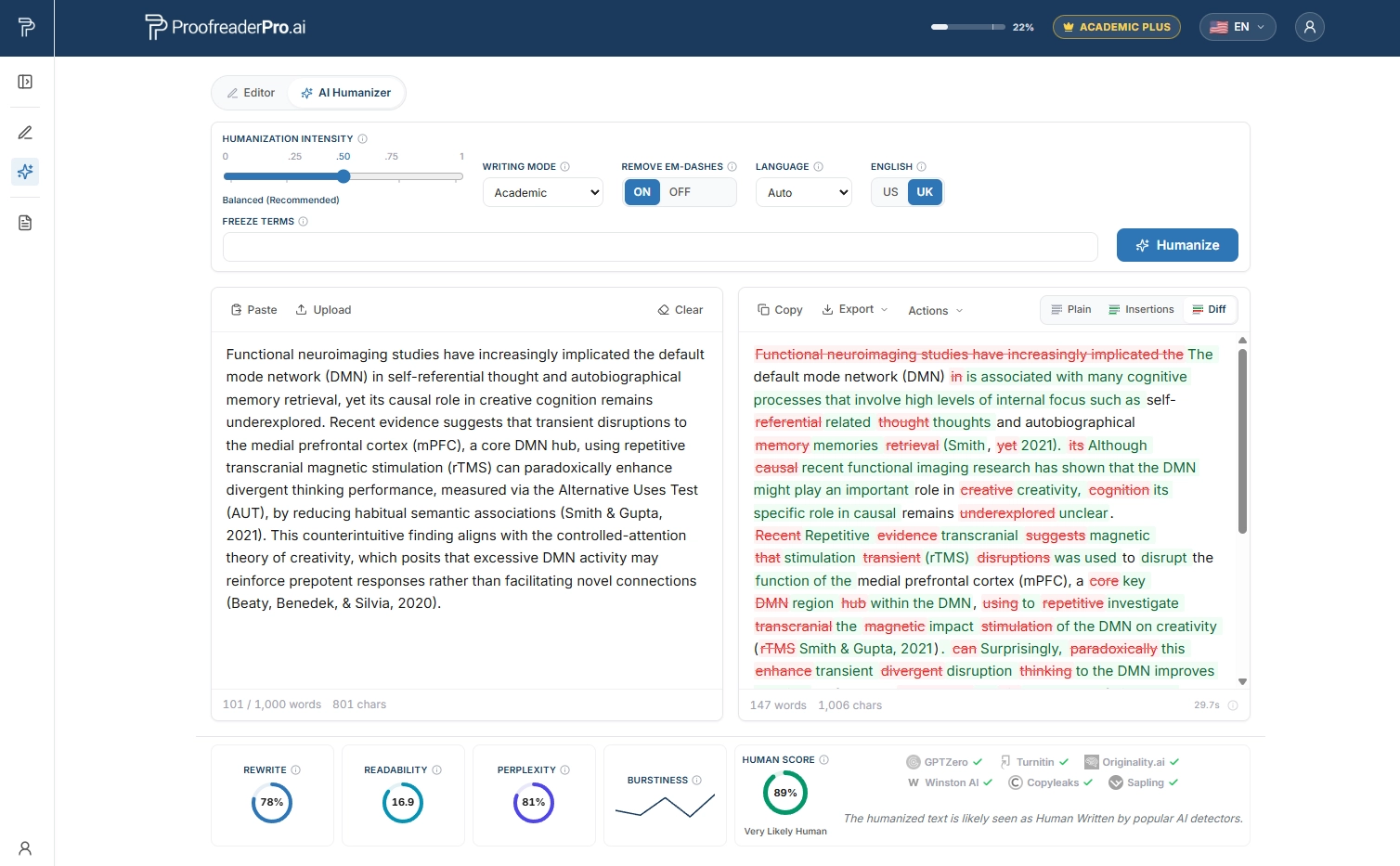
Detection bypass 87% of samples scored below 20% AI across all three detectors | 4.5/5 |
Academic tone Both reviewers rated every output as appropriate for journal submission | 5/5 |
Citation handling APA, IEEE, and Chicago preserved perfectly; one MLA edge case had a minor formatting shift | 5/5 |
Key term preservation Technical terms preserved in all but two instances | 4.5/5 |
Grammar quality Above 96% grammar accuracy after humanization | 5/5 |
We built this tool, so take our assessment with appropriate skepticism. But the numbers are real, and we applied the same scoring rubric to our own product that we applied to competitors.
The key differentiator: our text humanizer was trained on peer-reviewed, human-written research papers across all academic disciplines rather than web content. It has a dedicated Academic Mode that treats citations, statistical expressions, and technical terminology as protected elements. It recognizes APA, MLA, Chicago, Turabian, and numerical IEEE citation formats, keeps discipline key terms where you put them, holds the register at journal level, and exports every change to Word as tracked changes so you can review the rewrite line by line. Grammar accuracy stays above 96% after humanization when tested on LanguageTool's API. Most competitors make none of these distinctions.
Where it fell short: one sample in the biomedical category had technical phrases rephrased in ways that slightly shifted meaning. Acceptable, and also the user can easily review and modify those particular samples post-humanization.
2. Undetectable.ai: the raw bypass pick for general content
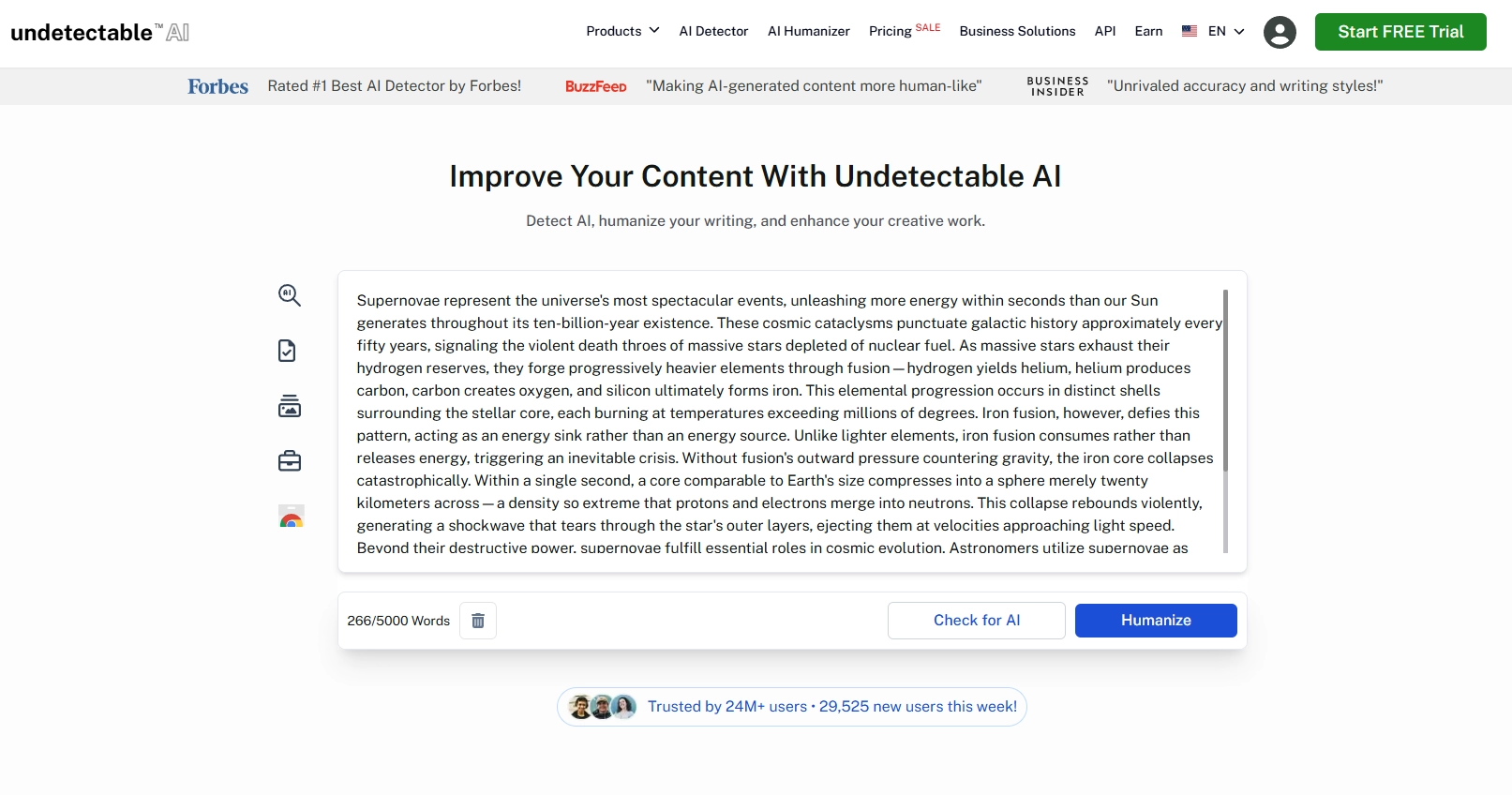
Detection bypass 94% bypass rate, the highest in our test | 5/5 |
Academic tone Output frequently shifted toward an informal, conversational register | 3/5 |
Citation handling In-text citations mostly survived; parenthetical references occasionally reformatted | 3/5 |
Key term preservation Several technical terms replaced with simpler alternatives | 3/5 |
Grammar quality Grammatically sound, but casual constructions need editing for academic use | 3.5/5 |
Undetectable.ai is the most effective pure bypass tool we lab-tested. If your only goal is making text undetectable, it wins on that single axis. For academic writing, the trade-offs are significant.
The tone shift was the biggest issue. Phrases like "the findings indicate" became "we can see that" or "this shows." That might fly in a blog post. In a journal manuscript, it reads as undergraduate writing.
If you're working on non-academic content such as marketing copy, blog posts, or general business writing, Undetectable.ai is a suitable choice with a mature API. For research papers, the tone and vocabulary compromises make it risky without heavy manual editing afterward. We compare it in depth in our Undetectable AI alternative breakdown.
3. Phrasly: good for casual drafts, with an unlimited plan
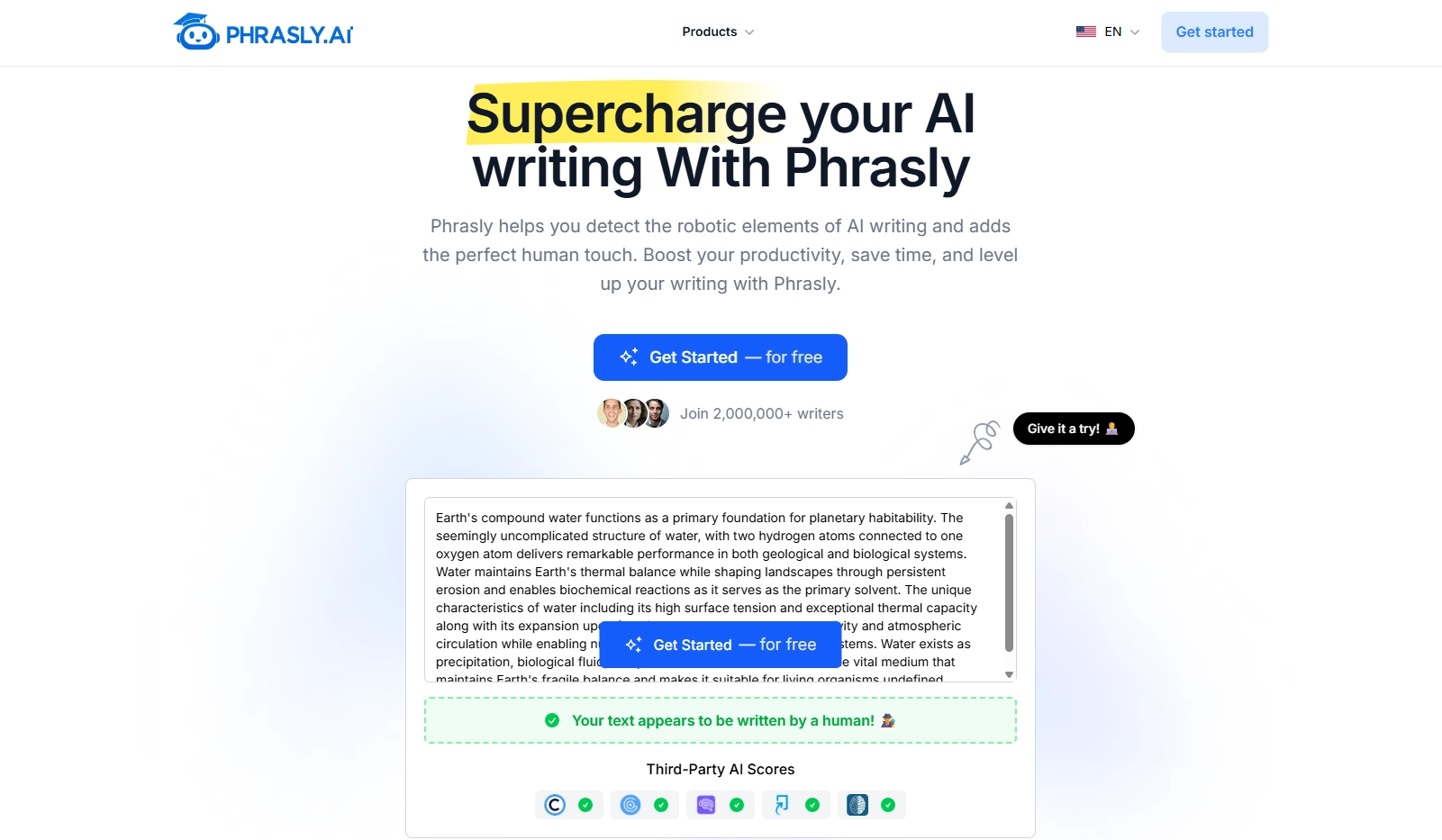
Detection bypass Strong reported results on short and mid-length content | 3.5/5 |
Academic tone No academic register mode | 2.5/5 |
Citation handling Advertised, but not style-aware in the APA, IEEE, or Chicago sense | 3/5 |
Key term preservation General-purpose rewriting engine | 2.5/5 |
Grammar quality Reviews consistently report readable output | 4/5 |
Phrasly has built one of the healthier reputations in the category, with thousands of positive Trustpilot reviews and an Unlimited plan that removes the word-count anxiety most competitors monetize. Its marketing also mentions citation preservation, which is rare in this market.
What reviews report: consistently readable output on general text, a clean interface, and strong results against common detectors on short and mid-length content. The Unlimited plan caps individual runs at 2,500 words, so a thesis chapter still means splitting your document and hoping the tone stays consistent across chunks.
For academic work the gaps are the familiar ones. There is no academic register mode, no tracked-changes export for advisor review, and its citation handling, while advertised, is not style-aware in the APA, IEEE, Chicago sense. A good pick for low-stakes drafts and general content on a budget. For a graded or submitted manuscript, it remains a general-purpose rewriter.
4. StealthGPT: suitable for bulk general content
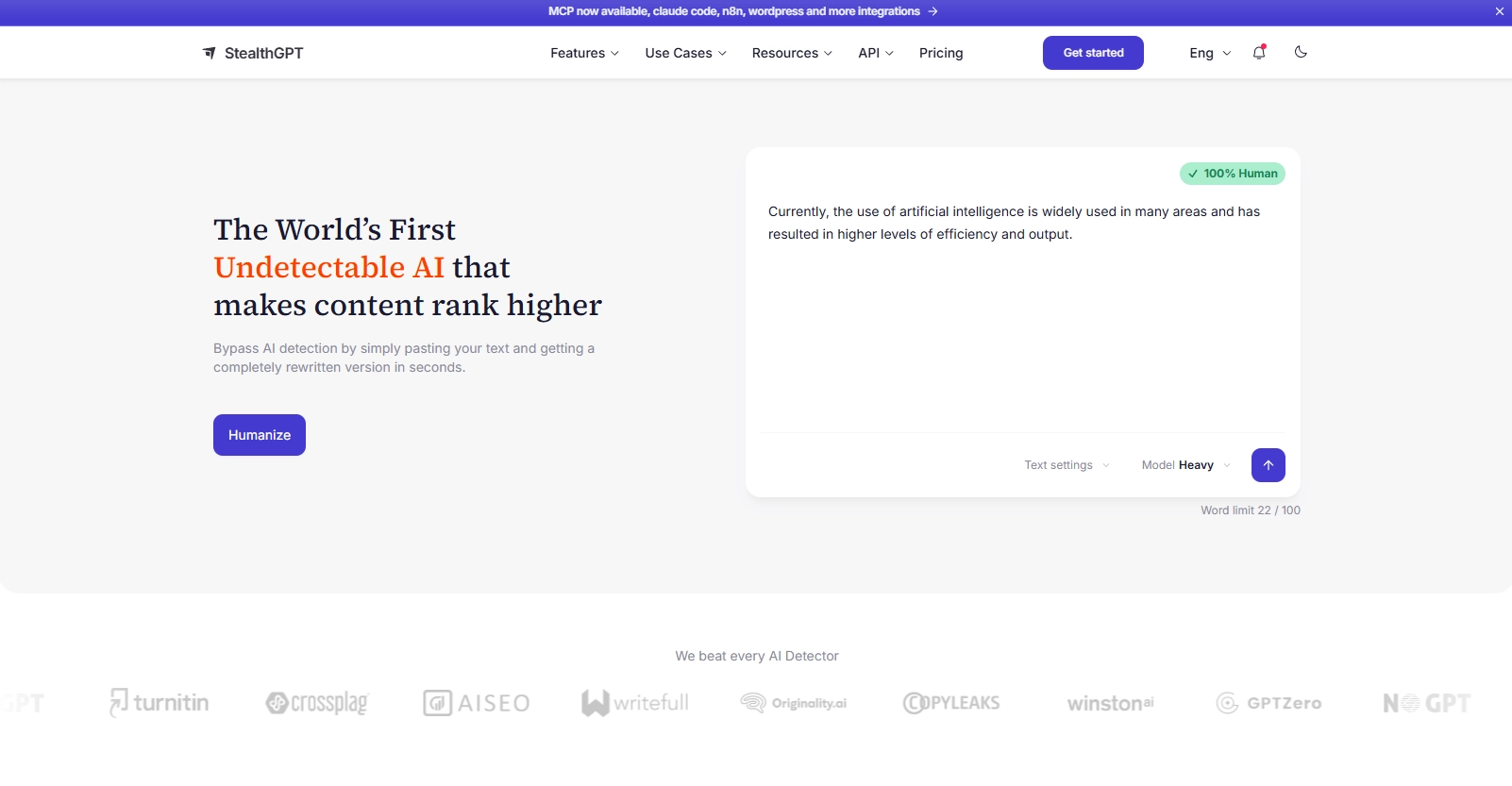
Detection bypass Solid reported bypass performance on general text | 3.5/5 |
Academic tone No academic tone control | 2/5 |
Citation handling No citation awareness | 1.5/5 |
Key term preservation Built for bulk general content, not discipline vocabulary | 2/5 |
Grammar quality Quality varies by mode and occasionally needs a cleanup pass | 3/5 |
StealthGPT is one of the longest-running names in the bypass niche and sells on volume: its plans meter by requests per day rather than a monthly word pool, which suits people processing a lot of short content.
What reviews report: solid bypass performance on general text and fast processing, with output quality that varies by mode and occasionally needs a cleanup pass. Requests are capped at roughly 1,500 words each, so long documents get chopped into pieces.
The academic fit is weak. There is no citation awareness, no academic tone control, and the per-request caps work against dissertation-length documents. For a content team pushing bulk blog posts through a detector, it is a workable choice. For a manuscript, the risks outweigh the speed.
5. WriteHuman: OK mid-range pick on a budget
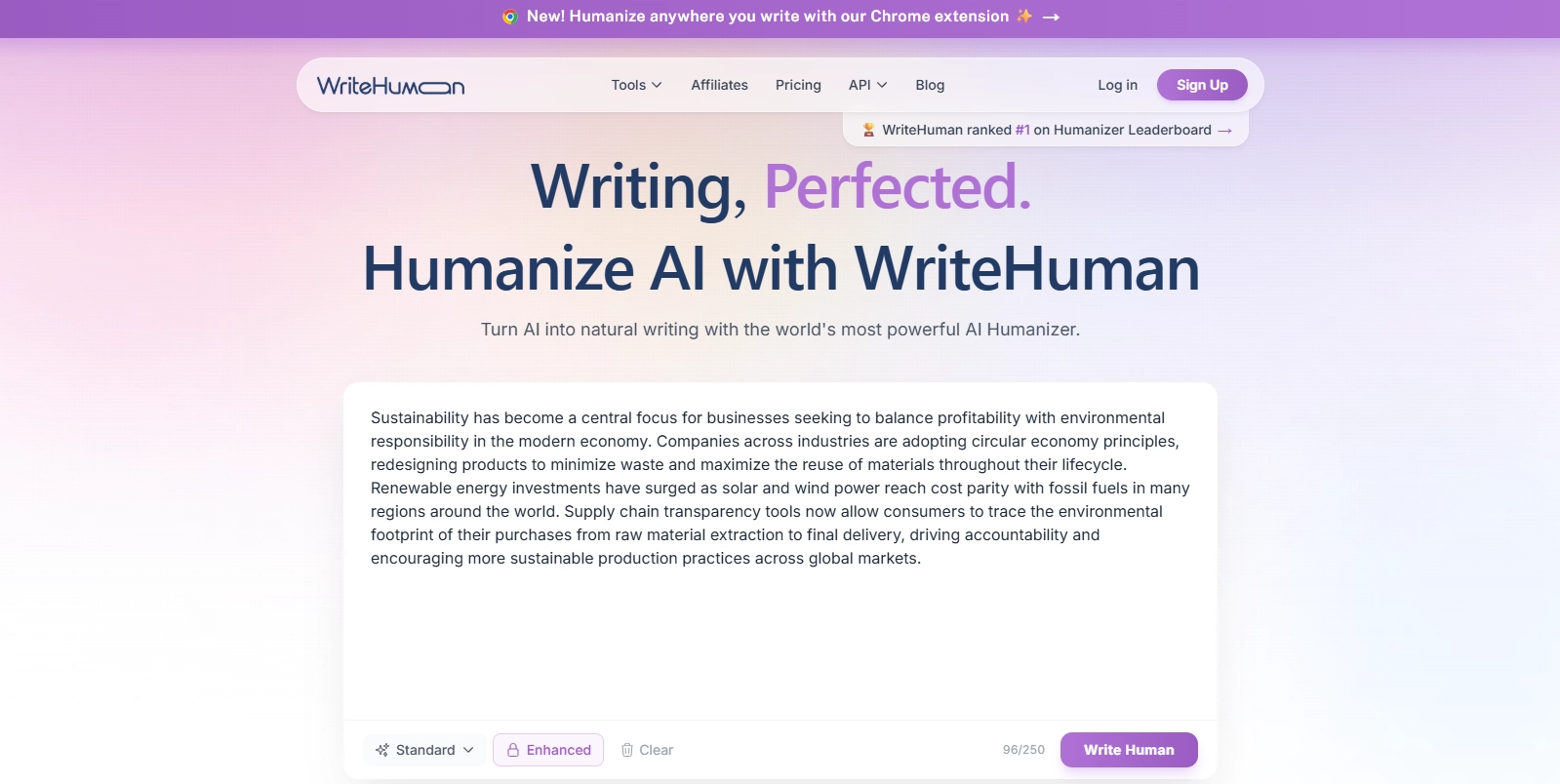
Detection bypass 72% of samples passed in our lab test | 3.5/5 |
Academic tone Reasonable register retention for a general-purpose tool | 3.5/5 |
Citation handling Parenthetical citations frequently restructured or relocated within sentences | 2.5/5 |
Key term preservation Mid-range accuracy on technical vocabulary | 3/5 |
Grammar quality No systematic errors; occasional awkward phrasing | 3.5/5 |
WriteHuman is a mid-range option that doesn't excel in any category but doesn't catastrophically fail either. Citation handling was its weakest point in our lab test.
Pricing is friendly, from $12 a month, and there is a usable free tier for short texts. The per-request word caps (600 to 3,000 words depending on plan) mean a full paper gets processed in fragments, which multiplies the consistency risk for long documents.
6. Walter Writes AI: suitable for agencies with volume needs
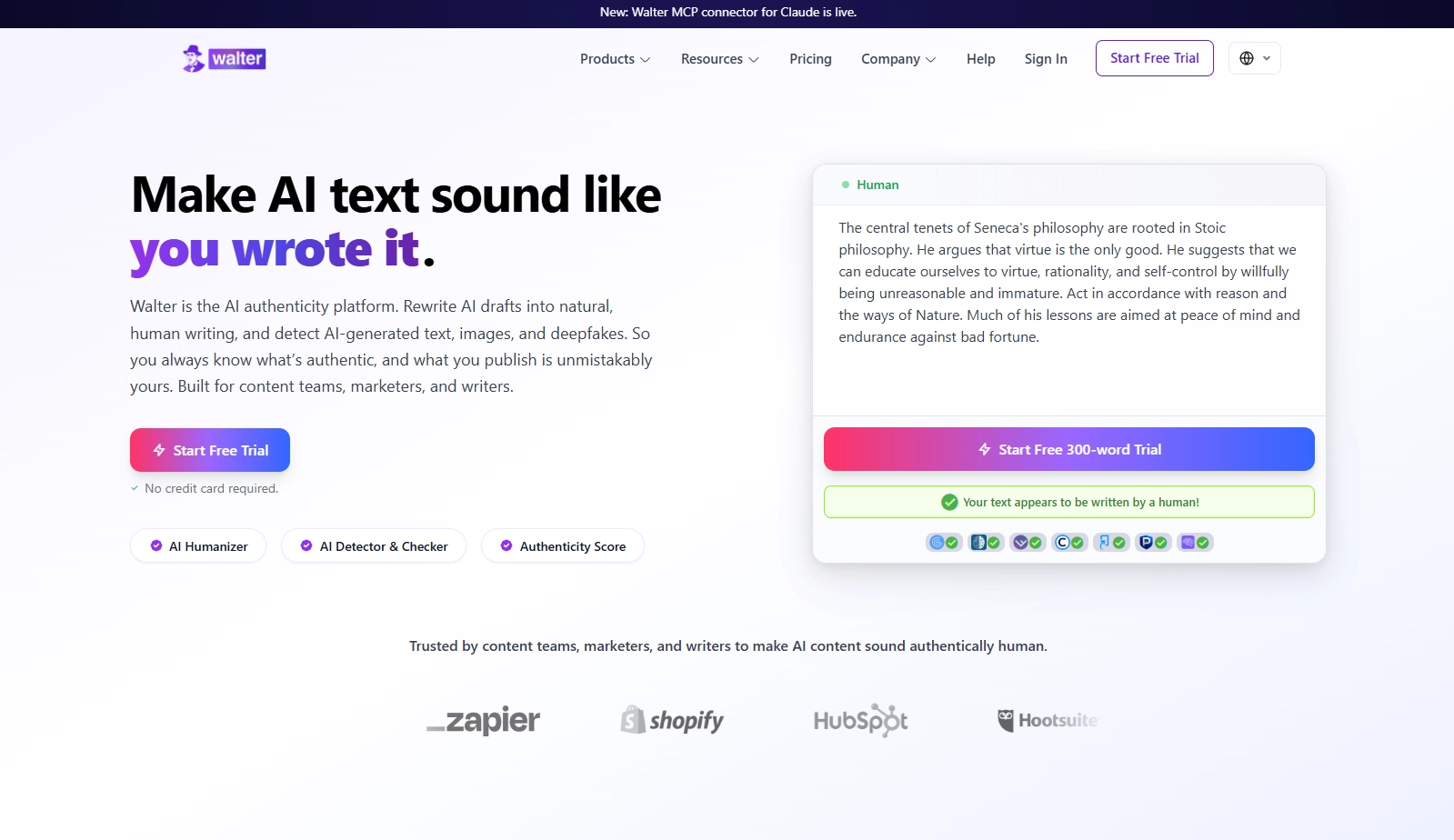
Detection bypass About 80% Turnitin bypass in an independent 100-sample test | 3.5/5 |
Academic tone Voice matching, but no academic register mode | 2.5/5 |
Citation handling No citation preservation | 1.5/5 |
Key term preservation General-purpose rewriting | 2.5/5 |
Grammar quality Readable output on general text | 3.5/5 |
Walter Writes has repositioned upmarket. Entry pricing now starts at about $49 a month for a 300,000-word pool, scaling through volume tiers into the millions of words, which places it as an agency and enterprise tool rather than a student or researcher purchase.
What reviews report: a voice-matching approach that is genuinely interesting, readable output on general text, and bypass performance that has tested well in some independent runs and inconsistently in others. An independent 100-sample test found about 80% Turnitin bypass despite the tool's stronger marketing claims.
There is no academic mode, no citation preservation, and no tracked-changes export. If you run a content operation with serious volume, it is worth a look. For academic writing, the price and the feature set both point elsewhere.
7. QuillBot Humanizer: OK for suite users, weak on Turnitin
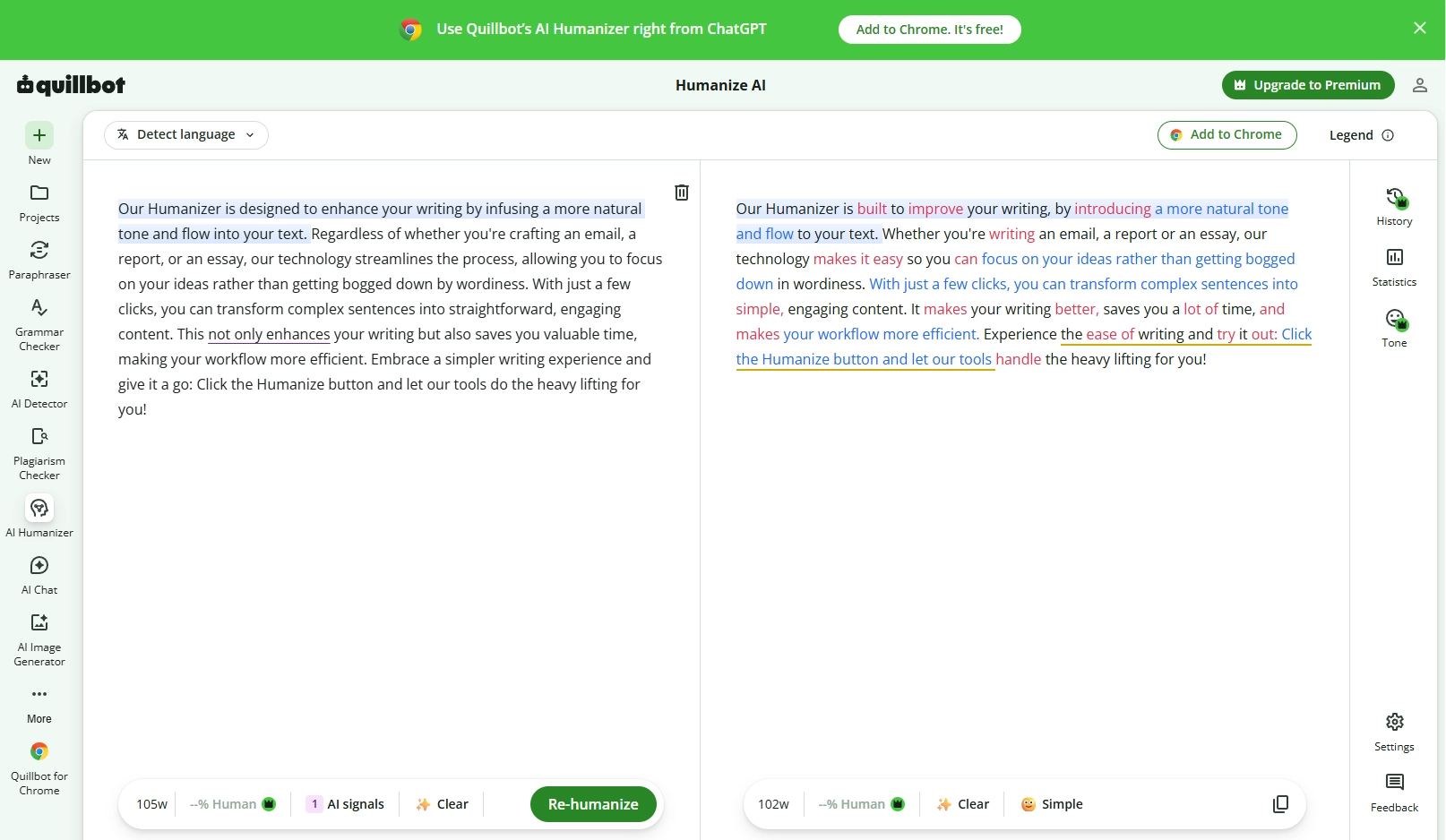
Detection bypass Independent tests show it failing Turnitin | 1.5/5 |
Academic tone Polished but general register | 3/5 |
Citation handling Unreliable in citation-dense passages | 2/5 |
Key term preservation Synonym swapping can hit technical terms | 2.5/5 |
Grammar quality Polished paraphrasing engine underneath | 4/5 |
QuillBot's humanizer arrives inside a polished suite that many students already use and trust. If you have QuillBot Premium for paraphrasing and summarizing anyway, the humanizer is effectively bundled into a tool you already pay for.
The catch is architectural. It is built on a paraphrasing engine, so it swaps synonyms and reorders clauses without changing the deeper statistical patterns detectors measure. Independent tests show it failing Turnitin, and Turnitin explicitly categorizes paraphrased AI output as AI-generated. Heavy use tends to raise rather than lower AI scores on academic text, and citation handling is unreliable in citation-dense passages.
Suitable as a convenience for existing QuillBot subscribers working on casual text. Not a serious option for a Turnitin-graded submission.
8. HIX Bypass: aggressive rewriting at a tone cost
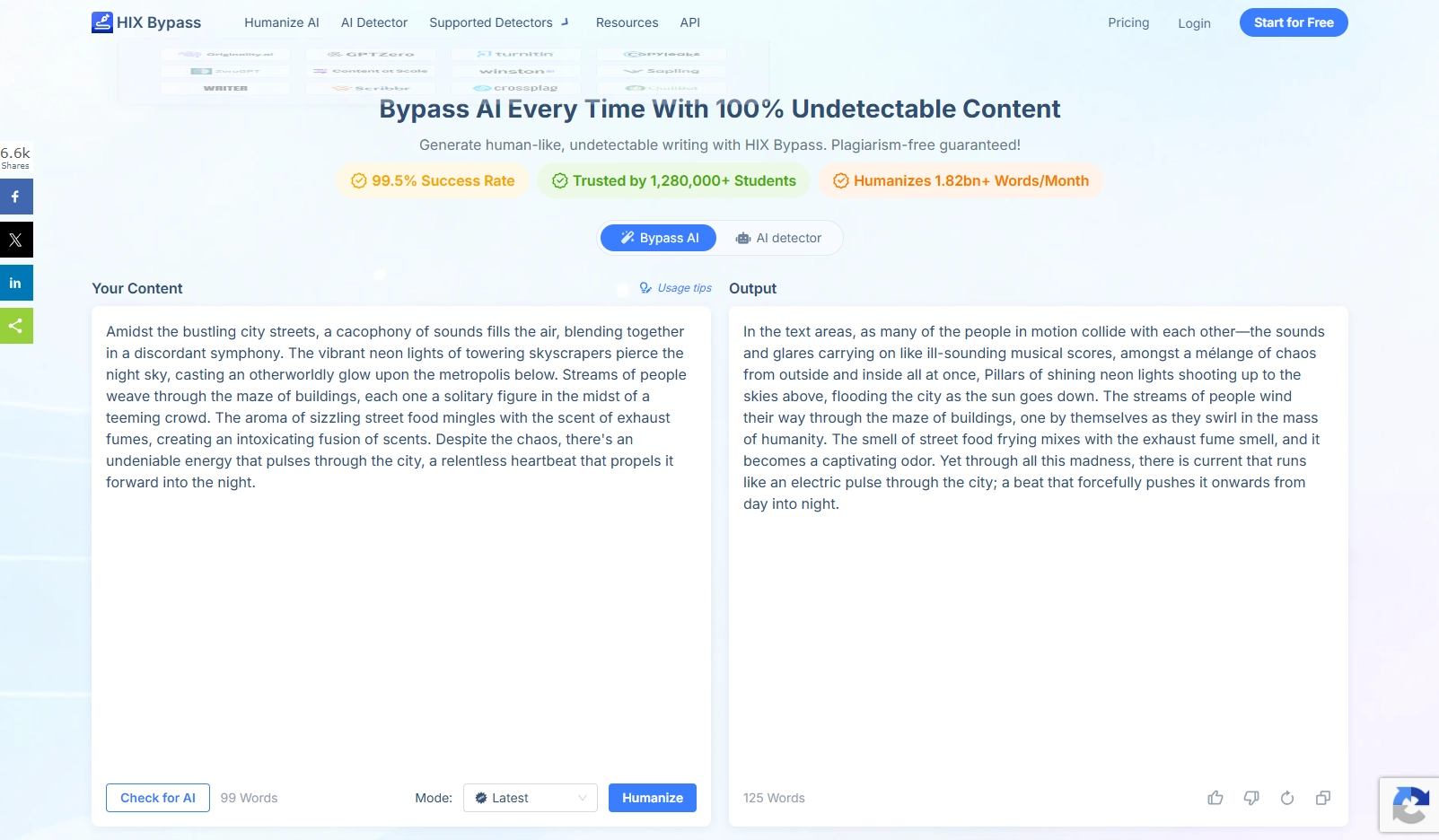
Detection bypass 78% bypass rate in our lab test | 4/5 |
Academic tone Multiple outputs read like science journalism | 2/5 |
Citation handling Not citation-aware | 2/5 |
Key term preservation Technical vocabulary frequently simplified | 3/5 |
Grammar quality The strongest mode produces the roughest prose | 3/5 |
Aggressive rewriting achieved that bypass rate at the cost of academic tone. Multiple outputs read more like science journalism than research papers. Technical vocabulary was frequently simplified, so we do not recommend it for manuscript-level text.
Its four rewrite modes trade quality against bypass strength, and the strongest mode produces the roughest prose. Plans start at about $14.99 a month for a modest word pool. For general web content inside the HIX suite it is serviceable. For research writing, the register loss is disqualifying.
9. BypassGPT: budget option with tight caps
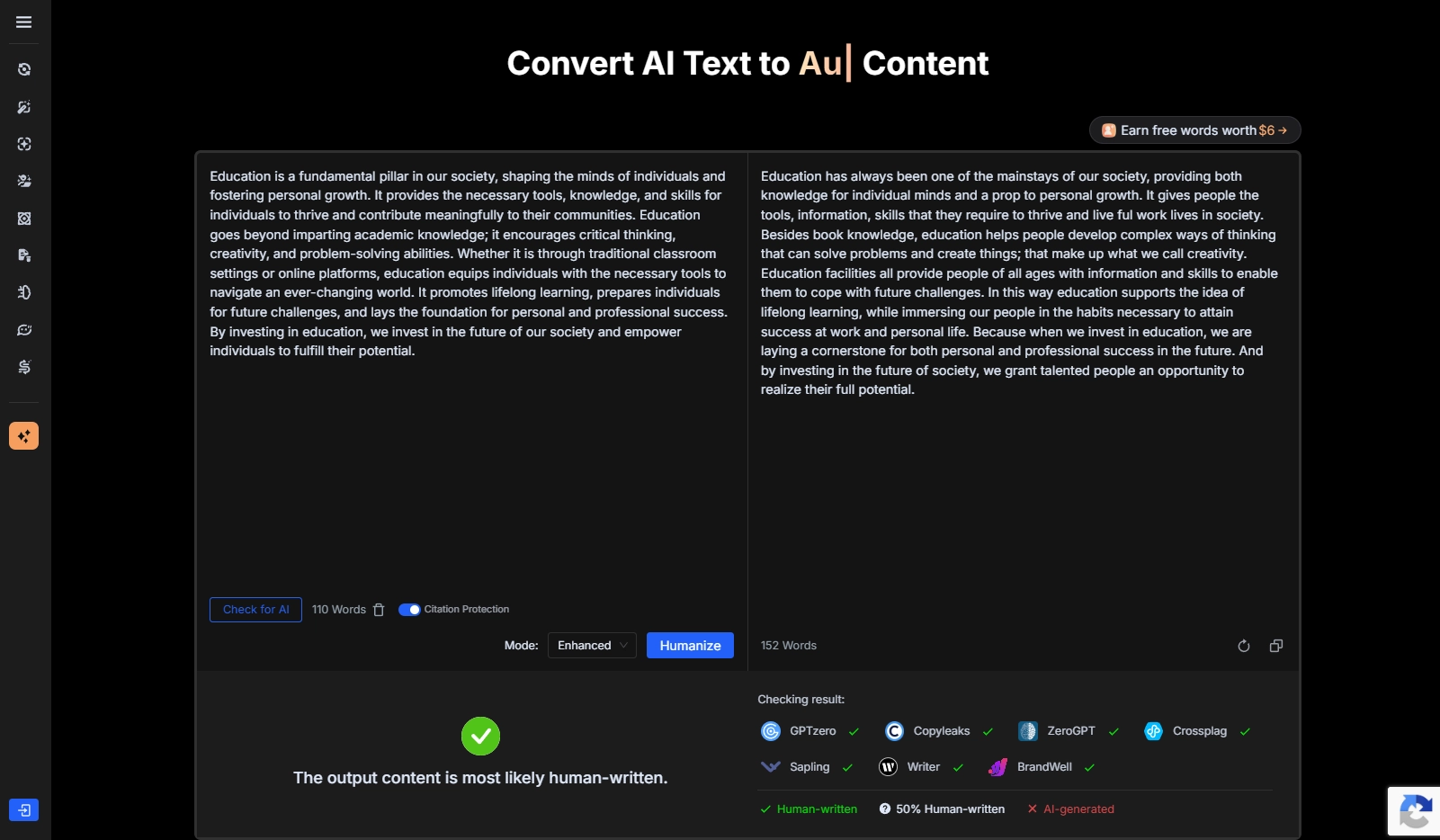
Detection bypass Moderate reported performance on general text | 3/5 |
Academic tone No academic register control | 2/5 |
Citation handling A protection toggle exists, but it is not style-aware | 2/5 |
Key term preservation Quality drops on technical passages | 2/5 |
Grammar quality Acceptable on casual text | 3/5 |
BypassGPT sells on price, with entry plans around $12 a month for a 5,000-word monthly pool.
What reviews report: moderate bypass performance on general text, with quality that drops on technical passages. The small monthly pool disappears fast against academic documents; a single dissertation chapter can consume most of it in one pass.
No citation awareness, no academic register control. Fine for the occasional short piece of casual text. Underpowered for research writing in both quality and quantity.
10. StealthWriter: transparent interface, risky method
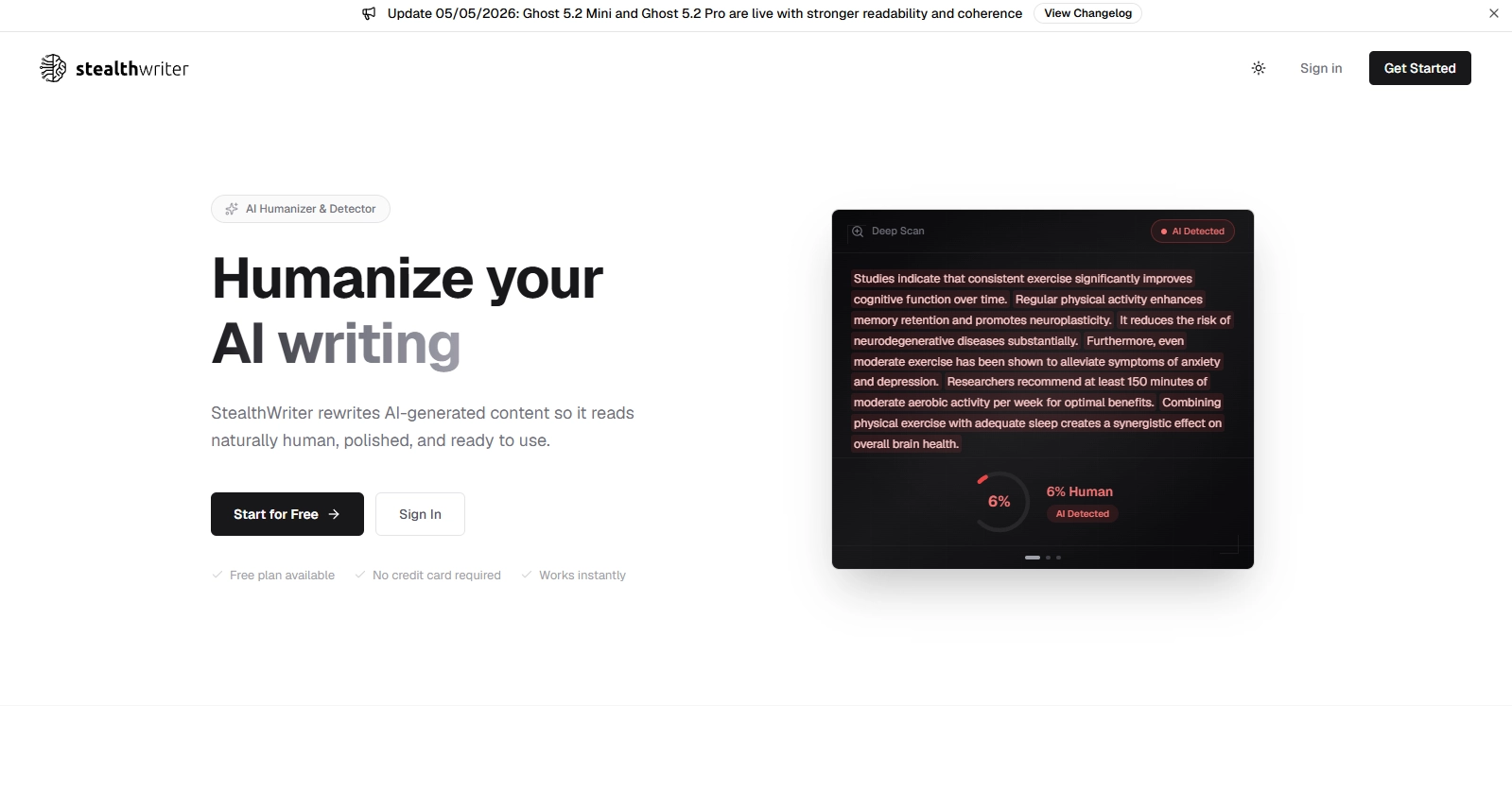
Detection bypass Independent tests show it struggling on Turnitin and Originality.ai | 2/5 |
Academic tone Register degraded by inserted errors | 1.5/5 |
Citation handling No citation awareness | 1.5/5 |
Key term preservation Sentence-level swaps hit terminology | 2/5 |
Grammar quality Inserts deliberate errors to fool detectors | 1.5/5 |
StealthWriter deserves credit for a clever idea. Its color-coded, sentence-level view shows you exactly what changed, which is more transparency than most tools in this list offer.
The problem is the method. To fool detectors it inserts deliberate errors, and those errors wreck the readability an academic reader expects, while independent tests still show it struggling on Turnitin and Originality.ai. Degrading your prose to chase a score is the opposite of what a paper needs, and a reviewer notices sloppy sentences long before a detector does. Plans run from about $20 a month.
11. Humbot: weakest in our lab test
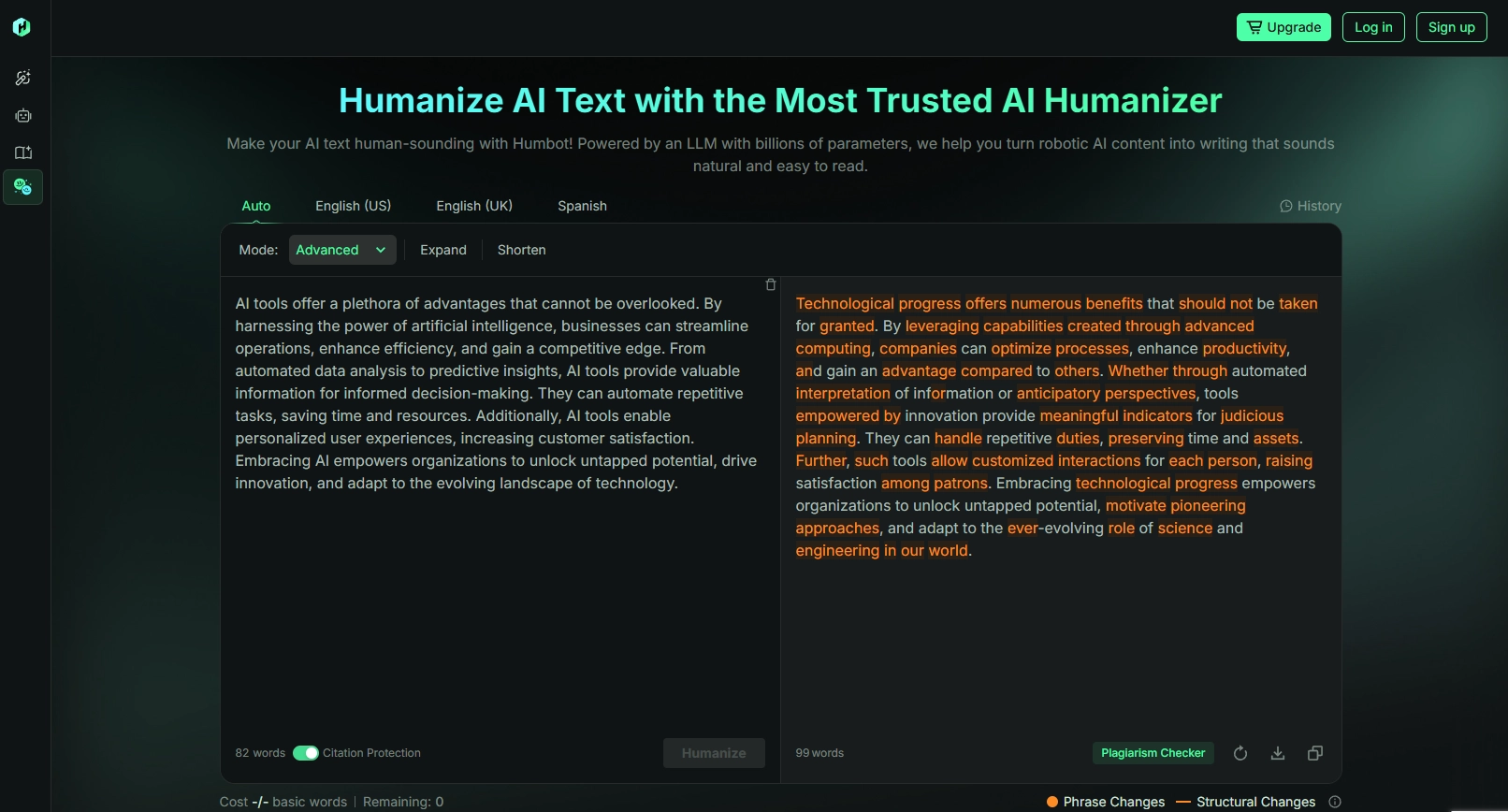
Detection bypass 70% bypass rate in our lab test | 3.5/5 |
Academic tone Register drops below journal quality | 2/5 |
Citation handling Citations mangled in 3 of 10 samples | 2/5 |
Key term preservation Technical wording degraded in several samples | 2/5 |
Grammar quality Grammar errors introduced in 4 of 10 samples | 2/5 |
Bypass rates were acceptable, but the output quality was poor. Using this tool would create more editing work than it saves.
Entry pricing is around $12 a month. For any text where quality matters, the cleanup cost cancels the low price.
12. Grubby AI: short casual texts only
Detection bypass Inconsistent reported results on longer texts | 2.5/5 |
Academic tone Casual output only | 1.5/5 |
Citation handling No citation handling of any kind | 1.5/5 |
Key term preservation Not built for technical content | 2/5 |
Grammar quality Reasonable on short, simple texts | 3/5 |
Grubby AI is the quick-fix end of the market: paste a short text, get a rewrite, at some of the lowest prices in the category, from about $7 a month on annual billing for a small monthly word pool.
What reviews report: reasonable results on short, simple texts and inconsistent quality on longer or more technical content. There is no academic tooling of any kind.
For a paragraph of casual text it is an acceptable budget option. For anything with citations, technical vocabulary, or a grade attached, it is not built for the job.
The full comparison
| Tool | Academic tone | Citation handling | Long-document fit |
|---|---|---|---|
| ProofreaderPro.ai | Trained for academic register | APA, MLA, Chicago, IEEE, Turabian preserved | Full documents, tracked-changes export |
| Undetectable.ai | Shifts conversational | Occasionally reformatted | Good caps, no tracked changes |
| Phrasly | General register | Advertised, not style-aware | 2,500 words per run |
| StealthGPT | General register | Not citation-aware | 1,500 words per request |
| WriteHuman | Reasonable | Frequently restructured | 600–3,000 words per request |
| Walter Writes AI | General register | Not citation-aware | Large volume pools |
| QuillBot Humanizer | Polished but general | Unreliable when citation-dense | Suite limits |
| HIX Bypass | Simplifies register | Not citation-aware | Small word pools at entry |
| BypassGPT | General register | Not citation-aware | 5,000 words per month at entry |
| StealthWriter | Degraded by inserted errors | Not citation-aware | Word caps by plan |
| Humbot | Errors introduced | Mangled in our test | Volume tiers exist |
| Grubby AI | Casual only | Not citation-aware | Short texts |
Price comparison
Paid plans only, with the monthly word allowance where the vendor publishes one. Prices are for monthly billing as of August 2026 unless noted; most vendors discount annual billing heavily. Check the vendor's pricing page before you buy, since these change often.
| Tool | Entry paid plan | Monthly words | Higher tiers |
|---|---|---|---|
| ProofreaderPro.ai | Academic, $19/mo | 25,000 | Academic Plus, $29/mo, 50,000 words |
| Undetectable.ai | About $10/mo (about $5/mo annual) | 10,000 | Up to 50,000 words tiers |
| Phrasly | Unlimited, about $17/mo (about $11/mo annual) | Not metered, 2,500-word runs | Single plan |
| StealthGPT | About $30/mo | Metered per request, about 1,500 words each | Higher-volume tiers to about $100/mo |
| WriteHuman | Basic, $12/mo | About 48,000 (80 runs x 600 words) | Pro $18/mo, Ultra $36/mo unlimited runs |
| Walter Writes AI | About $49/mo | 300,000 | Volume tiers into millions of words |
| QuillBot Premium | $19.95/mo (about $8.33/mo annual) | Humanizer included in Premium | Single plan |
| HIX Bypass | Basic, $14.99/mo | 5,000 | Pro $29.99/mo 50,000; Unlimited $59.99/mo |
| BypassGPT | About $12/mo | 5,000 | Higher tiers available |
| StealthWriter | Basic, $20/mo | Metered per request, 400 words each | Standard $35/mo 50,000 words; Premium $50/mo |
| Humbot | About $12/mo | Small pool at entry, tiers vary | Volume tiers available |
| Grubby AI | About $7/mo (annual) | About 7,500 | Pro about $9/mo, 30,000 words |
All 12 humanizer scores compared
Every tool above is scored on the same five academic criteria: detection bypass, academic tone, citation handling, key term preservation, and grammar quality. Lab-tested tools carry measured scores from our 10-sample benchmark. The rest carry assessed scores built from documented behavior, published plans, and independent test reports. Sorted by total score:
| Tool | Bypass | Tone | Citations | Key terms | Grammar | Total |
|---|---|---|---|---|---|---|
| ProofreaderPro.ai | 4.5 | 5 | 5 | 4.5 | 5 | 24 / 25 |
| Undetectable.ai | 5 | 3 | 3 | 3 | 3.5 | 17.5 / 25 |
| WriteHuman | 3.5 | 3.5 | 2.5 | 3 | 3.5 | 16 / 25 |
| Phrasly | 3.5 | 2.5 | 3 | 2.5 | 4 | 15.5 / 25 |
| HIX Bypass | 4 | 2 | 2 | 3 | 3 | 14 / 25 |
| Walter Writes AI | 3.5 | 2.5 | 1.5 | 2.5 | 3.5 | 13.5 / 25 |
| QuillBot Humanizer | 1.5 | 3 | 2 | 2.5 | 4 | 13 / 25 |
| StealthGPT | 3.5 | 2 | 1.5 | 2 | 3 | 12 / 25 |
| BypassGPT | 3 | 2 | 2 | 2 | 3 | 12 / 25 |
| Humbot | 3.5 | 2 | 2 | 2 | 2 | 11.5 / 25 |
| Grubby AI | 2.5 | 1.5 | 1.5 | 2 | 3 | 10.5 / 25 |
| StealthWriter | 2 | 1.5 | 1.5 | 2 | 1.5 | 8.5 / 25 |
Our verdict
If you are a researcher or postgraduate student, the field sorts itself quickly. Eleven of these twelve tools were built for general content, and it shows in the same three places every time: citations get moved or mangled, key terms get simplified, and the register drifts toward a blog post. They are fine tools for the job they were built for. That job is not your manuscript.
For academic text, ProofreaderPro.ai is unmatched. It was trained on peer-reviewed, human-written research papers, so it preserves APA, MLA, Chicago, Turabian, and numerical IEEE citations exactly where you placed them, protects statistical expressions and discipline key terms, keeps grammar accuracy above 96%, holds a formal academic tone through the rewrite, and exports everything to Word as tracked changes your supervisor can review. It is also the only tool in this list that publishes its benchmark corpus results instead of a marketing percentage. If your writing goes in front of a journal, a committee, or a Turnitin portal, start with the tool built for that and keep a general-purpose rewriter for your casual text.
Academic-Grade Humanization
Tested against Turnitin, GPTZero, and Originality.ai. Built to preserve your citations, vocabulary, and scholarly voice.
Try ProofreaderPro.ai FreeWhich humanization intensity should you use?
Our benchmark runs each document at two intensity settings. The trade-off is consistent. Aggressive humanization posts the highest detector pass rates (up to 92.33% against Turnitin AI in the latest run) and rewrites sentence structure more deeply. Balanced humanization passes slightly less often (86.0% against Turnitin AI) and stays closer to the original phrasing, making the tracked-changes review faster. For a thesis chapter where all claims have been carefully worded, start at Balanced and re-run flagged sections at Aggressive. For earlier drafts, Aggressive saves a revision cycle. Semantic faithfulness stayed above 94% at both settings in our runs, so you're preserving the meaning no matter what, but changing how much of the surface wording changes.
The best AI humanizer by use case
- Academic papers, theses, and journal manuscripts: ProofreaderPro.ai, for citation preservation, discipline vocabulary, and tracked-changes export. Try it on the AI text humanizer page.
- Turnitin-specific concerns: see our dedicated Turnitin humanizer guide, which covers how the AI indicator behaves and what pass rates look like in practice.
- General web content and marketing copy: Undetectable.ai handles casual registers well, though it simplifies technical vocabulary. Phrasly is a suitable budget alternative with its unlimited plan.
- Bulk content operations: StealthGPT and Walter Writes AI both meter for volume, at very different price points.
- A draft that was already flagged and needs a fix now: work through our step-by-step guide to reducing an AI detection score.
The academic humanization gap most tools miss
The core problem is that most AI humanizers were built for content marketers and SEO writers. They're designed to make blog posts and product descriptions pass detectors. Academic writing has fundamentally different requirements.
In a blog post, swapping "demonstrate" for "show" is fine. In a research paper, "demonstrate" might carry specific methodological implications that "show" doesn't.
In marketing copy, moving a citation is irrelevant. In an academic paper, "(Smith et al., 2024)" needs to stay exactly where the author placed it, because per-sentence citation placement indicates which claim is being attributed.
In general content, casual register is a feature. In a journal manuscript, however, it's a reason to send back a manuscript for revision.
This is why tools built for general content struggle with academic text. They're solving the wrong problem. A researcher needs undetectable text that a peer reviewer would approve, and those are two different bars.
For a deeper understanding of how detection itself works and where it fails, see our AI detection accuracy testing results.
Our recommendation for researchers
If you're humanizing AI-assisted academic text, here's what we recommend based on our testing:
For journal manuscripts and theses: Use an academic-specific humanizer. Our text humanizer scored highest for research writing. Follow it with a manual review pass to catch any edge cases with technical vocabulary. Then run the output through a detector to verify before submission.
For non-critical academic writing such as conference abstracts, internal reports, and grant drafts: WriteHuman or Undetectable.ai can work if you're willing to do tone correction afterward.
For non-academic content: Undetectable.ai had the highest raw bypass rate in our lab test and is a suitable choice when academic tone isn't a requirement. Phrasly's unlimited plan is the budget play for steady volume.
Regardless of tool: Always review the humanized output. No tool is perfect. Read it aloud. Check your citations. Make sure it sounds like something you would write. If it doesn't, edit until it does.
And always pair humanization with a proper proofreading pass. Our AI proofreader catches grammar errors that humanization sometimes introduces. For a step-by-step workflow on manually humanizing academic text, read our guide on how to humanize AI text for research papers.
Good tools make your writing better. The best tools make your writing actually sound like you.
Further reading
- Benefits of Humanizing AI Text for Researchers
- How to Avoid AI Detection in Academic Writing
- ProofreaderPro.ai vs ChatGPT for Academic Writing
Frequently asked questions
Q: Which AI humanizer works best for research papers?
Based on our testing, ProofreaderPro.ai scored highest for academic text with 24 out of 25 points. It had the best combination of detection bypass rate, academic tone preservation, and citation handling. Undetectable.ai had a higher raw bypass rate but scored lower on tone and vocabulary, making it better for general content than for journal-quality manuscripts. The key factor for academic use is whether the tool preserves technical vocabulary and citation formatting, which most general-purpose humanizers don't.
Q: Are free AI humanizers any good?
Most free AI humanizers we've tested produce noticeably lower-quality output than paid alternatives. Common issues include broken citations, simplified vocabulary, grammatical errors introduced during rewriting, and inconsistent tone. Some free tools work adequately for short, simple texts, but academic manuscripts are neither short nor simple. If your paper represents months or years of research, using a free tool that might introduce errors or destroy your scholarly tone is an issue that you would need to deal with afterwards when practically rewriting the entire humanized version. Most paid tools offer free trials, so use those to test before committing.
Q: Can AI humanizers preserve academic vocabulary?
It depends on the tool. General-purpose humanizers frequently replace technical terms with simpler alternatives because their training data is predominantly non-academic content. Academic-specific humanizers like ProofreaderPro.ai are designed to recognize and protect discipline-specific terminology, statistical expressions, and citation formats. In our testing, academic vocabulary preservation ranged from 65% to 95% depending on the tool. Always review humanized output for vocabulary accuracy before submission, since even the best tools occasionally rephrase a technical term unnecessarily.
Q: What is the best AI humanizer for academic writing?
ProofreaderPro.ai. It is the only humanizer in this comparison built specifically for research writing: citations, technical terms, and formal register survive the rewrite, and the output exports to Word as tracked changes. In our 2,000-document benchmark it cleared Turnitin's AI detection on up to 92.33% of documents.
Q: Do AI humanizers preserve citations?
Most do not. General-purpose humanizers treat in-text citations as ordinary prose and reword them, which corrupts the reference. Academic humanizers protect citation strings during the rewrite. This is one of the criteria we score in the comparison above.
Q: Is an unlimited humanizer plan worth it?
Volume is not the primary concern here. It would be better to humanize your text part by part and get good quality out of the process rather than bulk humanize the entire document with low quality output.
Q: How was the humanizer engine built?
The engine behind our humanizer was developed by NLP researchers and engineers at TextPulse, who fine-tuned a customized humanization model on our own dataset of peer-reviewed, human-written research papers. It was built specifically for research-heavy content: multilingual support, field-specific terminology, in-text citations, correct grammar, and a formal register. We update the engine periodically based on feedback from our users and the international research community, and those feedback-driven refinements are what keep it an academic-first humanizer rather than a general-purpose one trained on conversational blog posts and social media content.

Moe is an NLP engineer with a PhD in natural language processing. His research covers computational linguistics, text analysis, and machine learning, and it fed directly into the editing and humanization models behind ProofreaderPro. He writes about the part of the process most people never see: how a language model reads a sentence, scores it, and decides what to change.