AI Humanizer for SEO Content: Rank Without the Slop
AI humanizer for SEO content turns robotic AI text into a natural voice that reads human and ranks better in the SERPs. Protect your keywords, free.

You published twenty posts in a month. You generated them fast, they read fine, and then the traffic never came, or worse, the traffic you had started slipping. The pages were not thin on facts. They were thin on voice.
That is the quiet problem with raw AI text. It reads robotic and monotonous, every sentence about the same length, every paragraph the same shape, and readers feel that flatness even when they cannot name it. An AI humanizer for SEO content fixes exactly that. Run your draft through a humanizer built for the web and it comes back sounding like a real person wrote it, with the natural, personal rhythm that generic AI strips away.
That single change matters more for ranking than most writers realize, and it pairs with a fact most people get wrong about Google. So let us start with what Google actually says about AI content, then walk through how to humanize your own articles into a natural voice that reads human and performs in the SERPs.
How ProofreaderPro humanizes your blog content
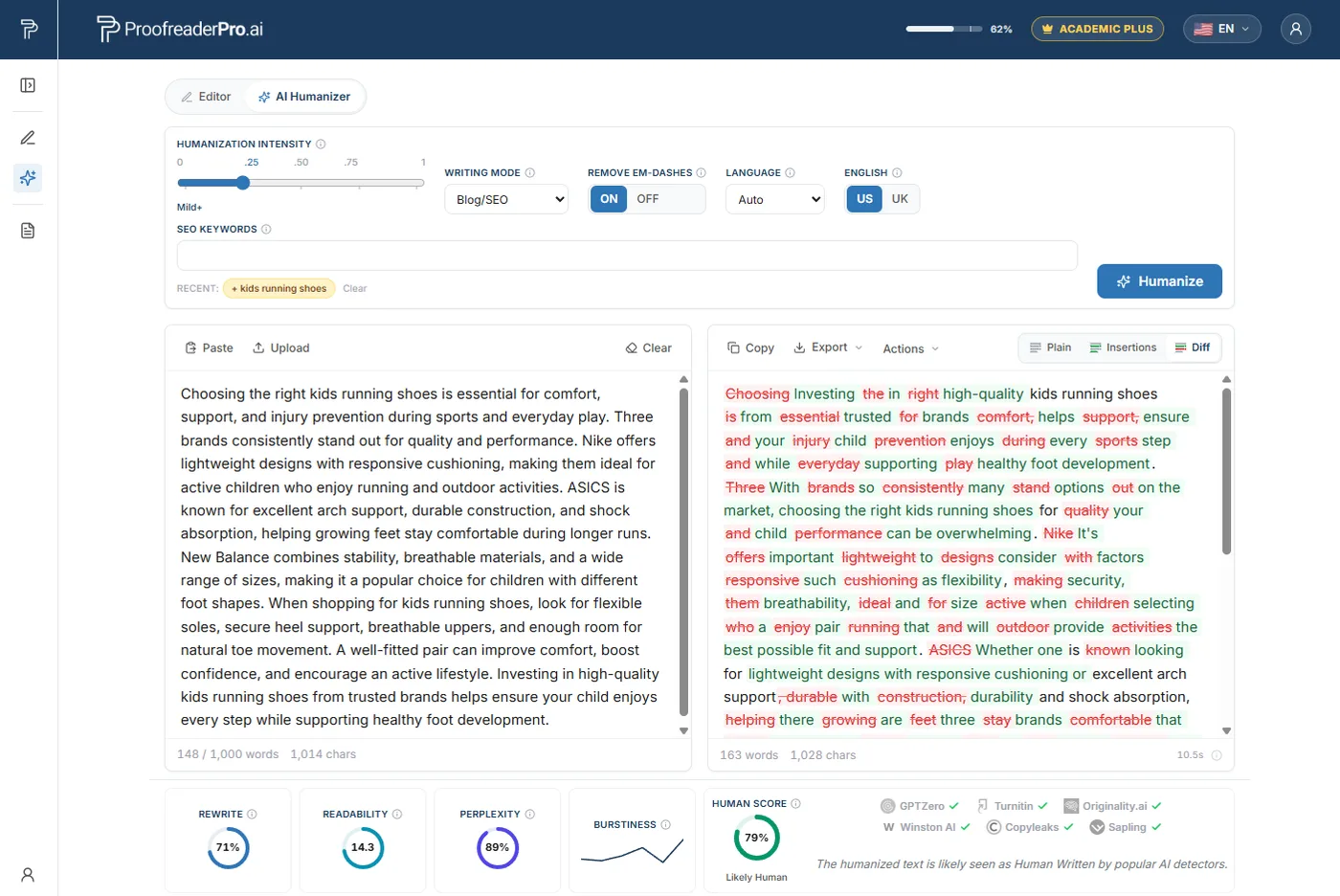
Raw AI articles read robotic and monotonous, every paragraph the same shape, and that flatness is what readers bounce off and search engines pass over. ProofreaderPro's Blog/SEO mode reworks the rhythm and register toward a natural, personal voice, the kind of writing that speeds up, slows down, and sounds like a person with an opinion rather than a slot being filled.
It does this while working to protect the keywords you enter, your primary, secondary, and long-tail terms, so the rewrite improves how the piece reads without disturbing what it needs to rank for. Your facts, links, headings, and formatting are meant to stay put while the voice changes. You can see the whole process on real content, step by step with screenshots, in the walkthrough further down this page.
Does Google penalize AI content, or something else?
No. Google does not penalize content for being written by AI. It judges quality and intent, not the production method, and it has said so plainly for years. That is good news, because it means a well made, AI-assisted article can rank in the SERPs as well as anything else.
The clearest statement lives under a section literally titled "Rewarding high-quality content, however it is produced." Google writes that its "focus on the quality of content, rather than how content is produced, is a useful guide that has helped us deliver reliable, high quality results to users for years." It also states directly that "appropriate use of AI or automation is not against our guidelines."
So the question "does Google penalize AI content" has a simple answer: not for being AI. What Google treats as a violation is intent. In its words, "using automation, including AI, to generate content with the primary purpose of manipulating ranking in search results is a violation of our spam policies." The trigger is the why, not the how.
Google frames the whole decision as a "Who, How, and Why" self-assessment. Who is behind the content, how it was made, and why it exists. If the straight answer to "why" is "to help people," you are inside the guidelines and free to use AI as a drafting assistant. The work left to you is to make that draft read like a person, which is exactly where a humanizer comes in.
You can read the primary source for yourself here.
Google Search's guidance about AI-generated content
That framing has held up. Google's May 2025 Search Central guidance reaffirmed it for AI Overviews and AI Mode, describing those features as rooted in its core Search ranking and quality systems, with the same advice: publish unique, helpful, satisfying, people-first content. The medium changed. The standard did not.
What Google's Scaled Content Abuse policy actually says
There is one thing Google genuinely acts against, and it has a specific name. Knowing it keeps you on the right side of the line.
Google defines it cleanly: "Scaled content abuse is when many pages are generated for the primary purpose of manipulating search rankings and not helping users." Notice the definition never mentions AI. It targets a behavior, not a tool.
When Google announced the policy in March 2024, it described the target as "creating large amounts of unoriginal content that provides little to no value to users, no matter how it's created." A thousand empty pages written by humans break this policy exactly as fast as a thousand written by a model. The problem is mass, low-value publishing, not the writing tool you used.
Generative AI appears only as one example among several. The policy lists "using generative AI tools or other similar tools to generate many pages without adding value for users" alongside older tactics such as scraping, stitching content together without adding value, and keyword pages that make little sense to a reader. AI is not singled out.
Here is the source.
Scaled Content Abuse spam policy
Violations show up two ways. One is a manual action: a reviewer flags the site, the owner gets a notice in Search Console, affected pages may rank lower or drop out of the SERPs entirely, and you can file a reconsideration request once you clean up. The other is algorithmic: core updates quietly reduce the visibility of low-value pages. Google said the March 2024 core update was built to reduce low-quality, unoriginal content by 40 percent, a figure it later updated to 45 percent.
The takeaway is simple. Publish a genuinely useful article that reads like a person wrote it, and none of this applies to you. That is the outcome a good humanizer is built to help you reach.
What Google rewards in the SERPs: E-E-A-T
If Google rewards quality however it is produced, it helps to know what quality looks like to its systems. The shorthand is E-E-A-T.
In December 2022, Google added a second E to its Quality Rater Guidelines, turning E-A-T into E-E-A-T: Experience, Expertise, Authoritativeness, and Trust. Experience means the extent to which the creator has genuine first-hand or life experience with the topic, and it is one of the things a real, personal voice signals to a reader. When your article carries the specific detail only someone who has actually done the thing would write, it reads as human and it demonstrates the qualities of E-E-A-T that Google says it rewards.
One caution on wording, because SEO advice online gets this wrong constantly. E-E-A-T is not a direct ranking factor. Google states plainly that these guidelines "are what are used by our search raters to help evaluate the performance of our various search ranking systems, and they don't directly influence ranking." There is no E-E-A-T score to chase. The point is simpler: write helpful content in a genuine human voice, add the angle and the accuracy only you can, and you are giving Google exactly what it wants to rank.
Why raw AI text reads robotic and monotonous
Now the core problem, and the one a humanizer solves. Raw AI prose has a footprint you can feel.
Sentences run to an even length. Transitions repeat. Paragraphs open with the same handful of moves, the diction stays smooth and mid-register, and the whole thing lacks the irregular rhythm of a person who cares about a sentence. It is competent and completely anonymous. A human voice does the opposite: it speeds up and stalls, drops a short blunt sentence after a long one, repeats a word on purpose, and lets its personality show.
That monotony is not a small cosmetic issue. Readers bounce off flat, samey writing, and a page nobody wants to read is a page that struggles to earn trust, attract links, or hold a position in the SERPs. Google is building for people, and people reward writing that sounds like a person. This is the gap between raw AI text and content that actually performs, and it is the gap an AI humanizer is designed to close.
Humanize your online articles with our Blog/SEO Humanizer
Turn robotic AI drafts into a natural, personal voice that reads human, and add your SEO keywords so they are protected during the rewrite. Free tier, no card required.
Try ProofreaderPro.ai FreeHow an AI humanizer for SEO content gives your writing a natural voice
This is what a humanizer is built for. It takes robotic, monotonous AI output and rewrites its rhythm and register so the article reads like a real person wrote it, natural, varied, and personal, while your facts, your terminology, and your links stay exactly where you put them. That is the difference between a purpose-built humanizer and a generic word-spinner, which swaps synonyms at random and mangles the specifics.
Our own AI humanizer ships a dedicated Blog/SEO mode tuned for exactly this register. It has been tested against Turnitin, GPTZero, Copyleaks, ZeroGPT, and Originality.ai, and keeps grammar above 96 percent, so the natural voice it produces holds up even when a client or agency runs the content through a detector. The table below is the real before and after.
| Your article | Raw AI text | Humanized with Blog/SEO mode |
|---|---|---|
| Voice and rhythm | Robotic, monotonous, even | Natural, varied, personal |
| Reads like | A machine filled a slot | A real person wrote it |
| Your target keywords | Left to chance | Protected during the rewrite |
| Facts, terms, and links | Sometimes garbled by spinners | Preserved intact |
| Value versus raw AI | Baseline | Higher, and more likely to rank |
A natural voice does the heavy lifting, and it pairs best with the substance only you can add: a first-hand angle, a real example, and facts you have checked, since AI can state a confident number that does not exist. Give it a genuine human voice and genuine human value, and you have an article built to rank. We go deeper on the mechanics in our pieces on whether AI humanizers actually work and how to make AI writing sound human, and the same approach carries into other registers like humanizing AI-drafted business content.
How to humanize your blog post with the ProofreaderPro Blog/SEO Humanizer
Here is the full workflow, start to finish. It takes about a minute.
1. Open the humanizer and paste in your post. Go to the humanizer dashboard and drop your AI-drafted blog post or article into the editor.
2. Choose Blog/SEO writing mode. Pick Blog/SEO from the writing-mode menu so the humanizer tunes the voice for web and search content rather than an academic or corporate register.
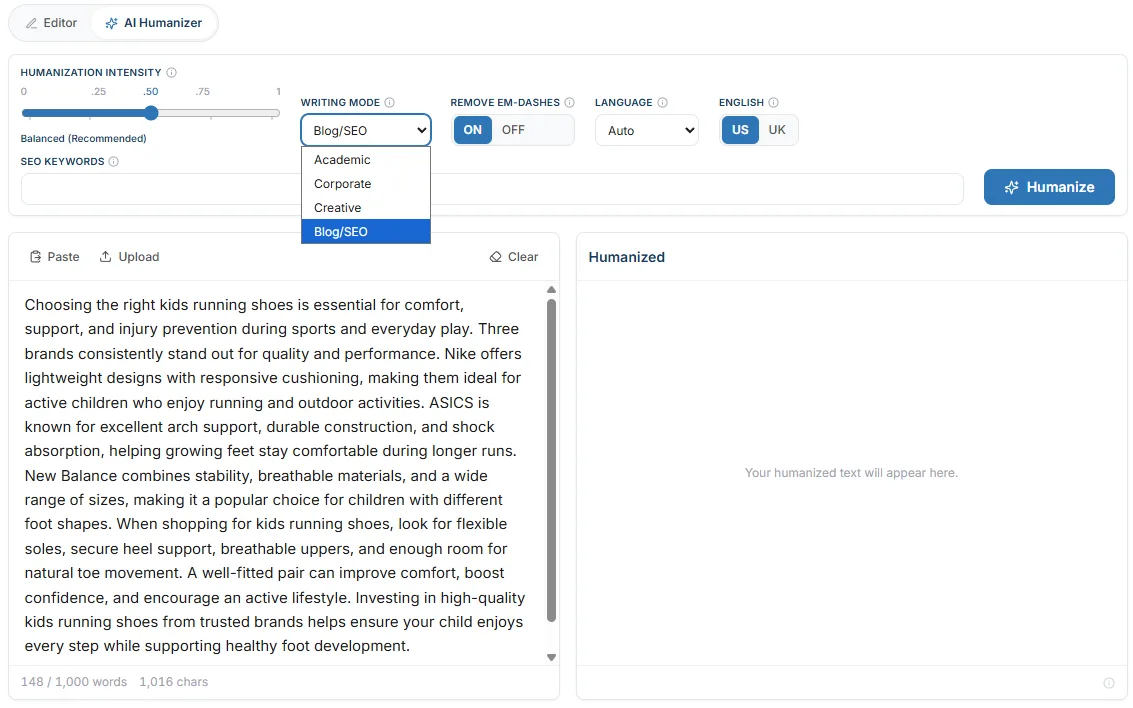
3. Add your SEO keywords. With Blog/SEO mode selected, an SEO Keywords field appears in the top panel. Enter your primary, secondary, and long-tail keywords so the humanizer knows which terms matter to your ranking, and watch them light up in your draft.
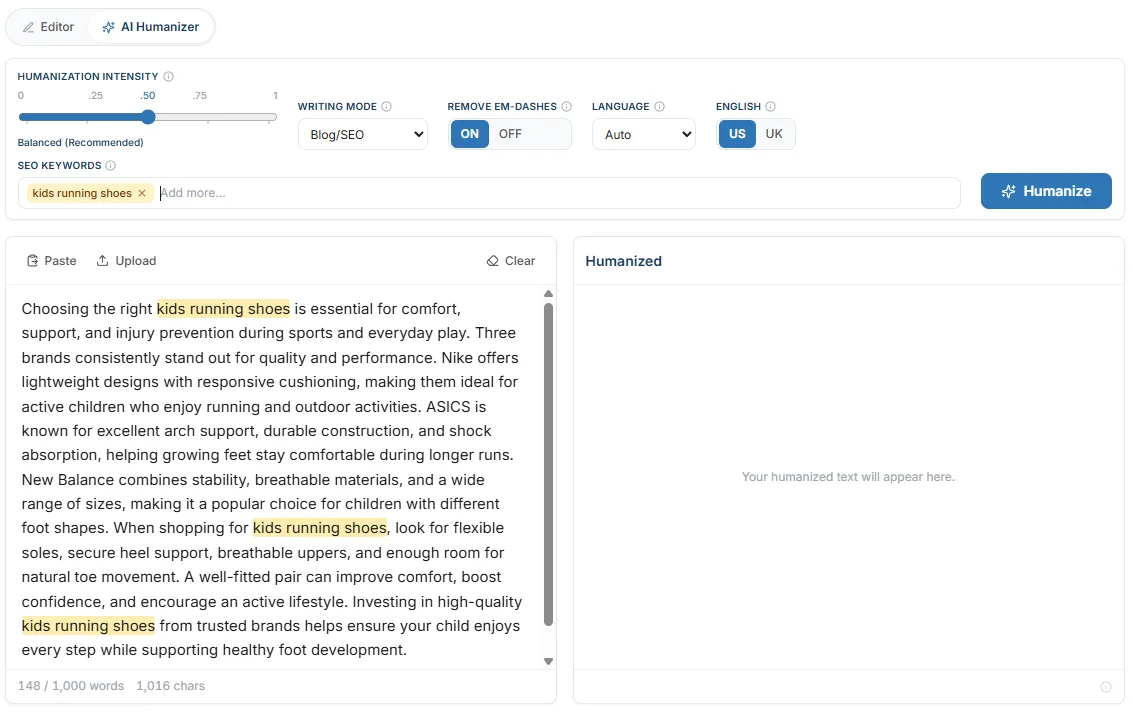
4. Humanize, and watch your keywords stay protected. The humanizer rewrites the article into a natural, personal voice while it protects the keywords you entered, so your target terms survive the rewrite intact, shown highlighted in the output.

5. Review in tracked changes and publish. Switch to the tracked-changes view to see exactly what changed, accept or reject anything you want, then export and publish.
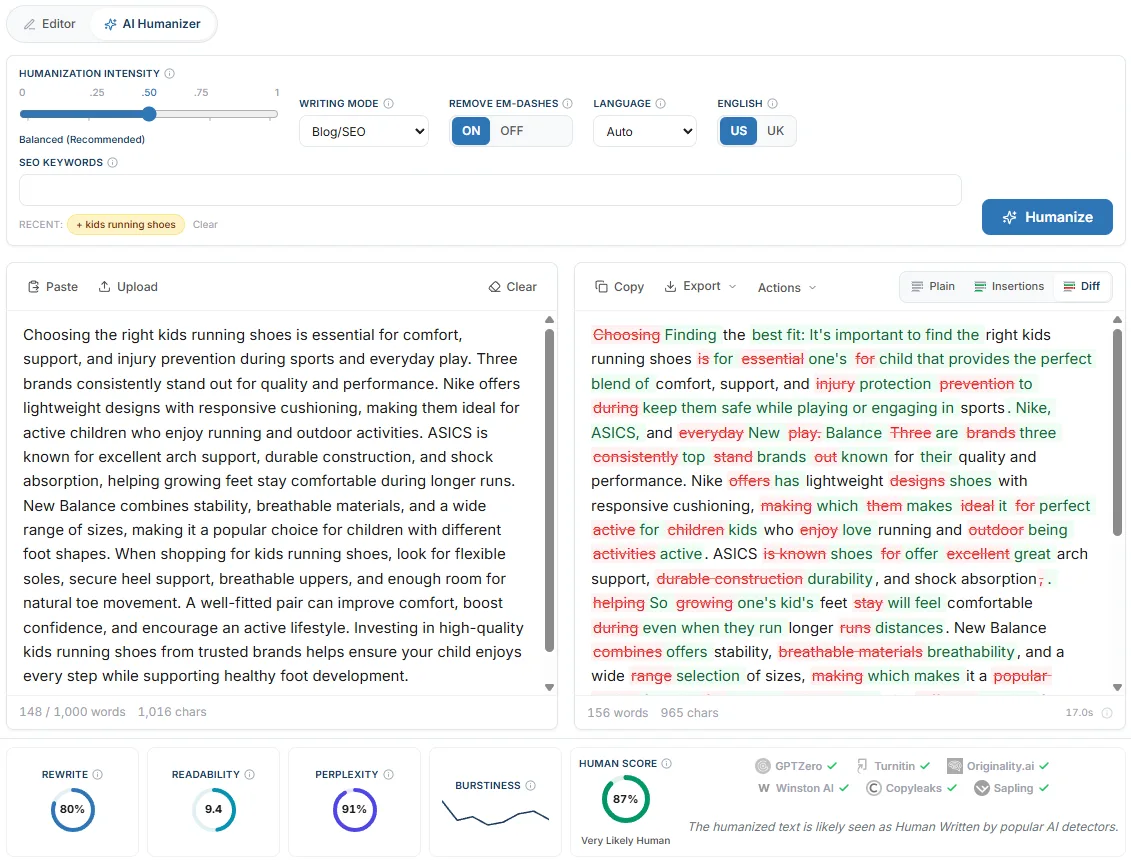
The result is an article that reads like a person wrote it and keeps your target keywords intact. That makes it more valuable than raw AI text, naturalizes your content, and improves its chances of ranking higher in the SERPs.
What humanizing did for one blog's Google traffic
Numbers make the case better than we can. Company X, a content site we work with, started running its AI-drafted posts through the Blog/SEO humanizer in April 2026. Here is what its Google Search Console has looked like since.
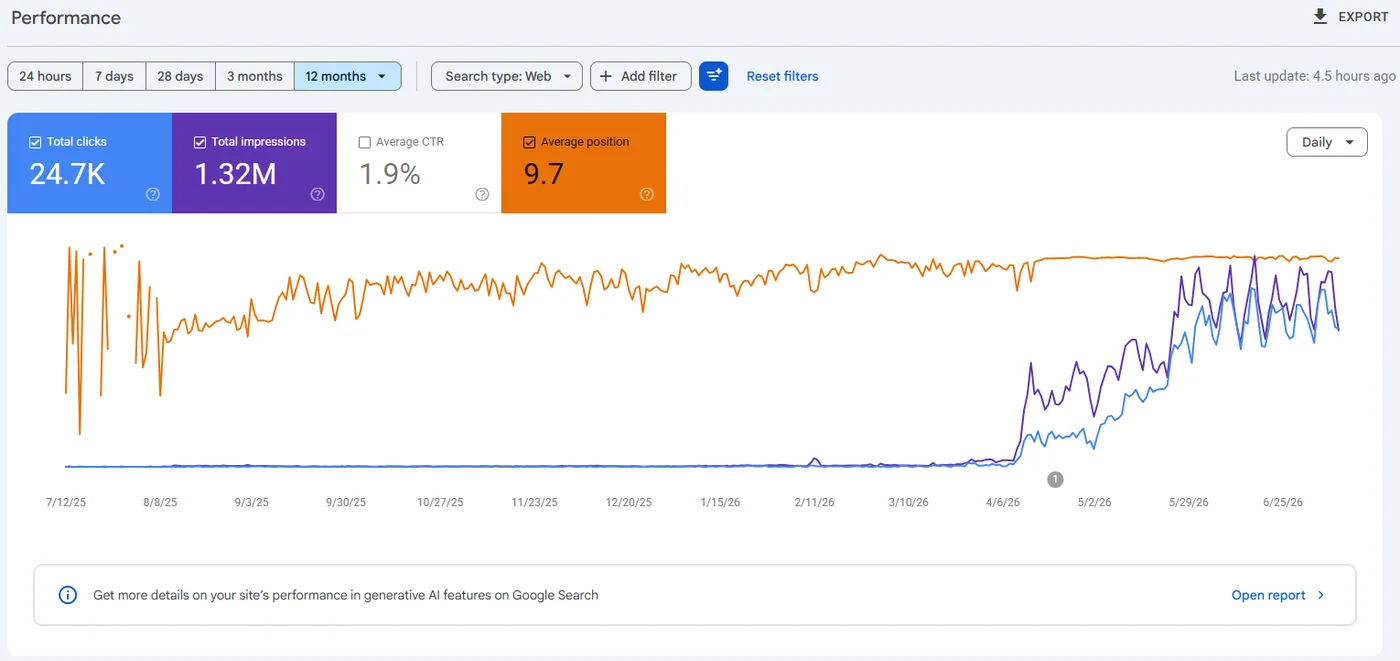
For most of the previous year, clicks and impressions sat almost flat. The marker on the chart is early April 2026, when the team began humanizing its library. From there, impressions climbed gradually, then spiked through May, and settled into a much higher, stable band. Over the twelve months shown, the property now records roughly 1.32 million impressions and 24.7 thousand clicks, at an average position of 9.7.
We will not pretend one chart proves a universal law. It is one site over one stretch of time. But the pattern is exactly what you would expect when a library of flat, robotic pages is rewritten into natural, people-first content. Google's systems reward helpful content, and the more readable, more human version of the same articles earned more visibility and a stronger position in the SERPs. The pages did not change what they were about. They changed how they read.
Humanized content also won more AI citations (GEO)
Ranking in the classic blue links is only half the game now. Generative engine optimization, or GEO, is about getting your content cited inside AI answers: Google's AI Overviews and AI Mode, Gemini, Perplexity, Copilot, Grok, ChatGPT, and the rest. Those engines pull from content they can read cleanly and trust, and robotic, interchangeable AI text is easy for them to pass over.
After humanizing, Company X saw its GEO footprint grow too. Here is its AI-visibility snapshot from Ahrefs.
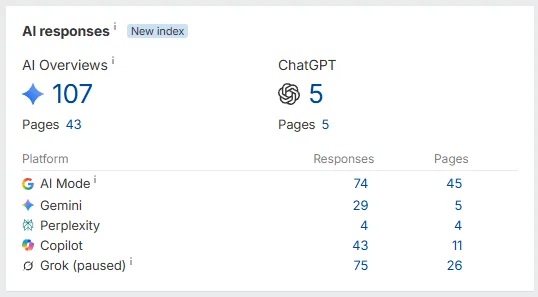
Across the answer engines the site is now cited widely: 107 appearances in Google's AI Overviews, 74 in AI Mode, 75 in Grok, 43 in Copilot, 29 in Gemini, plus a handful in ChatGPT and Perplexity. The lesson mirrors the Search Console story. Content that reads like a person wrote it is easier for both Google and the frontier models to surface, quote, and recommend. Humanizing your AI drafts is not only an SEO move anymore. It is a GEO move too.
Humanizing AI content for social media (LinkedIn, X, and captions)
Search is not the only place a robotic voice costs you. Social platforms are where the flat AI tell is most obvious, because the format is short and personal by nature. A LinkedIn post that opens with "In today's fast-paced digital landscape" tells every reader a model wrote it, and engagement drops accordingly.
Social media marketers can run the same Blog/SEO mode over short-form copy to fix it. Humanize a LinkedIn article or post so it sounds like a person with a point of view, not a brand account reading from a script. Tighten Instagram and Facebook captions into something with rhythm and personality. Rework an X thread so each post lands instead of blurring into the next. The keyword protection still applies, so branded terms, hashtags, or campaign phrases you enter stay intact through the rewrite.
The payoff is the same as it is for a blog post. People reward writing that sounds like a person, the algorithms surface what people engage with, and a humanized caption earns the comments and shares that a generic one never will. If your team is publishing across a blog and half a dozen social channels, humanizing is one pass that makes all of it read like your brand actually wrote it.
Frequently asked questions
Q: Does Google penalize AI-generated content?
Not for being AI. Google judges quality and intent, rewarding helpful content "however it is produced" and stating that "appropriate use of AI or automation is not against our guidelines." What it penalizes is content produced primarily to manipulate rankings, especially at scale, no matter how it was created.
Q: Can AI content rank on Google in 2026?
Yes, if it is genuinely helpful and reads like a person wrote it. Google's ranking systems reward people-first content regardless of how it was made, and its May 2025 guidance reaffirmed the same standard for AI Overviews and AI Mode. An AI-assisted article that is humanized into a natural voice can rank in the SERPs as well as any other page.
Q: Does humanizing AI content help SEO?
Yes. Raw AI reads robotic and monotonous, and humanizing it with Blog/SEO mode gives it the natural, personal voice that readers and Google reward. That makes a humanized article more valuable than raw AI text and improves its chances of ranking, and with keyword protection your target terms stay intact through the rewrite.
Q: Does humanizing content help with GEO and AI Overviews?
Yes. Generative engine optimization depends on content that AI answer engines can read cleanly and trust, and a natural, human voice is easier for Google's AI Overviews and AI Mode, Gemini, Perplexity, Copilot, and Grok to quote than robotic AI text. Humanizing your drafts improves your odds of being cited across those engines, not just your ranking in the SERPs.
Q: What is scaled content abuse?
Google defines scaled content abuse as generating many pages "for the primary purpose of manipulating search rankings and not helping users." The definition targets the behavior, not the tool: mass low-value pages break the policy "no matter how it's created," whether by AI, scraping, or humans. A single, genuinely useful humanized article is the opposite of that.
Turn robotic AI drafts into a natural voice and protect your SEO keywords, while your facts, links, and formatting stay intact.

Moe is an NLP engineer with a PhD in natural language processing. His research covers computational linguistics, text analysis, and machine learning, and it fed directly into the editing and humanization models behind ProofreaderPro. He writes about the part of the process most people never see: how a language model reads a sentence, scores it, and decides what to change.