Ryter Pro AI Humanizer Review (2026): Credits and Limits
Ryter Pro AI Humanizer review: credits and character limits translated into essays, plans from US$6 a month billed yearly, the API and its no-refund terms.

Ryter Pro is a credit-based AI humanizer and text-tools platform aimed mainly at students who rewrite essays and assignments. It has a small free tier, and paid plans start at US$6 a month billed yearly, with every humanization paid for in credits.
The detail that trips people up in any Ryter Pro AI humanizer review is that Ryter measures length in characters, while most of us think in words. A 5,000-character limit sounds large, but it's about 800 words of English. Once you translate characters and credits into essays, the plans are easy to compare.
What is Ryter Pro?
Ryter Pro is a web platform at ryter.pro with an AI humanizer, an AI detector, text-processing tools and image tools, plus a REST API, an MCP option and developer docs. Its tagline describes it as human-first AI writing, detection and text-processing tools for clearer, more thoughtful work. The site calls itself both Ryter and Ryter Pro. It describes its plans in terms of student needs, from occasional essay rewrites on Basic to graduate students and high-volume users on Enterprise.
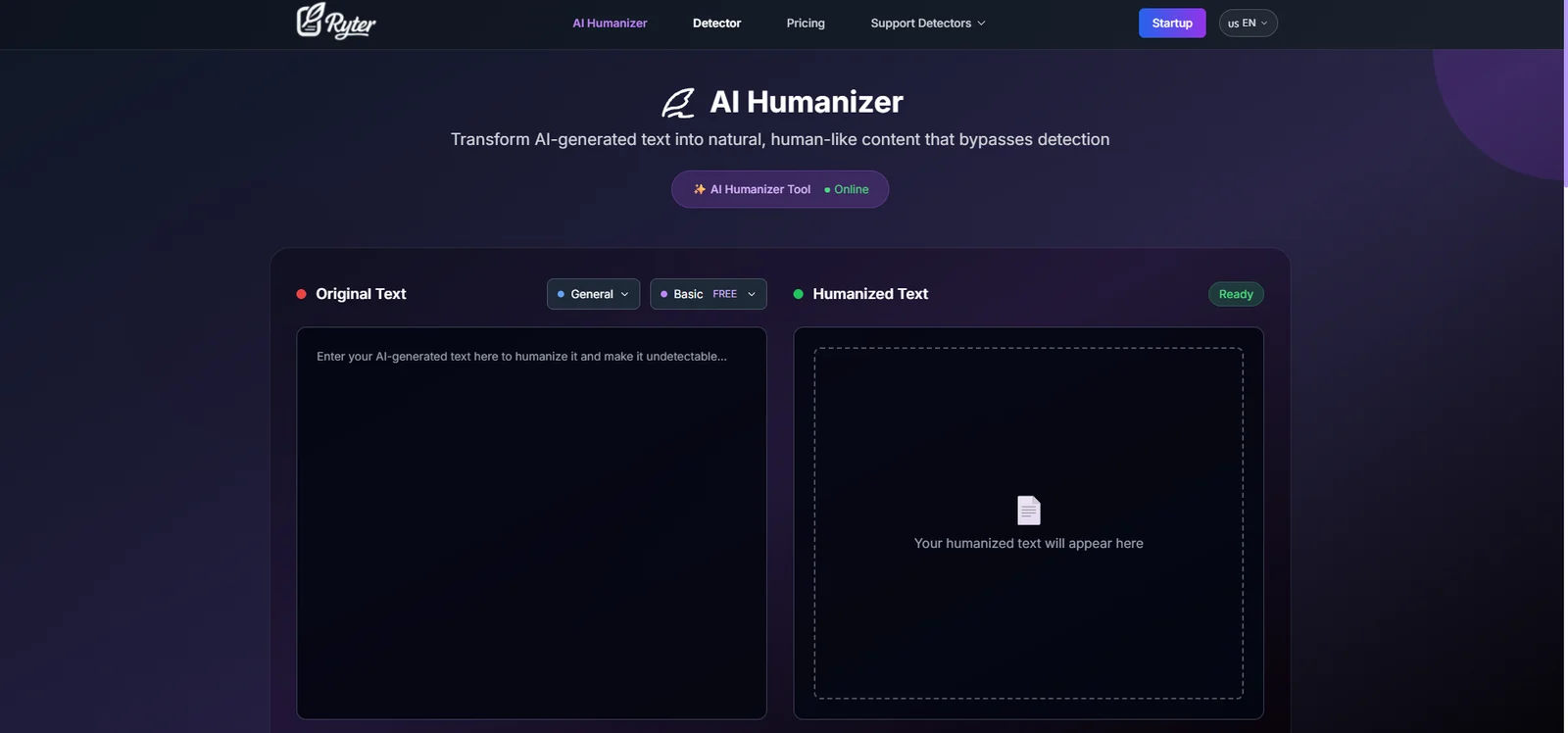
You paste text from ChatGPT, Claude, Gemini or another AI tool, choose a content type and an algorithm, and humanize it. Paid plans also let you run detection reports with the detector you pick.
Is Ryter Pro legit?
Yes. Ryter Pro publishes Terms of Service, a privacy policy and subscription plans, and support runs through support@ryter.pro. Its Terms set out the credit system, cancellation and a strict no-refund rule, which we cover below.
How Ryter Pro's humanizer works
Content types and algorithms
The humanizer has two menus: a content type, which tells it what kind of writing you're pasting, and an algorithm. The free tier uses the basic algorithm. Professional and Enterprise add the Pro Algorithm and a newer model, along with faster processing. Match the content type to what you're pasting, such as an essay, an article or an email, so the rewrite aims at the right register.
Ryter says its humanizer changes writing style and structure while keeping the original meaning and context. It says the tool is meant to improve writing quality and help with false AI-detection flags, and it asks users to follow their institution's academic integrity policies.
Using Ryter Pro
- Open the AI Humanizer at ryter.pro. You can paste up to 500 characters without an account.
- Sign up free to raise the limit to 1,000 characters, or choose a paid plan for longer text.
- Pick a content type and an algorithm.
- Click "Humanize Text" and read the result.
- On a paid plan, run a detection report with the detector you choose if you want one.
Credits and characters, translated into essays
Ryter Pro bills in credits. Its FAQ says a humanization costs 2 credits, a basic detection 1 credit and its Turnitin detection 10 credits. Credits reset each billing period, and unused credits don't roll over.
Each plan also caps the length of one humanization in characters. English averages about six characters per word, counting spaces, so the caps work out roughly like this:
| Plan | Characters per humanization | About this many words | Credits a month | Full-length humanizations a month |
|---|---|---|---|---|
| Free (no account) | 500 | 80 | None | Limited free use |
| Free (signed in) | 1,000 | 160 | None | Limited free use |
| Basic | 5,000 | 800 | 100 | 50 |
| Professional | 10,000 | 1,600 | 500 | 250 |
| Enterprise | Unlimited | No cap | 1,000 | 500 |
Ryter's FAQ also says free users get one humanization a day. On Basic, 50 humanizations of about 800 words is roughly 40,000 words a month if you use every credit on the humanizer. A 3,000-word essay is about 18,000 characters, so it takes four runs and 8 credits on Basic, or two runs and 4 credits on Professional. Detection reports come out of the same credits, so a Turnitin detection at 10 credits costs as much as five humanizations.
If you want to know how many characters a draft has before you paste it, our free word counter shows characters as well as words.
A semester on Basic
Here's a realistic term for a student on Basic. Four 3,000-word essays take 16 runs and 32 credits. A 10,000-word dissertation draft is about 60,000 characters, so it takes 12 runs and 24 credits. That's 56 credits, comfortably inside Basic's 100 a month, with room for a few detection reports. The limit you'd feel first is the 5,000-character cap, because every essay has to be split into chunks of about 800 words and checked at the joins. Our overview of AI tools for thesis writing covers where a humanizer fits among the other tools a long project needs.
What else Ryter Pro includes
Detection reports
The workflow ends with a detection report from the detector you select. Ryter lets you choose which detector runs, and each one has its own credit price. A basic detection costs 1 credit and the Turnitin detection 10. Any detector is one view of your text. If you'd like a different measure, our free burstiness checker shows how much your sentence lengths vary, one of the patterns detectors look at.
If a detector flags writing you did yourself, a rewrite isn't the answer. Our guide to appealing a false AI-detection flag sets out the evidence and steps that help.
Text tools, image tools and the API
Beyond the humanizer and detector, Ryter lists text tools, image tools and several humanizer variants in its menu. Every paid plan includes API access: basic on Basic and full access on Professional and Enterprise, with docs and an MCP option. MCP, the Model Context Protocol, is a standard way for AI assistants to use outside tools, so an assistant that supports it can call Ryter's tools directly. That makes Ryter an inexpensive way to try a humanizer API, since Basic costs US$6 a month on yearly billing.
Who Ryter Pro suits
Ryter's plan descriptions are written for students: occasional essay rewrites on Basic, frequent paper revisions on Professional, and graduate students or high-volume users on Enterprise. Its homepage reviews also come from a consultant, an educational content creator and a marketer. If you're a graduate student working on a long document, our master's thesis writing guide covers the writing process a humanizer can't replace.
Developers are the other group Ryter serves well. A study app, a writing plugin or an internal content tool can call the humanizer through the API from the Basic plan upward. Larger teams can ask for a Custom plan with its own limits.
Word Limits You Can Plan a Thesis Around
ProofreaderPro.ai's academic humanizer is designed to lower AI scores in 500 or 1,000-word passes while your citations stay in their original format.
See the academic humanizerRyter Pro pricing and refunds
Ryter Pro's paid plans start at US$6 a month on yearly billing, or US$9.99 billed monthly. Ryter says yearly billing saves 40%. Ryter's prices on 2 October 2026:
| Plan | Billed monthly | Billed yearly | Credits a month | Characters per humanization | Extras |
|---|---|---|---|---|---|
| Basic | US$9.99 | US$6 a month (US$72 a year) | 100 | 5,000 | Basic API access, email support |
| Professional | US$19.99 | US$12 a month (US$144 a year) | 500 | 10,000 | Pro Algorithm and New Model, full API, priority support |
| Enterprise | US$29.99 | US$18 a month (US$216 a year) | 1,000 | Unlimited | Pro Algorithm and New Model, full API, dedicated support |
| Custom | Quote | Quote | Custom | Custom | Tailored enterprise setup |
The Custom plan is for organizations that need more than Enterprise, and Ryter asks you to contact its team for a personalized quote.
I'd pick Professional on yearly billing. US$12 a month gives you five times Basic's credits, a 10,000-character limit and the Pro Algorithm, which is a big step up for US$6 more a month.
No refunds, and credits that expire
Ryter's Terms say all payments are non-refundable, and they give the cost of reserving GPU capacity for each subscription as the reason. No refunds are given for partly used billing periods. The Terms also say that starting the service right away means EU customers give up the 14-day withdrawal right once it begins.
You can cancel at any time to stop future charges, and you keep access and your remaining credits until the end of the billing cycle. Credits expire at the end of each period and never carry over. Try the free tier first, since there's no way to get your money back after you subscribe.
Is Ryter Pro worth it?
For a student on a budget, Ryter Pro is worth a look. US$72 a year buys enough credits for a full term of essays, and the free tier lets you judge the output first. Professional is the better buy if you write long papers, because the 10,000-character cap halves the number of chunks. The one thing to weigh is the refund policy: once you pay, the money is spent, so be sure before you subscribe. Developers get the best value of all, since the API comes with the cheapest plan.
Ryter Pro AI Humanizer vs. ProofreaderPro Humanizer
Ryter Pro is a low-priced, credit-based humanizer with an API on every plan. ProofreaderPro.ai is an academic editor whose humanizer works in words, keeps citations in format and can track every change.
| Feature | ProofreaderPro.ai | Ryter Pro |
|---|---|---|
| Made for | Essays, theses and journal papers | Student essays and assignments, plus general writing |
| Limit per run | 500 words on Academic, 1,000 on Academic Plus | 5,000 characters on Basic (about 800 words), 10,000 on Professional, unlimited on Enterprise |
| Monthly allowance | 25,000 words on Academic, 50,000 on Academic Plus | 100, 500 or 1,000 credits, at 2 credits per humanization |
| Settings | Five modes and five intensity levels on Academic Plus | Content types, basic algorithm, Pro Algorithm and New Model on higher plans |
| Citations | Keeps APA, MLA, Chicago, IEEE and Turabian formats | General rewrite |
| Price | US$19 or US$29 a month (US$169 or US$259 a year) | US$9.99 to US$29.99 a month, or US$72 to US$216 a year |
Ryter is cheaper and gives developers an API from the first paid plan. For a thesis or a journal paper, what matters is whether the rewrite leaves your references alone. ProofreaderPro.ai keeps citations such as (Haddad 112) in MLA format, which our MLA citation guide explains. On Academic Plus it also freezes field terms and exports tracked changes for your supervisor.
Ryter Pro AI Humanizer Alternatives
Ryter Pro's readers are mostly students on a budget and developers who want a cheap API. The closest alternatives are other credit-based or low-cost humanizers.
| Tool | Best for | Our write-up |
|---|---|---|
| ProofreaderPro.ai | Academic papers with citations and field terms | Academic AI humanizer |
| Ryne AI | A coin-based student platform with chat and notes | Ryne AI humanizer review |
| Undetectable AI | A humanizer and detector with an established API | Undetectable AI alternative |
| BypassGPT | High-volume rewriting for web content | BypassGPT alternative |
| StealthGPT | Many languages with a built-in detector | StealthGPT review |
| Smodin | A multilingual set of student tools | Smodin alternative |
| WriteHuman | Quick one-click rewrites | WriteHuman alternative |
Credits or coins: Ryter Pro and Ryne AI
Both price their tools in virtual units. Ryter Pro charges 2 credits per humanization and caps each run in characters, from 5,000 on Basic to unlimited on Enterprise. Ryne AI uses coins, caps each run in words, from 250 free to unlimited on Ruby, and adds a chat with 15+ models, an essay composer and a note taker. Ryter is cheaper and simpler. Ryne covers more of a student's week.
Ryter Pro and BypassGPT for bulk rewriting
Both suit people who rewrite a lot of text on a budget. BypassGPT is built for volume web content, such as blog pages and marketing text. Ryter Pro adds API access on every plan, so a developer can automate rewriting from the US$6 Basic plan. For hands-on rewriting, compare the two on the same paragraph. For automation, Ryter's API is the easier start.
Frequently asked questions
Q: What is Ryter Pro?
Ryter Pro is an AI humanizer and text-tools platform at ryter.pro, with an AI detector, an API and plans paid in credits. The site also calls itself Ryter.
Q: Is Ryter Pro free?
Ryter Pro has a free tier that takes 500 characters without an account and 1,000 when you sign in, and its FAQ says free users get one humanization a day. Paid plans start at US$6 a month billed yearly.
Q: Is Ryter Pro good?
Ryter Pro is good value for students and developers who want a cheap humanizer with API access. For academic papers with references, a humanizer that keeps citations in format suits the job better.
Q: How many credits does a humanization use?
A humanization uses 2 credits on Ryter Pro. A basic detection uses 1 credit, and Ryter's Turnitin detection uses 10.
Q: How many words can Ryter Pro humanize at once?
Ryter Pro counts characters: 5,000 on Basic is about 800 words, 10,000 on Professional is about 1,600 words, and Enterprise has no cap. Free users can paste 500 characters, or 1,000 after signing in.
Q: Do Ryter Pro credits roll over?
No. Ryter Pro credits expire at the end of each billing period, and unused credits don't carry over to the next one.
Q: Is Ryter the same as Ryter Pro?
Yes. The site at ryter.pro uses both names, Ryter and Ryter Pro, for the same humanizer and tools platform.
Q: Does Ryter Pro have an API?
Yes. Every paid plan includes API access, basic on Basic and full on Professional and Enterprise, and Ryter also offers an MCP option and developer docs.
Q: Can I use Ryter Pro for academic work?
Ryter says its tool is meant to improve writing quality and help with false AI-detection flags, and it asks users to follow their institution's academic integrity policies. Check your course's AI rules before you humanize an assignment.
Q: Can I get a refund from Ryter Pro?
No. Ryter Pro's Terms say all payments are non-refundable, including partly used billing periods, so try the free tier first.
Q: Can I cancel Ryter Pro at any time?
Yes. You can cancel whenever you like to stop future charges, and you keep access and your remaining credits until the end of the billing cycle. After that, the account stops renewing and the unused credits expire.
Word-based limits, citations kept in format and tracked changes on Academic Plus.

Dana is a content creator at ProofreaderPro, where she runs the daily blog and writing operations. She writes the articles on how the online editing platform works, and she handles customer messages every day, with a five-star satisfaction score to show for it.