QuillBot's AI Detector vs Paraphrased and Humanized Text
QuillBot's AI detector is near-perfect on plain and paraphrased AI text, but a 2025 study found its accuracy fell to 58% once that text was humanized.

QuillBot's AI detector is near-perfect at flagging plain and paraphrased AI text. Its accuracy falls to 58% once that text has been run through a humanizer, according to a 2025 independent study. QuillBot also builds one of the more popular AI paraphrasers, so its own detector has to deal with exactly the kind of reworded text its other tools produce.
This post covers how QuillBot labels a scan, what the 2025 study found on paraphrased and humanized text, and what QuillBot claims about its own accuracy. It also covers the free and Premium limits and how the detector relates to Turnitin.
How QuillBot's detector labels a text
A QuillBot scan returns a score from 0% to 100%. It also returns one of three labels: AI-generated, human-written, or AI-refined. QuillBot uses the AI-refined label for writing a person started that an AI tool then edited or paraphrased. That's different from text a model wrote from scratch. QuillBot applies the same three labels no matter which of its own tools, if any, touched the text first.
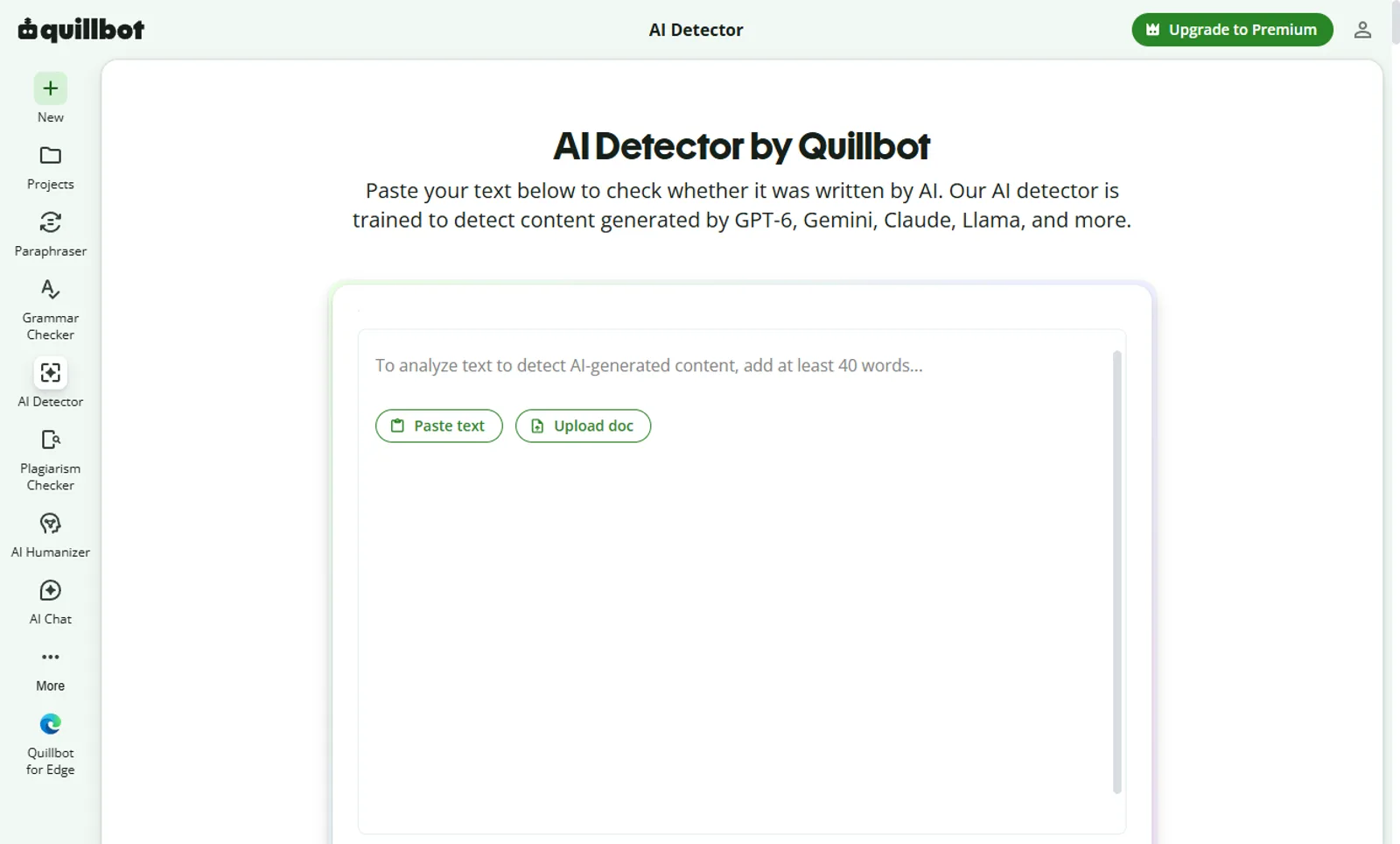
In practice, the three labels map to three common situations. A fully drafted ChatGPT or DeepSeek answer, pasted in untouched, is usually labeled AI-generated. A human draft that only had its grammar fixed usually stays human-written, since that kind of edit doesn't touch sentence structure. A human draft reworded by a paraphraser, or rewritten by a humanizer, is the case QuillBot built the AI-refined label for.
An explainer card appears next to each flagged sentence, with a short reason attached, such as predictable wording or an unusually even rhythm. Those two signals, predictable wording and sentence rhythm, line up with perplexity and burstiness, the measures most AI detectors use under one name or another. Our explainer on perplexity in AI detection covers how that works in more detail.
QuillBot recommends at least 80 words for a reliable score. It says accuracy is best at 300 words or more. A short passage, like one paragraph pulled out of context, gives the model far less to work with than a full document does. QuillBot checks a document sentence by sentence rather than as one block, so a long paper with a single AI-refined paragraph won't necessarily score as AI-generated overall.
None of these labels are permanent. QuillBot can rescan the same text after a revision, and the label can move between categories as the wording changes. A score from a single scan describes that one version of a document. It doesn't show how the document was written.
Site owners and bloggers can also request a QuillBot certificate and a verification badge for a published page, as a way to show the page is human-written. That feature is separate from the main scan box, and it's aimed at publishers who want to show proof of authorship on a live page.
A 2025 study: QuillBot on DeepSeek, paraphrased and humanized text
A 2025 study by Hulayyil Alshammari and Praveen Rao, posted on arXiv, tested six AI detectors against text from DeepSeek-v3. The six were AI Text Classifier, Content Detector AI, Copyleaks, QuillBot, GPT-2 and GPTZero. The researchers started with 49 human-written question-and-answer pairs from before the LLM era, then generated 49 matching DeepSeek-v3 answers to those same questions. They added 196 more samples by paraphrasing and humanizing the AI answers, then scored all six detectors across the full set.
DeepSeek-v3 is a newer model than the ones most public detectors are tuned around, which is part of why this study is useful. A detector built and trained mainly on ChatGPT-style output doesn't automatically handle a different model's writing the same way. Starting from real human answers written before large language models existed also rules out the chance that the human examples were themselves touched by AI.
| Condition (DeepSeek-v3 text) | QuillBot's result in the study |
|---|---|
| Original, unedited | Near-perfect |
| Paraphrased | Near-perfect |
| Humanized | 58% accuracy |
QuillBot and Copyleaks were both near-perfect on the original and paraphrased DeepSeek text, meaning each missed very few of those samples. Some of the other tools in the study, including AI Text Classifier and GPT-2, gave inconsistent results on the same samples. Humanizing the text was the change that affected accuracy most across all six detectors. It brought Copyleaks down to 71%, QuillBot to 58% and GPTZero to 52%.
The study's text set is modest by detector-benchmark standards: 49 original human answers, 49 unedited DeepSeek-v3 answers, and 196 more built by paraphrasing and humanizing those AI answers. That's enough to show a clear pattern across six detectors, though a larger set would give more precise percentages. The paper also tested DeepSeek itself as a detector, using few-shot examples and chain-of-thought prompting rather than a dedicated detection model. That part of the study is about DeepSeek's own classification ability and doesn't include a QuillBot result.
For someone who paraphrased an AI draft and is counting on that alone, this study is a useful data point. Paraphrasing didn't reduce QuillBot's accuracy in this test. Reordering words and sentence structure, on its own, wasn't enough to change the result. Humanizing the text was the one change that lowered QuillBot's accuracy, and QuillBot still detected most of the humanized samples.
For students, the useful part of this result is the difference between paraphrasing and rewriting. A paraphraser changes words and some sentence order. Rewriting from your own understanding changes the argument, the examples and the structure, and that's what makes a draft your own.
What QuillBot says about accuracy
QuillBot cites a 99% detection rate on RAID, an independent benchmark that covers several large language models. We explain what RAID tests in our post on Grammarly's AI detector, which ranks first on RAID's leaderboard.
QuillBot's FAQ names two conditions where it expects more errors. Formulaic writing, such as academic definitions, legal copy or structured templates, is more likely to trigger a false positive. Heavily paraphrased or lightly AI-edited writing is harder for any detector to identify. QuillBot also says no AI detector reaches 100% accuracy, and that a result should be treated as one signal.
The 2025 study above adds an independent data point on a newer model, DeepSeek-v3, that many detectors weren't originally tuned for.
QuillBot's humanizer page states a related point about how the company frames its whole AI-writing toolkit. It says the humanizer is meant to improve a draft, and it asks users to disclose AI use under their institution's or employer's policy. That framing applies to the detector in the same account, too.
Rewrite the structure along with the words
Our academic humanizer changes sentence rhythm and structure as well as word choice, and your citations, technical terms and numbers stay as they are.
Try ProofreaderPro.ai FreeFree vs Premium
| Feature | Free | Premium |
|---|---|---|
| Word limit per scan | Up to 1,200 words | No word limit |
| Daily scans | Up to 6 | Unlimited |
| Explainer cards | 1 free card | Unlimited, across the full text |
| Price | US$0 | US$4.17 a month, billed annually |
QuillBot's free AI Detector caps each scan at 1,200 words and allows six scans a day, with one explainer card per scan. Premium removes both limits and adds a full explainer for every flagged sentence instead of one. The rest of QuillBot's tools are included at the same price, US$4.17 a month when billed annually.
Someone checking a single short assignment will likely never hit the free caps, since one scan covers about four pages of double-spaced text. A 6,000-word literature review, checked in 1,200-word sections, takes five scans on the free plan, within the six-a-day limit. A longer dissertation chapter, checked several times in one sitting, is where you're most likely to reach the daily cap. Premium also lets you download a copy of the full report. That's useful if a supervisor or editor wants to see the explainer detail, not only the final percentage.
QuillBot's detector and Turnitin
QuillBot's AI Detector and Turnitin are two separate tools, built by two separate companies, and a score from one doesn't predict a score from the other. Turnitin licenses its AI writing detection to schools, universities and publishers, so most students see a Turnitin result only through an instructor. Our guide to Turnitin scores covers how Turnitin displays its own AI and similarity figures.
In August 2025, Turnitin added a feature it calls AI bypasser detection, a set of models aimed at text that has gone through a humanizer or a heavy paraphraser. The feature currently covers English only. Our QuillBot Humanizer alternative guide goes through what that update means for QuillBot's own humanizer specifically.
The practical gap between the two tools matters most for anyone submitting through a Turnitin-enabled course. A QuillBot score, even a reassuring one, says nothing about whether Turnitin's own AI writing report will show a low score too. The two run on different training data and different thresholds.
The DeepSeek study above shows a similar split. Paraphrasing alone didn't lower QuillBot's or Copyleaks' accuracy, while humanizing did. Turnitin's 2025 update targets that same gap: text reworded enough to read differently, but still carrying the structural patterns a detector can measure.
If your course uses Turnitin, treat a QuillBot scan as a check on your own draft and keep the result with your notes. If an instructor questions a Turnitin result later, your drafts and notes are better evidence than either score, as we explain in process is the new proof.
Scribbr's free AI Detector runs on QuillBot's own technology. Scribbr's detector page loads its scan from quillbot.scribbr.com, a QuillBot subdomain set up for Scribbr's site, through a QuillBot partner script. Our look at Scribbr's AI detector covers what that means for Scribbr's own results.
If you paraphrased an AI draft and are counting on that alone, the study above is worth a second look. Rewriting the content from your own notes, with your own examples and your own structure, changes more about a piece of writing than a paraphraser does. If you'd rather compare tools side by side first, our QuillBot alternative for academic writing and our ProofreaderPro.ai vs QuillBot comparison both cover where QuillBot fits for academic drafts. Whichever route you take, QuillBot's own guidance still applies: disclose AI assistance under your course or employer's policy, regardless of what any detector score shows. Our academic humanizer is built to score low on AI checks by changing sentence structure as well as word choice, and it leaves citations, technical terms and numbers untouched.
Frequently asked questions
Q: Can QuillBot's AI detector detect its own paraphraser?
On plain paraphrased text, yes. A 2025 study by Alshammari and Rao found QuillBot's detector near-perfect on DeepSeek-v3 text that had been run through a paraphraser. Humanizing the same text was a bigger challenge, cutting QuillBot's accuracy to 58% in that study.
Q: Does QuillBot's AI detector work on DeepSeek text?
Yes. The same 2025 study tested QuillBot specifically on DeepSeek-v3 output and found near-perfect results on the original and paraphrased versions, matching Copyleaks' performance in that test.
Q: What does "AI-refined" mean in QuillBot?
It's QuillBot's label for writing that started as a person's own text and was then edited or paraphrased with an AI tool, rather than written by a model from scratch. QuillBot scores sentence by sentence, so one AI-refined paragraph doesn't turn the whole document into an AI-generated result.
Q: How many words can I check for free?
Up to 1,200 words a scan, with up to six scans a day on QuillBot's free plan. Premium removes both limits for US$4.17 a month, billed annually.
Q: Is QuillBot Premium worth it for the detector alone?
That depends on how often you scan and how long your documents run. Premium removes the 1,200-word cap and the six-scan daily limit, and adds a full explainer for every flagged sentence instead of one. The rest of QuillBot's tools are included at the same price.
Q: Can Turnitin detect QuillBot paraphrasing?
Often, yes. Turnitin added dedicated AI-paraphrasing detection in July 2024 and an AI-bypasser layer in August 2025, aimed at text that has gone through a humanizer or a heavy paraphraser. Our QuillBot Humanizer alternative guide covers the full picture.
Q: Does QuillBot's detector work in other languages?
Yes. QuillBot says its AI Detector supports more than 20 languages, including English, Spanish, French and Portuguese. Its AI Humanizer covers fewer languages: Spanish, German, French, Portuguese and four English dialects.
Q: Is QuillBot's detector the same as Scribbr's?
Largely, yes. Scribbr's AI Detector page loads its scan from quillbot.scribbr.com, a QuillBot subdomain, through a QuillBot partner script embedded in the page. Our look at Scribbr's AI detector covers how Scribbr presents its own results from that same tool.
Rewrite AI-assisted academic drafts while your citations, terminology and meaning stay in place.

Dana is a content creator at ProofreaderPro, where she runs the daily blog and writing operations. She writes the articles on how the online editing platform works, and she handles customer messages every day, with a five-star satisfaction score to show for it.