What Is an Acceptable Turnitin Score? Every Percentage Range Explained
Acceptable Turnitin score by range: what 5%, 15%, 25% and higher mean, what universities accept, and how to lower a high similarity score before you submit.

A 32% Turnitin score does not mean you plagiarized 32% of your paper. We see this misunderstanding weekly - students panicking over a number that, on its own, tells you almost nothing about academic integrity.
What is a good Turnitin score? The short answer: it depends on context. The real answer requires understanding what each percentage range actually signals, why a 0% score should worry you more than a 15% one, and what your university reviewers are actually looking at when they open your report.
We analyzed Turnitin reports from over 200 student and researcher submissions to build this guide. Here's what every score range means in practice.
The quick answer
A similarity score less than 20% is okay for most universities, but if it is between 20% and 40%, they'll read your report carefully, and if it is more than 40%, then you need to rewrite your paper before submitting it. A score of exactly 0% is suspicious rather than perfect, because genuine academic writing always shares some phrasing with the existing literature.
| Similarity score | What it usually signals | What to do |
|---|---|---|
| 0% | Possible manipulation or a processing error | Check the report and settings |
| 1-15% | Normal overlap: citations, references, common phrases | Submit with confidence |
| 16-25% | Acceptable at most institutions | Review the quoted and paraphrased matches |
| 26-40% | High: usually over-quoting or patchwork paraphrasing | Rework the flagged passages |
| Above 40% | Very high | Revise structurally before submission |
Every institution sets its own thresholds, so treat these bands as the norm across the universities we have seen rather than a rule. The sections below explain each range in detail.
What the Turnitin similarity score actually measures
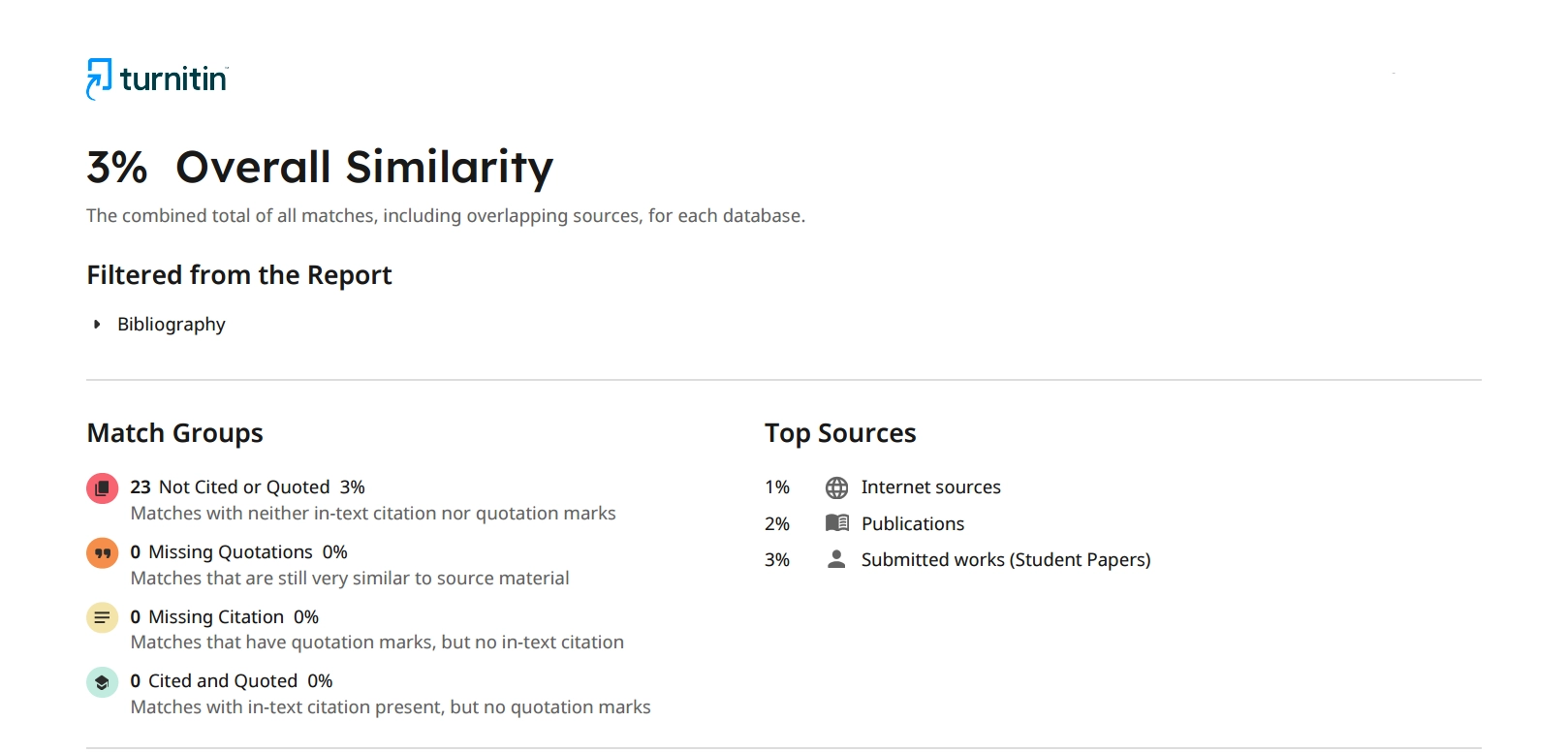
Turnitin compares your text against a massive database of academic papers, websites, books, and previously submitted student work. The resulting percentage - your Turnitin similarity score - represents how much of your text matches existing content in that database.
It measures textual overlap. Not plagiarism. Not cheating. Not intent.
A properly cited direct quote registers as a match. Your own bibliography, which shares formatting with thousands of other papers, registers as a match. Even common academic phrases like "the results suggest that" register as matches because they appear in millions of published works.
The score is a starting point for human review, not a verdict.
Our guide to the best AI humanizer for Turnitin covers Turnitin's separate AI writing detection in depth.
The score ranges: what each percentage means
0–15% (Green) - Generally acceptable
This is where most original academic writing lands. Common phrases, standard methodology descriptions, and properly formatted citations generate enough background matches to put almost any paper in this range.
We tested a 3,000-word essay written entirely from scratch - no sources, no AI, no outside material. It scored 12%. That's how much "noise" exists in standard English academic prose.
What to do: Nothing. A score in this range is exactly what reviewers expect. Move on.
15–25% (Yellow) - Review needed
A score in this range isn't automatically problematic, but it warrants a look at the detailed report. The question isn't the total number - it's the distribution.
If the 20% is spread across dozens of small 1–2% matches from different sources, that's normal. You're matching common phrases and citation formats from multiple papers. No single source dominates.
If one source accounts for 8% or more, that passage needs attention. You may have paraphrased too closely or quoted without proper attribution.
What to do: Open the full report. Check the source breakdown. If no single source exceeds 3–4%, you're fine. If one source dominates, rework that section. Our guide on how to paraphrase without triggering plagiarism checkers covers the technique.
25–50% (Orange) - Significant concern
This is where professors start paying close attention. A Turnitin percentage in this range can still be legitimate - papers with extensive quoted material, large bibliographies, or methodology sections that follow strict disciplinary conventions can land here legitimately.
But it can also indicate real problems: insufficient paraphrasing, over-reliance on a single source, or patches of text that were copied without attribution.
What to do: Go through the report match by match. Legitimate reasons for a high score include:
- Long bibliographies - a 40-source reference list can add 5–10% on its own
- Required direct quotes - legal writing and textual analysis papers quote heavily by design
- Self-matching - your own earlier submissions in the Turnitin database
- Standard methodology language - describing established procedures in a fixed disciplinary vocabulary
If those account for the score, document it for your instructor. If they don't, you need to reduce your Turnitin similarity score through genuine rewriting.
50%+ (Red) - Major issue
A score above 50% almost always requires action. Even with legitimate explanations for some matches, half your paper matching existing sources signals a structural problem.
What to do: This paper likely needs substantial revision. Identify the largest source matches, close your sources, and rewrite those sections from your own understanding. Don't just swap words - restructure your argument. A paraphrasing tool designed for academic text can help you rebuild passages while preserving technical accuracy.
The 0% myth: why a perfect score is a red flag
Here's something counterintuitive: a 0% Turnitin score is not the goal. In fact, it can raise suspicion.
Legitimate academic writing almost always matches something. Standard disciplinary phrases, citation formats, common transitions, methodology descriptions - these create a baseline of similarity that's completely normal.
A 0% score on a research paper means one of three things: the paper is extremely short, it's on a topic so niche that nothing in the database relates to it, or the text has been artificially processed to avoid any matches. That third possibility is exactly what manipulation detection looks for.
The ideal Turnitin score for most academic work sits between 5% and 15%. Anything in that range reflects natural overlap from genuine academic writing.
Need to Lower a High Turnitin Score?
Our paraphrasing tool restructures academic text while preserving meaning and citations. Reduce similarity without compromising quality.
Try the Paraphrasing ToolWhy your score is high (when you didn't plagiarize)
We see these non-plagiarism causes inflate scores constantly:
Bibliography and reference lists. Every formatted citation in your works cited matches the same citation in other papers. A 30-source bibliography can add 5–10% to your total score. Many institutions configure Turnitin to exclude these, but not all do.
Direct quotes with citations. You quoted a passage, you cited it correctly, and Turnitin flagged it anyway. Because Turnitin measures text overlap, not attribution. Properly cited quotes are legitimate - but they still increase your percentage.
Headers and institutional text. Title pages, headers, course information, and standard formatting elements match across submissions.
Common academic phrasing. "The findings of this study indicate" and "further research is needed" appear in millions of papers. You can't avoid all common phrases, and trying to makes your writing worse.
Self-plagiarism matches. If you submitted a draft or proposal through Turnitin earlier, your final paper will match against it. This is self-matching, not misconduct.
What universities actually accept
There is no universal acceptable Turnitin percentage. Every institution sets its own thresholds, and many don't publish them explicitly. But based on our review of publicly available academic integrity policies across dozens of universities, here's what we've found:
Most common threshold: 15–25%. The majority of universities we reviewed flag papers above 20–25% for manual review. Below that, reports are typically not examined unless a student has a prior integrity violation.
Some are stricter. A handful of institutions set thresholds at 10% or even 5%, particularly for graduate-level work. These are outliers, but if your program has strict requirements, find out early.
Context always matters. A 30% score on a literature review, where half the paper is summarizing existing work, is very different from a 30% score on an opinion essay. Smart reviewers account for paper type.
The source breakdown overrides the total. We've seen professors clear a 35% score because it was distributed across 25 sources at 1–2% each. We've also seen 18% scores trigger investigations because a single source accounted for 12%. What matters is whether any single source shows concentrated matching.
If your institution hasn't published its threshold, ask. It's a reasonable question, and knowing the number saves you anxiety.
How to check your score before submitting
ProofreaderPro.ai is an AI academic editing suite that proofreads, humanizes, paraphrases, summarizes, and translates research writing, with tracked-changes export to Word.
Many universities allow draft submissions through Turnitin, giving you a chance to review your report before the final deadline. If your institution offers this, use it every time.
If not, you can still prepare:
- Review your paraphrasing. Go back to every passage based on a source. Did you genuinely rewrite it, or did you just swap a few words? Close the source and rewrite from memory if you're unsure.
- Check your quote ratio. If more than 10% of your paper is direct quotation, you're likely over-quoting. Paraphrase where possible.
- Verify your bibliography format. Consistent, correct formatting helps reviewers quickly identify reference-list matches as non-issues.
Similarity score vs AI writing score: two different numbers
Turnitin produces two separate results that students regularly conflate. The similarity score measures how much of your text matches existing sources. The AI writing indicator estimates how much of your text was machine-generated. They are calculated independently, displayed separately, and a change in one does not move the other.
The distinction decides your revision plan. Quoting less and paraphrasing more deeply lowers similarity and has no effect on the AI indicator. Rewriting AI-helped passages in your own voice, or running them through an academic humanizer that preserves citations and terminology, addresses the AI indicator and has almost no effect on similarity. Our guides to lowering a similarity score and reducing an AI detection score cover the two problems separately, and our Turnitin-focused humanizer comparison explains how the AI indicator behaves in practice.
Frequently asked questions
What is a good Turnitin score for a research paper?
For most research papers, a Turnitin score between 5% and 15% is considered good. This range reflects normal textual overlap from standard academic phrases, citation formatting, and common methodology language. Scores up to 25% are typically acceptable if the matches are distributed across many sources rather than concentrated in one. Your institution may have specific thresholds, so check your academic integrity policy.
Does a high Turnitin score mean I plagiarized?
No. A high Turnitin score means your text has significant overlap with content in the database. This can result from properly cited quotes, large bibliographies, self-matching against your own prior submissions, or common disciplinary phrases. The score measures similarity, not intent or misconduct. What matters is the source breakdown and whether matching passages are properly attributed.
Can I get a 0% Turnitin score?
It's theoretically possible but extremely unusual for genuine academic writing. Standard phrases, citation formats, and disciplinary vocabulary create a baseline of matches in almost any paper. A 0% score can actually raise suspicion because it may suggest the text was artificially processed to avoid detection. Aim for the 5–15% range rather than zero.
Should I ask my professor to exclude my bibliography from the Turnitin report?
Yes - if your institution's default settings don't already exclude it. Reference lists naturally generate high similarity because every citation matches the same citation in other papers. Excluding the bibliography from the similarity calculation gives a more accurate picture of your actual writing. Most professors are happy to adjust this setting when asked.
Is a 25% Turnitin score bad?
Not by itself. At most universities 25% sits in the review band: markers open the report and look at where the overlap comes from. If the matches are references, quoted definitions, and standard methodology phrasing, a 25% paper passes without comment. If the matches form long unbroken blocks inside your own argument, revise those passages.
What Turnitin score is acceptable for a thesis?
Thesis thresholds are usually stricter than coursework thresholds, because the document is long and mostly original argument. Many graduate schools ask for similarity below 15% excluding the bibliography. Check your institution's written policy before relying on any general figure.
Does Turnitin show which sources you matched?
Yes. The similarity report lists every matched source with a color-coded overlap percentage, and markers see the same list. This is why the composition of the score matters more than the score itself: the report shows whether a match is a citation or copied prose.
Restructure academic text while preserving technical accuracy and proper citations. Built for ethically reducing Turnitin similarity scores.

Lisa holds a PhD in linguistics from NYU, and has always been curious about how computers can leverage applied linguistics to understand and communicate in human language and assist with editing human written content. She is currently the Chief Marketing Officer at ProofreaderPro, where she leads marketing across copy, social media, email, and offline channels.