The Best Free Grammarly Alternative for Academic Writing in 2026
Grammarly's free tier isn't enough for academic writing. We compare free alternatives that offer tracked changes, citation handling, and academic editing.

Your advisor just flagged twelve errors in your discussion section. You ran it through Grammarly Free last night - and it caught exactly three of them. The other nine? Style-level issues, tense inconsistencies, and a citation that Grammarly mangled into a sentence fragment.
Grammarly's free tier checks basic spelling and grammar. That's it. No style suggestions, no tone adjustments, no tracked changes, no citation awareness. For an email to your department chair, that's fine. For a journal manuscript? Not even close.
The best free Grammarly alternative for academic writing is ProofreaderPro.ai's free tier. In our test of five free tools on 20 graduate manuscripts, it was the only one that combined full grammar correction with citation-aware editing that recognizes APA, MLA, Chicago, and IEEE without breaking them. Here is the complete comparison, and where each of the other free tools still earns a place.
Why Grammarly Free falls short for academics
Grammarly Free catches misspellings and straightforward grammar mistakes. Subject-verb agreement, missing articles, basic punctuation. It does this reasonably well.
But academic writing has needs that go beyond basic grammar. You need a tool that understands citation formats. One that won't flag "(Hernandez et al., 2025)" as an incomplete sentence. One that preserves your technical terminology instead of suggesting simpler synonyms.
Grammarly Free doesn't offer style-level editing. It won't tell you that your methods section shifts between past and present tense. It won't suggest restructuring a 47-word sentence that buries your main finding in a subordinate clause.
And the biggest gap - no tracked changes. You can't export a .docx showing your advisor exactly what changed. In academic workflows, that's a dealbreaker.
The free tier comparison
| Feature | ProofreaderPro.ai Free | Grammarly Free |
|---|---|---|
| Word limit | 250 words/month free, 25,000+ on paid plans | Unlimited basic checks |
| Grammar correction | Full AI-powered grammar fixes | Basic grammar and spelling |
| Style suggestions | Included | Premium only |
| Citation preservation | APA, MLA, Chicago, IEEE | Not available on any tier reliably |
| Tracked changes export | Paid plans (.docx) | Not available |
| AI humanization | Demo on free; full on paid | Not available |
| Paraphrasing | Included | Premium only |
| Languages | 50+ | English only |
| Built for | Academic researchers | General professionals |
| Editing depths | Light / Standard / Comprehensive | Single level |
| Summarization | Included | Not available |
| Browser extension | No | Yes (works across web) |
| Real-time inline editing | No (paste and review) | Yes |
| Academic tone calibration | Yes | No (general readability) |
| Account required | Yes | Yes |
| Upgrade price | $19-$29/mo | $12-$30/mo |
The numbers tell a clear story. Grammarly Free gives you unlimited access to a narrow feature set. ProofreaderPro.ai Free gives you limited words but access to every feature - including ones Grammarly reserves for paying customers.
What we tested and how
We took 20 manuscripts from graduate students across four disciplines: molecular biology, political science, computer science, and education research. Each paper was between 4,000 and 8,000 words.
We ran each manuscript through Grammarly Free, ProofreaderPro.ai Free, LanguageTool Free, Hemingway Editor (free web version), and QuillBot's free grammar checker. Two experienced academic editors then scored each tool's output on five criteria: grammar accuracy, citation handling, academic tone preservation, actionable suggestions, and export quality.
Every tool caught basic errors. The differences emerged in everything beyond spelling and punctuation.
Grammarly Free: the straight assessment
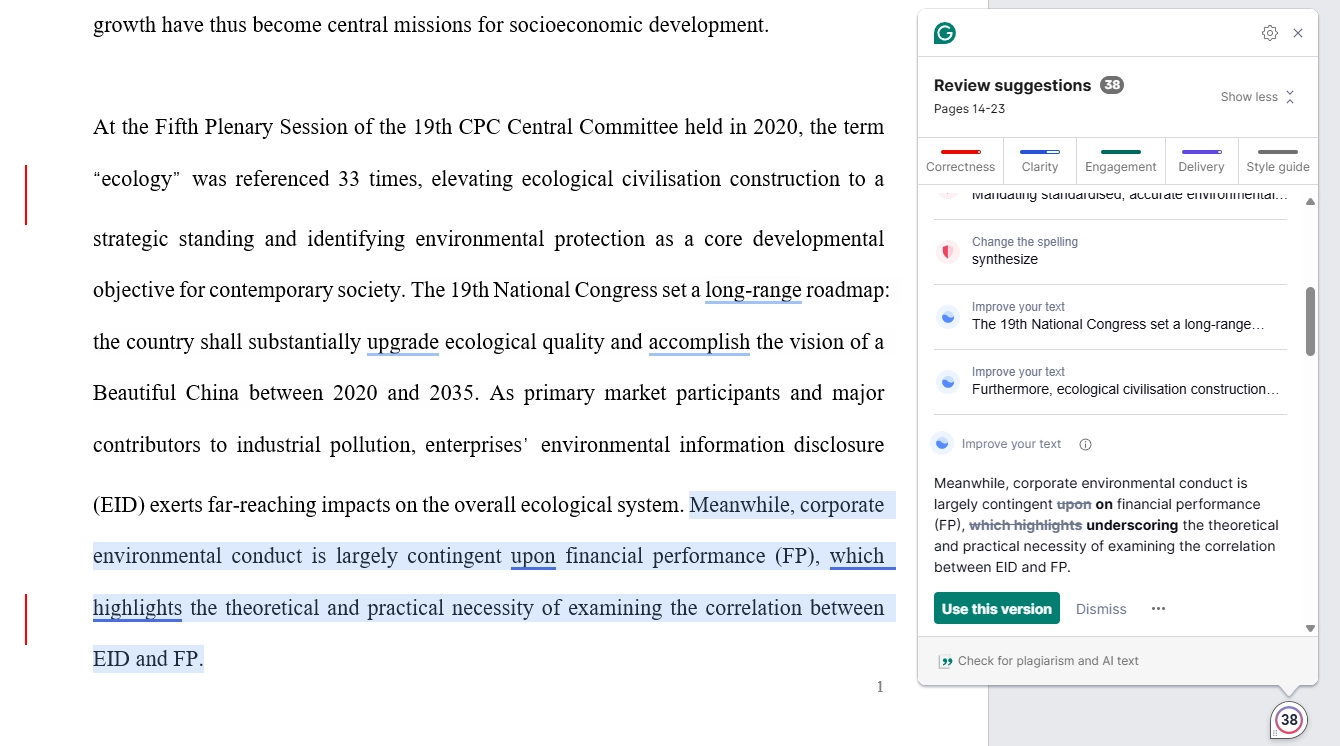
Grammarly Free caught 62% of grammar errors in our test set. That's decent - better than LanguageTool Free (54%) and QuillBot Free (48%). But it also generated false positives on citations in 28% of passages and offered zero style-level feedback.
The real frustration is what Grammarly shows but won't fix. The free tier underlines "advanced" suggestions in the sidebar, then asks you to upgrade to see them. You know there are issues. You just can't access the corrections without paying $12-$30/month.
For students on a stipend, that paywall stings. Especially when the features behind it - tone detection, sentence rewrites, style suggestions - are exactly what academic writing demands.
ProofreaderPro.ai Free: what you actually get
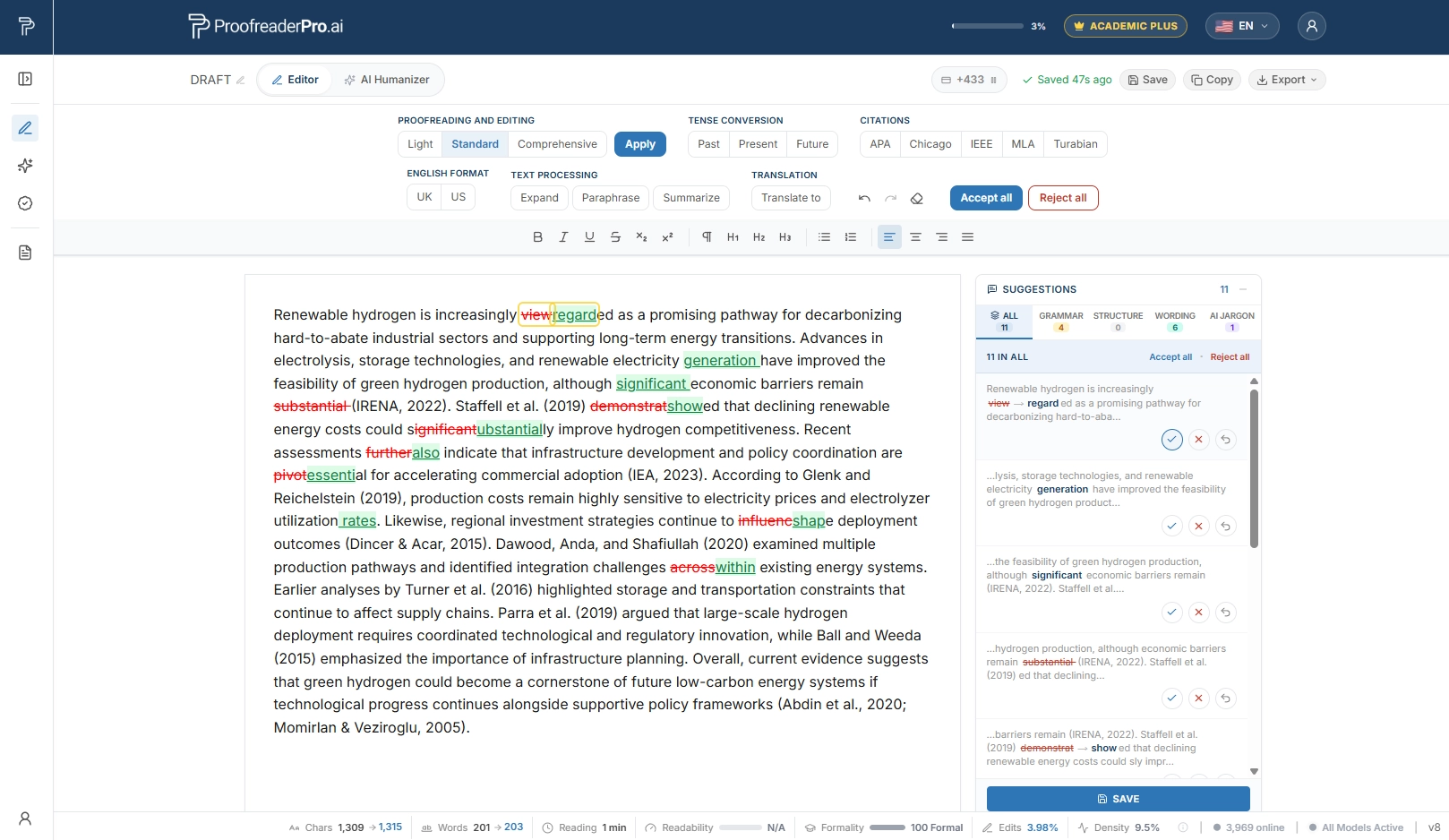
ProofreaderPro.ai's free tier caps you at 250 words a month, enough to test the editor on a real passage. The Academic plan at $19 a month raises that to 25,000 words.
That means full grammar correction - not just basic checks. Style-level suggestions that flag passive voice overuse, tense inconsistencies, and overly complex sentence structures. Citation-aware editing that recognizes APA, MLA, Chicago, and IEEE formats without breaking them.
The paid plans add tracked changes export. Upload your paper, get back a .docx with every edit visible. Your advisor can review changes in Word exactly the way they're used to working.
The AI proofreader also includes a humanization demo on the free tier, with full text humanization on the paid plans. If you used AI to help draft sections - something increasingly common and often perfectly acceptable - you can ensure the text reads naturally before submission.
The other free alternatives worth knowing
LanguageTool Free offers 10,000 characters per check (roughly 1,500 words). It catches grammar basics and some style issues. The browser extension works well. But it lacks citation awareness, tracked changes, and academic-specific features. It's a solid general tool - not an academic one.
Hemingway Editor is free on the web and highlights readability problems with color coding. Sentences that are hard to read get marked in yellow or red. But Hemingway doesn't correct anything. It shows problems without offering fixes. For identifying issues, it's useful. For actually editing your paper, you still need another tool.
QuillBot Free gives you a grammar checker alongside its paraphrasing tool, but the free paraphraser limits you to 125 words per check. The grammar corrections are basic - comparable to Grammarly Free minus the polish.
The gaps that persist even on Grammarly Premium
Upgrading to Grammarly Premium unlocks the style suggestions and sentence rewrites, and the academic-fit problems stay. Premium still treats "(Smith et al., 2024)" as a sentence fragment, still offers no tracked changes export on any tier, and still calibrates clarity suggestions for business readability, so it flags perfectly appropriate academic sentences as "hard to read." It also offers a single level of intervention: there is no way to ask for a light proofread on a near-final draft or a comprehensive restructure on a rough one.
Full Academic Editing - Free to Start
Tracked changes, citation preservation, AI humanization, and style editing. Free to try, with plans from $19 a month.
Try ProofreaderPro.ai FreeThe workflow difference: inline versus tracked review
Grammarly works inline as you type. It underlines errors in Gmail, Google Docs, Word Online, and dozens of other platforms. That real-time correction is convenient for daily communication. You see the suggestion, click to accept, and keep writing.
ProofreaderPro.ai works differently. You paste a section of your manuscript, select your editing depth, and receive a complete set of tracked changes to review. This deliberate, batch-oriented workflow suits academic editing because it encourages careful review of every suggestion rather than quick acceptance. For research papers, the review step matters: you do not want to auto-accept a suggestion that changes the meaning of a technical claim or repositions a citation.
Beyond grammar: the full academic toolkit
The biggest difference between Grammarly and a research-focused alternative is everything beyond basic grammar. Both tools catch comma errors reliably.
Academic paraphrasing. When you need to rephrase a passage from a source while preserving the citation and technical meaning, you need a paraphrasing tool that understands academic text. Grammarly does not offer paraphrasing.
Text humanization. If you used AI to help draft sections of your paper, those passages may need adjustment to read naturally and avoid AI detection patterns. ProofreaderPro.ai's text humanizer handles this while maintaining scholarly tone. Grammarly has no equivalent feature.
Translation. Researchers working across languages need to move text between their native language and English for publication. ProofreaderPro.ai includes translation across 50+ languages in the same platform as editing.
Summarization. Condensing a 25-page source paper for your literature review, or generating an abstract from your full manuscript, is native to the platform.
The features that matter most for academic writing
Not all grammar checkers are equal for research papers. Here's what separates a genuine academic tool from a general-purpose grammar checker with an "academic" label.
Tracked changes are essential. Academic writing is collaborative. Your advisor, co-authors, and reviewers all need to see what changed. A tool that gives you corrected text without showing the edits doesn't fit academic workflows. ProofreaderPro.ai is the only tool we tested that exports tracked changes.
Citation handling can't be an afterthought. We've seen Grammarly suggest rewriting a sentence in a way that detaches a claim from its citation - creating what amounts to an unsupported assertion. A free academic grammar checker needs to treat citations as fixed anchors, not movable text.
Style editing matters as much as grammar. Your paper might have zero grammar errors and still read poorly. Meandering sentences, inconsistent tense, excessive nominalization - these are the issues that make reviewers write "needs significant revision." Basic grammar tools don't catch them.
Language support is critical for international researchers. English-only tools exclude the majority of the global research community. A tool that supports paraphrasing and editing in 50+ languages serves researchers who need help writing in English as a second language.
When Grammarly Free is still the right choice
We're being straight here. Grammarly Free wins in one specific scenario: you want grammar checking everywhere you type on the web, all the time, with zero friction.
The browser extension catches typos in Gmail, Slack, Google Docs, and dozens of other platforms. If your main need is avoiding embarrassing errors in everyday communication - and you don't need academic-grade editing - Grammarly Free does that better than anything else.
It's also useful as a first-pass sanity check. Run your draft through Grammarly Free to catch obvious errors, then use a dedicated academic tool for the deep edit. The two aren't mutually exclusive.
For a detailed head-to-head with Grammarly's paid tier, see our full ProofreaderPro.ai vs Grammarly comparison.
Our recommendation
If you're a student or researcher looking for a free Grammarly alternative that actually handles academic writing, ProofreaderPro.ai's free tier is the strongest option available. For graded academic work, a purpose-built academic editor beats unlimited access to a feature-locked basic checker.
Pair it with Grammarly's free browser extension for everyday emails and casual writing. Use ProofreaderPro.ai's AI proofreader when you're editing manuscripts, theses, and conference papers. That combination gives you better coverage than either paid tier alone - and it costs nothing.
If you want the full picture beyond grammar checking, our tested ranking of the best AI proofreading tools covers the paid options as well.
Further reading
- ProofreaderPro.ai vs Grammarly: In-Depth Comparison
- ProofreaderPro.ai vs Wordtune for Research Papers
- ProofreaderPro.ai vs QuillBot for Researchers
Frequently asked questions
Q: Is ProofreaderPro.ai really free, or is it a limited trial?
The free tier is permanent rather than a trial: 250 words a month in the editor, with no time limit and no credit card required. Paid plans are $19 a month for Academic and $29 a month for Academic Plus.
Q: Can I use Grammarly Free and ProofreaderPro.ai together?
Absolutely. Many of our users do exactly this. They keep Grammarly's browser extension active for emails, messages, and quick writing tasks. When they're ready to edit a research paper or thesis chapter, they switch to ProofreaderPro.ai for the deep academic edit with tracked changes. The two tools complement each other well.
Q: Why doesn't Grammarly Free include tracked changes?
Tracked changes export isn't available on any Grammarly tier - free or paid. Grammarly's design philosophy is real-time inline correction rather than document-level editing with change tracking. For academic workflows where advisors and co-authors need to review edits, this is a significant limitation.
Q: What's the best free grammar checker for non-native English speakers?
ProofreaderPro.ai supports 50+ languages and is specifically tuned for common ESL error patterns in academic writing. Grammarly works in English only. LanguageTool supports multiple languages but lacks academic-specific features. For non-native speakers writing research papers in English, ProofreaderPro.ai's combination of multilingual support and academic focus makes it the strongest free option.
Q: Why doesn't Grammarly work well for research papers?
Grammarly was designed for general professional writing. It lacks citation awareness (treating references as errors), tracked changes export (needed for academic collaboration), and academic register calibration (it suggests oversimplifying complex but appropriate sentences). These gaps apply on every tier, free and Premium alike.
Q: Does ProofreaderPro.ai have a browser extension like Grammarly?
No. ProofreaderPro.ai uses a paste-and-review workflow rather than inline corrections. For academic editing this deliberate review model is an advantage, because it prevents auto-accepting changes that might alter technical meaning. The trade-off is that it does not correct your emails as you type.
Q: What about Grammarly's AI writing features?
Grammarly has added generative AI features for drafting and rewriting. These are calibrated for business communication rather than academic writing: they do not preserve citations, maintain academic register, or produce text suited to journal submission. ProofreaderPro.ai's paraphrasing and editing tools are specifically tuned for scholarly text.
Academic editing with tracked changes, citation preservation, and style suggestions. Free to try.

Dana is a content creator at ProofreaderPro, where she runs the daily blog and writing operations. She writes the articles on how the online editing platform works, and she handles customer messages every day, with a five-star satisfaction score to show for it.