How to Write a Thesis Statement: Formula and 12 Examples
How to write a thesis statement: a formula for each essay type, 12 examples, the four tests a strong thesis passes and where it goes in a research paper.

To write a thesis statement, turn your topic into one specific claim a reasonable reader could disagree with, and add the main reason you'll use to support it. Place it at the end of your introduction. A strong thesis statement is usually one sentence, sometimes two, and every section of the paper should help prove it.
Most weak thesis statements fail in one of a few predictable ways. They announce the topic, state a fact nobody disputes or make a claim too big for the word count. The formulas, tests and 12 examples here help you avoid all of them.
What is a thesis statement?
A thesis statement is the sentence that states the main claim of your essay or paper. It tells the reader what you'll argue, explain or analyze, and it sets the limits of what the paper covers. Everything after the introduction exists to support it.
The thesis statement is different from the topic. "Remote work" is a topic. "Remote work changes who gets promoted more than how much work gets done" is a thesis, because it makes a claim you now have to support with evidence.
The word "thesis" also names the long document you write for a master's degree or PhD. That document has a thesis statement too: the central argument, stated in the introduction chapter and defended across every chapter after it.
What makes a thesis statement strong
A strong thesis statement passes four tests. Run your draft through each one before you build the rest of the paper on it.
| Test | What to check | Fails | Passes |
|---|---|---|---|
| Specific | It names your claim as well as the topic | "This essay is about school uniforms." | "School uniforms reduce visible income differences between students more than they improve behavior." |
| Arguable | A reasonable reader could disagree with it | "Coral reefs are under threat." | "Reef restoration funding does more good spent on reducing local pollution than on planting coral." |
| Supportable | Your evidence can defend it | "Video games cause violence in every country." | "In the three studies I analyze, short-term aggression after gaming fades within an hour." |
| Scoped | It fits the length of the paper | "Technology has changed education." | "Lecture recordings help commuting students more than they help students who live on campus." |
The arguable test applies to argumentative and analytical writing. An expository essay explains a topic without arguing for a side. Its thesis can be a statement of fact, as long as it's specific and previews what the essay covers.
Thesis statement formulas you can adapt
A formula gives you a first version to improve. Fill in the brackets with your own topic and reasons, then rewrite the sentence until it sounds like you.
| Essay type | Formula |
|---|---|
| Argumentative | [Specific claim] because [main reason] and [second reason]. |
| Argumentative with a concession | Although [opposing view], [specific claim] because [main reason]. |
| Analytical | In [text, case or data], [author or actor] [does something] to [effect], which shows [insight]. |
| Expository | [Topic] [happens or works] through [first aspect] and [second aspect]. |
| Compare and contrast | Both [A] and [B] [shared feature], but [A] [key difference], which [consequence]. |
| Cause and effect | [Cause] leads to [effect] by [mechanism]. |
| Research paper | This paper argues that [claim], based on [evidence or method]. |
The concession formula is worth learning early. Naming the strongest opposing view in the thesis shows the reader you've considered it, and it gives your paper a natural section for the counterargument.
12 thesis statement examples by essay type
Each example makes one clear claim and hints at how the paper will support it. Use them to see the shape of a strong thesis, then write your own about your topic and evidence.
| # | Type | Thesis statement |
|---|---|---|
| 1 | Argumentative | Social media apps should switch off autoplay by default for users under 16, because autoplay is the feature most closely tied to late-night use. |
| 2 | Argumentative | Cities should replace minimum parking rules near rail stations with parking caps, because the rules raise housing costs where transit already exists. |
| 3 | Argumentative, with a concession | Although a final thesis shows a student's finished argument, universities should also assess research students on their drafts, because drafts show the thinking a polished document hides. |
| 4 | Analytical (literature) | In Frankenstein, Mary Shelley uses the creature's self-education to suggest that rejection, more than his nature, turns him violent. |
| 5 | Analytical (history) | Wartime censorship explains why the 1918 influenza pandemic received so little press coverage in the countries fighting the First World War. |
| 6 | Analytical (art history) | Van Gogh's letters show that he planned his color choices more carefully than the popular image of an impulsive painter suggests. |
| 7 | Expository | Coral bleaching happens when heat stress makes corals expel the algae that feed them, and repeated events leave reefs too little time to recover. |
| 8 | Expository | Peer review at most journals has three stages: screening by an editor, assessment by expert reviewers and a decision that may ask for revisions. |
| 9 | Compare and contrast | Online and in-person seminars can cover the same material, but in-person seminars produce more discussion between students, where much of a seminar's learning happens. |
| 10 | Cause and effect | Rising rents near new rail stations push lower-income renters away from the neighborhoods the lines were built to serve. |
| 11 | Research paper (empirical) | This study argues that short daily writing sessions predict thesis completion better than long weekly sessions, based on a survey of 300 doctoral students. |
| 12 | Research paper (humanities) | Letters from Irish emigrants in the 1840s show that families used money sent home to pay for further departures, which turned single journeys into chains of migration. |
Example 11 describes an invented study, to show the shape of an empirical thesis. In a real paper, the method and sample in the thesis would be your own.
How to write a thesis statement in five steps
- Start from the assignment question. Rewrite the prompt as a question your paper will answer, such as "Do lecture recordings help commuting students?" The thesis is your answer to that question.
- Write a working answer in one sentence. Don't polish it yet. A rough claim gives you something to test and improve.
- Add the main reason. Put "because" after your claim and finish the sentence. If you can't, you don't have enough evidence yet, and the thesis needs to change.
- Narrow the scope. Limit the claim by place, time, group or source so it fits your word count. "Students" can become "first-year commuting students at large urban universities."
- Test it and revise it. Run the four tests, then check that each planned section of the paper supports the claim. Our guide on how to outline a research paper shows how to map sections to a thesis before you draft.
A worked example: from topic to thesis
Say your assignment asks whether universities should record their lectures. The topic is lecture recordings, and the question your essay answers is whether recordings help students learn.
A first working answer might be "Lecture recordings help students." It's a claim, but it's too broad to test. Some students might benefit and others might not, and the sentence doesn't say which or why.
Adding a reason gives "Lecture recordings help students because they can review difficult material." That's better, and it's still generic. Almost any study aid would fit the same sentence.
Narrowing the scope gives "Lecture recordings help commuting students more than students who live on campus, because commuters miss more live sessions." Now the claim names a group, a comparison and a reason, and a reader could reasonably disagree. Someone might argue that recordings reduce attendance for everyone, which gives the essay its counterargument.
Say your reading then shows that students with part-time jobs use recordings even more than commuters. The thesis should follow the evidence: "Lecture recordings help students who commute or work more than other students, because these groups miss more live sessions and use recordings to catch up." The topic stayed the same through every version. What changed is how precisely the claim matches what you can show.
See your position framed four ways
Describe your topic, your stance and your evidence, and get four specific, arguable thesis statements to choose from and rewrite in your own words.
Try the thesis statement generatorWhere does the thesis statement go?
The thesis statement usually goes at the end of the introduction. In a short essay, that's the last sentence or two of the first paragraph. In a longer paper, it comes at the end of the introduction section, often followed by a sentence that previews how the paper is organized.
The conclusion comes back to the thesis. It restates the claim in light of the evidence you've presented, without copying the original sentence. Our guide to writing the conclusion of a research paper covers how to do that without repeating yourself.
How long should a thesis statement be?
A thesis statement is usually one sentence, and a complex argument can take two. If yours runs to three sentences or more, it's probably trying to summarize the whole paper. Keep the claim and the main reason, and move the detail into the body.
A dissertation or long research paper may state its central argument across a short paragraph in the introduction. Even then, there's usually one sentence that states the claim, and supervisors often ask you to give the argument in that one sentence.
Thesis statements for short essays, long papers and dissertations
The length of the assignment changes how narrow the thesis has to be. A 600-word essay can defend one focused claim with one main reason, such as a single text, case or dataset. A 3,000-word research paper can carry a claim with two or three reasons, plus a section that answers the strongest objection.
A dissertation needs a claim broad enough to hold several chapters together and precise enough that each chapter can test part of it. Supervisors often ask for the central argument in a single sentence early on, then help you narrow it as the chapters take shape. If a chapter doesn't help prove that sentence, either the chapter or the sentence needs to change.
Thesis statements in research papers and dissertations
In the humanities and many social sciences, a research paper has a thesis statement much like an essay's. It states the argument the paper makes about its sources, data or texts.
In empirical science papers, the aim statement at the end of the introduction does the same job. It names the gap in the research and says what the study shows, often in a form such as "Here we show that..." or "This study tests whether...". Our guide on writing a research paper introduction covers how to build up to that aim from the gap.
A thesis statement, a research question and a hypothesis are related, and they do different jobs.
| Thesis statement | Research question | Hypothesis | |
|---|---|---|---|
| What it is | Your answer or main claim | The question your study sets out to answer | A testable prediction about variables |
| Where it appears | End of the introduction | End of the introduction | After the research question, before the methods |
| Example | "Lecture recordings help commuting students more than resident students." | "Do lecture recordings affect grades differently for commuting and resident students?" | "Commuting students who use recordings will score higher than those who don't." |
| Tool | Thesis statement generator | Research question generator | Hypothesis generator |
For a master's or PhD thesis, the central argument usually develops during the project. Our guide to writing a master's thesis covers how the argument grows from the proposal to the final draft.
Common thesis statement mistakes and how to fix them
| Mistake | Weak version | Stronger version |
|---|---|---|
| Announcing the topic | "This paper will discuss homework." | "Homework in primary school builds study habits only when it takes under 30 minutes a night." |
| Stating a fact | "Many students work part-time jobs." | "Part-time work of more than 15 hours a week lowers first-year grades more than any other factor in the survey." |
| Listing without a claim | "This essay covers the causes, effects and solutions of food waste." | "Most household food waste comes from buying too much, so smaller pack sizes would cut waste more than education campaigns." |
| Asking a question | "Should cities ban cars from their centers?" | "Cities should ban private cars from their historic centers, because pedestrian zones raise footfall for local shops." |
| Giving an opinion without a reason | "Standardized tests are unfair." | "Standardized tests disadvantage students who can't afford test preparation, so universities should weigh them less in admissions." |
| Making two claims | "Social media harms teenagers and schools should teach coding." | Pick one claim, and save the other for a different paper. |
The stronger versions are examples of the shape, and each one still needs evidence in the paper. If your evidence doesn't support the number or the comparison in your thesis, change the thesis.
Revising a working thesis as you draft
Treat your first thesis statement as a working thesis. Most writers find their real argument while drafting, often in the second half of the paper, and the thesis should change to match.
When the draft is done, read your conclusion and then your thesis. If they describe different papers, rewrite the thesis to match what you argued. Then check that the first sentence of each body section supports the revised claim. If a section doesn't support it, cut the section or adjust the thesis again.
A careful claim often needs a hedge, such as "suggests" or "in most cases". Our academic writing style tips show how to hedge a thesis without making it vague.
Using a thesis statement generator
A generator helps most when you have a topic and a rough position but can't find the sentence. Check your course's AI policy before you use one, and treat any option it gives you as a draft to rewrite.
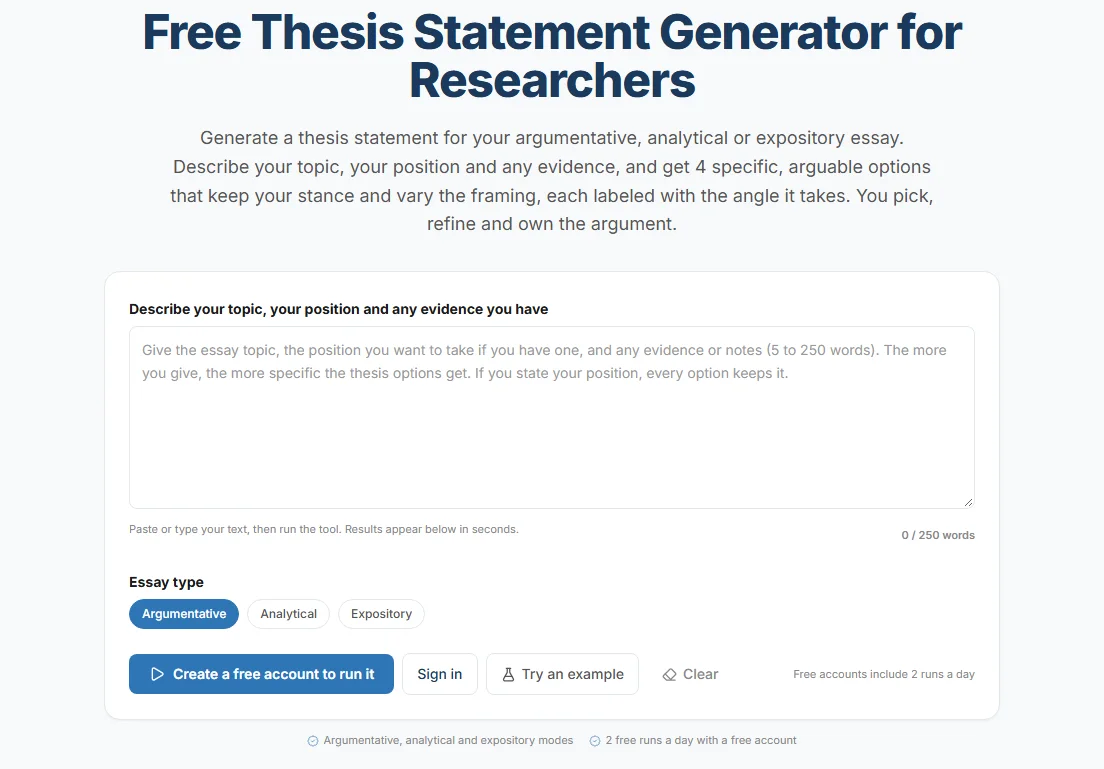
With the ProofreaderPro.ai thesis statement generator, you first choose argumentative, analytical or expository. Then you describe your topic, your position and your evidence in up to 250 words. You get four thesis options, each labeled with the angle it takes, such as a focus on cause or on comparison. Every option keeps the position you stated, so the argument stays yours. A free account gives you 2 runs a day.
Frequently asked questions
Q: Can a thesis statement be a question?
No. A question tells the reader what you'll explore, and the thesis statement has to give your answer. Turn the question into a claim: "Should homework be banned?" becomes "Primary schools should replace nightly homework with in-class practice, because..."
Q: Can a thesis statement be two sentences?
Yes. A complex argument sometimes needs two sentences, one for the claim and one for the main reason or the scope. If you need more than two, the thesis is probably summarizing the paper instead of stating its claim.
Q: Does a thesis statement need three points?
No. The three-point thesis is one common pattern for five-paragraph essays, and it can box you into three equal sections. A single claim with one strong reason often makes a better thesis for a research paper.
Q: Can I use "I" in a thesis statement?
Often yes. Many fields accept "I argue that..." in a thesis, and APA 7 accepts the first person. Some instructors prefer the third person, so check your brief. In most cases the claim is clear without "I argue", and the sentence is shorter.
Q: What is the difference between a thesis and a thesis statement?
The thesis is your main argument, and the thesis statement is the sentence that states it. The word "thesis" also names the long document written for a master's degree or PhD, which has its own central argument.
Q: Where does the thesis statement go in a research paper?
At the end of the introduction. In empirical papers, the aim statement in that position does the same job, saying what the study shows or tests.
Q: What is a working thesis?
A working thesis is the first version of your claim, written before or early in the draft. It guides your research and outline, and you revise it once the draft shows what you can argue.
Q: How do I know if my thesis statement is arguable?
Ask whether a reasonable reader, looking at the same evidence, could disagree. If nobody could disagree, the sentence is a fact. If the disagreement depends only on personal taste, it's an opinion that needs reasons.
Q: Can my thesis statement change after I start writing?
Yes, and it often should. Revise it whenever your evidence or argument changes, then check that the introduction, body sections and conclusion all match the new version.
Describe your topic and constraints and get six focused research questions across descriptive, comparative, causal and exploratory types, ready to shape into a thesis.

Lisa holds a PhD in linguistics from NYU, and has always been curious about how computers can leverage applied linguistics to understand and communicate in human language and assist with editing human written content. She is currently the Chief Marketing Officer at ProofreaderPro, where she leads marketing across copy, social media, email, and offline channels.