How to Outline a Research Paper: Templates and Examples
How to outline a research paper: IMRaD, argumentative and literature review templates, outline formats, a worked example and a word budget per section.


To outline a research paper, write your research question or thesis at the top and list the sections the paper needs. Then fill each section with its points and evidence, one level at a time. For an empirical paper the sections are usually introduction, methods, results and discussion, and for an argumentative paper they follow the claims you'll make.
An outline takes an hour or two, and it can save days of rewriting. Moving a line in an outline is quick, while moving a section in a finished draft means rewriting the transitions around it. An outline also gives your supervisor something short to comment on before you've written 5,000 words in the wrong order.
What a research paper outline is
A research paper outline is a plan of the paper's sections and points, in the order they'll appear. The top level lists the main sections. The next levels hold the points inside each section and the evidence for each point, such as a source, a dataset or a figure.
A good outline shows what each section has to say and where each source and result will be used. It also shows whether the sections are balanced against your word limit. If a section in the outline has no evidence under it, you've found a gap while it's still cheap to fill.
Outline formats: topic, sentence, alphanumeric and decimal
Outlines differ in two ways: what each line contains and how the levels are numbered.
| Format | What each line looks like | Best for |
|---|---|---|
| Topic outline | A short phrase, such as "Gap in heat studies" | Early planning and quick reordering |
| Sentence outline | A full sentence that states the point | Papers where each paragraph's claim matters, and outlines your instructor will grade |
| Alphanumeric | Levels labeled I., A., 1., a. | Essays, humanities papers and most course assignments |
| Decimal | Levels labeled 1, 1.1, 1.1.1 | Science and engineering papers, theses and reports with numbered headings |
You can combine them. Many researchers write a topic outline first, then turn the lines for the hardest sections into sentences before drafting. If your instructor gives you a template, use it, since a graded outline is marked partly on format.
The APA Publication Manual doesn't set a format for outlines, so follow your instructor's template when there is one. APA's heading levels are still a useful model for naming the sections.
Research paper outline template (IMRaD)
Most empirical papers in the sciences and social sciences follow the IMRaD structure: introduction, methods, results and discussion. This template shows the usual points under each section in alphanumeric form.
| Level | Section or point | What to plan for it |
|---|---|---|
| I. | Introduction | |
| A. | Background | What's already known, with the three to five sources the paper builds on |
| B. | Gap | What earlier studies haven't answered |
| C. | Aim | Your research question, hypothesis or thesis |
| II. | Methods | |
| A. | Design and setting | The type of study, where and when it took place |
| B. | Participants or materials | Who or what you studied, and how you selected them |
| C. | Procedure and measures | What you did and how you measured each outcome |
| D. | Analysis | The tests or methods you used on the data |
| III. | Results | |
| A. | Main finding | The result that answers your research question, with its table or figure |
| B. | Secondary findings | Other results in order of importance |
| IV. | Discussion | |
| A. | Answer to the question | What the main finding means |
| B. | Comparison with earlier work | Where your results agree or disagree with the background sources |
| C. | Limitations | What the design can't show |
| D. | Implications | What should change, and what research should come next |
| V. | Conclusion | Only if your journal or brief asks for one |
The introduction and the discussion mirror each other. The gap you name in I.B is the question the discussion answers in IV.A, and the sources in I.A come back in IV.B. Planning both together keeps the paper consistent from the first page to the last.
For the detail inside each section, see our guides to research paper introductions, results sections and discussion sections.
Outline template for an argumentative research paper
Papers in the humanities and many social sciences are organized around an argument. The outline follows your claims, and each claim has its own evidence.
| Level | Section or point | What to plan for it |
|---|---|---|
| I. | Introduction | Context for the topic, then your thesis statement |
| II. | Background | The terms, history or debate the reader needs first |
| III. | First claim | The strongest point that supports the thesis, with its evidence |
| IV. | Second claim | The next point, building on the first |
| V. | Third claim | Optional, depending on length |
| VI. | Counterargument | The strongest opposing view, stated fairly, and your response |
| VII. | Conclusion | The thesis restated in light of the evidence, and why it matters |
Order the claims so they build on each other. Some writers put the strongest claim first to persuade the reader early, and others save it for last. Either works, as long as each claim depends only on points that came before it.
The thesis statement at the top controls everything below it. If you're still working on yours, our guide on how to write a thesis statement has formulas and examples for each essay type.
Outline template for a literature review
A literature review needs an organizing pattern before it needs an outline. Pick the pattern first, then outline within it.
| Pattern | How sections are grouped | When to use it |
|---|---|---|
| Thematic | By topic or debate, such as "measurement problems" and "effects on retention" | Most reviews, since it lets you compare sources directly |
| Methodological | By how studies were done, such as surveys, trials and interviews | Fields where method changes the findings |
| Chronological | By period, such as before and after a policy change | Fields that changed in clear stages |
Inside each section, plan the claim the section makes, the sources that support it, the sources that disagree and the gap that leads to your own study. Our guide on how to write a literature review explains how to move from notes on single sources to a synthesis built on themes.
How to outline a research paper in six steps
- Write the question or thesis at the top. Every line below it should help answer the question or support the thesis, and anything that doesn't belongs in a different paper.
- Gather your notes in one place. Collect your source notes, results and ideas as separate short items, one point per item, so you can move them around.
- Group the notes into sections. Use the IMRaD headings for an empirical paper, or one section per claim for an argumentative paper.
- Put the sections and points in order. Ask what the reader needs to know first, then build from there.
- Add the evidence under each point. Write the source, the table or the figure next to each point. A point with nothing under it needs more research, or it needs to go.
- Check the balance against your word limit. Give each section a word budget and compare it with the amount of material you have.
Then share the outline with your supervisor or instructor. Comments on a two-page outline are faster to give and much faster to act on than comments on a full draft.
Turn your assignment prompt into an outline
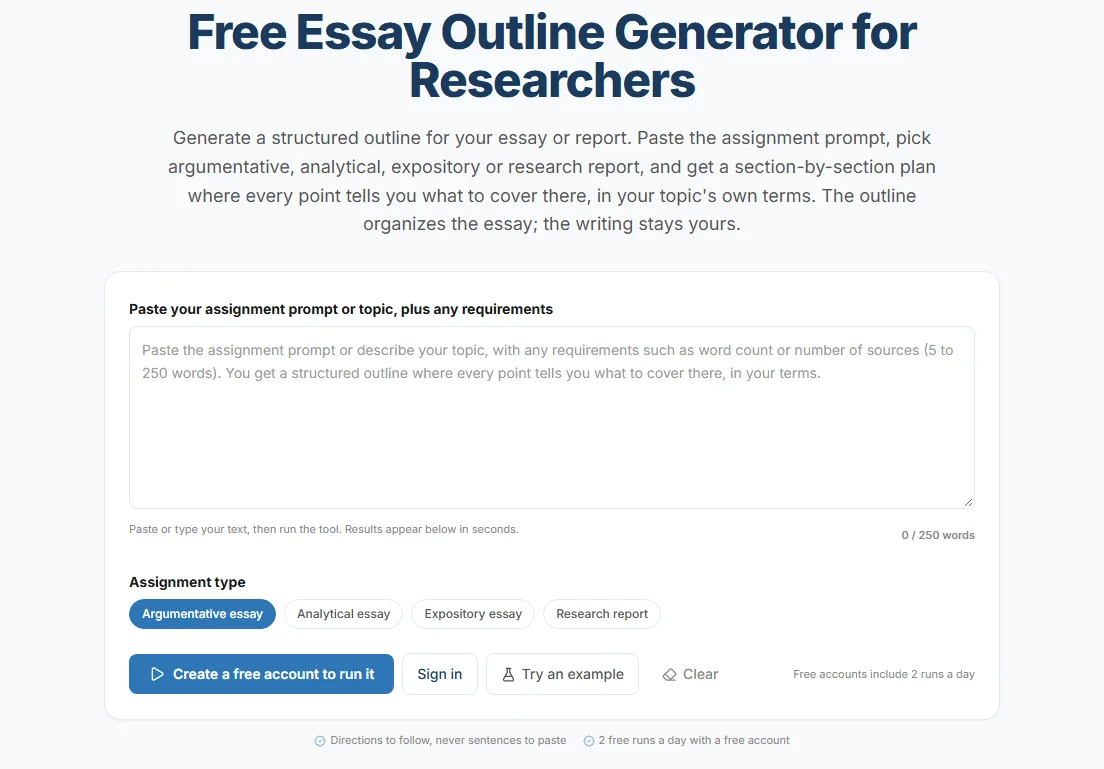
Paste the prompt and the word count, choose the paper type, and get a structured outline in I. A. 1. notation, with directions for what each section should cover.
Try the essay outline generatorSharing your outline with a supervisor
An outline gets the most useful feedback when it shows your thinking as well as your headings. Put the research question or thesis at the top, then the sections with their main points and key sources. Add the word budget for each section, so your supervisor can see where the paper will spend its space.
List your open questions at the end, such as whether a source belongs in the background or the discussion. Specific questions get specific answers, and they show your supervisor exactly where you're unsure. Send the outline before you start drafting, and leave enough time to make the changes before your writing schedule begins.
A worked example: from notes to outline
Say your paper asks whether tree cover lowers summer temperatures in one city's neighborhoods. This example uses an invented study. Your notes might start as a loose list:
- Satellite temperature data for 40 neighborhoods
- Tree cover maps from the city council
- Earlier studies found cooling effects in other cities
- Income may explain both tree cover and temperature
- Hottest neighborhoods have the least shade
- Policy: city plans to plant 10,000 trees
Grouped and ordered, the same notes become an outline:
| Level | Point | Evidence |
|---|---|---|
| I. | Introduction | |
| A. | Urban heat is rising, and trees are one proposed fix | Earlier studies from other cities |
| B. | Gap: no neighborhood-level study for this city | Search of local studies |
| C. | Research question: whether tree cover predicts lower summer temperatures here | |
| II. | Methods | |
| A. | Data | Satellite temperatures for 40 neighborhoods and council tree maps |
| B. | Analysis | Regression of temperature on tree cover, controlling for income |
| III. | Results | |
| A. | Main finding on tree cover and temperature | Table 1 and Figure 1 |
| B. | The hottest areas have the least shade | Figure 2 |
| IV. | Discussion | |
| A. | What the finding means for the planting plan | City council planting plan |
| B. | Comparison with other cities | Earlier studies |
| C. | Limitation: one summer of data |
Two notes changed jobs during outlining. "Income may explain both" became a control in the analysis, and the planting plan moved from the background to the discussion, where it shows why the results matter.
Turning your outline into a first draft
Write from the outline one section at a time, and in any order that suits you. Many researchers draft the methods first, since that section records what they did and needs the least argument. The introduction often comes last, because its gap and aim have to match the results you end up reporting.
Turn each line of the outline into the topic sentence of a paragraph, then write the evidence underneath it. Keep the outline open next to the draft and mark each point as you cover it, so you can see what's left at any time.
When a paragraph needs a point that isn't in the outline, add the point to the outline before you write it. The structure then stays visible, and you'll notice quickly if a new point belongs in a different section. If one section starts to grow far past its word budget, stop and check the outline. The section may hold two topics that work better apart.
How detailed should your outline be?
Make it detailed enough that each point names its evidence, and loose enough that you can still change it as you write. Two or three levels suit most course papers. A thesis chapter often needs a fourth level for the paragraphs inside each subsection.
A useful rule of thumb from our essay outline generator is one body section for every 300 to 500 words of the assignment. A 2,000-word paper then has four to six body sections, and a 600-word essay has one or two.
A word budget for each section
A word budget turns the outline into a writing plan. These shares are a starting point for a 5,000-word empirical paper, and your field's journals may balance the sections differently.
| Section | Share | Words in a 5,000-word paper |
|---|---|---|
| Introduction | 10% to 15% | 500 to 750 |
| Methods | 20% to 25% | 1,000 to 1,250 |
| Results | 20% to 25% | 1,000 to 1,250 |
| Discussion | 30% to 35% | 1,500 to 1,750 |
| Conclusion | 5% | About 250 |
Check the budget while you draft. The free word counter counts each section as you paste it, so you can see early when one section is taking words the others need.
Reverse outlining a draft
A reverse outline is an outline made from a draft you've already written. Write one line for each paragraph that states its main point, then read the lines in order.
The list shows problems that are hard to see in full prose. Two paragraphs may make the same point, a paragraph may be in the wrong section, or a point the paper needs may be missing. Fix the order in the reverse outline first, then move the paragraphs to match. It's the quickest structural check before you send a draft to a supervisor or a journal. Our research paper writing steps cover where that check fits in the full process.
Using an outline generator
An outline generator helps when you have an assignment prompt and some reading done, but no structure yet. If your course limits AI help, ask whether an outline tool is allowed.
To use the ProofreaderPro.ai essay outline generator, paste your assignment prompt with its word count and source requirements, up to 250 words in total. Choose argumentative, analytical, expository or research report. The outline comes back in I. A. 1. notation, with more body sections for a longer assignment. Its points tell you what each section should cover, and it never writes sentences for the paper, so the writing stays yours. The free plan allows 2 runs a day once you've signed in.
Frequently asked questions
Q: What are the main parts of a research paper outline?
For an empirical paper, the main parts are the introduction, methods, results and discussion, often followed by a short conclusion. For an argumentative paper, they are the introduction with the thesis, the background, one section per claim, the counterargument and the conclusion.
Q: Does APA have an outline format?
No. The APA Publication Manual doesn't set a format for outlines, so use the template your instructor gives. If there's none, an alphanumeric outline with APA-style section names works for most courses.
Q: Should an outline use full sentences?
Use full sentences when your instructor asks for a sentence outline, or for the sections where the exact claim matters. Short phrases are faster for early planning and easier to reorder.
Q: How long should a research paper outline be?
Most outlines for course papers fit on one or two pages. An outline for a thesis chapter can run longer, because it lists the points inside each subsection.
Q: What is the difference between an outline and a table of contents?
An outline is a planning tool that lists the points and the evidence for each section. A table of contents lists only the headings of the finished paper, with page numbers.
Q: Can I change my outline while writing?
Yes. Writing often shows a better order or a missing point. Update the outline when the draft changes, so you can still use it to check the structure at the end.
Q: How many levels should an outline have?
Two or three levels suit most papers: sections, points and evidence. Add a fourth level for long documents such as a thesis chapter, where each subsection has several paragraphs.
Q: What is a reverse outline?
A reverse outline lists the main point of each paragraph in a draft you've already written. It shows repeated points, misplaced paragraphs and gaps, so you can fix the structure before you revise the sentences.
Q: Do I need an outline for a short essay?
A short outline helps even for a 600-word essay. Three or four lines with the thesis and one point per paragraph take a few minutes and keep the essay focused.
Start the outline with a clear claim. Give your topic and stance, then pick from four thesis options that frame your position in different ways.

Lisa holds a PhD in linguistics from NYU, and has always been curious about how computers can leverage applied linguistics to understand and communicate in human language and assist with editing human written content. She is currently the Chief Marketing Officer at ProofreaderPro, where she leads marketing across copy, social media, email, and offline channels.