AI humanizer voice control in ProofreaderPro sets which grammatical person the humanized text may use. The Voice dropdown in the AI Humanizer has four settings: Formal academic, First person only, Second person only and Match my draft. The humanizer detects the person your draft is written in and preserves it. A neutral, objective paragraph comes back neutral and objective, and a first-person reflection comes back in the first person. The setting is included in Academic Plus.
Academic writing depends on this. Most general-purpose humanizers learn from conversational text, so a formal paragraph often comes back addressed to "you" or reported by "we". This guide covers why the neutral register matters and how the voice filter works. It then shows what the filter preserved in three humanized examples: a formal academic paragraph, a first-person reflection and a second-person guide.
| Voice setting | The humanized text may use | Blocked | Use it for |
|---|---|---|---|
| Formal academic | The third person only, with no "I", "we" or "you" | First and second person | Theses, dissertations, journal manuscripts, essays marked for academic register |
| First person only | "I", "we", "my", "our" | Second person ("you") | Reflective essays, personal statements, cover letters |
| Second person only | "You", "your" | First person ("I", "we") | Guides, instructions, tutorials, handbooks, marketing copy |
| Match my draft | Whatever your draft already uses | Any person the draft does not use | Mixed drafts, interview quotes, anything you want preserved as written |
Why academic writing needs a neutral, objective voice
Formal academic writing keeps the writer and the reader out of the sentence. The subject is the study, the sample, the method or the finding: "The survey was distributed to 240 nurses", "The results indicate a weak correlation". This impersonal, third-person register is what most university guides for essays, dissertations and theses ask for, and what most journals expect in a manuscript.
The reason is objectivity. A claim written as "the data show" invites the reader to check the data. The same claim written as "I think the data show" or "you can see the data show" turns it into an opinion or an address to the reader. Examiners read the first form as evidence and the second as commentary, and a rubric with a line for academic register marks the second form down.
The conventions vary at the edges. Some disciplines and journals accept "we" for the authors' own procedures ("we recruited", "we argue"), and reflective assignments ask for "I". The second person is the one form that almost no academic submission accepts. "You" turns a reported finding into an instruction and a formal paper into a conversation.
So the person a paper is written in is a requirement of the submission, and the department or the journal sets it before a word is written. A paper written in the right register and then humanized into the wrong one fails that requirement on every page. The post on passive voice in academic writing covers the related choice between "the sample was analyzed" and "we analyzed the sample".
How most humanizers shift your voice
Most humanizers are built for general content: blog posts, emails, captions and marketing pages. Their models learn from conversational writing, and conversational English is written to the reader. "You" is everywhere, "we" is the brand, and contractions and direct questions are normal.
When a model trained that way rewrites a formal paragraph, it reaches for the sentence shapes it knows. "It was observed that participants completed the task faster" comes back as "We noticed that participants got through the task faster" or "You'll notice participants finished the task faster". The meaning is preserved and the AI score may drop, but the paragraph has changed from neutral and objective to subjective.
The writer then has to check every sentence of a 6,000-word chapter for a stray "you", "we" or "I", the editing they expected the humanizer to save them. For a thesis chapter that is a second read of the whole text by hand. A humanizer that writes well for a newsletter is a fine tool for a newsletter, and a research manuscript needs one that preserves the academic register. Our guide on how to humanize AI text covers the other settings that matter for research writing.
The four settings of the AI humanizer voice control
The Voice dropdown is between the English (US/UK) toggle and the Freeze terms field on the AI Humanizer tab. It applies to the whole text you humanize, and the Doc Humanizer copies the same setting to a whole Word document.
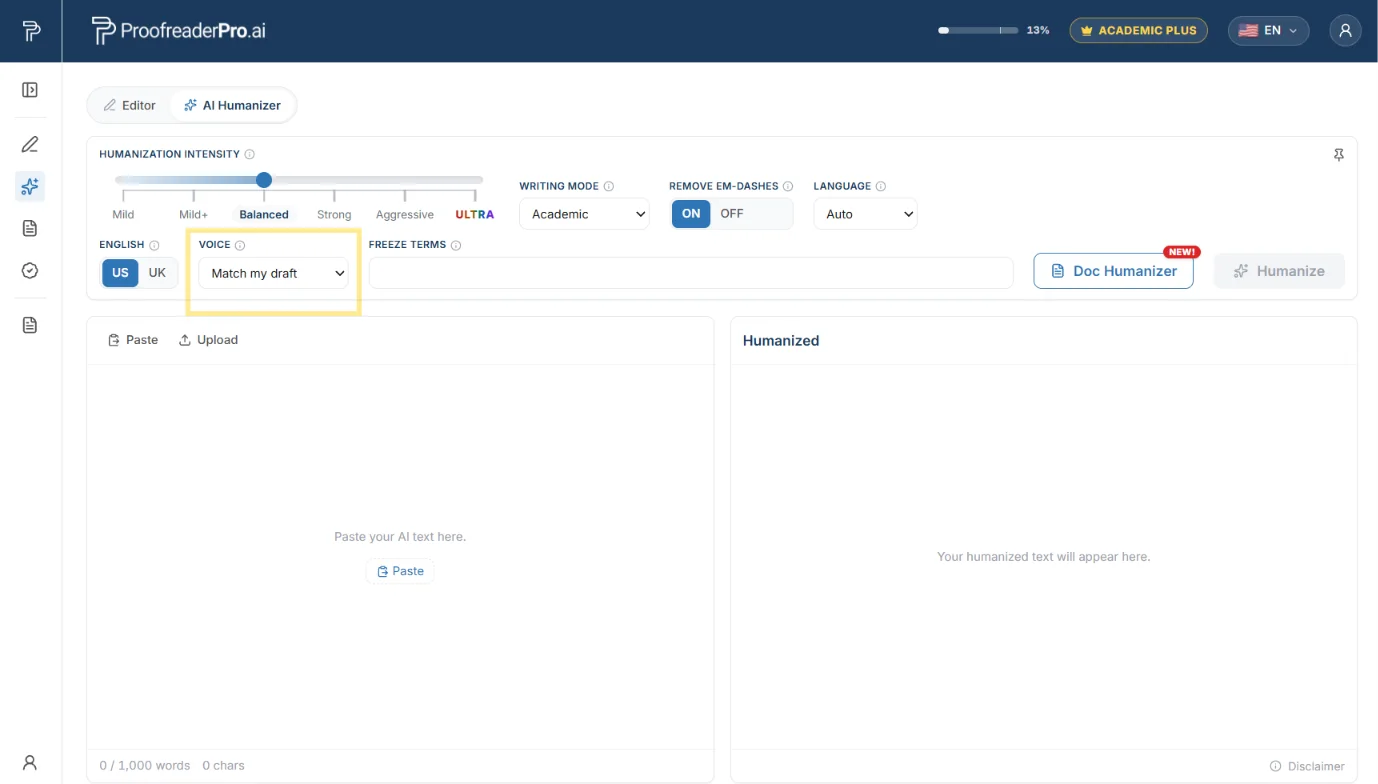
Match my draft
The default. The humanizer detects which person your draft uses and preserves it. A draft with no first or second person comes back with none, and a draft written as "I" comes back as "I". The engine cannot add a person your draft does not already use.
Formal academic
The output may not use the first or second person at all. This is the setting for theses, dissertations and journal manuscripts written in the impersonal register, and the draft has to be in that register already.
First person only
Preserves "I", "we", "my" and "our" and blocks "you". For reflective essays, personal statements, cover letters and any section written in the author's own voice.
Second person only
Preserves "you" and "your" and blocks "I" and "we". For guides, instructions, tutorials and marketing copy written to the reader.
The voice setting filters the output. It does not convert a draft from one person to another, so the draft has to be written in the voice you select. If the draft conflicts with the setting, the humanizer stops before any words are charged. Choose Formal academic on a draft that contains "you", and a message asks you to remove the second person first or switch to Match my draft.
The check knows the difference between a pronoun and "Part I", "Type I error" or a name in title case. A cited title such as (You Are Not So Smart, 2011) does not trigger it either. To convert a draft first, the free First to Third Person Converter does the conversion, and the humanizer then preserves the result.
Example 1: a formal academic paragraph with Formal academic
The draft below is a methods paragraph from a plant-science thesis, written in the third person with two citations. It was humanized in Academic mode with Voice set to Formal academic.
The draft
Flag-leaf senescence was assessed visually after anthesis. Visual assessment of the progressive loss of green leaf area is widely used for phenotyping senescence and stay-green traits in wheat (Pask et al., 2012; Chapman et al., 2021). In the present study, a predefined 0-7 ordinal scale was used. A score of 0 indicated a completely green, physiologically active flag leaf, whereas a score of 7 indicated advanced senescence, corresponding to approximately 70-80% yellowing or drying of the flag-leaf area. Intermediate scores represented progressively increasing levels of yellowing and drying.
Humanized with Formal academic
Senescence of the flag leaves was evaluated by visual observation following anthesis. Visual scoring of gradual leaf yellowing is frequently employed for the characterization of senescence and stay-green traits in wheat (Pask et al., 2012; Chapman et al., 2021). The 0-7 rating scale that was adopted here was predetermined. Score 0 corresponded to a fully green, physiologically active flag leaf, while score 7 represented late senescence, which corresponds to about 70-80% of the flag-leaf area being yellowed or dried out. Scores between 0 and 7 suggested a gradually increasing degree of yellowing and drying.
Every sentence was rewritten and the paragraph is still in the third person. "Flag-leaf senescence was assessed visually" became "Senescence of the flag leaves was evaluated by visual observation". "A predefined 0-7 ordinal scale was used" became "The 0-7 rating scale that was adopted here was predetermined". Both citations, the 0 to 7 scale and the 70-80% figure are preserved verbatim, and the output has no "we", "I" or "you" in it.
Humanize in the voice your submission needs
Academic Plus includes the voice filter, the six intensity settings up to ULTRA, the Doc Humanizer and 50,000 words a month.
See the voice filterExample 2: a first-person reflection with First person only
The second draft is a paragraph from a professional reflection on performance measurement, written in the first person. It was humanized in Academic mode with Voice set to First person only.
The draft
Over the years, working with performance measurement in hybrid organizations, I have learned that the quality of the measurement system reflects the quality of the organization's clarity about what it is trying to produce. An organization with clear, specific, observable definitions of what excellent performance looks like in every role can design a measurement system that assesses contribution rather than presence. Organizations that are unclear about what good performance looks like or depend on vague descriptions of desirable behaviors and trust that managers will know good work when they see it invariably find that what managers know best is the behavior they feel most comfortable to supervise, which, in hybrid settings, is the behavior of the people they can see.
Humanized with First person only
In my experience, over the years, working with performance measurement in hybrid organizations, I have learned that the quality of the measurement system reflects the quality of the organization's clarity about what it is trying to produce. Organizations with clear, specific, observable definitions of what excellent performance looks like in every role can design a measurement system that assesses contribution rather than presence. In contrast, organizations that are unclear about what good performance looks like or depend on vague descriptions of desirable behaviors and trust that managers will know good work when they see it invariably find that what managers know best is the behavior they feel most comfortable to supervise, which, in hybrid settings, is the behavior of the people they can see.
The paragraph came back in the first person. "I have learned" is preserved, the humanizer added "In my experience" at the start and "In contrast" before the third sentence, and "An organization" became "Organizations". No "you" was added. First person only blocks the second person and leaves "I", "we" and "my" as the writer uses them.
Example 3: a second-person guide with Match my draft
The third draft is a paragraph from a project-management guide, written to the reader. It was humanized in Academic mode with Voice at the default, Match my draft.
The draft
The difference between a schedule deviation and a schedule change comes down to how bad the delay is and who has to sign off on it. A deviation is minor. It might eat into extra buffer time, but the finish date stays the same and the overall scope does not move. You can handle a deviation internally just by logging the shift and keeping people informed. A schedule change actually pushes the deadline, budget, or major milestones. You cannot fix that kind of shift on your own. It requires a formal change request and explicit approval from the client or project sponsor to reset the baseline.
Humanized with Match my draft
The difference between a schedule deviation and a schedule change is in how badly you are delayed and who needs to approve it. A deviation is a small problem. It may be chewing up some slack time, but the due date remains unchanged and the whole scope does not move. You can manage a deviation without a fuss if you log the change and keep everyone updated. A schedule change actually shifts the due date, budget, or key milestones. You cannot fix that type of change by yourself. A formal change request and clearance from the client or project sponsor are needed to shift the baseline.
Match my draft detected the second person and blocked the first. "You can handle a deviation internally" became "You can manage a deviation without a fuss". "You cannot fix that kind of shift on your own" became "You cannot fix that type of change by yourself", and the first sentence gained "how badly you are delayed". The output has no "I" or "we" in it. Second person only applies the same block with the person named in advance, and it refuses a draft that contains "I" or "we".
Which voice setting to choose
Match the setting to the document, and check the guide your department or journal publishes before you decide. The table gives the usual pairing.
| Document | Voice setting | Why |
|---|---|---|
| Thesis, dissertation or journal manuscript in the impersonal register | Formal academic | The output cannot use "I", "we" or "you", whatever the model does with the sentence |
| Manuscript for a journal that accepts "we" for the authors' procedures | Match my draft | The "we" in the draft is preserved and no "you" can appear |
| Reflective essay, personal statement, cover letter | First person only | "I" and "we" are preserved and the second person is blocked |
| Tutorial, handbook, instructions, marketing copy | Second person only | "You" is preserved and no "I" or "we" can appear |
| Essay that quotes interviewees or includes a reflective section | Match my draft | Every person the draft uses is preserved as written |
Two settings usually travel together. Academic mode with Formal academic is the pairing for a thesis chapter, because Academic mode expands contractions and preserves citations while the voice filter preserves the register. The humanization intensity is a separate choice, and the voice filter applies at every setting from Mild to ULTRA.
If a draft is in the wrong person for its destination, convert it before you humanize it. With the free Academic Tone Converter you can turn informal sentences into the formal register, and the Formality Checker gives a text a formality score.
Why we added voice control
Voice was among the most requested changes from our users. Students wrote that a humanized chapter came back addressed to "you". Authors wrote that a methods section came back as "we measured" for a journal that asks for the passive. The requests came in high volume, from several disciplines, and they all described the same change: the register had moved from neutral and objective to personal.
ProofreaderPro.ai is one of the few humanizers with this control. The engine was fine-tuned on peer-reviewed research writing, so the academic register is its starting point. The voice filter adds a firm rule on top of that: the output may use only the person your draft uses, or only the person you select. Citations, numbers, key terms and freeze terms are preserved verbatim at every voice setting, as they are at every intensity setting.
Frequently asked questions
Q: Does the AI humanizer voice control convert my text to the third person?
No. It filters the humanized output so that it uses only the person you select, and the draft has to be in that person already. To change a draft from the first person to the third, use the free First to Third Person Converter first, then humanize the result with Formal academic.
Q: Which voice setting should I use for a thesis or a journal article?
Formal academic, if the draft is written without "I", "we" or "you", which is what most departments and journals ask for. If your journal accepts "we" for the authors' own procedures and the draft uses it, choose Match my draft and the "we" is preserved.
Q: What happens if my draft contains "you" and I select Formal academic?
The humanizer stops before any words are charged and shows a message. Remove the second person from the draft and humanize again, or switch to Match my draft to preserve the voice as written.
Q: Is the voice filter on the Academic plan?
The voice filter is included in Academic Plus. On the Academic plan the Voice control is locked and the humanizer uses the default, Match my draft.
Q: Does the voice filter work in other languages?
The voice filter works on English text, in the AI Humanizer and in the Doc Humanizer.
A voice filter with four settings: Formal academic, First person only, Second person only and Match my draft. Citations, numbers and freeze terms are preserved verbatim at every setting. Included in the Academic Plus plan.

Lisa holds a PhD in linguistics from NYU, and has always been curious about how computers can leverage applied linguistics to understand and communicate in human language and assist with editing human written content. She is currently the Chief Marketing Officer at ProofreaderPro, where she leads marketing across copy, social media, email, and offline channels.