
Passive Voice in Academic Writing: How and When to Fix It
Passive voice in academic writing: how to spot it, when to keep it and how to change passive to active voice, with 10 examples and APA and journal advice.

Passive voice in academic writing is fine when the doer of an action is unknown or unimportant, as in most methods sections. It's worth fixing when it hides who made a claim or a decision. To fix it, find the doer, make it the subject and put the verb right after it. "The samples were analyzed by the lab" becomes "The lab analyzed the samples."
Style guides have moved toward the active voice. The APA Publication Manual recommends it, and Nature's guidance for authors asks for it, with "we performed the experiment" as its example. The passive still has real jobs in research writing, so the skill is choosing it on purpose, sentence by sentence.
What is passive voice?
A sentence is in the passive voice when the thing acted on becomes the subject. The doer goes into a "by" phrase or is left out. In the active voice, the doer is the subject and comes first.
- Active: "The committee approved the protocol."
- Passive: "The protocol was approved by the committee."
- Passive with no doer: "The protocol was approved."
The passive is built from a form of "be" plus a past participle, such as "was approved", "is measured" or "has been shown". Informal writing also uses "get" in place of "be", as in "the paper got rejected". The passive works in every tense:
| Tense | Passive | Active |
|---|---|---|
| Present | The survey is distributed each spring. | We distribute the survey each spring. |
| Past | The survey was distributed in March. | We distributed the survey in March. |
| Present perfect | The survey has been distributed twice. | We have distributed the survey twice. |
| Progressive | The survey is being distributed now. | We are distributing the survey now. |
| With a modal | The survey can be distributed online. | Researchers can distribute the survey online. |
| Future | The survey will be distributed in May. | We will distribute the survey in May. |
What passive voice is not
A few kinds of sentence often get mistaken for the passive. Knowing them saves you from rewriting sentences that were never passive.
| Sentence | Passive voice | Why |
|---|---|---|
| "We collected the data in 2024." | No | The doer is the subject. This is the active voice in the past tense. |
| "The results were significant." | No | "Significant" is an adjective, so the sentence describes a state. |
| "The reviewers were interested in the method." | No | "Interested" describes how the reviewers felt, which is also a state. |
| "There are three limitations." | No | It's a "there is" sentence. It can be weak, but it isn't passive. |
| "The data were cleaned before analysis." | Yes | A form of "be" plus "cleaned", and the doer is missing. |
| "The model was trained by the second team." | Yes | The doer appears in the "by" phrase. |
Past tense and passive voice are separate things. Tense says when an action happened, and voice says whether the doer or the receiver is the subject. A sentence can be past and active, or present and passive.
How to spot passive voice in your draft
Use one or more of these checks, depending on how long the draft is.
- Look for "be" plus a past participle. Scan for is, are, was, were, be, been and being. Then check whether a past participle follows, such as a verb ending in -ed or an irregular form like "shown" or "written".
- Ask "by whom?" If the sentence describes an action and you can ask who did it, and the answer isn't the subject, the sentence is passive.
- Try the "by zombies" test. Add "by zombies" after the verb. "The samples were collected by zombies" makes sense grammatically, so it's passive. "We collected the samples by zombies" doesn't, so it's active.
- Search the document. In Word or Google Docs, search for "was", "were" and "been" and read each sentence they appear in.
- Run a passive voice checker. For a full chapter, a checker is faster than any manual search.
The free ProofreaderPro.ai passive voice checker works in the browser, so you can paste a whole chapter without signing up. Each passive construction is highlighted, including split forms with an adverb in the middle and get-passives. Passives that already name the doer in a "by" phrase are shown in amber, since you can fix them by moving the doer to the front. Sentences with "be" plus an adjective aren't flagged, and the checker gives you the share of your sentences that are passive.
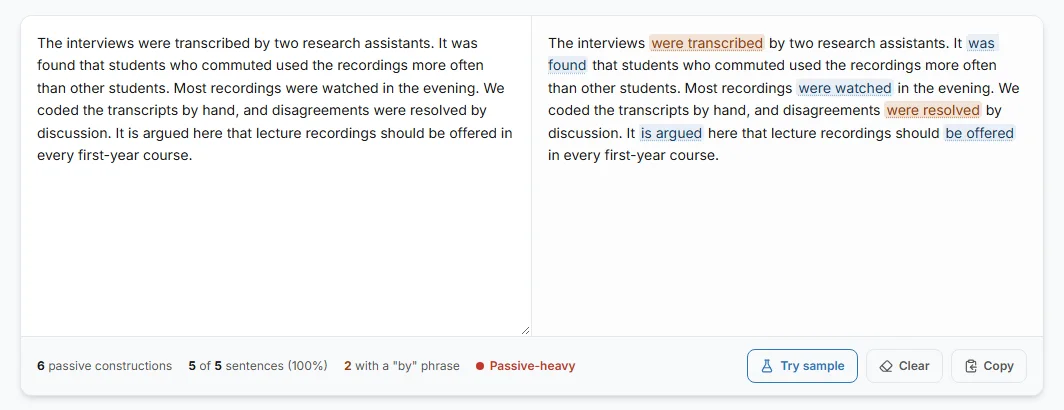
In this example, a five-sentence paragraph from an invented interview study, the checker found six passive constructions. Every sentence had at least one, so it rated the paragraph passive-heavy. The two in amber have a "by" phrase. "Were transcribed by two research assistants" becomes "Two research assistants transcribed the interviews." In "were resolved by discussion", the "by" phrase names a method, so the doer is the research team: "We resolved disagreements by discussion."
How to change passive voice to active voice
Changing passive to active takes four steps.
- Find the verb and the receiver. In "The interviews were transcribed by two assistants," the verb is "transcribed" and the receiver is "the interviews".
- Find the doer. It may be in the "by" phrase or in an earlier sentence. In your own research, it's usually you and your co-authors.
- Make the doer the subject and put the verb after it. "Two assistants transcribed the interviews."
- Check tense, agreement and emphasis. Keep the original tense, make the verb agree with the new subject and read the sentence in its paragraph to check the emphasis still fits.
If the sentence never says who did the action and you don't know, leave it passive. Inventing a doer puts a claim in your paper that you can't support.
10 passive to active examples
| # | Where it appears | Passive | Active, or keep |
|---|---|---|---|
| 1 | Biology results | The enzyme was inhibited by high salt concentrations. | High salt concentrations inhibited the enzyme. |
| 2 | Psychology introduction | It was hypothesized that sleep loss would reduce recall. | We hypothesized that sleep loss would reduce recall. |
| 3 | Sociology methods | The petition was signed by 2,000 residents. | Two thousand residents signed the petition. |
| 4 | Economics | Interest rates were raised three times by the central bank. | The central bank raised interest rates three times. |
| 5 | Engineering results | The beam was found to fail at 40 kN. | The beam failed at 40 kN. |
| 6 | Education methods | Students were asked by their teachers to rate each lesson. | Teachers asked their students to rate each lesson. |
| 7 | Discussion | It is argued in this paper that funding cuts slowed recovery. | We argue that funding cuts slowed recovery. |
| 8 | Data cleaning | After checking the logs, duplicate entries were removed. | After checking the logs, we removed duplicate entries. |
| 9 | Literature review | Burnout has been studied widely in nursing (Kim, 2019; Lopez, 2021). | Keep it. The citations name the researchers, and the topic is the focus. |
| 10 | Methods | Blood samples were taken at baseline and after 12 weeks. | Keep it. The procedure matters more than who drew the blood. |
Example 3 also shows a small rule that comes with fronting the doer. A sentence shouldn't start with a numeral, so "2,000" becomes "Two thousand".
Example 8 fixes a dangling modifier as well. In the passive version, "after checking the logs" has no doer, so the sentence says, grammatically, that the duplicate entries checked the logs. Making "we" the subject gives the opening phrase someone to attach to. Dangling modifiers are one of the 12 grammar mistakes that get research papers rejected, along with tense shifts and comma splices.
Find every passive sentence in your draft
Paste a section or a full chapter and see each passive construction highlighted, with your passive percentage for the whole text. Free, with no word limit.
Check my passive voiceWhen passive voice in academic writing is the right choice
The passive is the better choice in these situations.
- The doer is unknown. "The manuscript was lost in transit" works when nobody knows who lost it.
- The doer is obvious or unimportant. In a methods section, "The samples were stored at -80 °C" is clearer than naming the technician.
- You want to keep the topic in the subject position. In a paragraph about a drug, "The drug was approved in 2019 and is now prescribed widely" works well. The drug stays at the front of each clause.
- The doer is a large, general group. "The theory is widely accepted" is often more accurate than naming who accepts it.
- You want the result to come first. "A 12% drop in errors was recorded after the change" puts the finding at the start of the sentence.
Some fields still expect a mostly passive methods section, and others now prefer "we" throughout. Read two or three recent papers in your target journal before you rewrite a methods section into the active voice.
Passive voice in each section of a research paper
| Section | Where the passive works | What to rewrite |
|---|---|---|
| Abstract | One methods sentence, such as "Data were collected from 14 schools" | Claims about your findings, which read more clearly as "We found..." |
| Introduction | Established background with citations | "It has been shown that..." with no citation. Name the source: "Lee (2021) showed that..." |
| Methods | Standard procedures and materials | Decisions that need a reason, such as "Three participants were excluded." Say who excluded them and why. |
| Results | Reporting measurements | "It was observed that..." and "It was found that..." State the result directly. |
| Discussion | Rarely needed | Claims and interpretations. "We argue", "These results suggest" and "Our findings show" make clear who is claiming what. |
| Limitations | Rarely needed | "Errors were made" and similar phrases. Readers see a limitation you state openly as a sign of careful work. |
The results and discussion sections gain the most from rewriting. Our guides to reporting results and writing a discussion cover how to state findings and claims clearly.
What style guides and journals say
The APA Publication Manual (7th edition) recommends the active voice and accepts the passive when the focus is on the recipient of an action. APA also accepts the first person, so "we analyzed" is fine in APA papers.
Journals set their own rules in their author guidelines. Nature's guidance asks authors to write in the active voice. Science's instructions for authors ask for the active voice where it fits, and give "we constructed a library" in place of "a library was constructed" as an example. Many other journals accept both voices, so the guidelines of your target journal decide.
Students often learn that academic writing should avoid "I" and "we", and the passive is the usual way to do that. If your instructor or field still asks for an impersonal style, make the study, the data or a table the subject instead. Examples are "Table 2 lists the results" and "The data show a rise in...".
Passive voice when English is your second language
Many writers who learned English for academic purposes were taught that the passive sounds more formal and more objective. That advice is out of date for most journals. It can also make a strong paper sound hesitant, with long chains of "it was found that" and "it can be seen that".
Some languages also rely on impersonal forms in academic writing. Translating those forms directly into English tends to produce one passive sentence after another. The meaning survives, and the reader has to work harder to see who did what.
A few habits fix most of it. Start sentences about your own work with "we" or "I" where your journal allows it, and keep the passive for procedures. Put the result first in results sentences, without an "it was found that" frame. Check that your tenses stay consistent after you rewrite, because switching voice can also shift the tense. The free verb tense checker highlights tense changes across a paragraph.
How much passive voice is too much?
There's no fixed limit, because the right amount depends on the section. A methods section can be mostly passive and still read well. An introduction or a discussion that's mostly passive usually hides the argument.
The guidance with our passive voice checker treats about one passive sentence in five as a sensible working target for introductions and discussions, with more allowed in methods. Use the percentage as a prompt to look at the sentences, since a single passive in a key claim matters more than several in a procedure.
The percentage is most useful section by section. Paste the introduction on its own, then the methods, then the discussion, and compare the three figures. A methods section at 50% is normal. An introduction at 50% usually means the background is written as a list of things that "have been shown", and naming the researchers who showed them fixes most of it.
Passive voice is only one of the habits that make academic prose slow to read. Our tips on improving your academic writing style cover the others, such as wordy openings and stacked hedges.
Tools that find and fix passive voice
- Passive voice checker. Highlights every passive and shows your passive percentage, free in your browser with no limit.
- Passive to active converter. Rewrites passive clauses into the active voice, using the doer your own text names. Clauses with no named doer stay passive with a note. A methods mode keeps the conventional passives a journal expects, and you see each change before and after. Sign in with a free account for 2 runs a day of up to 500 words each.
- AI proofreader. Edits a full manuscript for grammar, clarity and wordiness, including weak passives, with every change shown as a tracked edit.
Frequently asked questions
Q: Is passive voice grammatically wrong?
No. The passive voice is correct grammar. Teachers and editors flag it because overusing it makes writing wordy and can hide who did what, which makes it a question of style.
Q: Is passive voice allowed in APA style?
Yes. APA 7 recommends the active voice and accepts the passive when the focus is on the recipient of the action, as in many methods sentences. APA also accepts "I" and "we", which makes the active voice easy to use.
Q: Should the methods section be written in passive voice?
It depends on the field and the journal. Many journals still expect a mostly passive methods section, such as "Samples were collected at three sites", and many others prefer "we". Check recent papers and the author guidelines of your target journal.
Q: Is "there is" or "there are" passive voice?
No. "There are three limitations" is an existential sentence, which is a different structure from the passive. It can still be weak writing, and "The study has three limitations" is often shorter and clearer.
Q: Is every sentence with "was" in the passive voice?
No. "Was" makes a passive only when it comes before a past participle that describes an action, as in "was collected". "The sample was small" uses "was" with an adjective, and "She was writing" is the active voice in the past progressive.
Q: What is the difference between passive voice and past tense?
Tense says when something happened, and voice says whether the doer or the receiver is the subject. "We measured the samples" is past and active. "The samples are measured daily" is present and passive.
Q: What is a get-passive?
A get-passive uses "get" in place of "be", as in "the paper got rejected" or "three participants got excluded". It's common in speech and informal writing. In academic writing, use the "be" form or rewrite the sentence in the active voice.
Q: Can I use "we" to avoid passive voice?
Yes, in most fields and in APA style. "We interviewed 20 teachers" is clearer than "Twenty teachers were interviewed". If your instructor asks for no first person, make the study or the data the subject instead.
Q: How do I change passive voice to active voice?
Find the doer of the action, make it the subject and put the verb right after it, keeping the same tense. "The survey was completed by 300 students" becomes "Three hundred students completed the survey."
Rewrite passive clauses into the active voice with the doer taken from your own text, and keep the methods passives your journal expects.

Lisa holds a PhD in linguistics from NYU, and has always been curious about how computers can leverage applied linguistics to understand and communicate in human language and assist with editing human written content. She is currently the Chief Marketing Officer at ProofreaderPro, where she leads marketing across copy, social media, email, and offline channels.


