AI Humanizer for Ethiopian Researchers Writing in English
AI humanizer for Ethiopian researchers. Reduce false AI-detection flags on Amharic-influenced English, keep meaning and citations, disclose honestly.

Ethiopia published 10,614 Scopus-indexed papers in 2023, a 20.2% jump that ranks it among the fastest-growing research producers in Africa. Its H-index sits 77th in the world, one of only three low-income countries in the global top 100 for citation impact. Behind those numbers are thousands of Amharic-speaking academics who draft, revise, and increasingly reach for AI tools to write in a second language.
That is where the trouble starts. An AI humanizer for Ethiopian researchers is not about hiding work. It is about protecting careful, standard English from detectors that misread it.
When a researcher at Bahir Dar or Gondar writes clear, predictable academic prose, the very qualities that make it readable can trip an AI detector into a false flag. This guide explains why that happens, and how to fix it plainly: humanize your own AI-assisted draft, keep your meaning and citations, then disclose your AI use the way your institution and journal require.
ሰላም: an AI humanizer built for Ethiopian researchers writing in English
ሰላም (selam) means hello. Our humanizer helps Ethiopian researchers publish in English by taking your own AI-assisted draft and smoothing the machine-like rhythm out of it, without touching your meaning, your data, or your citations. It supports more than 60 languages, including Amharic (አማርኛ), Tigrinya, and Oromo, so a paper you think through first in your working language can move into academic English and stay yours.
It doesn't matter whether you're writing at Addis Ababa University in the capital or at a regional campus with limited English support. You can use it from anywhere with an internet connection. That matters in a country where the language gap between institutions is wide and the publication pressure is the same everywhere.
Writing in Amharic? It is auto-detected and humanized natively
Many Ethiopian researchers draft in Amharic before writing up in English, and the humanizer handles that directly. Paste Amharic (አማርኛ) text and ProofreaderPro recognises the Ge'ez script on its own, then processes it through a language-aware model that keeps your terminology and citations exactly as written. Your Amharic draft is humanized as readily as your English, so nothing has to be translated first. The same detection spans more than sixty languages, each rewritten in its own script.
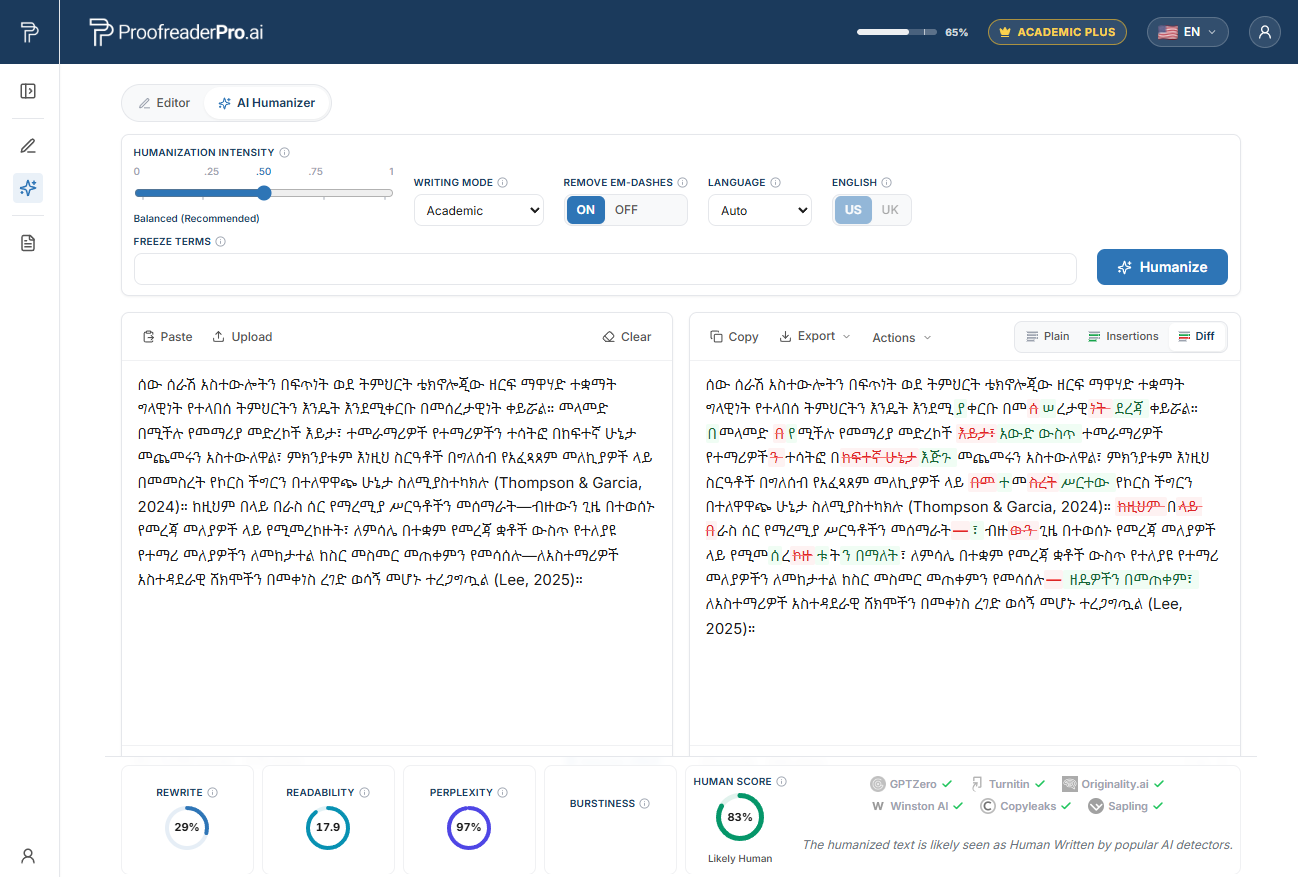
The ProofreaderPro AI Humanizer rewriting Amharic academic text. The before and after diff keeps your meaning and citations, and the detector checks confirm a natural, human read.
Why Ethiopian researchers get flagged by AI detectors
In 2023, a Stanford study by Liang and colleagues, published in the Cell Press journal Patterns, carried a blunt title: "GPT detectors are biased against non-native English writers." The team ran human-written TOEFL essays through seven widely used AI detectors. Every essay had a human author.
The detectors flagged about 61% of the non-native essays as AI-generated, compared with about 5% for native English writers. Nearly one in five (about 19.8%) was unanimously flagged by every detector in the set. Not one had been written by a machine.
The mechanism is perplexity. Many detectors score how surprising each word choice is to a language model. Careful second-language writers reach for common words and standard, predictable phrasing, which produces low perplexity, which reads as machine text. The habits that make Amharic-speaking academics clear in English are the habits these tools were trained to flag. We walk through the full mechanism in why AI detectors flag non-native writers.
The Amharic first-language patterns behind false flags
Amharic is a Semitic language written in the Ge'ez script, and its grammar diverges from English in systematic ways. Research on Ethiopian student writing found that 55.6% of students say Amharic syntax directly shapes their English. Here is the part detectors miss: once you correct for these patterns, your prose becomes textbook-standard, and textbook-standard is exactly what reads as low perplexity.
Passive voice. Amharic formal writing favors impersonal constructions, and older English instruction in Ethiopia taught passive voice as "more academic." Roughly 32% of manuscripts lean heavily on it. Passive prose is grammatical and consistent, and that consistency is one more signal a detector reads as machine cadence.
Verb tense. Amharic marks tense, aspect, and mood through consonantal roots and vowel patterns that do not map onto English past, present, and future. About 28% of manuscripts shift tense within a section. When an editor smooths those shifts into a single steady tense, the result is uniform and predictable.
Subject-verb agreement. Amharic encodes the subject inside the verb, so the explicit agreement English demands can feel redundant. Around 23% of manuscripts carry agreement slips with complex subjects, such as "The analysis of the collected data from all three sites show." Corrected, these become clean and regular, another low-surprise signal.
Article omission. Amharic has no direct equivalent of "a," "an," or "the," so articles get dropped: "Result was significant" for "The result was significant." Add them back the way a careful writer does, and the reference becomes precise and standard.
Word order. Amharic places the modifier before the head noun in a different order from English, producing compounds like "temperature increase rate" for "rate of temperature increase." Fixed, they read as clean technical English.
None of this is cheating and none of it is weakness. It is careful writing that happens to be predictable, and a humanizer restores the natural variation a detector expects to see.
Ethiopia's AI-detection and Turnitin context
Turnitin or iThenticate is one of the tools used to check similarities in theses and journal submissions at public universities in Ethiopia. The use of AI indicators is becoming commonplace. Academic promotions need publication in internationally indexed journals under the Ministry of Science and Higher Education (MoSHE) harmonized directive. This means that all papers will go through more scrutiny, not less.
It helps to know how shaky these AI scores are. In 2023, Vanderbilt turned off Turnitin's AI detector because of false positives and a bias against non-native writers. Michigan State, UT Austin, Northwestern, Pittsburgh, SMU, and Waterloo also did so. Turnitin itself suppresses scores in the 1 to 19% range and warns that its number shouldn't be used alone to decide integrity cases.
The takeaway for an Ethiopian researcher is simple: an AI flag is a claim you can contest, not a verdict. No student "sued Turnitin and won"; the real disputes were with schools over how a flag was used. Your job is to keep your writing straight and to keep it from being misread in the first place.
Humanize your own draft, keep every citation
Upload your AI-assisted paper and let the humanizer restore natural variation while preserving your meaning, terminology, and references. Built for Amharic-speaking researchers writing in English.
Try the Humanizer FreeTop Ethiopian universities and where AI checks appear
Ethiopia's university system has grown to more than 47 public institutions, and its strongest research producers all screen theses and manuscripts for similarity and AI indicators. If you write at any of these, the workflow below applies to you:
- Addis Ababa University (አዲስ አበባ ዩኒቨርሲቲ), the country's oldest and most research-intensive university, in the capital.
- Jimma University (ጅማ ዩኒቨርሲቲ), strong in health sciences and public health.
- Bahir Dar University (ባህር ዳር ዩኒቨርሲቲ), a growing engineering, agriculture, and education hub in the Amhara region.
- University of Gondar (ጎንደር ዩኒቨርሲቲ), known for medicine and veterinary science.
- Hawassa University (ሃዋሳ ዩኒቨርሲቲ), a top-ranked producer in agriculture and natural sciences.
- Mekelle University (መቀሌ ዩኒቨርሲቲ), a major research university in Tigray with strengths in dryland agriculture and geosciences.
- Adama Science and Technology University (አዳማ ሳይንስና ቴክኖሎጂ ዩኒቨርሲቲ), engineering and technology focused.
- Haramaya University (ሀረማያ ዩኒቨርሲቲ), one of the oldest, strong in agriculture and veterinary medicine.
- Arba Minch University (አርባ ምንጭ ዩኒቨርሲቲ), known for water technology and environmental research.
- Debre Berhan University (ደብረ ብርሃን ዩኒቨርሲቲ), a regional university with fast-developing research capacity.
Here we see the importance of the regional proficiency gap. Addis Ababa scores 522 on the EF English Proficiency Index, but the Amhara region scores 436 (a difference of 86 points). So the researcher in Bahir Dar or Gondar has a higher hurdle than their counterpart in Addis. But they have the same set of rules and the same detectors. A tool that works from any connection helps level that field.
How the AI humanizer for Ethiopian researchers works
Here is the workflow we recommend, start to finish.
First, draft. Write your argument in whatever language thinks fastest for you: Amharic, Oromo, Tigrinya, or English. If you draft in your working language, our AI translator moves it into academic English while keeping your terms and structure.
Second, proofread. Run the grammar pass that fixes the passive-voice density, tense drift, agreement slips, and missing articles described above. Clean, correct English is the foundation, and the humanizer is not a substitute for it.
Third, humanize. Take your own AI-assisted draft and run it through the text humanizer. It varies sentence rhythm and word choice, removes repetitive cadence and stray em dashes, and restores the natural variation a detector expects, all while preserving your meaning, your technical terminology, and your citations.
Our humanizer, tested against the major detectors, reworks AI text into a more natural human form that reads as human across Turnitin, Originality.ai, and GPTZero, while keeping grammar accuracy high on academic text. These are results from testing, not guarantees. Detectors retrain every few months, and no serious tool promises to be undetectable. The goal is fairness for real work, not disguise.
Fourth, disclose. State your AI use in the format your institution and target journal require. Humanizing your own writing and disclosing that you used AI are not in tension; together they keep you inside integrity rules while protecting careful non-native prose from a false flag.
This humanizer step is the counterpart to our academic editing for Ethiopian researchers guide, and it sits inside our broader multilingual AI humanizer hub, which covers researchers writing in dozens of languages.
Local funding bodies, journals, and AI-disclosure expectations
Ethiopian funding for research comes primarily from the government via university grants under MoSHE as well as international development projects and NGO collaborations. Most funds are focused on health, agriculture and engineering where the target journals are all published in English. The National Academic Digital Repository of Ethiopia (NADRE) requires open access publishing of publicly funded research. Open access means publication in English. Researchers need to publish to get promoted and secure future funding.
The country's own indexed journals hold submissions to international language standards:
- Ethiopian Journal of Health Sciences, indexed in MEDLINE and Scopus.
- Ethiopian Journal of Health Development, indexed in Scopus and Web of Science.
- Ethiopian Medical Journal, one of Africa's oldest medical journals.
- Ethiopian Journal of Education and Sciences, covering education and pedagogy.
- Ethiopian Journal of Agricultural Sciences, covering Ethiopia's agrarian research.
Funders and journals increasingly ask authors to disclose AI use, and that expectation is only growing. The safe pattern is the same everywhere: humanize your own writing for fairness, run the manuscript through the text humanizer before you submit, then disclose exactly how you used AI. If a detector still flags careful, legitimate work, you have every right to appeal that flag with your editor rather than accept it as final.
Frequently asked questions
Q: Will an AI humanizer help Ethiopian researchers pass Turnitin fairly?
It helps in the real sense: it restores natural variation to your own AI-assisted, careful English so a detector is less likely to misread it. In our testing the humanizer rewrites AI text into a more human form, which lowers the AI signal on Turnitin, but detectors retrain constantly and no tool can promise to be undetectable. Treat any flag as a claim to discuss, keep your work genuine, and disclose your AI use.
Q: Does the humanizer work if I draft in Amharic first?
Yes. Many Ethiopian researchers think fastest in Amharic, Oromo, or Tigrinya. You can draft in your working language, translate into academic English, proofread the grammar, then humanize, and the tool preserves your meaning and citations at every step across more than 60 languages.
Q: Is using an AI humanizer considered cheating?
No, not when you use it on your own work and disclose it. Humanizing means smoothing machine-like rhythm out of a draft you wrote and researched yourself, keeping the meaning intact. Cheating is submitting fabricated or someone else's work, and disclosing genuine AI assistance is the opposite of hiding it.
Q: Why do careful, correct English papers still get flagged?
Because many detectors score perplexity, or how predictable your word choices are. Second-language academic writing tends to be standard and low in surprise, and that low-surprise profile is what these tools were trained to call machine-written. A Stanford study found about 61% of human-written non-native essays flagged as AI, so this is a known bias, not a reflection of your ability.
Q: Will humanizing change my citations or technical terms?
No. The humanizer preserves your citations, your data, and your discipline-specific terminology while it varies sentence rhythm and word choice. You review every change, so nothing in your references or your findings shifts without your approval.
Restore natural variation to your own AI-assisted academic English, preserve every citation, and disclose with confidence. Built for Ethiopian researchers writing for international journals.

Moe is an NLP engineer with a PhD in natural language processing. His research covers computational linguistics, text analysis, and machine learning, and it fed directly into the editing and humanization models behind ProofreaderPro. He writes about the part of the process most people never see: how a language model reads a sentence, scores it, and decides what to change.