AI Humanizer for Japanese Researchers Writing in English
AI humanizer for Japanese researchers. Reduce false AI-detection flags on Japanese-influenced English, keep meaning and citations, disclose honestly.

Japan spends 18.1 trillion yen on research and development every year, employs 705,000 researchers, and ranks fifth in the world for published output with more than 70,000 papers a year. By every input measure, it is a scientific powerhouse.
Yet Japan placed 96th out of 123 countries on the 2025 EF English Proficiency Index, its lowest ranking ever, and nearly half of early-career researchers draft a full paper in Japanese before translating it into English. That gap between world-class science and second-language English is where automated AI detectors do real harm. An AI humanizer for Japanese researchers exists to protect careful, correct English from being wrongly flagged as machine writing, not to disguise anything.
You humanize your own AI-assisted draft, you keep every result and citation intact, and then you disclose your AI use the way your university and target journal require. The science is world class. The English often is not.
日本の研究者のためのAIヒューマナイザー
ProofreaderPro.aiのAIヒューマナイザーは、日本の研究者が国際誌で英語論文を発表する際に、丁寧で正確な英文が検出ツールに誤判定されるのを防ぐお手伝いをします。
Our humanizer works on your own writing. It takes an English draft you prepared with the help of a tool like ChatGPT, varies the rhythm and word choice, and preserves your meaning, your technical terms, and your references. It supports Japanese and more than 60 other languages, so the version you submit still says exactly what your data show.
The goal is fairness, not concealment. A detector flag is a claim you can contest, and careful writing deserves the benefit of the doubt.
The humanizer also detects and processes Japanese
Not every first draft is in English, and it does not need to be. Paste Japanese text and ProofreaderPro identifies the language on its own, then routes it through a Japanese-aware model that respects kanji, kana, and your academic register while keeping citations untouched. As an AIヒューマナイザー it works directly on your Japanese writing, so you can humanize before you translate rather than after. The same detection covers more than sixty languages, each rewritten as itself.
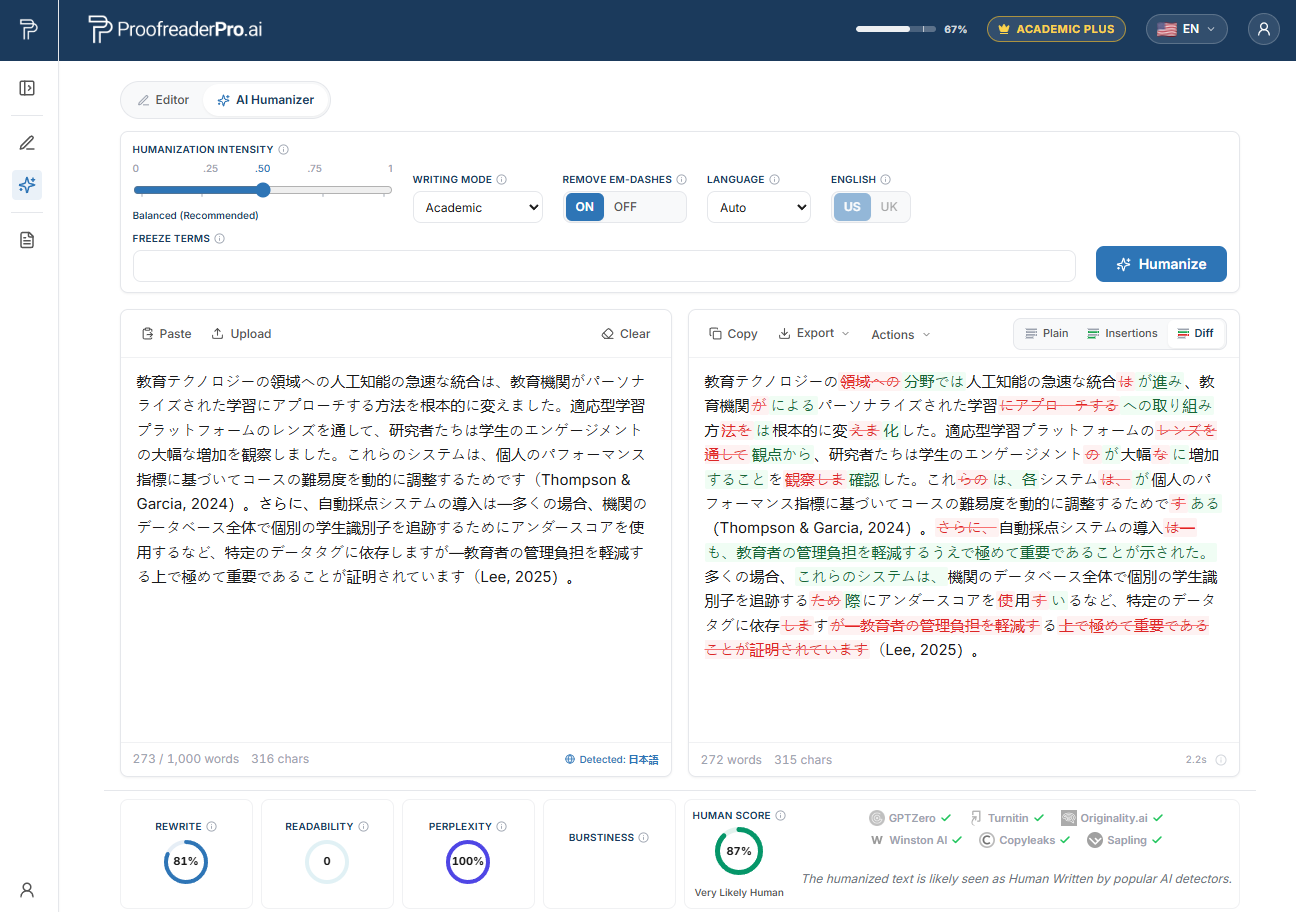
The ProofreaderPro AI Humanizer rewriting Japanese academic text. The before and after diff keeps your meaning and citations, and the detector checks confirm a natural, human read.
Why Japanese researchers get flagged by AI detectors
In 2023, a Stanford team led by Weixin Liang published a study in the Cell Press journal Patterns titled "GPT detectors are biased against non-native English writers." They ran human-written TOEFL essays through seven widely used detectors.
On average, about 61% of the essays by non-native English writers were flagged as AI generated, compared with about 5% for native writers. Nearly one in five non-native essays (about 19.8%) was flagged unanimously by every detector. Every single essay was written by a human.
The mechanism is a measure called perplexity: how surprising each word choice is to a language model. Second-language writers who have trained themselves to use common words and safe, standard phrasing produce low-perplexity text, and low perplexity is exactly what these detectors read as machine writing. For a fuller explanation, see our piece on why AI detectors flag non-native writers. The habits that make Japanese researchers' English clear and correct are the same habits the detectors were trained to punish.
The Japanese first-language patterns behind false flags
Japanese and English differ so deeply that Japanese researchers learn to apply a small set of very safe corrections. Those corrections are right. They are also highly predictable, which is what pushes perplexity down and makes a detector suspicious.
Articles. Japanese has no articles, no "the," "a," or "an." Writers who know this over-correct toward the safest, most standard placement, producing textbook-perfect noun phrases that a detector reads as generated.
Plural marking. Japanese nouns carry no plural inflection, so careful writers add every "s" by rule. The result is grammatically flawless and utterly regular, exactly the even surface a perplexity score rewards as machine-like.
Word order. Japanese runs subject, object, verb, while English runs subject, verb, object. To stay safe in English, many researchers fall back on short, canonical subject, verb, object sentences that are correct and, to a detector, suspiciously uniform.
Nominal groups. Studies of Japanese researchers' English find that the overwhelming majority of syntactic errors sit inside noun phrases. Writers respond by leaning on standard, formulaic modifier patterns, which reads as low-variance text.
Verb tense. Japanese marks only past and non-past, so careful writers adopt fixed tense conventions for their methods and results sections. Consistency is good scholarship and, unfortunately, a low-perplexity signal.
Connectors. Japanese leans on reader inference for cohesion, so writers add explicit English connectors like "however," "therefore," and "in addition." Those standard signposts, repeated at every turn, look exactly like the phrasing detectors associate with AI.
None of this is bad writing. It is careful writing. The detector simply cannot tell the difference between a diligent second-language author and a language model.
Japan's AI-detection and Turnitin context
Theses and manuscripts in Japan are commonly screened for text similarity with Turnitin or iThenticate, and those systems now surface AI-writing indicators alongside the similarity score. Graduate schools and journal editors increasingly look at both numbers together.
The wider climate is one of rising caution. Funders and publishers are asking authors to disclose how they used AI tools, and many Japanese universities have issued their own guidance on acceptable use. None of that makes AI assistance forbidden. It makes disclosure the expected, responsible step, and it makes the quality of your English matter more than ever.
It is worth remembering that detector scores are contestable. Vanderbilt University disabled Turnitin's AI detector in 2023, citing false positives and bias against non-native writers, and several other institutions took similar steps. A flag is a claim to examine, not a verdict to accept, especially when the underlying work is genuinely your own.
Protect your careful English from false AI flags
Humanize your own AI-assisted draft, keep every result and citation, then disclose your AI use. Supports Japanese and 60+ languages, with instant results and no per-word charges.
Try the Humanizer FreeTop Japan universities and where AI checks appear
Japan's research output is concentrated in its former Imperial universities and a handful of leading national and private institutions. All of them screen theses and submitted manuscripts for similarity and, increasingly, for AI indicators.
- The University of Tokyo (東京大学), Tokyo. The country's top-ranked institution across physical and life sciences.
- Kyoto University (京都大学), Kyoto. Strong in chemistry and materials science, home to multiple Nobel laureates.
- Osaka University (大阪大学), Suita. Engineering, immunology, and laser science.
- Institute of Science Tokyo (東京科学大学), Tokyo. Formerly Tokyo Institute of Technology, Japan's leading science and engineering university.
- Tohoku University (東北大学), Sendai. Materials science, spintronics, and disaster research.
- Nagoya University (名古屋大学), Nagoya. Physics and chemistry, with six affiliated Nobel Prize winners.
- Hokkaido University (北海道大学), Sapporo. Environmental science, agriculture, and veterinary medicine.
- Kyushu University (九州大学), Fukuoka. Hydrogen energy, organic chemistry, and engineering.
- University of Tsukuba (筑波大学), Tsukuba. Sports science, clinical medicine, and physics.
- Hiroshima University (広島大学), Hiroshima. Peace studies, education, and biological sciences.
- Keio University (慶應義塾大学), Tokyo. Japan's oldest private university, strong in medicine and economics.
- Waseda University (早稲田大学), Tokyo. Engineering, political science, and international collaboration.
- Okinawa Institute of Science and Technology (OIST), Okinawa. Small but exceptionally high-impact, with one of Japan's highest per-capita citation rates.
- Tokyo University of Science (東京理科大学), Tokyo. Applied sciences, pharmaceuticals, and mathematics.
- Osaka Metropolitan University (大阪公立大学), Osaka. A newly merged public university with fast-growing output.
At every one of these, English-language publication drives faculty advancement, and the same manuscripts pass through the detectors described above.
How the AI humanizer for Japanese researchers works
The workflow behind the AI humanizer for Japanese researchers has four steps, and disclosure is built into it rather than bolted on at the end.
First, draft. Write in Japanese if that is clearer for you, then translate into English, or draft in English directly with the help of an AI assistant. Second, proofread the grammar so that articles, plurals, and tense are correct before anything else happens. Third, run the English through our text humanizer, which varies rhythm and word choice, trims repetitive cadence, removes stray em dashes, and keeps your meaning, terminology, and citations exactly as they were. Fourth, disclose your AI use in the format your institution and target journal specify.
Tested against the major detectors, the humanizer rewrites AI text into a more natural human form, which lowers the AI signal and improves its odds against tough detectors, while keeping grammar accuracy high on academic text. These are results from testing, not guarantees, and detectors retrain every few months, so we never promise a score or a way to bypass a system. What we offer is a fair chance for careful non-native prose to be read as what it is.
This post sits inside our multilingual AI humanizer hub, and it pairs with our guide to academic editing for researchers in Japan if you want the full editing workflow alongside the humanizer.
Local funding bodies, journals, and AI-disclosure expectations
KAKENHI (科学研究費助成事業), administered by JSPS with an annual budget near 250 billion yen, is Japan's largest competitive grant program, and it expects results to reach international journals rather than domestic ones. MEXT, whose science and technology budget passed 5 trillion yen for FY2025, evaluates national universities partly on their international publication record. The pressure to publish in English is structural, even though twice as many peer-reviewed articles still appear in Japanese as in English in domestic journals.
That same system is where AI-use disclosure now matters. Journals published through J-STAGE, which hosts more than 3,200 Japanese scholarly titles, and international venues alike increasingly ask authors to state how AI tools were used. Prominent English-language journals from Japan include:
- Progress of Theoretical and Experimental Physics (PTEP), Physical Society of Japan and Oxford University Press
- Journal of the Physical Society of Japan (JPSJ)
- Chemistry Letters, Chemical Society of Japan
- Bulletin of the Chemical Society of Japan (BCSJ), established 1926
- Chemical and Pharmaceutical Bulletin, Pharmaceutical Society of Japan
- The Journal of Japanese Studies
Write a short, clear AI-use statement, humanize your own draft with the text humanizer so your careful English is not misread, and if a flag ever lands on genuine work, our appeal playbook walks through how to respond. Disclosure plus fair writing keeps you inside the rules while defending the work you actually did.
Frequently asked questions
Q: Will an AI humanizer for Japanese researchers help my paper pass Turnitin?
It can improve the odds, but no serious tool guarantees a score. In our own testing the humanizer rewrites AI text into a more human form, which lowers the AI signal on Turnitin and the other detectors, and those systems retrain often. Treat it as protection for careful writing, not a promise to bypass anything.
Q: Is using a humanizer cheating or hiding AI use?
No, as long as you humanize your own work and then disclose your AI use. The purpose is to keep correct, second-language English from being misread as machine text, not to pass off fabricated or borrowed work. Disclosure is what keeps the whole process transparent.
Q: Does the humanizer change my citations or technical terms?
No. It preserves your references, your specialized terminology, and your data while it varies rhythm and word choice. Your meaning stays the same, which matters when a single wrong term can change a result.
Q: Can I draft in Japanese and still use the humanizer?
Yes. Many researchers write in Japanese, translate into English, proofread the grammar, and then humanize the English output. The tool supports Japanese and more than 60 languages, so the pipeline works from first draft to final submission.
Q: What should my AI-disclosure statement say?
Keep it short and factual: name the tools you used, say what you used them for (for example drafting, translation, or language polishing), and confirm that the analysis and conclusions are your own. Follow the exact format your institution or target journal specifies.
Protect careful non-native writing from false AI flags. Preserves meaning, terminology, and citations across Japanese and 60+ languages. Tested against Turnitin, Originality.ai, and GPTZero.

Moe is an NLP engineer with a PhD in natural language processing. His research covers computational linguistics, text analysis, and machine learning, and it fed directly into the editing and humanization models behind ProofreaderPro. He writes about the part of the process most people never see: how a language model reads a sentence, scores it, and decides what to change.