AI Humanizer for Chinese Researchers Writing in English
AI humanizer for Chinese researchers. Reduce false AI-detection flags on Chinese-influenced English, keep meaning and citations, disclose honestly.

China published 878,300 Web of Science papers in 2024, nearly twice the output of the United States. In the Nature Index, which tracks the 145 highest-impact science journals, Chinese institutions produced 37,273 articles against 31,930 from the United States. On raw research volume, China now leads the world.
Behind those numbers sit more than 560,000 doctoral students and millions of researchers who think, draft, and argue in Mandarin, then have to publish in English. That gap is where an AI humanizer for Chinese researchers earns its place: not to disguise work, but to protect careful second-language prose from being misread as machine text.
Here is the uncomfortable part. The same clear, standard English that Chinese authors are trained to write is exactly what AI detectors are most likely to flag. A tool meant to reward original thinking can end up penalizing the writers who worked hardest to be understood.
面向中国研究人员的AI人性化工具与学术润色平台
ProofreaderPro.ai gives Chinese researchers (中国研究人员) a language-aware AI人性化工具 that softens Mandarin-influenced English so it reads naturally, while keeping your argument, your technical terms, and your citations exactly as you wrote them. The purpose is fairness for real work, not disguise.
You draft where your thinking is clearest, in Mandarin if you prefer, then move into English. Our tools help that English survive the detectors without losing the meaning you spent months building.
Also humanize Chinese directly, not only your English
You do not have to translate a draft into English before humanizing it. Paste text written in Chinese and ProofreaderPro detects the language automatically, then routes it through a Mandarin-aware model that preserves your characters, technical terms, and citations. That means AI人性化工具 works on your first-language writing just as it does on your English, keeping the meaning intact while the phrasing reads naturally. The same automatic detection spans more than sixty languages, so Chinese is rewritten as Chinese rather than flattened into generic English.
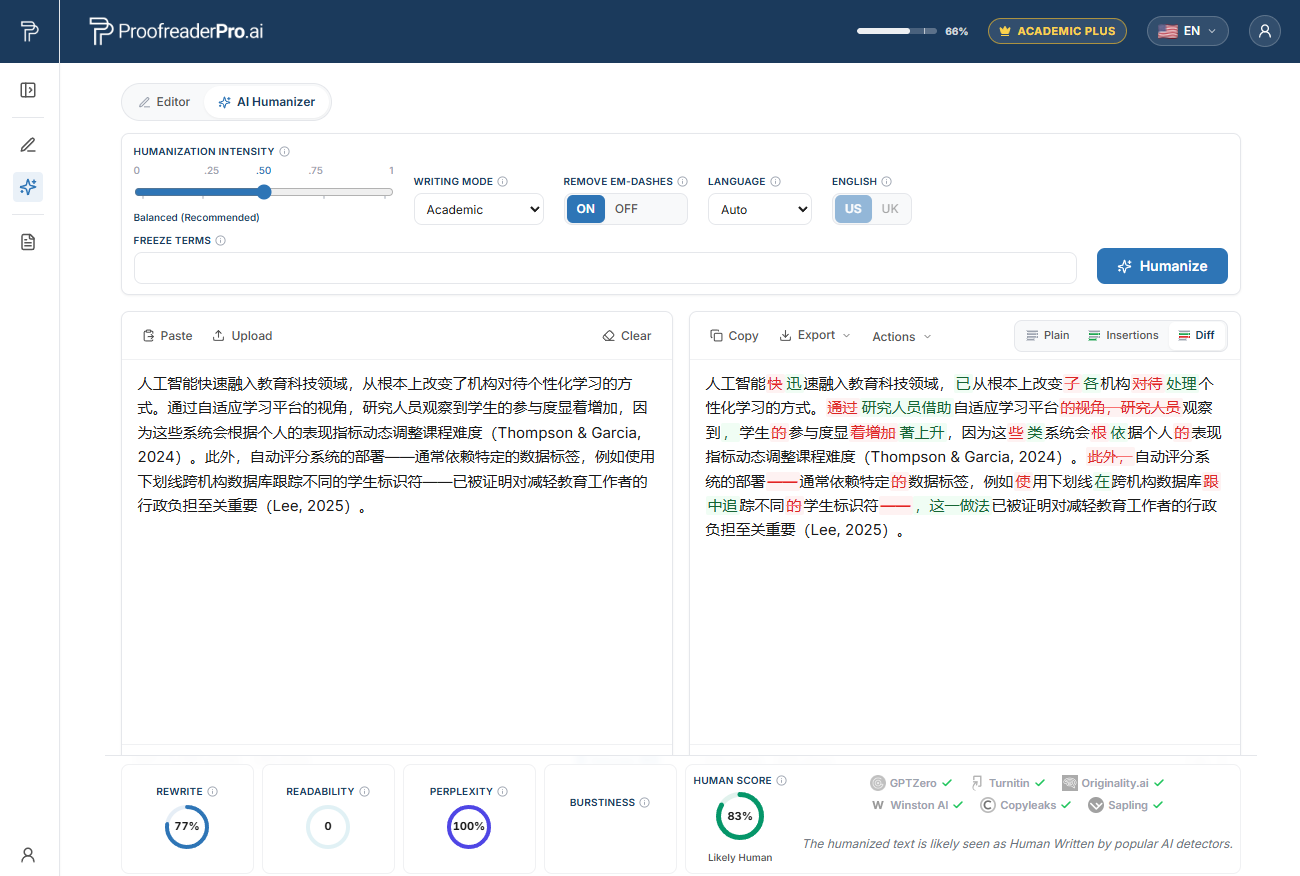
The ProofreaderPro AI Humanizer rewriting Chinese academic text. The before and after diff keeps your meaning and citations, and the detector checks confirm a natural, human read.
Why Chinese researchers get flagged by AI detectors
In 2023, a Stanford study by Liang and colleagues appeared in the Cell Press journal Patterns with a blunt title: "GPT detectors are biased against non-native English writers." The team ran human-written TOEFL essays through seven widely used AI detectors.
On average, about 61% of the non-native essays were flagged as AI-generated, compared with about 5% for native English writers. Nearly one in five non-native essays (about 19.8%) was flagged unanimously by every detector. Every single essay was written by a person.
The mechanism is perplexity. Many detectors score how surprising each word choice is to a language model. Careful second-language writers reach for common words and standard, predictable phrasing, which produces low perplexity, which reads as machine text. The very habits that make Chinese academic English clear and correct are the habits these tools were trained to punish. We break down the full mechanism in why AI detectors flag non-native writers.
The Chinese first-language patterns behind false flags
Mandarin and English are built differently, and the corrections Chinese authors make to sound "correct" often flatten their prose into exactly the standard, low-perplexity English that detectors distrust. None of these constructions are mistakes. That is the point.
Articles. Mandarin has no "the," "a," or "an." A Chinese author who has trained hard to add them writes textbook-correct noun phrases: "The result shows that the method is effective." Clean, standard, and predictable enough to read as generated.
Plural markers. Mandarin nouns do not change form for number. Careful writers add every "-s" by rule, producing regular, uniform plurals that a detector reads as smooth statistical text.
Tense. Mandarin marks time with context words, not verb endings. When a Chinese researcher enforces English tense consistently across a section, the result is orderly and uniform, another low-perplexity signal.
Subject use (pro-drop). Mandarin drops subjects when the context is clear. Corrected English restores every subject, giving evenly structured sentences that lack the small irregularities detectors read as "human."
Topic to main claim. Chinese rhetoric builds context before stating the point. Authors who reorganize to lead with the claim adopt standard academic templates, which can read as formulaic to a detector.
Hedged conclusions. Norms of modesty produce careful qualifiers such as "the results may suggest a possible tendency." Once tidied into conventional hedging, the phrasing is common, expected, and low in perplexity.
In surveys, sentence construction ranks as the number one challenge for Chinese academics, and about 45% of Chinese students say Chinese grammar directly interferes with their English. The reward for fixing that interference should not be an AI flag.
China's AI-detection and Turnitin context
Chinese theses and journal submissions are routinely screened for similarity and AI indicators, most often with Turnitin or iThenticate. Under the Double First Class initiative (双一流), universities are evaluated heavily on international SCI publication, so manuscripts pass through more integrity checks, not fewer, on their way to an English-language journal.
A detector score is a claim, not a verdict. In fact, Turnitin itself suppresses scores in the 1 to 19% range (showing an asterisk instead of a number) and warns that its indicator shouldn't be used alone for integrity decisions. Several universities have stepped back from AI detectors entirely: Vanderbilt disabled Turnitin's AI detector in 2023, citing false positives and bias against non-native writers. Michigan State, UT Austin, Northwestern, Pittsburgh, SMU, and Waterloo took similar steps.
Meanwhile, funders and journals increasingly ask authors to disclose AI use rather than hide it, and that shift works in your favor. The right move is to write and humanize your own draft, then say so. If a flag is wrong, you can appeal a false AI-detection flag using your drafts and version history as evidence.
Humanize your own draft, keep your meaning
Adjust Mandarin-influenced English so detectors are less likely to misread it, with your citations and technical terms preserved. 保留原意与引用。
Try the Humanizer FreeTop Chinese universities and where AI checks appear
China's C9 League (九校联盟) accounts for about 3% of the country's researchers but produces roughly 20% of its publications. These institutions, and the major research universities beside them, all screen theses and manuscripts for similarity and AI indicators, and all require English-language publication for advancement:
- Tsinghua University (清华大学), Beijing, ranked among the world's top few institutions in the Nature Index.
- Peking University (北京大学), Beijing, strongest in life sciences, chemistry, and the humanities.
- Zhejiang University (浙江大学), Hangzhou, one of China's largest research universities.
- Shanghai Jiao Tong University (上海交通大学), Shanghai, engineering, medicine, and business.
- Fudan University (复旦大学), Shanghai, medicine and natural sciences with heavy international collaboration.
- Nanjing University (南京大学), Nanjing, physical sciences, chemistry, and earth sciences.
- University of Science and Technology of China (中国科学技术大学), Hefei, physics and quantum computing.
- Xi'an Jiaotong University (西安交通大学), Xi'an, engineering and energy research.
- Harbin Institute of Technology (哈尔滨工业大学), Harbin, aerospace, robotics, and civil engineering.
- University of Chinese Academy of Sciences (中国科学院大学), Beijing, China's largest graduate institution.
- Sun Yat-sen University (中山大学), Guangzhou, medicine and biological sciences.
- Huazhong University of Science and Technology (华中科技大学), Wuhan, engineering, medicine, and optics.
- Wuhan University (武汉大学), Wuhan, remote sensing, water resources, and law.
- Sichuan University (四川大学), Chengdu, materials science and chemistry.
- Tongji University (同济大学), Shanghai, civil engineering, architecture, and environmental science.
Every one of these universities requires English-language publication for faculty advancement, and every English manuscript that leaves them can be run past a detector before or after review.
How the AI humanizer for Chinese researchers works
The workflow is simple, and it keeps you inside the rules. Draft your argument where it is clearest, in Mandarin if you prefer, then translate to English. Proofread the grammar so that article, plural, and tense corrections are clean. Then run your own AI-assisted prose through our text humanizer, which varies rhythm and word choice, removes repetitive cadence and stray em dashes, and preserves your meaning, your technical terminology, and every citation.
This is the whole idea of an AI humanizer for Chinese researchers: it does not write your paper, and it does not disguise fabricated work. It adjusts careful, Mandarin-influenced English so a detector is less likely to misread it, while leaving your science untouched. The humanizer supports more than 60 languages and routes non-English text through a language-aware model that keeps sentence structure and meaning intact.
On testing, the results are strong but measured. Tested against the major detectors, our humanizer rewrites AI text into a more natural human form, which lowers the AI signal and improves its odds against tough detectors, while keeping grammar accuracy high on academic text. These are results from testing, not guarantees. Detectors retrain every few months, so we never promise "100% undetectable" and we never frame this as a way to bypass integrity checks.
Then you disclose. Add the AI-use statement your institution and target journal require. Humanizing your own draft and disclosing it is not hiding AI; it is fairness for real work. This post is the Chinese entry in our multilingual AI humanizer hub, and it pairs with our guide to academic editing for researchers in China for the grammar side of the same workflow.
Local funding bodies, journals, and AI-disclosure expectations
China's funders reward English-language output and increasingly expect transparency about how it was produced.
NSFC (国家自然科学基金委员会) is the primary basic-research funder, and its grants commonly allow language polishing (语言润色) as an expense. CAS (中国科学院) runs institutes and journals that publish heavily in English. MOE (教育部) weights international English-language publication in university evaluation under Double First Class. CSC (国家留学基金管理委员会) funds tens of thousands of scholars a year who are expected to publish abroad during their fellowships.
The English-language journals where careful language matters most include National Science Review (国家科学评论), Cell Research (细胞研究), Science Bulletin (科学通报), Light: Science & Applications, the Chinese Journal of Catalysis (催化学报), Nano Research, and the Science China series. Every one requires an English manuscript, and a growing number ask for an explicit AI-use disclosure at submission.
Treat that disclosure as routine. Run each near-final draft through the humanizer before you submit, then attach a short, clear statement (see our AI-disclosure statement templates). That combination satisfies most journals and protects you if a detector flags your careful prose later.
Frequently asked questions
Q: Is using an AI humanizer for Chinese researchers considered cheating?
No, not when you use it properly. You humanize your own AI-assisted draft to keep careful, Mandarin-influenced English from being misread, you preserve your meaning and citations, and then you disclose your AI use the way your institution and journal require. Disguising fabricated work would be a different thing, and that is not what this is for.
Q: Will the humanizer guarantee that my paper passes Turnitin or GPTZero?
No. Tested against the major detectors, our humanizer rewrites AI text into a more natural human form, which lowers the AI signal and improves its odds against tough detectors, though no tool can guarantee a specific result. Detectors retrain often, so no credible tool can promise a pass or claim to be 100% undetectable.
Q: Does it keep my citations and technical terms intact?
Yes. The humanizer varies rhythm and word choice while preserving your references, your discipline-specific terminology, and the substance of your argument. It is built to protect your meaning, not to rewrite your science.
Q: Can I draft in Chinese first and still use the humanizer?
Yes. Many Chinese researchers draft in Mandarin, translate to English, proofread the grammar, then humanize. The humanizer supports more than 60 languages and routes non-English text through a language-aware model that keeps sentence structure and meaning intact.
Q: What should I do if a detector flags my human-written paper?
Keep your evidence and contest the score rather than panic. A detector result is a claim, not a verdict, and your drafts, notes, and version history are strong proof of authorship. Many institutions have grown cautious about AI detectors precisely because they misfire on non-native writing.
Language-aware humanizing for Mandarin-influenced English. Preserve your meaning, citations, and technical terms, then disclose your AI use with confidence.

Moe is an NLP engineer with a PhD in natural language processing. His research covers computational linguistics, text analysis, and machine learning, and it fed directly into the editing and humanization models behind ProofreaderPro. He writes about the part of the process most people never see: how a language model reads a sentence, scores it, and decides what to change.