AI Humanizer for Indian Researchers Writing in English
AI humanizer for Indian researchers. Reduce false AI-detection flags on Hindi-influenced English, keep meaning and citations, disclose honestly.

India publishes over 278,000 Scopus-indexed papers a year, which makes it the third largest research nation in the world, behind only China and the United States. PhD enrollment jumped 81% between 2015 and 2022, and the UGC's 2025 draft regulations moved publishing from encouraged to legally required for faculty recruitment and promotion. More Indian researchers are writing for international journals than ever before.
Many of them now draft with AI assistance and run the result through an AI check before submission. That is where an AI humanizer for Indian researchers earns its place, because a specific problem shows up on that check: careful, correct, second-language English is being misread as machine-generated text.
Non-native English speakers already face rejection rates about 2.5 times higher than native speakers. When an AI detector adds a false flag on top of that, a human-written methods section can be treated as suspect for no reason other than the way a second-language writer phrases things. This guide explains why that happens to Indian researchers, and how to handle it plainly.
एआई ह्यूमनाइज़र भारतीय शोधकर्ताओं को अंग्रेज़ी में प्रकाशित करने में मदद करता है
Our एआई ह्यूमनाइज़र (AI humanizer) helps Indian researchers publish in English without having their careful writing mistaken for AI output. It works on your own AI-assisted draft, keeps your meaning, terminology, and citations in place, and varies the rhythm and word choice that detectors tend to flag.
It supports more than 60 languages. If you think through an argument in Hindi, Tamil, Bengali, Telugu, or Marathi first, a language-aware text humanizer preserves your sentence structure and meaning as you move into academic English.
Writing in Hindi? It is auto-detected and humanized too
Many Indian researchers think and draft in Hindi before moving into English, and the humanizer is built for exactly that. Paste a Hindi passage and ProofreaderPro recognises the Devanagari script automatically, then processes it through a language-aware model that keeps your text, terminology, and references exactly as you wrote them. एआई ह्यूमनाइज़र runs on your Hindi draft as naturally as on your English, so nothing has to be translated first. Auto-detection extends across more than sixty languages, and each is humanized in its own voice.
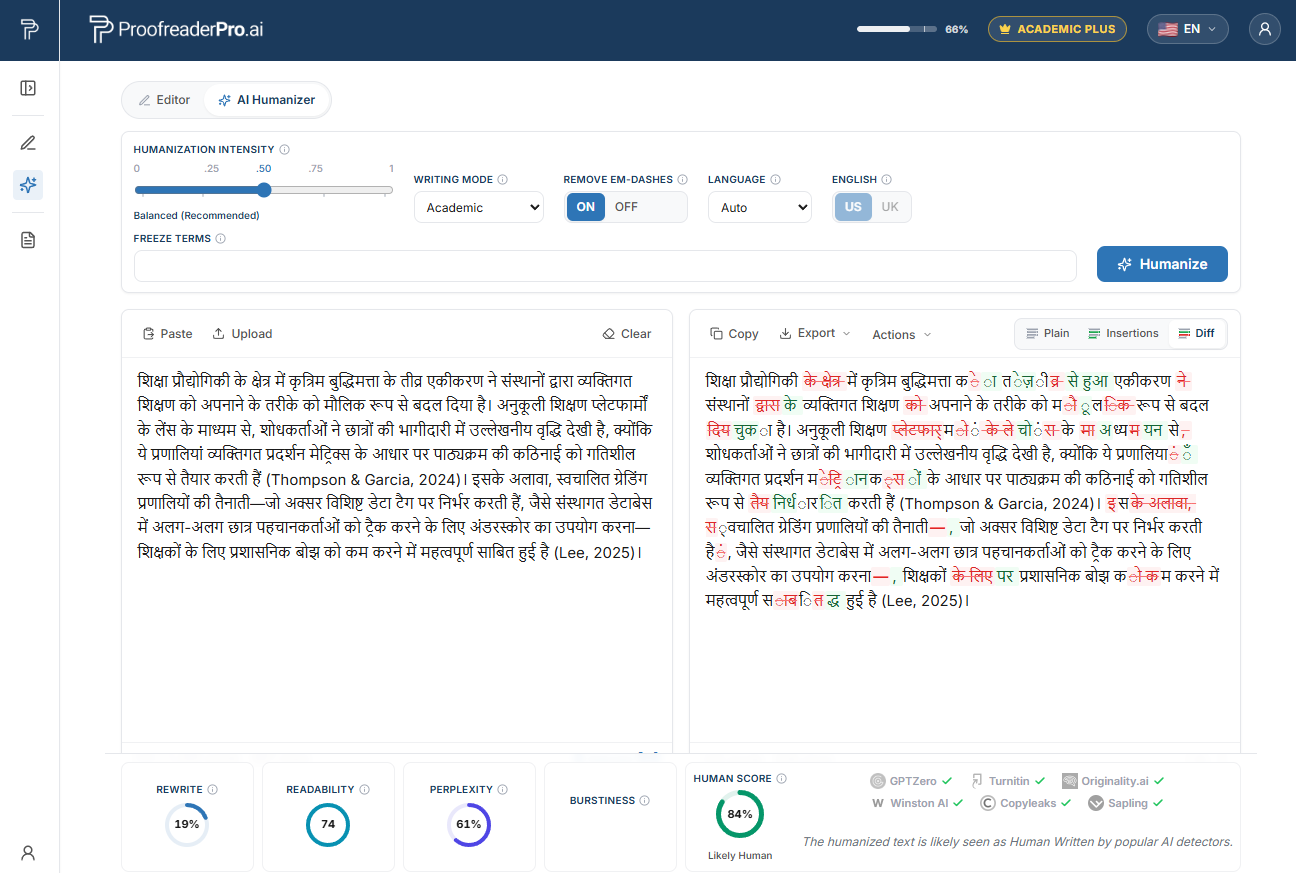
The ProofreaderPro AI Humanizer rewriting Hindi academic text. The before and after diff keeps your meaning and citations, and the detector checks confirm a natural, human read.
Why Indian researchers get flagged by AI detectors
In 2023, a Stanford team led by Liang and colleagues published a study in the Cell Press journal Patterns titled "GPT detectors are biased against non-native English writers." They ran human-written TOEFL essays through seven widely used detectors. On average, about 61% of the non-native essays were flagged as AI, compared with about 5% for native English writers. Nearly one in five non-native essays (about 19.8%) was flagged unanimously by every detector. Every essay was written by a human.
The mechanism is perplexity. Many detectors score how surprising each word choice is to a language model. Careful second-language writers use common words and standard, predictable phrasing, which produces low perplexity, which reads as machine text. The habits that make non-native academic prose clear and correct are the exact habits these tools were trained to flag. We cover this in detail in why AI detectors flag non-native writers.
The Hindi and regional-language patterns behind false flags
Indian academic English carries systematic influence from Hindi, Tamil, Bengali, Telugu, Marathi, and other first languages. These are not sloppy mistakes. They are the predictable, standardized ways careful writers compensate for the distance between their first language and English, and that predictability is exactly what a perplexity-based detector rewards with a high AI score.
Articles. Many Indian languages have no article system, so "the" versus "a" versus no article is a distinction that does not exist in Hindi. Writers who have trained themselves out of dropping articles often overcorrect into very regular, textbook phrasing such as "The experiment was conducted using a modified protocol." Correct, standard, and low perplexity.
Prepositions. Patterns such as "discuss about," "comprises of," and "interested on" transfer directly from Hindi. Once edited to the standard English form, the sentence lands on the most common, most predictable preposition every time, which is what a detector expects a model to produce.
Word order and agreement. Hindi follows subject-object-verb order. Indian researchers building long English sentences often reorganize them into the safest, most conventional subject-verb-object structure to stay correct. Safe and conventional also reads as low perplexity.
Tense consistency. English tense markers are more rigid than those in most Indian languages, so careful writers lock a methods section into uniform past tense. Uniform, regular, and predictable once again.
Sentence length. Indian academic prose tends toward longer, elaborately structured sentences. When these are trimmed to journal expectations, they often collapse into short, even, similarly shaped sentences that a detector reads as machine cadence.
India's AI-detection and Turnitin context
Theses and journal submissions in India are commonly screened with Turnitin or iThenticate for both similarity and AI indicators. Most universities run a mandatory plagiarism check before a thesis is accepted, and many now read the AI writing indicator on the same report. UGC guidance on academic integrity has made similarity screening a routine part of research evaluation.
It is worth being precise about what these tools actually do. Turnitin itself suppresses AI scores in the 1 to 19% range, showing an asterisk rather than a number, and warns that its score should not be used alone to make an integrity decision. Several institutions abroad, including Vanderbilt, went further and disabled Turnitin's AI detector in 2023, citing false positives and bias against non-native writers. Michigan State, UT Austin, Northwestern, Pittsburgh, SMU, and Waterloo took similar steps. A detector score is a claim to contest, not a verdict.
At the same time, funders and journals increasingly ask authors to disclose how they used AI. The sensible position for an Indian researcher is not to hide AI use. It is to write and edit carefully, protect that careful writing from a false flag, and then disclose exactly what you did.
Protect your careful English from a false AI flag
Humanize your own AI-assisted draft, keep your meaning and citations, then disclose. Built for Indian researchers writing for Scopus and Web of Science journals.
Try the Humanizer FreeTop Indian universities and where AI checks appear
India's research output is concentrated in a network of elite institutions, and each of them screens theses and manuscripts for similarity and AI before the work goes forward.
- IISc Bengaluru (भारतीय विज्ञान संस्थान): India's top-ranked research institution (NIRF 2025 number one), strongest in physical sciences, engineering, and biological sciences.
- IIT Madras, IIT Delhi, IIT Bombay, IIT Kharagpur, and IIT Kanpur (भारतीय प्रौद्योगिकी संस्थान): the original five IITs, consistently in the top ten for research in engineering, computer science, and materials science.
- IIT Roorkee, IIT Guwahati, and IIT Hyderabad: newer IITs with fast-growing research profiles across engineering and applied sciences.
- AIIMS New Delhi (अखिल भारतीय आयुर्विज्ञान संस्थान): India's premier medical research institution, publishing biomedical and clinical work in high-impact journals.
- Jawaharlal Nehru University (जवाहरलाल नेहरू विश्वविद्यालय): NIRF 2025 number two in the university category, strongest in social sciences and humanities.
- University of Delhi (दिल्ली विश्वविद्यालय): one of India's largest research universities, with broad coverage across the sciences and humanities.
- Banaras Hindu University (काशी हिन्दू विश्वविद्यालय): major output in the sciences, engineering, and Ayurvedic medicine.
- Jadavpur University: strong engineering and science research, consistently ranked in the top ten Indian universities.
- Homi Bhabha National Institute: nuclear science, physics, and engineering, affiliated with BARC and other DAE institutions.
Every one of these institutions requires researchers to publish in English-language international journals for career advancement, and every one of them runs the AI and similarity checks that a false flag can trip.
How the AI humanizer for Indian researchers works
The AI humanizer for Indian researchers is built around one workflow, not a shortcut. Here is the sequence we recommend.
First, draft. If it helps, write in the language you think in, Hindi or Tamil or Bengali, then translate into English, or draft in English with AI assistance. Second, proofread the grammar so articles, prepositions, and tenses are correct. Third, run the result through the text humanizer so your careful, standardized prose carries natural variation in rhythm and word choice, and is less likely to be misread as machine output. Your meaning, technical terminology, and citations stay exactly where you put them.
Our humanizer reworks AI text into a more natural human form, which lowers the AI signal and improves its odds against tough detectors (grammar accuracy stays high on academic text). This is based on testing, not guarantees. Detectors retrain every few months, so we describe what the tool has done, never promise that any text is permanently undetectable, and never treat this as a way to bypass a check.
Then disclose. Add an AI-use statement in the format your institution and your target journal require. Careful writing, protected from a false flag, followed by clear disclosure, keeps you inside integrity rules. This is the same principle behind our academic editing guide for researchers in India, and it sits within our wider multilingual AI humanizer hub.
Local funding bodies, journals, and AI-disclosure expectations
Researchers funded by DST-SERB, CSIR, ICMR, or DBT are expected to publish in international journals as part of their grant deliverables, and language editing is a recognized, allowable expense under most of these bodies. That matters, because it means using a proofreading and humanizing tool on an AI-assisted draft is a legitimate research cost, not a workaround.
Indian researchers publish across both international and domestic journals. Several prominent Indian titles expect publication-ready English and increasingly ask about AI use at submission:
- Current Science: India's oldest multidisciplinary journal, founded by C.V. Raman in 1932.
- Indian Journal of Medical Research (IJMR): open access, published by ICMR, English only and one of India's highest-impact journals.
- Pramana (Journal of Physics): Indian Academy of Sciences, co-published by Springer.
- Economic & Political Weekly (EPW): the premier social science journal, Scopus-indexed.
- Journal of Biosciences and Journal of Earth System Science: both from the Indian Academy of Sciences.
- Sadhana: engineering sciences from the Indian Academy of Sciences, ranked Q1 and Q2.
- The National Medical Journal of India: peer-reviewed clinical and medical research.
All Indian Academy of Sciences journals require English manuscripts. Wherever you submit, the safest habit is to disclose your AI use in the journal's required format, and to keep a short private note of what you did in case you ever need to appeal a false flag.
Frequently asked questions
Q: Is using an AI humanizer for Indian researchers a form of cheating?
No. The right use is to humanize your own AI-assisted draft, keep your meaning and citations intact, and then disclose your AI use in the format your institution and journal require. You are protecting careful, human research from a false flag, not disguising fabricated work or someone else's writing.
Q: Will the humanizer guarantee my paper passes Turnitin's AI detector?
No tool can promise that, and any tool that does is misleading you. Tested against the major detectors, our humanizer rewrites AI text into a more natural human form, which lowers the AI signal and improves its odds against tough detectors, and detectors keep retraining, so no result is permanent. We report what testing has shown, and we never claim text is permanently undetectable.
Q: Does it work for Hindi, Tamil, Bengali, and other Indian languages?
Yes. The humanizer supports more than 60 languages. You can draft in the language you think in, then move into academic English, and a language-aware model preserves your sentence structure and meaning. It handles the English interference patterns common to Hindi, Tamil, Bengali, Telugu, Marathi, and other first languages.
Q: Can I pay for this from my DST-SERB or CSIR grant?
Language editing is a recognized, allowable expense under most Indian funding bodies, including DST-SERB, CSIR, ICMR, and DBT. Editing and humanizing software subscriptions generally fall within allowable research costs. Check your specific grant terms to be sure.
Q: What happens to my citations and technical terms?
They stay exactly where you put them. The humanizer varies rhythm and word choice and removes repetitive cadence, but it preserves your meaning, your technical terminology, and every citation. You review the result before you submit.
Keep your meaning, terminology, and citations. Vary the rhythm detectors flag. Built for Indian researchers writing in English as a second or third language.

Moe is an NLP engineer with a PhD in natural language processing. His research covers computational linguistics, text analysis, and machine learning, and it fed directly into the editing and humanization models behind ProofreaderPro. He writes about the part of the process most people never see: how a language model reads a sentence, scores it, and decides what to change.