AI Humanizer for Vietnamese Researchers Writing in English
AI humanizer for Vietnamese researchers. Reduce false AI-detection flags on Vietnamese-influenced English, keep meaning and citations, disclose honestly.

Vietnam's research output has changed faster than almost any country in the developing world. Two regulations rewrote the rules. Circular 08/2017 made a Scopus or Web of Science publication a PhD graduation requirement, and Decision 37/2018 made ISI and Scopus papers mandatory for professor promotion. Vietnam now produces roughly 14,880 Web of Science papers a year, and every doctoral student must publish in English to graduate.
Many of these researchers now write with AI support, only to be subjected to detectors not designed to treat them fairly. For this gap, an AI humanizer for Vietnamese researchers exists: to keep careful, standard second-language English from being misread as machine writing, while you preserve your meaning and disclose your AI use the way your institution requires.
That is the real version of this tool. You are not hiding work. You are protecting real research from a false accusation, and there is good evidence the accusation is common.
Công cụ nhân hóa văn bản AI cho nhà nghiên cứu Việt Nam
Công cụ nhân hóa văn bản AI của ProofreaderPro.ai giúp nhà nghiên cứu Việt Nam công bố bằng tiếng Anh. It keeps your meaning, your technical terminology, and your citations intact, then varies rhythm and word choice so the prose reads the way a careful human wrote it.
The workflow is simple. You can draft in Vietnamese and translate, or write directly in English, then run the passage through our text humanizer. It works across more than 60 languages through a language-aware model that respects sentence structure instead of scrambling it. The goal is fairness for genuine work, not disguise.
Drafting in Vietnamese? The humanizer detects and processes it too
Not every draft starts in English, and the humanizer does not require it to. Paste Vietnamese text and ProofreaderPro recognises the tone marks and diacritics automatically, then routes it through a language-aware model that keeps your terminology and citations exactly as written. As a công cụ nhân hóa văn bản AI it rewrites your Vietnamese prose directly, so nothing needs to be translated first. Auto-detection covers more than sixty languages, each rewritten as itself.
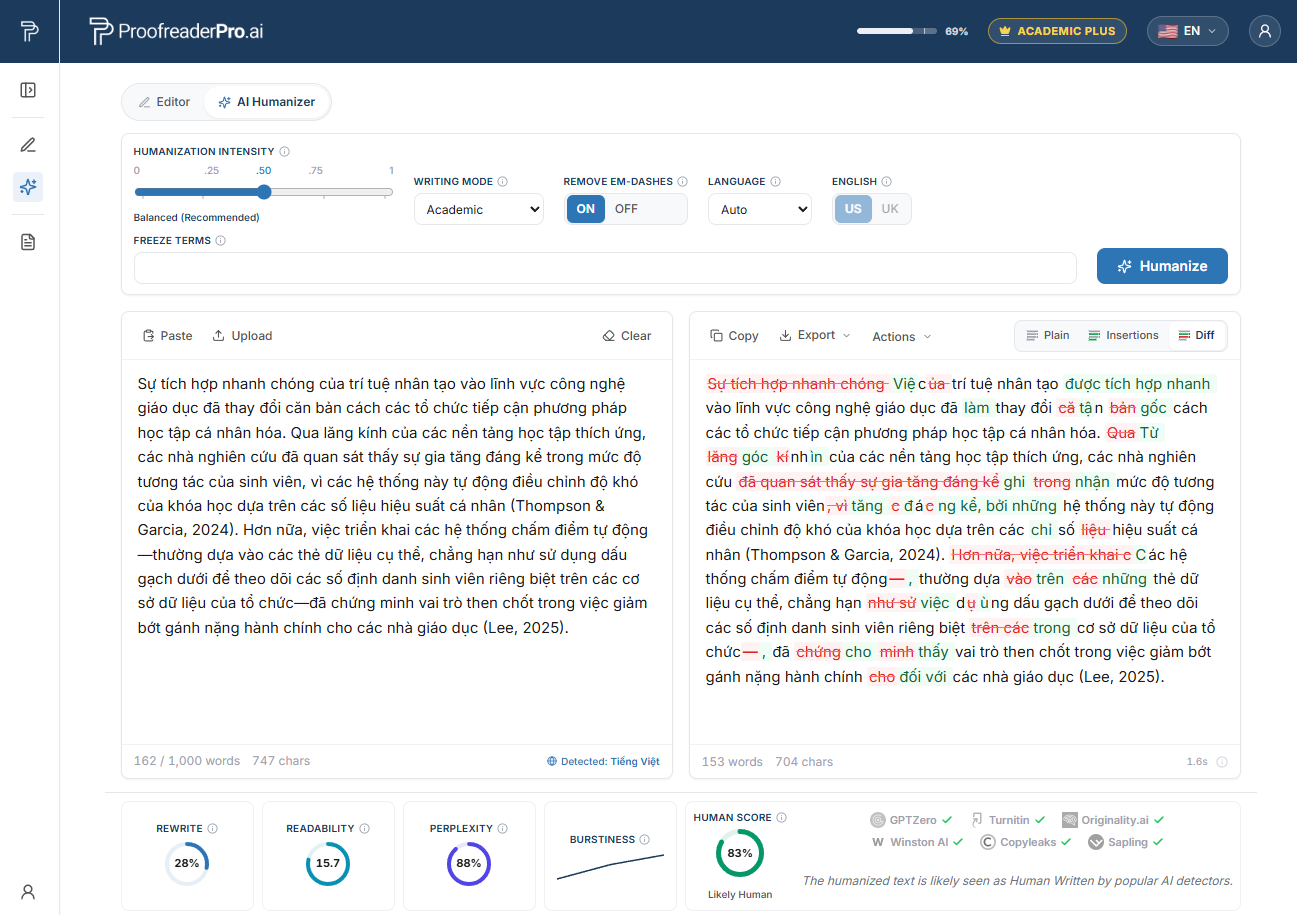
The ProofreaderPro AI Humanizer rewriting Vietnamese academic text. The before and after diff keeps your meaning and citations, and the detector checks confirm a natural, human read.
Why Vietnamese researchers get flagged by AI detectors
In 2023, a Stanford team led by Weixin Liang published a study in the Cell Press journal Patterns titled "GPT detectors are biased against non-native English writers." They ran human-written TOEFL essays through seven widely used detectors. On average, about 61% of the non-native essays were flagged as AI, compared with about 5% for native English writers. Nearly one in five non-native essays, about 19.8%, was unanimously flagged by every detector. Every single essay had been written by a human.
The mechanism is called perplexity. Many detectors score how surprising each word choice is to a language model. When a writer uses common words and standard, predictable phrasing, perplexity is low, and low perplexity reads as machine text. This is the trap for second-language writers. The very habits that make Vietnamese academic English clear and correct are the habits detectors learned to punish.
We explain the full mechanism in why AI detectors flag non-native writers. The short version: a detector score is a probability, not a verdict, and it is a probability tilted against you before you write a word.
The Vietnamese first-language patterns behind false flags
Vietnamese is an isolating language. Grammar rests on word order and function words rather than word endings, so Vietnamese speakers learn English grammar as a set of rules to apply consistently. That consistency is correct. It is also exactly what a perplexity model reads as predictable.
Consider a few patterns documented in Vietnamese English writing:
Article use. Vietnamese has no article system, so writers learn "a," "an," and "the" as deliberate choices and apply them in careful, standard positions. A sentence like "the results confirm the hypothesis" is textbook correct, and textbook correct is low perplexity.
Verb tense. Vietnamese marks time with particles (đã for past, đang for the present continuous, sẽ for the future) rather than changing the verb. Writers who have mastered English tense tend to use the safest, clearest forms, such as the plain present and past. Safe and clear scores as machine-like.
Plural and agreement. Vietnamese has no plural morphology and no subject-verb agreement, so Vietnamese researchers learn these as fixed rules and follow them exactly. Flawless agreement across a whole methods section is human, but a detector reads the regularity as generated.
Sentence rhythm. Careful second-language writers avoid risk. They keep clauses even, repeat reliable connectors, and rarely use the odd flourish a native writer throws in. That smooth, uniform cadence is the single strongest false signal a detector picks up.
None of these are errors. They are the marks of a disciplined writer who learned English well. Our humanizer restores natural variation to that prose without changing what it says.
Vietnam's AI-detection and Turnitin context
Vietnamese theses and journal submissions are commonly screened for text similarity and AI indicators, most often with Turnitin or iThenticate. Under Circular 08 and Decision 37, doctoral work and faculty portfolios face heavy scrutiny, and international journals add their own similarity and AI checks at submission.
It helps to know how these tools actually behave. Turnitin suppresses AI scores in the 1 to 19% range, showing an asterisk instead of a number, and it warns that its score should not be used alone for an integrity decision. Several major universities have gone further. Vanderbilt disabled Turnitin's AI detector in 2023, citing false positives and bias against non-native writers, and Michigan State, UT Austin, Northwestern, Pittsburgh, SMU, and Waterloo took similar steps.
The takeaway for Vietnamese researchers is practical. A flag is a claim you can contest, not proof of anything. If it happens to you, our guide to appealing a false AI detection flag walks through how to respond with evidence.
Protect your English from a false AI flag
Humanize your own AI-assisted draft, keep every citation and technical term, then disclose your AI use. Free to try, flat monthly pricing, more than 60 languages.
Try the Humanizer FreeTop Vietnam universities and where AI checks appear
These institutions screen theses and manuscripts for similarity and AI, and all of them require internationally indexed publications for doctoral graduation and faculty advancement under Circular 08 and Decision 37.
- Đại học Quốc gia Thành phố Hồ Chí Minh (Vietnam National University, Ho Chi Minh City, VNU-HCM), the country's largest research producer with 3,288 Scopus papers in 2025.
- Đại học Quốc gia Hà Nội (Vietnam National University, Hanoi, VNU), Vietnam's oldest national university.
- Đại học Bách khoa Hà Nội (Hanoi University of Science and Technology, HUST), known as the "MIT of Vietnam."
- Đại học Tôn Đức Thắng (Ton Duc Thang University, TDTU), a fast-rising research university in Ho Chi Minh City.
- Đại học Duy Tân (Duy Tan University, DTU), a Da Nang private university with rapidly rising citation impact.
- Đại học Cần Thơ (Can Tho University, CTU), the Mekong Delta's leading university, strong in agriculture and aquaculture.
- Đại học Y Dược Thành phố Hồ Chí Minh (University of Medicine and Pharmacy at Ho Chi Minh City), a leading medical research institution.
- Đại học Y Hà Nội (Hanoi Medical University, HMU), a center for medical and public health research.
- Đại học Phenikaa (Phenikaa University), a new private university with fast-growing research output.
- Đại học Huế (Hue University), central Vietnam's largest university.
- Đại học Kinh tế Thành phố Hồ Chí Minh (University of Economics Ho Chi Minh City, UEH), home to Vietnam's first social science journal indexed in Scopus.
- Viện Hàn lâm Khoa học và Công nghệ Việt Nam (Vietnam Academy of Science and Technology, VAST), a major national research institute that publishes several indexed journals.
How the AI humanizer for Vietnamese researchers works
The AI humanizer for Vietnamese researchers follows a clear, four-step workflow that keeps you inside integrity rules.
First, draft. Write in Vietnamese and translate to academic English, or write directly in English with AI assistance. Second, proofread the grammar so the article use, tense, and agreement are correct. Third, run the clean draft through our text humanizer, which preserves your meaning, terminology, and citations while restoring the natural variation in rhythm and word choice that careful non-native prose tends to lose. Fourth, disclose your AI use in the format your university and target journal require.
Tested against the major detectors, our humanizer rewrites AI text into a more natural human form, which lowers the AI signal and improves its odds against tough detectors, while keeping grammar accuracy high on academic text. These are results from testing, not guarantees. Detectors retrain every few months, so we report what we measured and never promise a number. The point is to give genuine work a fair reading, not to bypass anything.
This humanizer is one spoke of our multilingual AI humanizer hub, which covers the same fairness problem across languages. If your first need is grammar and clarity rather than detection, start with our academic editing guide for researchers in Vietnam, then humanize the polished draft.
Local funding bodies, journals, and AI-disclosure expectations
Vietnam's two major research funders both tie money to international publication, which raises the stakes on every English manuscript. NAFOSTED (Quỹ Phát triển khoa học và công nghệ Quốc gia) requires principal investigators to hold recent ISI papers and to produce indexed outputs from funded projects. VINIF (Quỹ Đổi mới sáng tạo Vingroup), funded by the Vingroup conglomerate, expects SCIE and SSCI articles from its postdoctoral fellows and keeps a narrowed list of accepted journals.
Vietnam has journals indexed in Web of Science and Scopus that increasingly expect clean, disclosed English. Prominent titles include:
- Vietnam Journal of Science and Technology (VAST, Scopus indexed)
- Vietnam Journal of Science, Technology and Engineering (Ministry of Science and Technology, fully English since 2017)
- Advances in Natural Science: Nanoscience and Nanotechnology (VAST)
- Vietnam Journal of Earth Sciences (VAST)
- Vietnam Journal of Chemistry (VAST)
- Vietnam Journal of Mathematics (Springer, Scopus and WoS indexed)
- Journal of Asian Business and Economic Studies (UEH, the first Vietnamese social science journal in Scopus)
More funders and journals now ask authors to state where AI assisted their writing. A clear disclosure line protects you, and our guide to writing an AI-disclosure statement shows the format most journals accept. Disclose, do not hide, and let the humanizer make sure your careful English is read as your own.
Frequently asked questions
Q: Is using an AI humanizer for Vietnamese researchers cheating?
No, not when you use it properly. You humanize your own AI-assisted draft, keep your meaning and citations intact, and then disclose your AI use in the way your institution and journal require. The tool protects careful non-native English from a false flag. It is not a way to submit someone else's work or to hide fabricated results.
Q: Can the humanizer guarantee my paper passes Turnitin or GPTZero?
No, and any tool that promises 100% is not being straight with you. Tested against the major detectors, our humanizer rewrites AI text into a more natural human form, which lowers the AI signal and improves its odds against tough detectors, but detectors retrain often. We report tested results, never guarantees.
Q: Will it change my citations or my Vietnamese technical terms?
No. The humanizer preserves your citations, your meaning, and your technical terminology. It varies sentence rhythm and word choice and removes repetitive cadence, so the argument and the references you built stay exactly where you put them.
Q: Can I draft in Vietnamese first?
Yes. You can write in Vietnamese, translate to academic English, then proofread and humanize in the same platform. The humanizer supports more than 60 languages through a language-aware model, so structure and meaning survive the process.
Q: Why do Vietnamese researchers get flagged when the writing is human?
Because many detectors score perplexity, and careful second-language English uses common words and predictable, standard phrasing that reads as low perplexity. A Stanford study found about 61% of human-written non-native essays were flagged as AI, versus about 5% for native writers. The regularity that marks a disciplined writer is what the detector misreads.
Keep your meaning, citations, and Vietnamese technical terms. Restore natural rhythm to careful non-native prose, then disclose your AI use with confidence.

Moe is an NLP engineer with a PhD in natural language processing. His research covers computational linguistics, text analysis, and machine learning, and it fed directly into the editing and humanization models behind ProofreaderPro. He writes about the part of the process most people never see: how a language model reads a sentence, scores it, and decides what to change.