AI Humanizer for Sri Lankan Researchers Writing in English
AI humanizer for Sri Lankan researchers. Reduce false AI-detection flags on Sinhala and Tamil influenced English, keep meaning and citations, disclose honestly.

Sri Lanka ranks 98th on the Nature Index, with 17 national universities, 6,064 researchers, and only one SCIE-indexed journal inside its borders. That means nearly every paper that counts toward a promotion has to clear the language bar at a journal based somewhere else, in English. An AI humanizer for Sri Lankan researchers exists for one real reason: careful, correct second-language English is now being misread as machine writing, and that costs real people real publications.
The problem, simply put, is this. Sri Lanka has an overall EF English Proficiency Index score of 486, putting it firmly within the "Low Proficiency" range. Around 10% of the country's population is fluent in English. The error rate for Sinhala speakers trying to write English academic texts stands at 54%. Those that speak Tamil are no better off thanks to patterns common to that language. In many cases, it's sound science. The English trips up submissions.
Now add AI detectors to that pressure. When you write in the plain, standard, predictable English that a second-language writer is trained to aim for, a detector can flag your genuinely human paragraphs as machine-generated. This guide explains why, how it maps onto Sinhala and Tamil, and how to humanize your own AI-assisted draft without hiding anything.
ශ්රී ලාංකික පර්යේෂකයන් සඳහා AI පෙළ මානවකරණය
AI පෙළ මානවකරණය ශ්රී ලාංකික පර්යේෂකයන්ට තම පර්යේෂණ ඉංග්රීසියෙන් ප්රකාශයට පත් කිරීමට උපකාර කරයි.
In plain English: our text humanizer helps researchers across Sri Lanka turn careful Sinhala-influenced or Tamil-influenced academic prose into natural English, without altering your findings, your terms, or your citations. It varies rhythm and word choice so that careful non-native writing is less likely to be misread as machine output.
This matters equally for Tamil-medium researchers, especially at the University of Jaffna, who move from Tamil into English publication. Both communities meet the same wall, and both benefit from the same workflow: write, proofread, humanize your own draft, then disclose.
Drafting in Sinhala or Tamil? The humanizer detects and processes it
Not every draft begins in English, and the humanizer does not require it to. Paste Sinhala text and ProofreaderPro recognises the script on its own, then routes it through a language-aware model that keeps your terminology and citations exactly as written. As AI පෙළ මානවකරණය it rewrites your Sinhala prose directly, so you can humanize before you translate rather than after. The same detection covers more than sixty languages, so a Tamil draft is recognised and humanized just as readily.
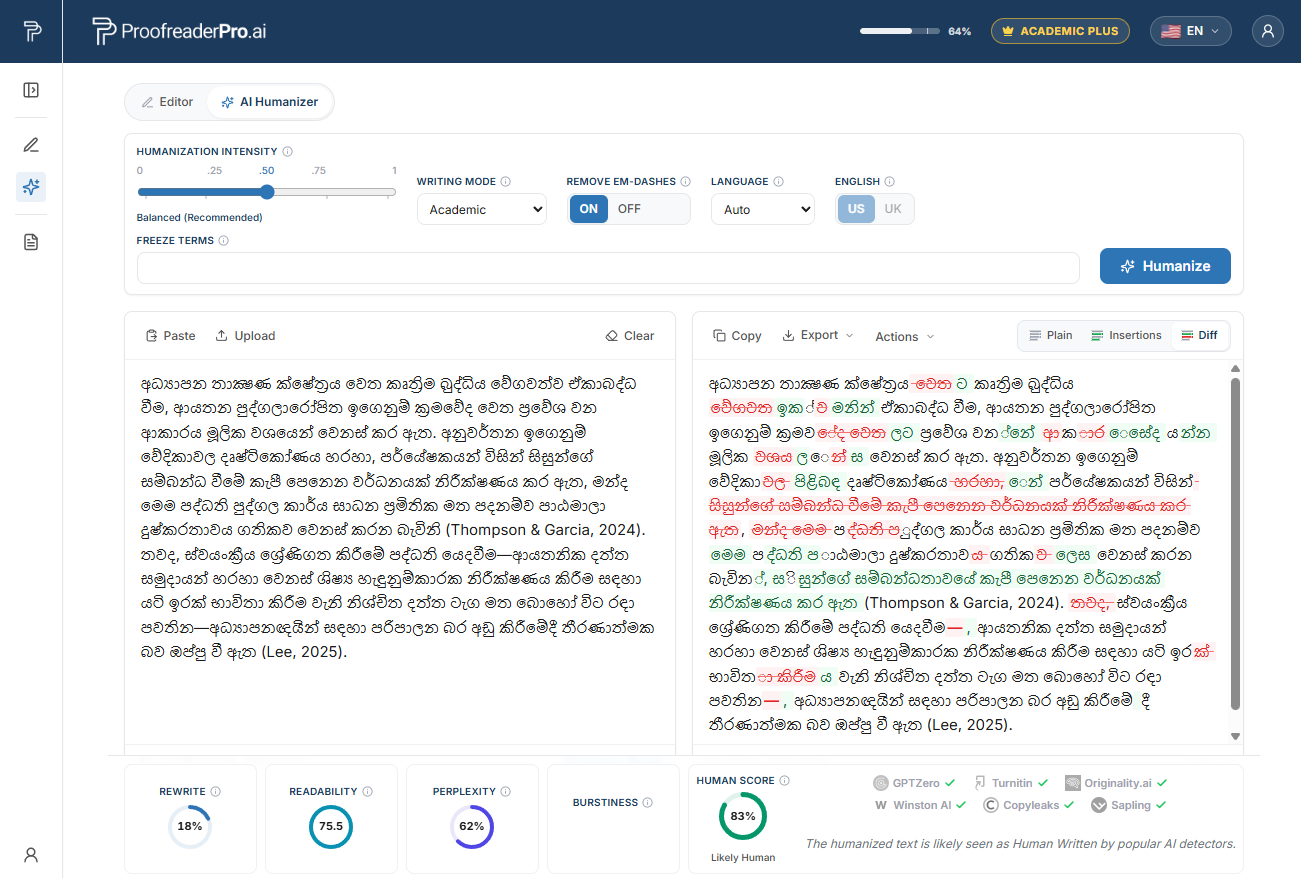
The ProofreaderPro AI Humanizer rewriting Sinhala academic text. The before and after diff keeps your meaning and citations, and the detector checks confirm a natural, human read.
Why Sri Lankan researchers get flagged by AI detectors
In 2023, a Stanford team led by Liang and colleagues published a study in the Cell Press journal Patterns titled "GPT detectors are biased against non-native English writers." They ran human-written TOEFL essays through seven widely used AI detectors. On average, about 61% of the non-native essays were flagged as AI, against about 5% for native English writers. Nearly one in five non-native essays (about 19.8%) was unanimously flagged by every detector. Every single essay was written by a human.
The mechanism explains the injustice. Many detectors score "perplexity," a measure of how surprising each word choice is to a language model. Careful second-language writers reach for common words and standard, predictable phrasing. That produces low perplexity, which the detector reads as machine text. The habits that make Sri Lankan academic prose clear and correct are the exact habits these tools were trained to punish.
You can read the full mechanism in our explainer on why AI detectors flag non-native writers. The short version: a flag on your writing is often a statement about your English proficiency, not about whether a machine wrote it.
The Sinhala and Tamil first-language patterns behind false flags
The features that make second-language English read as low perplexity are not mistakes. They are correct, careful, standard constructions. The more diligently you clean them up, the more conventional your prose becomes, and conventional is exactly what a perplexity-based detector treats as suspicious.
Article omission. Neither Sinhala nor Tamil has an article system equivalent to English. There is no direct translation of "the," "a," or "an" in either language, and article omission accounts for about 51% of all article-related errors in Sri Lankan academic writing. A writer who corrects "Result showed that method was effective" into "The result showed that the method was effective" has produced a flawless, utterly standard sentence. That standardness is what scores as low perplexity.
Copula and be-verb dropping. Both languages routinely drop the copula. In Sinhala, "Oya lassanai" means "She is beautiful" with no "is." In Tamil, "Avan periyavan" means "He is big" with no "is." In writing this surfaces as "The result significant at p < 0.05." Once corrected to "The result was significant at p < 0.05," the sentence is textbook conventional English, the kind detectors expect from a model.
Tense from simpler systems. Tamil works with three tenses against English's twelve tense-aspect combinations, and Sinhala, while richer, still lacks English perfect and progressive forms. So "We collected samples since 2019" becomes the corrected "We have collected samples since 2019." Careful, journal-standard tense usage is highly predictable, and predictable prose is what gets flagged.
Prepositions from postpositions. Sinhala and Tamil place markers after the noun. Sinhala "mese uda" is literally "table on," and Tamil "mesei mel" does the same. That yields "in the table" where English wants "on the table." When you learn the correct prepositions and apply them consistently, you produce some of the most standard English possible, which is again low perplexity.
Pronoun and register patterns. Sinhala selects pronouns by social register rather than the strict he, she, it system, and Tamil uses a gender-neutral formal pronoun ("avar") alongside gendered forms. Correcting these into consistent English pronouns produces smooth, conventional prose. None of this is cheating. It is skilled second-language writing that a detector cannot tell from a machine.
Sri Lanka's AI-detection and Turnitin context
Theses and journal submissions in Sri Lanka are commonly screened with Turnitin or iThenticate for text similarity, and those tools now surface AI indicators alongside the similarity score. Under UGC promotion criteria, careers are tied to indexed publication, so a single misread flag can stall a manuscript that a Sri Lankan researcher has worked on for months.
It helps to know that the tools themselves are contested. Vanderbilt disabled Turnitin's AI detector in 2023, citing false positives and bias against non-native writers, and Michigan State, UT Austin, Northwestern, Pittsburgh, SMU, and Waterloo took similar steps. Turnitin suppresses scores in the 1 to 19% range, showing an asterisk rather than a number, and warns that its score should not be used alone to decide an integrity case.
The takeaway is practical. A detector score is a claim you can contest, not a verdict. Journals and funders increasingly ask for AI-use disclosure, and the right response is to write plainly and disclose clearly, not to hide the tools you used.
Protect your careful English from a false flag
Humanize your own AI-assisted draft in Sinhala-influenced or Tamil-influenced English. Keep your meaning, your terminology, and your citations, then disclose your AI use the way your journal requires.
Try the Humanizer FreeTop Sri Lanka universities and where AI checks appear
Sri Lanka's 17 national universities all operate under UGC promotion criteria that require indexed publication, and all screen theses and manuscripts for similarity and AI indicators before they go out:
- University of Colombo, Colombo. The leading university by most measures and the largest producer of Scopus-indexed publications in the country.
- University of Peradeniya, Peradeniya, Kandy. The largest campus in Sri Lanka, strong in agriculture, science, engineering, and veterinary medicine.
- University of Moratuwa, Moratuwa. The premier engineering university, leading in civil engineering, computer science, and architecture.
- University of Kelaniya, Kelaniya. Strong in humanities, social sciences, science, and commerce, with growing output in health sciences.
- University of Jaffna, Jaffna. The leading university in the Northern Province and particularly significant for Tamil-medium researchers moving into English publication.
- University of Sri Jayewardenepura, Nugegoda. Strong in management, applied sciences, and medical sciences.
- University of Ruhuna, Matara. The leading university in the Southern Province, strong in agriculture, fisheries, engineering, and medicine.
- University of Rajarata, Mihintale. Focused on agriculture, social sciences, and technology, with growing work in heritage and environmental studies.
- Sabaragamuwa University of Sri Lanka, Belihuloya. Strong in food science, agriculture, and geomatics.
- Wayamba University of Sri Lanka, Makandura and Kuliyapitiya. Specialized in agriculture and technology, notable in food technology and biotechnology.
- Uva Wellassa University, Badulla. Focused on science and technology, with growing research in animal science and computing.
- Open University of Sri Lanka, Nawala. The country's distance education institution, serving working professionals who pursue research careers.
With only 6,064 active researchers nationally, the demand for language support runs high, and almost all of them need to protect careful non-native prose from being flagged.
How the AI humanizer for Sri Lankan researchers works
Here is the workflow. Draft your argument first, optionally in Sinhala or Tamil where the reasoning flows most naturally, then translate it into English. Proofread the grammar so the article, copula, tense, and preposition patterns above are corrected. Then run your own AI-assisted draft through our text humanizer so the careful, standardized prose regains natural human rhythm and is less likely to be misread. Your meaning, terminology, and citations stay intact.
We are specific about results because you deserve honesty, not hype. Tested against the major detectors, the humanizer rewrites AI text into a more natural human form, which lowers the AI signal and improves its odds against tough detectors, while keeping grammar accuracy high on academic text. Those are results from testing, not guarantees. Detectors retrain every few months, so no credible tool can promise to be 100% undetectable or to bypass a checker permanently.
Then comes the step that keeps you safe: disclose. State your AI use in the format your institution and target journal require. Humanizing your own writing to protect it from a false flag, and then disclosing that you used AI assistance, is the opposite of hiding. It is fairness for real work. If you also need grammar and structure fixed first, our companion guide on academic editing for Sri Lankan researchers walks through that side, and this post sits inside our multilingual AI humanizer hub covering the same workflow across languages.
Local funding bodies, journals, and AI-disclosure expectations
Sri Lanka's main funders tie money to published output. The National Science Foundation (NSF) funds Competitive Research Grants and evaluates renewals on publication in internationally recognized journals. The National Research Council (NRC) offers grants of up to Rs 50 million over 5 years, with proportionate publication expectations. The University Grants Commission (UGC) requires a minimum of 12 marks from journal articles for promotion, with 5 outstanding papers for senior positions, and assigns the highest marks to SCIE, SSCI, and Scopus-indexed journals.
The journal landscape at home is small. The Journal of the National Science Foundation of Sri Lanka (JNSF) is the country's only SCIE-indexed journal, holding that indexing for 14 consecutive years. Alongside it sit the Ceylon Journal of Science, one of the oldest scientific journals in South Asia; the Ceylon Medical Journal, published by the Sri Lanka Medical Association since 1887; the Sri Lanka Journal of Social Sciences; the Journal of the Rubber Research Institute of Sri Lanka; and Tropical Agricultural Research from the Postgraduate Institute of Agriculture at Peradeniya. SLJOL (Sri Lanka Journals Online) hosts 172 national journals for open access.
Because virtually all highly weighted journals publish in English and sit outside the country, most careers depend on international submission, where editors increasingly expect an AI-use disclosure statement. Write your disclosure plainly, keep it accurate, and if you are ever flagged unfairly, treat it as a claim to answer, not a judgment to accept. Our guides on writing an AI disclosure statement and on how to appeal a false AI detection flag cover both cases.
Frequently asked questions
Q: Is an AI humanizer for Sri Lankan researchers a way to cheat Turnitin?
No. The proper use is to humanize your own AI-assisted draft so that careful Sinhala or Tamil influenced English is not misread as machine text, while your meaning and citations stay exactly as you wrote them. You then disclose your AI use in the format your journal requires, which keeps you inside integrity rules. That is the opposite of hiding anything.
Q: Why do AI detectors flag my writing when I wrote every word myself?
Because many detectors score perplexity, meaning how predictable your word choices are. Careful second-language writers use common words and standard phrasing, which produces low perplexity that reads as machine output. A 2023 Stanford study found about 61% of human-written non-native essays flagged as AI, against about 5% for native writers, so the pattern is documented and not your fault.
Q: Does the humanizer work for Sinhala and Tamil influenced English?
Yes. It is language-aware and supports more than 60 languages, so it recognizes the article omission, copula dropping, tense simplification, and postposition-driven preposition patterns that both Sinhala and Tamil speakers carry into English. It varies rhythm and word choice while preserving your technical terms, findings, and references.
Q: Can you guarantee my paper will pass every AI detector?
No, and you should distrust any tool that promises this. Tested against the major detectors, our humanizer rewrites AI text into a more natural human form, which lowers the AI signal and improves its odds against tough detectors, while keeping grammar accuracy high. Those are test results, not guarantees, because detectors retrain every few months.
Q: Will humanizing change my citations or my results?
No. The humanizer preserves your meaning, your technical terminology, and your citations in APA, MLA, Chicago, or IEEE. It adjusts rhythm and phrasing and removes repetitive cadence and stray em dashes, so the science you reported stays identical while the prose reads naturally.
A language-aware AI text humanizer for Sri Lankan researchers. Keep your meaning, terminology, and citations while careful Sinhala and Tamil influenced English reads naturally and fairly.

Moe is an NLP engineer with a PhD in natural language processing. His research covers computational linguistics, text analysis, and machine learning, and it fed directly into the editing and humanization models behind ProofreaderPro. He writes about the part of the process most people never see: how a language model reads a sentence, scores it, and decides what to change.