AI Humanizer for Spanish Researchers Writing in English
AI humanizer for Spanish researchers. Reduce false AI-detection flags on Spanish-influenced English, keep meaning and citations, disclose honestly.

Spain is one of Europe's larger research producers, consistently in the world's top 10 to 12 by output. Almost all of that work reaches its readers in English, a second language for most of the people who write it. That gap, between thinking in Spanish and publishing in English, is exactly where an AI humanizer for Spanish researchers earns its place.
Here is the problem nobody planned for. AI writing detectors now sit inside the tools that screen theses and journal submissions. They were built to catch machine text, but they routinely flag careful, correct, human writing by non-native English speakers. Your prose is not the issue. Its predictability is.
A researcher in Madrid or Barcelona who drafts in Spanish, translates, and edits toward clean academic English can end up looking more like a machine than a careless native speaker who never touched a language tool. This post is about closing that gap openly: improving your own draft, keeping your meaning and your citations, and disclosing your AI use the way your university and your journal expect.
Un humanizador de texto de IA para investigadores españoles
Nuestro humanizador de texto de IA ayuda a los investigadores españoles a publicar en inglés sin que su escritura cuidada se confunda con texto generado por una máquina. Conserva tu significado, tu terminología técnica y tus citas, y varía el ritmo y la elección de palabras que un detector interpreta como automáticas.
In plain terms, the tool reworks the rhythm and word choice of your own draft so that careful second-language prose is less likely to be misread, while your argument and your references stay exactly where you put them. It is built for real work by real authors, not for disguising anything.
Also humanize your Spanish directly, not only your English
You do not have to move into English before humanizing your work. Paste a passage in Spanish and ProofreaderPro detects the language automatically, then routes it through a Spanish-aware model that keeps accents, terminology, and citations exactly as written. As a humanizador de texto de IA it works on your Spanish draft just as it does on your English, preserving meaning while the phrasing reads naturally. Detection covers more than sixty languages, so Spanish is rewritten as Spanish, not flattened into English.
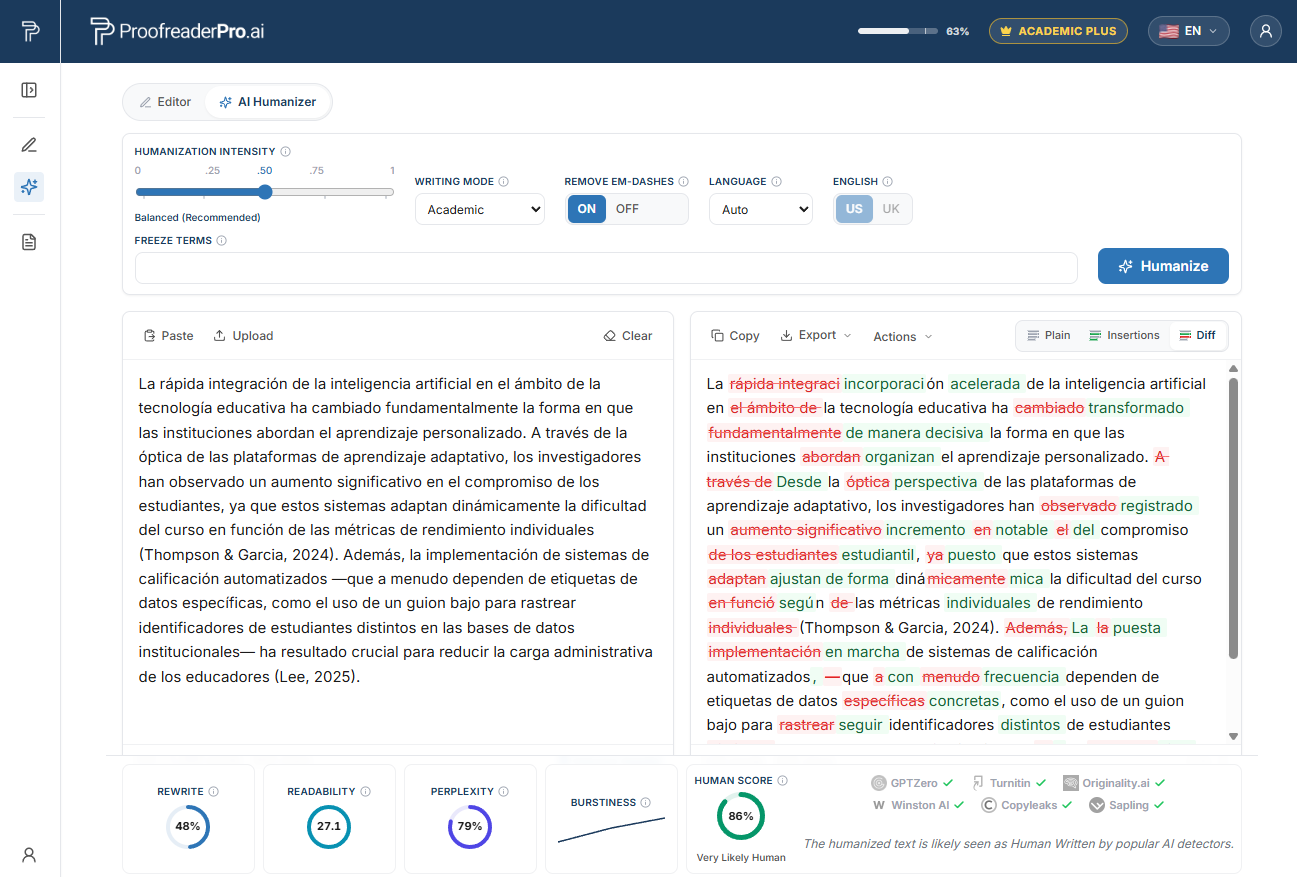
The ProofreaderPro AI Humanizer rewriting Spanish academic text. The before and after diff keeps your meaning and citations, and the detector checks confirm a natural, human read.
Why Spanish researchers get flagged by AI detectors
The clearest evidence comes from a 2023 Stanford study by Liang and colleagues, published in the Cell Press journal Patterns under the title "GPT detectors are biased against non-native English writers." The team ran human-written TOEFL essays through seven widely used detectors.
The result should worry anyone who publishes in a second language. About 61% of the non-native essays were flagged as AI on average, compared to about 5% for native English writers. Nearly one in five non-native essays, about 19.8%, was flagged unanimously by all detectors. All essays were written by humans.
The mechanism is called perplexity: a measure of how surprising each word choice is to a language model. Careful second-language writers reach for common words and standard, predictable phrasing, which produces low perplexity, which a detector reads as machine text. The very habits that make Spanish researchers' English clear and correct are the habits these tools were trained to flag. We unpack the full mechanism in our guide to why AI detectors flag non-native writers.
The Spanish first-language patterns behind false flags
Spanish is a Romance language, and its patterns carry into English in ways that are perfectly correct yet highly regular. That regularity is the trap. Here are the ones we see most in Spanish authors' manuscripts.
False cognates. "Actual" and "actually" get used for "current" and "currently" (Spanish "actual" means current), "realize" stands in for "carry out" (realizar), "assist" for "attend" (asistir), and "sensible" for "sensitive." Each is a standard, learnable substitution, which is exactly why it reads as predictable.
Article overuse with abstract nouns. Spanish places definite articles before generic nouns, so "the research shows," "the science," and "the society" appear where English drops the article. It is a consistent, rule-driven pattern, and consistency is what lowers perplexity.
Long, subordinate-heavy sentences. Romance academic style favors long periodic sentences with stacked relative clauses. They are grammatically sound, but their even, clause-after-clause cadence looks machine-smooth to a detector.
Preposition transfer. "Depend of" (depender de), "consist on" (consistir en), "different to," and "in relation with" come straight from Spanish government of prepositions. Careful and systematic, and therefore easy for a model to predict.
Heavy nominalization and word order. Constructions like "the realization of the analysis of" pile abstract nouns in a fixed shape. Add relative "which" overuse and a calqued "On the other hand" opening many sentences, and the text becomes strikingly regular.
None of these is an error of thought. They are correct, careful, standard constructions, and that standardness is precisely what a detector scores as low perplexity, and low perplexity is what it labels as machine text.
Spain's AI-detection and Turnitin context
The career advancement of Spanish academics depends on the sexenios de investigación, the six-year research assessment through ANECA and CNEAI, rewarding papers published in journals listed in the Journal Citation Reports (Web of Science) and Scopus. This system creates a constant drive for Spanish researchers to publish in high-impact English-language journals, where detectors now wait.
Theses in Spain are deposited in institutional repositories such as TDX and in the national TESEO registry, and similarity screening with Turnitin or iThenticate is routine before that point. Increasingly, the same platforms surface an AI indicator alongside the similarity score.
It helps to keep that indicator in proportion. Vanderbilt disabled Turnitin's AI detector in 2023, citing false positives and bias against non-native writers, as did Michigan State, UT Austin, Northwestern, Pittsburgh, SMU, and Waterloo. Turnitin suppresses scores in the 1 to 19% range and cautions against relying solely on the score for integrity decisions. A detector flag is a claim to contest, not a verdict, and funders and journals increasingly ask for a plain disclosure of how AI was used rather than a guessed percentage.
Protect your careful English from a false AI flag
Humanize your own AI-assisted draft while keeping every citation and technical term in place, then disclose your AI use the way your journal asks.
Try the Humanizer FreeTop Spanish universities and where AI checks appear
Spanish research is spread across a strong public university system, and these institutions screen theses and manuscripts for similarity, commonly with Turnitin, and increasingly weigh AI indicators too:
- Universitat de Barcelona (UB), Barcelona
- Universidad Autónoma de Madrid (UAM), Madrid
- Universidad Complutense de Madrid (UCM), Madrid
- Universitat Autònoma de Barcelona (UAB), Barcelona
- Universitat de València (UV), Valencia
- Universidad de Granada (UGR), Granada
- Universidad Politécnica de Madrid (UPM), Madrid
- Universitat Politècnica de València (UPV), Valencia
- Universidad de Sevilla (US), Seville
- Universidad del País Vasco / Euskal Herriko Unibertsitatea (UPV/EHU), Bilbao
- Universidad de Salamanca (USAL), Salamanca
- Universitat Pompeu Fabra (UPF), Barcelona
- Universidad de Navarra (UNAV), Pamplona
- Universidad de Zaragoza (UNIZAR), Zaragoza
Whether your thesis lands at UB, UAM, or UNIZAR, the screening step is much the same, and so is the risk that careful second-language English gets read the wrong way.
How the AI humanizer for Spanish researchers works
The workflow is simple, and it keeps you inside the rules. Draft your paper the way that lets you think best, often in Spanish first, then translate. Fix the grammar so the meaning is exact; if you want a second pass on the English itself, our guide to AI proofreading for Spanish researchers walks through that step. Only then do you humanize your own AI-assisted prose so that careful, low-perplexity writing is less likely to be misread.
That last step is what our AI humanizer does. It preserves your meaning, your technical terminology, and your citations, and it varies the rhythm and word choice that a detector reads as machine cadence. It supports more than 60 languages, routing non-English text through a language-aware model that keeps sentence structure and sense intact.
We're careful about what we claim. The humanizer rewrites AI text into a more natural human form, which lowers the AI signal and improves its odds against tough detectors, tested against the major detectors. It also does better than 96% for grammar on academic text. Those are results from testing, not guarantees. Detectors retrain every few months, so we never promise a number or a way to "bypass" anything.
Then you disclose. Add an AI-use statement in the format your institution and target journal require, so the tool protects careful writing without hiding how it was produced. This spoke sits inside our multilingual AI humanizer hub, and it pairs with our global academic editing hub if you want a human editing layer on top.
Local funding bodies, journals, and AI-disclosure expectations
Competitive funding in Spain flows through the Agencia Estatal de Investigación (AEI) and the Ministerio de Ciencia, Innovación y Universidades, while the Consejo Superior de Investigaciones Científicas (CSIC) is the country's largest public research organization. Academic posts are accredited by ANECA, and FECYT awards a quality seal to Spanish scholarly journals, so indexing and language quality both carry real weight for a Spanish career.
On the publishing side, Spanish researchers target Web of Science (JCR) and Scopus-indexed journals, with national and disciplinary indices mattering in some fields, and theses reaching TDX and the TESEO registry. Across these bodies, AI-use disclosure is moving from optional to expected. The safe posture is the same everywhere: use the tools on your own work, keep your citations exact, and state plainly how AI helped. Run that final pass through the humanizer and you protect the writing without misrepresenting it.
Frequently asked questions
Q: Is using an AI humanizer for Spanish researchers considered cheating?
Not when you use it on your own AI-assisted draft and then disclose it. The tool rephrases the rhythm of writing you already produced, keeping your meaning and citations, so that careful non-native English is not misread as machine text. Disclosing your AI use in the format your journal or university requires is what keeps the whole process inside integrity rules.
Q: Will a humanizador de texto de IA change my citations or technical terms?
No. The humanizer is built to preserve technical terminology, references, and the structure of your argument while it varies word choice and cadence. Your citation keys, figures, and specialist vocabulary stay exactly where you placed them, because changing them would defeat the purpose.
Q: Why does my correct English get flagged as AI in the first place?
Because many detectors score perplexity, or how predictable your word choices are. Careful Spanish writers use common words and standard phrasing, which produces low perplexity, which reads as machine text. In the Stanford study, about 61% of human-written non-native essays were flagged, against roughly 5% for native writers, so a flag on your work is common and contestable.
Q: What pass rates has the humanizer actually reached?
Tested against the major detectors, it rewrites AI text into a more natural human form, which lowers the AI signal and improves its odds against tough detectors, while keeping grammar accuracy high on academic text. These are results from testing, not guarantees. Detectors retrain often, so we describe what we measured rather than promising a fixed outcome.
Q: My thesis will be screened with Turnitin at my university. What should I do?
Treat the AI indicator as one signal, not a verdict. Write in the language that lets you think best, edit for accuracy, humanize your own draft to reduce the chance of a false flag, and attach a clear AI-use disclosure. If a flag still appears, you have the evidence of your own drafting process to contest it.
A language-aware humanizer that keeps your meaning, terminology, and citations intact while reducing the false AI flags that hit careful Spanish authors.

Moe is an NLP engineer with a PhD in natural language processing. His research covers computational linguistics, text analysis, and machine learning, and it fed directly into the editing and humanization models behind ProofreaderPro. He writes about the part of the process most people never see: how a language model reads a sentence, scores it, and decides what to change.