AI Humanizer for Colombian Researchers Writing in English
AI humanizer for Colombian researchers. Reduce false AI-detection flags on Spanish-influenced English, keep meaning and citations, disclose honestly.

The country produces around 25,000 to 30,000 Scopus indexed papers per year, making it number 45 to 50 worldwide in output of scientific knowledge. The country does this with an investment in R&D of around 0.3% of GDP, which means Colombian scientists do a lot with very little. And almost all of that work has to reach international journals written in English.
That is where an AI humanizer for Colombian researchers earns its place. Many academics here read English fluently in their fields but write it more slowly. Colombia sits at 485 on the EF English Proficiency Index, 69th globally in the "Moderate Proficiency" band, so careful, standard, textbook-correct English is the norm in Colombian manuscripts.
Here is the uncomfortable part. That careful correctness is exactly what AI detectors misread as machine writing. A clean second-language sentence, built from common words and predictable phrasing, can trip the same flag as text pasted from a chatbot. Real work by real researchers gets caught in the net.
El humanizador de texto de IA para investigadores colombianos
Nuestro humanizador de texto de IA ayuda a los investigadores colombianos a publicar en ingles con mayor seguridad. Conserva el significado, la terminologia tecnica y las citas de tu manuscrito, y reduce el riesgo de que una redaccion cuidadosa en segundo idioma sea confundida con texto generado por una maquina.
In plain terms: you write the science, and the humanizer helps your prose read like a person wrote it, because a person did. It does not fabricate content, and it does not hide that you used AI tools. It protects careful writing from an unfair flag, then hands the disclosure decision back to you.
The goal is fairness for genuine work, not disguise. You keep your citations, keep your findings, and stay inside the integrity rules your university and target journal set.
Drafting in Spanish? The humanizer detects and rewrites it too
You can humanize a Spanish draft without translating it into English first. Paste your text and ProofreaderPro detects the language automatically, then routes it through a Spanish-aware model that keeps accents, terminology, and citations in place. As a humanizador de texto de IA it varies the rhythm of your Spanish prose while preserving every finding and reference. Automatic detection reaches across more than sixty languages, so Spanish is treated as Spanish rather than reshaped into English.
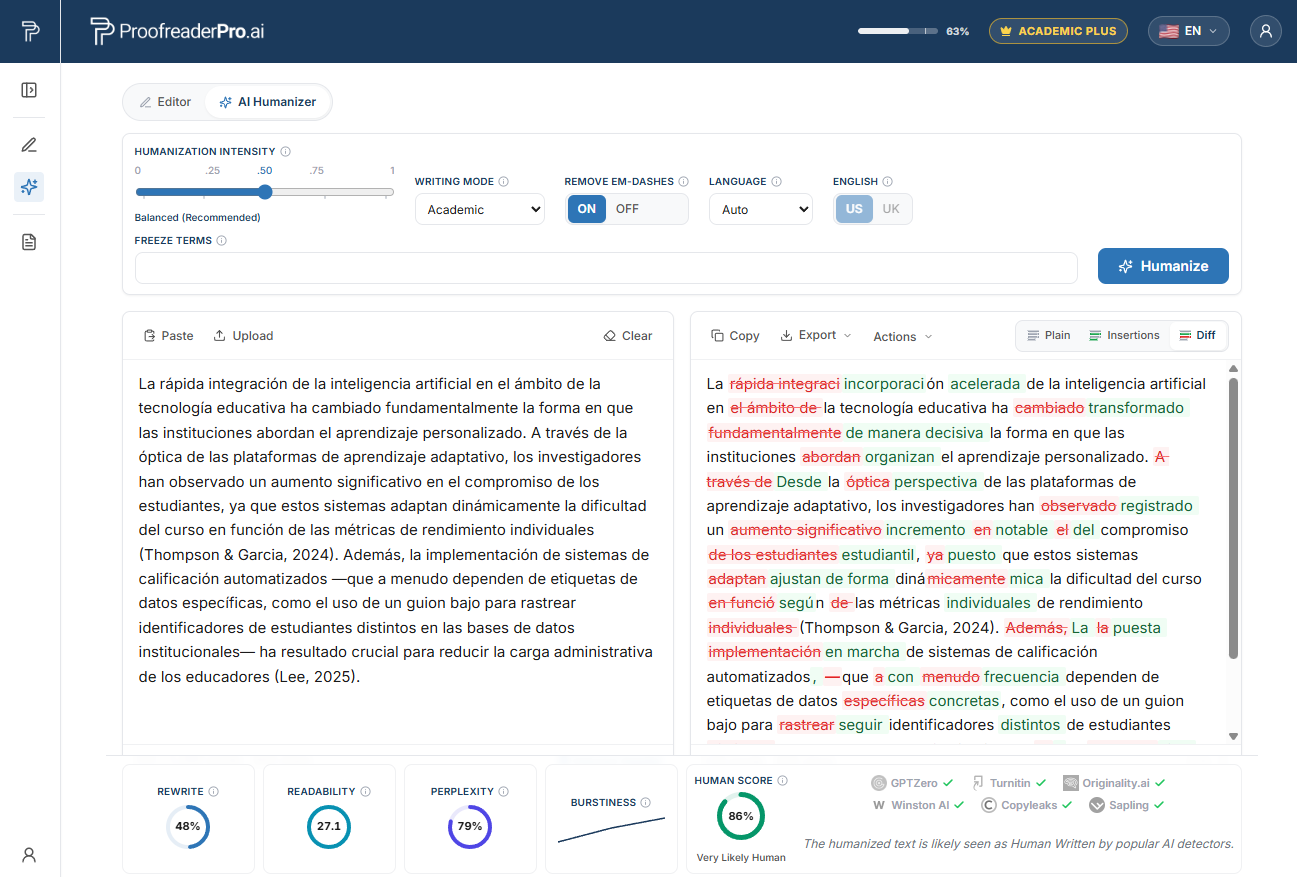
The ProofreaderPro AI Humanizer rewriting Spanish academic text. The before and after diff keeps your meaning and citations, and the detector checks confirm a natural, human read.
Why Colombian researchers get flagged by AI detectors
In 2023, a Stanford team led by Liang and colleagues published a study in the Cell Press journal Patterns titled "GPT detectors are biased against non-native English writers." They ran human-written TOEFL essays through seven widely used detectors. Every essay had a human author.
On average, around 61% of the non-native essays were flagged as AI, compared with about 5% for native English writers. Nearly one in five non-native essays, about 19.8%, was flagged by every single detector at once. These were not AI essays. They were human writing that happened to be careful and standard.
The mechanism is "perplexity." Many detectors score how surprising each next word is to a language model. Fluent native writers scatter idioms and unusual turns of phrase, which raises perplexity. Second-language writers reach for the safe, common, correct word, which lowers it. Low perplexity reads as machine text. We wrote a fuller explanation in why AI detectors flag non-native writers, and it maps almost perfectly onto Spanish-speaking academics.
The Spanish first-language patterns behind false flags
Spanish speakers do not make random errors in English. They produce systematic, patterned constructions, and many of those patterns are perfectly correct English that simply reads as too standard. Here are the ones that push perplexity down.
Article discipline with abstract nouns. Spanish uses definite articles broadly, so a Colombian writer thinks carefully about every "the" before an abstract noun. When they self-correct to natural English ("poverty affects education," not "the poverty affects the education"), they land on the plainest possible phrasing. Correct, careful, and low-perplexity.
Adjective placement. Spanish places adjectives after the noun ("resultados significativos"). Writers who consciously flip to English order tend to choose conservative, unambiguous constructions rather than risk an odd stack of modifiers. Safe word order reads as predictable to a detector.
Avoiding false friends. Because "actual" means current, "realizar" means to carry out, "eventualmente" means occasionally, and "sensible" means sensitive, careful Colombian writers learn to avoid the risky cognate and pick the plain English verb instead. That deliberate, cautious vocabulary is exactly the common-word choice that lowers perplexity.
Tense caution. Spanish present perfect (he analizado) does not line up with English simple past. Writers who have trained themselves to write "We collected the data in 2023" produce clean, textbook methods sentences. Textbook is the problem here, not the grammar.
Preposition precision. After being corrected on "consist in" versus "consist of," or "depend of" versus "depend on," researchers stick tightly to the standard collocation every time. Consistent, correct, and predictable.
None of these are mistakes a detector is catching. They are the marks of a disciplined second-language writer, and the detector cannot tell the difference between discipline and machine output.
Colombia's AI-detection and Turnitin context
Colombian theses and journal submissions are commonly screened with Turnitin or iThenticate for text similarity, and both platforms now surface AI-writing indicators alongside the traditional similarity score. Most Colombian universities and their editorial boards run manuscripts and dissertations through one of these systems before a defense or an editorial decision.
It is worth knowing how fragile the AI number is. Vanderbilt disabled Turnitin's AI detector in 2023, citing false positives and bias against non-native writers, and Michigan State, UT Austin, Northwestern, Pittsburgh, SMU, and Waterloo took similar steps. Turnitin itself suppresses scores in the 1 to 19% range, showing an asterisk instead of a number, and warns that its score should not be used alone to decide an integrity case.
So a flag is a claim you can contest, not a verdict. At the same time, funders and journals increasingly ask authors to disclose how they used AI tools. The right path is to protect careful writing from a false flag and to disclose real AI assistance, both at once.
Humanize your own draft, keep every citation
Protect careful Spanish-to-English writing from a false AI flag. Preserve your meaning, terminology, and references, then disclose your AI use the way your journal requires.
Try the Humanizer FreeTop Colombian universities and where AI checks appear
Research output in Colombia concentrates in a set of well-known public and private universities, and each of them screens theses and manuscripts for similarity and AI indicators before graduation or publication.
- Universidad Nacional de Colombia (UNAL), Bogota, the country's largest and most productive research university, with campuses in Bogota, Medellin, Manizales, and Palmira.
- Universidad de los Andes (Uniandes), Bogota, the top-ranked private university, strong in engineering, economics, and physics.
- Universidad de Antioquia (UdeA), Medellin, a major public university with many Minciencias-classified research groups.
- Pontificia Universidad Javeriana, Bogota and Cali, a leading Jesuit university with wide output in medicine and environmental sciences.
- Universidad del Valle (Univalle), Cali, the principal public university of the southwest.
- Universidad Industrial de Santander (UIS), Bucaramanga, recognized for engineering, petroleum sciences, and chemistry.
- Universidad EAFIT, Medellin, a private university with growing programs in engineering and applied sciences.
- Universidad del Norte (Uninorte), Barranquilla, the leading private university on the Caribbean coast.
- Universidad de Caldas, Manizales, strong in agricultural sciences and health.
- Universidad del Cauca, Popayan, a historic public university with growing research capacity.
- Escuela de Ingenieria de Antioquia (EIA), Medellin, a specialized institution in engineering and biomedical sciences.
- Universidad del Rosario, Bogota, one of the oldest universities in the Americas, strong in law, medicine, and economics.
At every one of these institutions the pressure is the same: publish in English-language international journals to advance a Minciencias classification. That makes a fair AI-detection outcome a practical career issue, not an abstract one.
How the AI humanizer for Colombian researchers works
The workflow is simple, and none of it involves hiding your work. Here is how the AI humanizer for Colombian researchers works in practice.
First, draft. Many researchers here think and outline in Spanish, where the argument flows more naturally, then translate into English. That is fine. Second, fix the grammar, the article choices, the false friends, and the prepositions, so the science is clean. Third, run your own AI-assisted draft through the text humanizer. It varies your rhythm and word choice, removes repetitive cadence and stray dashes, and keeps your meaning, technical terms, and citations exactly where you put them.
What can you expect from the detector side? Tested against the major detectors, our humanizer rewrites AI text into a more natural human form, which lowers the AI signal and improves its odds against tough detectors, while keeping grammar accuracy high on academic text. Those are results from testing, not guarantees. Detectors retrain every few months, so we describe what we have measured and never promise to "bypass" anything or claim text is 100% undetectable.
Then disclose. Add the AI-use statement your institution and target journal require. Humanizing your own careful prose and disclosing your AI use are not in tension. Together they keep you inside the integrity rules while protecting real second-language writing from a false positive. If you also want a human-facing language pass, our academic editing for Colombian researchers guide covers that side, and this post sits inside our wider multilingual AI humanizer hub.
Local funding bodies, journals, and AI-disclosure expectations
Minciencias (Ministerio de Ciencia, Tecnologia e Innovacion) runs Colombia's researcher classification system, sorting academics into Investigador Junior, Asociado, Senior, and Emerito tiers. Each step up requires sustained publication in indexed journals, with Scopus and Web of Science outputs weighted most heavily. The Colciencias research groups now administered by Minciencias are ranked A1, A, B, C, and D on similar productivity metrics, and a group's rank governs its access to competitive funding.
Because international publication is the currency of the whole system, the English in your manuscripts, grant applications, and reviewer responses has to be both correct and natural. A false AI flag on a submission can stall exactly the publication a classification upgrade depends on.
The situation in Colombia illustrates just how English-first the system has become. The country has some very highly regarded journals. Colombia Medica (Universidad del Valle) appears in both PubMed and Scopus. Other examples include Revista Colombiana de Quimica (Universidad Nacional de Colombia), Ingenieria y Competitividad (Universidad del Valle), Revista Colombiana de Ciencias Pecuarias (Universidad de Antioquia), Universitas Scientiarum (Pontificia Universidad Javeriana), and Boletin de Investigaciones Marinas y Costeras (INVEMAR). There are many more in SciELO Colombia. Despite their use of Spanish, most will still insist on polished English for submissions to get into Scopus or Web of Science.
Across these funders and journals, AI-use disclosure is moving from optional to expected. Plan to state your tool use plainly. Running the humanizer on your own draft and then disclosing is the combination that holds up under scrutiny.
Frequently asked questions
Q: Is using an AI humanizer for Colombian researchers considered cheating?
No, as long as you humanize your own AI-assisted draft and then disclose your AI use the way your institution and journal require. The tool preserves your meaning and citations and helps careful second-language writing avoid a false flag. It is not for disguising fabricated work or hiding that you used AI.
Q: Will the humanizer guarantee my paper passes Turnitin or GPTZero?
No, and be wary of anyone who promises that. Tested against the major detectors, our humanizer rewrites AI text into a more natural human form, which lowers the AI signal and improves its odds against tough detectors, though no tool can guarantee a specific result. Detectors retrain often, so we report what we measured rather than promise an outcome.
Q: Why do detectors flag careful Spanish-to-English academic writing at all?
Because many detectors score perplexity, meaning how predictable your word choices are. Disciplined second-language writers use common words and standard phrasing, which reads as low perplexity and therefore as machine-like. The Stanford study found human non-native essays flagged at about 61% versus about 5% for native writers, which shows the bias clearly.
Q: Does the humanizer change my citations or technical terms?
No. It preserves your references, your discipline-specific terminology, and your findings, and only varies rhythm and word choice. Your APA, Vancouver, IEEE, or other citations stay intact, so nothing in your evidence or attribution shifts.
Q: Can I draft in Spanish first and still use the humanizer?
Yes. Many Colombian researchers outline and reason in Spanish, then translate into English before polishing. The humanizer works on your English draft after translation and proofreading, smoothing the prose while keeping the argument you built in Spanish fully intact.
Humanize your own AI-assisted academic draft, preserve meaning and citations, and protect careful Spanish-to-English writing from unfair AI-detection flags, then disclose with confidence.

Moe is an NLP engineer with a PhD in natural language processing. His research covers computational linguistics, text analysis, and machine learning, and it fed directly into the editing and humanization models behind ProofreaderPro. He writes about the part of the process most people never see: how a language model reads a sentence, scores it, and decides what to change.