AI Humanizer for Mexican Researchers Writing in English
AI humanizer for Mexican researchers. Reduce false AI-detection flags on Spanish-influenced English, keep meaning and citations, disclose honestly.

Mexico produces more published research than any Latin American country except Brazil. Almost all of it reaches its audience in English, even though most of the researchers behind it think, draft, and argue in Spanish first. Career standing depends on it: the Sistema Nacional de Investigadores (SNI), administered by CONAHCYT, rewards publication in indexed international journals.
A good AI writing assistant can speed up a literature review, but the trouble starts at submission, when an AI detector flags the careful English of a human author who used the tool responsibly. An AI humanizer for Mexican researchers exists for exactly this moment: to protect genuine, AI-assisted work from being misread as machine-generated.
This guide explains why detectors misfire on second-language English, how Spanish first-language habits feed that error, and how to humanize your own draft while keeping your meaning, your citations, and your integrity intact.
Un humanizador de texto de IA para investigadores mexicanos
Nuestro humanizador de texto de IA ayuda a los investigadores mexicanos a publicar en inglés sin que su trabajo cuidadoso, redactado primero en español, sea confundido con texto generado por una máquina. Conserva su significado, su terminología y sus citas.
In plain terms: you write and reason the way you always have, in Spanish and then in English, and the tool reworks the rhythm of your own draft so a detector is less likely to misread it. Nothing about your argument, your data, or your sources changes. You can start with the humanizer pillar at /text-humanizer and see how it treats a paragraph of your own writing.
Writing in Spanish? It is auto-detected and humanized natively
Many researchers in Mexico draft in Spanish before writing up in English, and the humanizer handles that directly. Paste Spanish text and ProofreaderPro detects the language on its own, then processes it through a Spanish-aware model that keeps your terminology, accents, and citations exactly as written. As a humanizador de texto de IA it runs on your Spanish draft as readily as on your English, so nothing has to be translated first. The same detection spans more than sixty languages, each rewritten in its own voice.
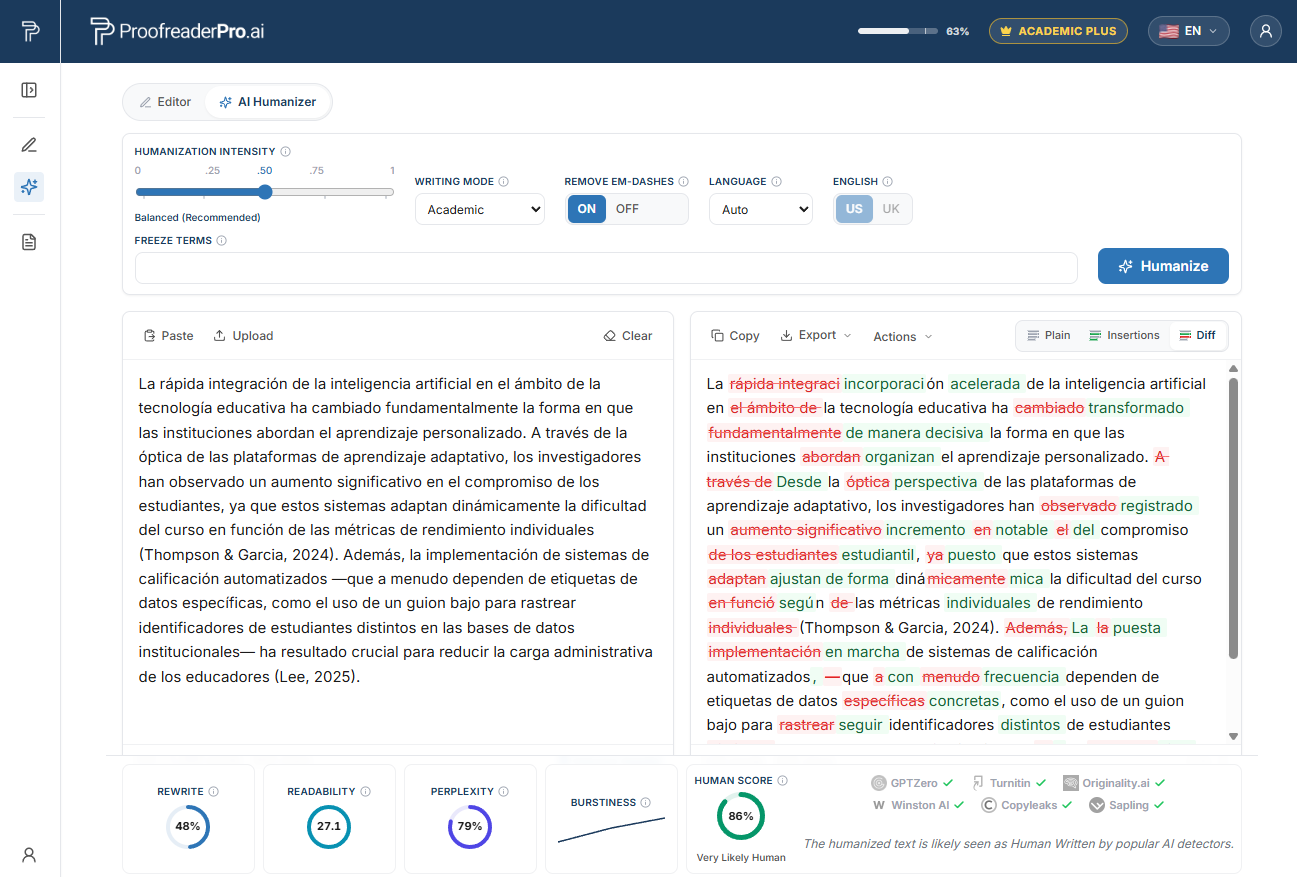
The ProofreaderPro AI Humanizer rewriting Spanish academic text. The before and after diff keeps your meaning and citations, and the detector checks confirm a natural, human read.
Why Mexican researchers get flagged by AI detectors
In 2023, a Stanford team led by Weixin Liang published a study in the Cell Press journal Patterns titled "GPT detectors are biased against non-native English writers." They ran human-written TOEFL essays through seven widely used detectors. On average, about 61% of the non-native essays were flagged as AI, against about 5% for native English writers. Nearly one in five non-native essays, about 19.8%, was unanimously flagged by every detector. Every one of those essays was written by a person.
The mechanism is not malice, it is math. Many detectors score "perplexity," a measure of how surprising each word choice is to a language model. When you write carefully in a second language, you reach for common words and standard, predictable phrasing. That produces low perplexity, and low perplexity is what these tools were trained to read as machine text.
So the very habits that make Mexican academic English clear and correct are the habits a detector penalizes. We wrote a fuller explanation of this false-positive problem in why AI detectors flag non-native writers.
The Spanish first-language patterns behind false flags
None of the patterns below are errors. They are correct, careful constructions, and that standardness is exactly what reads as low perplexity to a detector.
False cognates. Spanish nudges writers toward "actual" for "current," "eventually" for "possibly," "realize" for "carry out," and "assist" for "attend." A careful author often over-corrects into very plain, dictionary-safe vocabulary, which flattens the surprise a detector looks for.
Article use with abstract nouns. Spanish keeps the article where English drops it: "the research shows," "the science suggests," "the society expects." The phrasing is grammatical and consistent, and consistency lowers perplexity.
Long, subordinate-heavy sentences. Spanish academic style favors long periodic sentences with stacked clauses. Rendered faithfully in English, they become smooth and even, the kind of measured cadence a model predicts easily.
Preposition transfer. "Depend of," "consist on," "different to," and "in relation with" all carry over from Spanish government of prepositions. Once edited toward safe, standard English, the result is textbook-neutral prose.
Discourse connectors. Sentence-initial "On the other hand," "In this sense," and "Nevertheless" are calqued from Spanish markers. They signal structure clearly, and clear, formulaic signposting is easy for a detector to anticipate.
A grammar pass first, then a humanizing pass, treats these together. If you want a language check tuned to Spanish habits before you humanize, see our note on AI proofreading for Spanish-speaking researchers.
Mexico's AI-detection and Turnitin context
Theses and journal submissions from Mexican institutions are commonly screened for similarity, usually with Turnitin or iThenticate, and increasingly read for AI indicators alongside the similarity score. Doctoral and master's theses are deposited in institutional repositories, such as TESIUNAM at UNAM, where a similarity report is a routine part of the deposit.
It helps to be precise about what a detector score is. Turnitin suppresses AI scores in the 1 to 19% range, showing an asterisk rather than a number, and warns that its score should not be the only basis for an integrity decision. In 2023, several universities, including Vanderbilt, disabled Turnitin's AI detector over false positives and bias against non-native writers. A flag is a claim you can contest, not a verdict.
At the same time, CONAHCYT, the SNI, and international journals are moving toward explicit AI-use disclosure. The sensible response is not to hide that you used a tool. It is to keep your work clearly yours and to declare the assistance in the format your institution and journal require.
Protect your careful English from a false AI flag
Humanize your own AI-assisted draft in more than 60 languages, keep your meaning and citations, then disclose your AI use with confidence.
Try the Humanizer FreeTop Mexican universities and where AI checks appear
These institutions screen theses and manuscripts for similarity, commonly with Turnitin, and increasingly weigh AI indicators. If you study or work at one of them, expect your submitted English to pass through this kind of check.
- Universidad Nacional Autónoma de México (UNAM), Mexico City
- Instituto Politécnico Nacional (IPN), Mexico City
- Tecnológico de Monterrey (ITESM), Monterrey
- Universidad Autónoma Metropolitana (UAM), Mexico City
- Universidad de Guadalajara (UdeG), Guadalajara
- Benemérita Universidad Autónoma de Puebla (BUAP), Puebla
- Centro de Investigación y de Estudios Avanzados (CINVESTAV), Mexico City
- El Colegio de México (COLMEX), Mexico City
- Universidad Autónoma de Nuevo León (UANL), Monterrey
- Universidad de Guanajuato (UG), Guanajuato
- Universidad Veracruzana (UV), Xalapa
- Universidad Autónoma del Estado de México (UAEMéx), Toluca
- Centro de Investigación Científica y de Educación Superior de Ensenada (CICESE), Ensenada
- Universidad Autónoma de San Luis Potosí (UASLP), San Luis Potosí
The point is not that these universities are hostile to AI. It is that careful, second-language English moves through automated checks at every one of them, and a false flag costs you time you would rather spend on the research.
How the AI humanizer for Mexican researchers works
The AI humanizer for Mexican researchers follows a workflow, not a trick. Here is the order we recommend.
First, draft. Many researchers think most clearly in Spanish, so write your argument there if that is faster, then translate into English. An AI assistant can help with the first pass.
Second, proofread the grammar. Fix the false cognates, the preposition transfers, and the article habits so the English is correct before anything else touches it.
Third, humanize your own AI-assisted prose. The /text-humanizer tool varies your rhythm and word choice, removes repetitive cadence, and clears out stray em dashes, so careful non-native writing is less likely to be misread. It preserves your meaning, your technical terminology, and your citations. It supports more than 60 languages, routing non-English text through a language-aware model that keeps your sentence structure intact.
Here's the real ceiling, stated as test results rather than promises. Our humanizer reworks AI text into a more natural human form that reads as human across Turnitin, Originality.ai, and GPTZero. Grammar accuracy is over 96% on academic text. These are results from testing, not guarantees. Detectors retrain every few months, so no responsible tool can promise to bypass them or claim your text will be 100% undetectable.
Fourth, disclose. Add an AI-use statement in the format your institution and target journal require. That combination, clean human-owned work plus clear disclosure, is what keeps you inside integrity rules while protecting your English from a false flag.
This spoke sits inside our multilingual AI humanizer hub, and it pairs with our global academic editing hub for researchers who want a human editor in the loop as well.
Local funding bodies, journals, and AI-disclosure expectations
Research assessment in Mexico runs on a small set of national bodies. CONAHCYT (Consejo Nacional de Humanidades, Ciencias y Tecnologías, formerly CONACYT) is the national science agency, and it maintains a national index of quality Mexican journals. The Sistema Nacional de Investigadores (SNI) ranks researchers and rewards indexed publications, so membership affects both income and standing. PRODEP (Programa para el Desarrollo Profesional Docente) supports faculty development.
Mexican researchers target journals indexed in Scopus and Web of Science. The region has its own portals, like SciELO and Redalyc, that are also widely used. Nationally, the CONAHCYT journal index is important. Editors and funders are moving towards explicit AI-use disclosure on all of these.
None of this asks you to pretend you wrote without help. It asks you to be transparent. If you are unsure how to phrase it, our templates for an AI-use disclosure statement give you a starting point that satisfies most journals.
Frequently asked questions
Q: What is an AI humanizer for Mexican researchers, and is it cheating?
It is a tool that reworks the rhythm and word choice of your own AI-assisted draft so careful, second-language English is less likely to be misread as machine text. It is not cheating when you humanize work that is genuinely yours, keep your meaning and citations, and then disclose your AI use the way your institution and journal require. The goal is fairness for real work, not disguise.
Q: Will the humanizer keep my technical terminology and citations intact?
Yes. It preserves your meaning, your discipline-specific terms, and your references, changing rhythm and phrasing rather than substance. Your equations, variable names, and cited authors stay exactly as you wrote them.
Q: Can it help if I draft in Spanish first and then translate to English?
That is a common and valid workflow. Write where you think most clearly, translate into English, proofread the grammar, then humanize. The tool supports more than 60 languages and keeps your sentence structure while it varies the cadence.
Q: I sometimes work in Nahuatl or Maya sources. Does that cause problems?
Working from indigenous-language sources or quotations does not change the process. You humanize your own English prose, and quoted material stays as quoted. The same workflow of draft, proofread, humanize, and disclose applies.
Q: Can you guarantee my paper will pass Turnitin or GPTZero?
No, and you should distrust any tool that promises it. In testing, our humanizer rewrites AI text into a more natural human form, which lowers the AI signal and improves its odds against tough detectors, but detectors retrain often, so these are tested results rather than guarantees. What we can promise is that your work stays yours and your disclosure stays transparent.
Rework your own AI-assisted draft so careful, second-language English reads naturally, with your meaning, terminology, and citations preserved.

Moe is an NLP engineer with a PhD in natural language processing. His research covers computational linguistics, text analysis, and machine learning, and it fed directly into the editing and humanization models behind ProofreaderPro. He writes about the part of the process most people never see: how a language model reads a sentence, scores it, and decides what to change.