AI Humanizer for Argentine Researchers Writing in English
AI humanizer for Argentine researchers. Reduce false AI-detection flags on Spanish-influenced English, keep meaning and citations, disclose honestly.

Argentina publishes between 18,000 and 22,000 Scopus-indexed papers a year, ranking around 40th to 45th in the world and second in Latin America only to Brazil and Mexico. Much of that work now begins with an AI assistant somewhere in the loop: a first draft outlined with ChatGPT, a paragraph tightened by Claude, a translation smoothed out from Spanish. That is normal, and most journals allow it when you disclose it.
The trouble starts afterward. An AI humanizer for Argentine researchers exists because AI detectors routinely misread careful second-language English as machine writing, and Argentine authors pay for prose that is simply clean, standard, and correct.
Argentina scores 562 on the EF English Proficiency Index, the highest in Latin America. That high proficiency does not protect you here. If anything, the polished, textbook-correct English that comes from years of formal study is exactly the kind of writing a detector is most likely to flag.
Humanizador de texto de IA para investigadores argentinos
Nuestro humanizador de texto de IA ayuda a los investigadores argentinos a publicar en ingles con mayor seguridad. Reescribe tu propio borrador asistido por IA para que tu ingles cuidadoso no sea confundido con texto automatico, conservando tu significado, tu terminologia tecnica y tus citas.
In plain terms: you write the science, you keep the meaning, and the text humanizer varies the rhythm and word choice so that careful Spanish-influenced English reads as the human work it already is. It supports more than 60 languages, and non-English text routes through a language-aware model that preserves sentence structure.
This is not about hiding anything. It is about giving real work a fair reading before you send it out and disclose your AI use the way your institution and journal require.
Writing in Spanish? It is auto-detected and humanized directly
Many researchers in Argentina draft in Spanish before writing up in English, and the humanizer supports that directly. Paste Spanish text and ProofreaderPro recognises the language on its own, then processes it through a Spanish-aware model that keeps your terminology, accents, and citations exactly as written. Through humanizador de texto de IA your Spanish draft is humanized as readily as your English, with nothing translated first. The same detection spans more than sixty languages, each rewritten in its own voice.
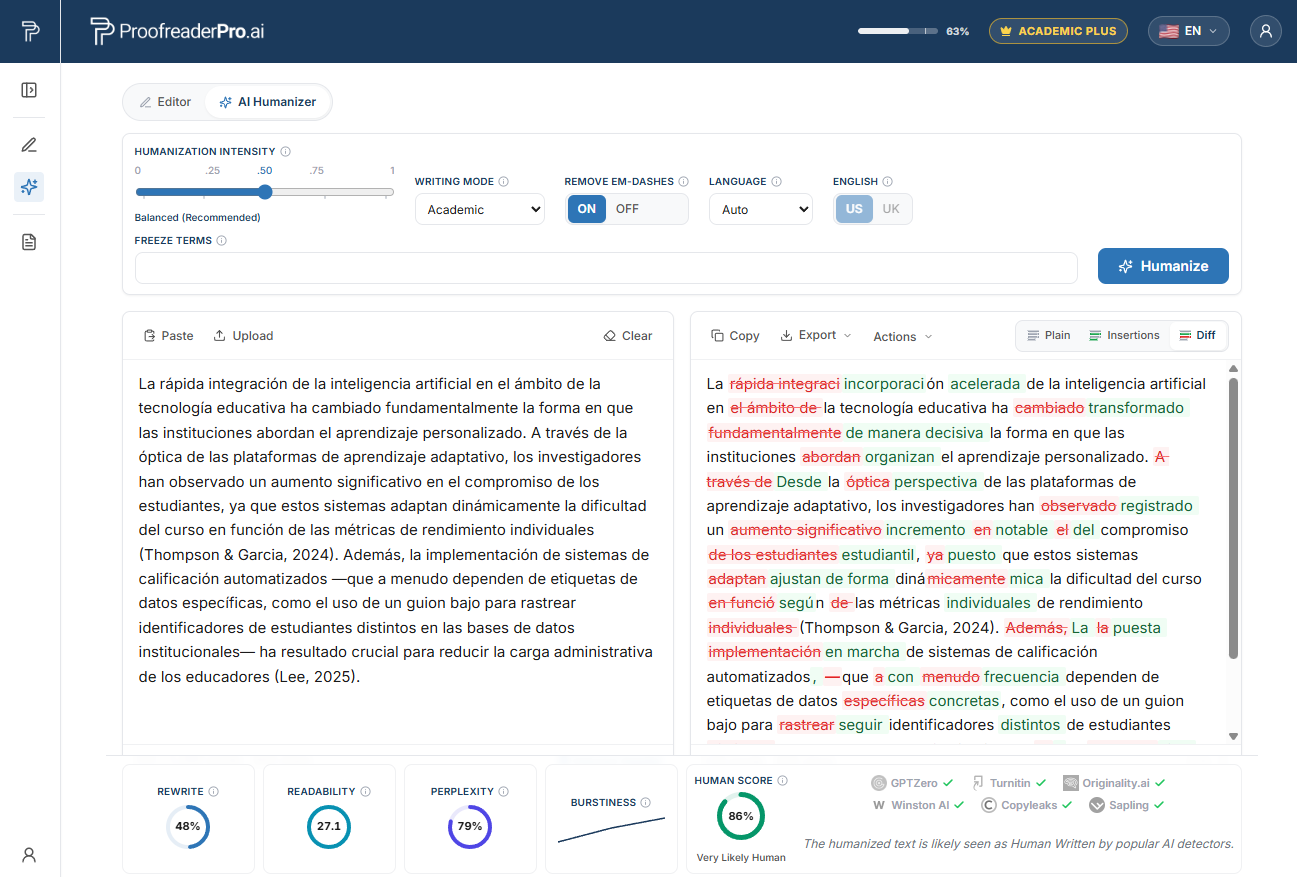
The ProofreaderPro AI Humanizer rewriting Spanish academic text. The before and after diff keeps your meaning and citations, and the detector checks confirm a natural, human read.
Why Argentine researchers get flagged by AI detectors
In 2023, a Stanford team led by Liang and colleagues published a study in the Cell Press journal Patterns titled "GPT detectors are biased against non-native English writers." They ran human-written TOEFL essays through seven widely used detectors. On average, about 61% of the non-native essays were flagged as AI, against about 5% for native writers. Nearly one in five non-native essays was flagged by every single detector at once. Every essay was written by a person.
The mechanism is perplexity. Many detectors score how surprising each word choice is to a language model. Careful second-language writers reach for common words and standard, predictable phrasing, which produces low perplexity, which reads as machine text. The very habits that make Argentine academic prose clear and safe are the habits these tools were trained to distrust.
We explain this failure mode in depth in why AI detectors flag non-native writers. The short version: a detector flag is a statistical guess about word patterns, not evidence about how your paper was written.
The Spanish first-language patterns behind false flags
Argentina's proficiency level means the tell-tale signs are not gross errors. They are the careful, standard choices advanced writers make to stay correct, and that standardness is precisely what lowers perplexity. Here are the patterns that push Argentine English toward a machine-like signature.
The safest article rule, applied everywhere. Spanish uses definite articles with abstract nouns far more freely than English ("la investigacion demuestra que la desigualdad afecta la educacion"). Argentine authors learn to strip those articles in general statements, then apply the corrected rule uniformly. The result is textbook-predictable noun phrases with almost no variation, which is exactly what a model expects.
Canonical adjective order. Spanish places adjectives after the noun; English stacks them before. Writers who have drilled the English convention render "un analisis estadistico multivariado robusto" as "a robust multivariate statistical analysis" and follow that ordering every time. Rigid correctness is low-surprise by construction.
The safest synonym for every false friend. To dodge falsos amigos ("actual," "realizar," "eventualmente," "sensible," "pretender"), careful authors pick the most common, unambiguous English word instead. Choosing the highest-probability synonym repeatedly flattens the lexical variety a detector reads as human.
One dictionary-correct preposition each time. After learning that Spanish transfer produces "consist in," "depend of," "interested on," and "different to," writers lock in "consist of," "depend on," "interested in," and "different from." Always the single canonical collocation, never a surprising one.
Mechanical tense selection. Rioplatense Spanish leans on the simple past, so Argentine writers apply English present-perfect and simple-past rules deliberately in methods and results sections. Deliberate, rule-bound tense use is consistent and predictable, which reads as low perplexity.
Maximum formality. Argentine academic register tends toward the formal, so authors reach for the most standard, most conservative phrasing available. The safest sentence is also the most expected one, and expected prose is what detectors score as machine-generated.
Argentina's AI-detection and Turnitin context
Theses, career reports, and journal submissions in Argentina are commonly screened with Turnitin or iThenticate for both similarity and AI indicators. CONICET evaluation committees, university tenure processes, and international journals all sit somewhere in that pipeline, so a graduate student and a senior investigator can meet the same detector.
It helps to know how the vendors talk about their own tools. Turnitin suppresses AI scores in the 1 to 19% range, showing an asterisk rather than a number, and warns that its score should not be used alone for integrity decisions. Several universities have gone further: Vanderbilt disabled Turnitin's AI detector in 2023 over false positives and bias against non-native writers, and Michigan State, UT Austin, Northwestern, Pittsburgh, SMU, and Waterloo took similar steps.
The fair reading of that history is not that detectors are meaningless, but that a score is a claim to contest, not a verdict. At the same time, funders and journals increasingly ask you to disclose AI assistance. Both facts point the same way: protect careful writing from misreading, and be transparent about the tools you used.
Give your English a fair reading
Humanize your own AI-assisted draft so careful Spanish-influenced writing is not misread as machine text. Meaning, terminology, and citations preserved. Then disclose with confidence.
Try the Humanizer FreeTop Argentine universities and where AI checks appear
Argentina's public university system is large and free at the undergraduate level, with research concentrated in national universities and CONICET institutes often co-located on campus. These are the country's leading research producers, and each screens theses and manuscripts for similarity and AI indicators.
- Universidad de Buenos Aires (UBA), Buenos Aires, by far the largest producer at roughly 40% of national output.
- Universidad Nacional de Cordoba (UNC), Cordoba, founded in 1613 and one of the oldest in the Americas, strong in astronomy, physics, and chemistry.
- Universidad Nacional de La Plata (UNLP), La Plata, a major center in exact and natural sciences with several CONICET research units.
- Universidad Nacional de Rosario (UNR), Rosario, notable in medicine, biochemistry, and agricultural sciences.
- Universidad Nacional del Litoral (UNL), Santa Fe, strong in chemical engineering, food technology, and biotechnology.
- Universidad Nacional de Cuyo (UNCuyo), Mendoza, western Argentina's primary research university.
- Universidad Tecnologica Nacional (UTN), multi-campus, the country's largest by enrollment, focused on engineering and technology.
- Universidad Austral, Buenos Aires area, a leading private university strong in medicine and biomedical engineering.
- Universidad Nacional del Sur (UNS), Bahia Blanca, strong in chemistry, chemical engineering, and geosciences.
- Universidad Nacional de San Martin (UNSAM), Buenos Aires province, growing fast in biotechnology and nanotechnology.
- Instituto Balseiro, Bariloche, Argentina's elite physics and nuclear engineering institute, small but exceptionally productive.
- Instituto Tecnologico de Buenos Aires (ITBA), Buenos Aires, a private engineering institution strong in computer and data science.
At every one of these institutions, CONICET career advancement and ANPCyT grant competition make English-language publication a professional necessity, which means more manuscripts pass through more detectors every year.
How the AI humanizer for Argentine researchers works
The AI humanizer for Argentine researchers is the last step in a workflow, not a shortcut around one. Here is the sequence we recommend.
First, draft. Many Argentine researchers reason more naturally in Spanish, so outline your argument in Spanish, then translate it into English (our AI translator keeps citations intact). Second, proofread the grammar, so the article, preposition, and false-friend patterns above are actually correct. Third, run your own AI-assisted prose through the text humanizer so that careful, low-perplexity writing is less likely to be misread as machine output.
The humanizer preserves your meaning, technical terminology, and citations. It varies rhythm and word choice, breaks up repetitive cadence, and removes the stray em dashes that AI drafts tend to leave behind.
On testing, we are specific rather than promising. Tested against the major detectors, our humanizer rewrites AI text into a more natural human form, which lowers the AI signal and improves its odds against tough detectors, while keeping grammar accuracy high on academic text. Those are results from testing, not guarantees, and detectors retrain every few months, so no credible tool can promise to be undetectable.
Then disclose. State your AI use in the format your institution and target journal require. That combination, careful writing protected from false flags plus full disclosure, is what keeps you inside integrity rules. If you want to compare this with human-led correction, see academic editing for Argentine researchers, and for the full country cluster, visit the multilingual AI humanizer hub.
Local funding bodies, journals, and AI-disclosure expectations
Two institutions set the publication pressure that brings Argentine researchers to detectors in the first place. CONICET (Consejo Nacional de Investigaciones Cientificas y Tecnicas) employs over 11,000 researchers in a five-tier career system, and advancement depends on sustained publication in Scopus and Web of Science indexed journals. ANPCyT (Agencia Nacional de Promocion de la Investigacion, el Desarrollo Tecnologico y la Innovacion) administers competitive grants, most notably the PICT (Proyectos de Investigacion Cientifica y Tecnologica) program, which weighs international publication heavily in every evaluation.
Argentina also has a strong journal tradition, much of it indexed in SciELO Argentina and increasingly in Scopus and Web of Science. Titles Argentine authors know well include:
- Medicina (Buenos Aires), one of Latin America's most respected medical journals, indexed in PubMed and Scopus.
- Ecologia Austral, from the Argentine Ecological Association.
- Latin American Applied Research, published by Universidad Nacional del Sur and CONICET.
- Revista de la Union Matematica Argentina, one of the oldest mathematics journals in the region.
- Ameghiniana, in paleontology and geological sciences.
- Electronic Journal of Biotechnology, with a Latin American focus.
As these journals seek or maintain Scopus indexation, they increasingly prefer English and, like their international peers, increasingly ask for a statement on AI assistance. Write the disclosure plainly, name the tools, and describe what they did. If a detector flag ever lands on genuine work despite your care, the appeal a false AI-detection flag playbook walks through the evidence to gather and the tone to take with a committee.
Frequently asked questions
Q: Does the AI humanizer for Argentine researchers help me cheat Turnitin?
No. It is meant for your own AI-assisted draft, and its job is to keep careful second-language English from being misread as machine text. You still keep your meaning and citations, and you still disclose your AI use to your institution and journal. Protecting real work from a false flag is not the same as disguising it.
Q: Will humanizing change my meaning, my technical terms, or my citations?
No. The humanizer preserves your meaning, technical terminology, and references while it varies rhythm and word choice. It is built to smooth the statistical patterns that trip detectors, not to rewrite your science or move your citations.
Q: How well does it actually pass AI detectors?
Tested against the major detectors, it rewrites AI text into a more natural human form, which lowers the AI signal and improves its odds against tough detectors, while keeping grammar accuracy high. Those are testing results, not guarantees. Detectors retrain often, so no serious tool can promise you will never be flagged.
Q: My English is already strong. Why would a detector flag me?
Strong, standard English is part of the problem. Detectors score perplexity, and careful, predictable, textbook-correct phrasing reads as low perplexity, which they associate with machine writing. Argentina's high proficiency can make your prose more uniform, not less likely to be flagged.
Q: Should I still disclose AI use if I humanize my draft?
Yes, always. Disclosure and humanizing solve two different problems. Humanizing protects careful writing from misreading, and disclosure keeps you accountable to your funder, committee, and journal. Do both, every time.
For Argentine researchers publishing in English: reduce false AI flags on your own AI-assisted work while keeping meaning, terminology, and citations intact, then disclose with confidence.

Moe is an NLP engineer with a PhD in natural language processing. His research covers computational linguistics, text analysis, and machine learning, and it fed directly into the editing and humanization models behind ProofreaderPro. He writes about the part of the process most people never see: how a language model reads a sentence, scores it, and decides what to change.