AI Humanizer for Korean Researchers Writing in English
AI humanizer for Korean researchers. Reduce false AI-detection flags on Korean-influenced English, keep meaning and citations, disclose honestly.

South Korea invests 5.21% of its GDP in research and development, the second highest ratio in the world, and produces roughly 85,000 to 90,000 Scopus-indexed papers a year. Half of that output lands in first-quartile journals, the highest proportion among comparable nations. On paper, Korean science is thriving.
Behind the numbers sits a quieter problem. About 74% of Korean graduate students report difficulty writing and publishing in English. A new obstacle now compounds it: AI writing detectors that flag careful, correct, non-native English as machine-generated. An AI humanizer for Korean researchers exists to protect that legitimate work, not to disguise it.
It matters. We aren't talking about concealing falsified results or submitting something generated by a machine under our name. We're talking about a Korean postdoc who wrote up a real paper, cleaned it up with an AI helper, and is watching a detector flag the entire discussion section as suspicious. The researcher deserves a fair hearing.
한국 연구자를 위한 AI 휴머나이저
우리의 AI 휴머나이저(AI humanizer)는 한국 연구자가 영어로 연구를 발표할 때 겪는 부담을 덜어줍니다. It helps Korean researchers publish in English by making careful, standard second-language prose read the way a human reviewer expects, without changing your findings, your terminology, or your citations.
The tool is one part of a workflow, not a shortcut around integrity rules. You keep your meaning and your references intact, and you disclose your AI use the way your department and target journal require.
Writing in Korean? It is auto-detected and humanized natively
Korean researchers often draft in Hangul first, and the humanizer handles that directly. Paste Korean text and ProofreaderPro recognises the script automatically, then processes it through a Korean-aware model that keeps your terminology, spacing, and citations intact. AI 휴머나이저 runs on your Korean draft as readily as on your English, so there is no need to translate before you humanize. The same detection spans more than sixty languages, each rewritten in its own voice.
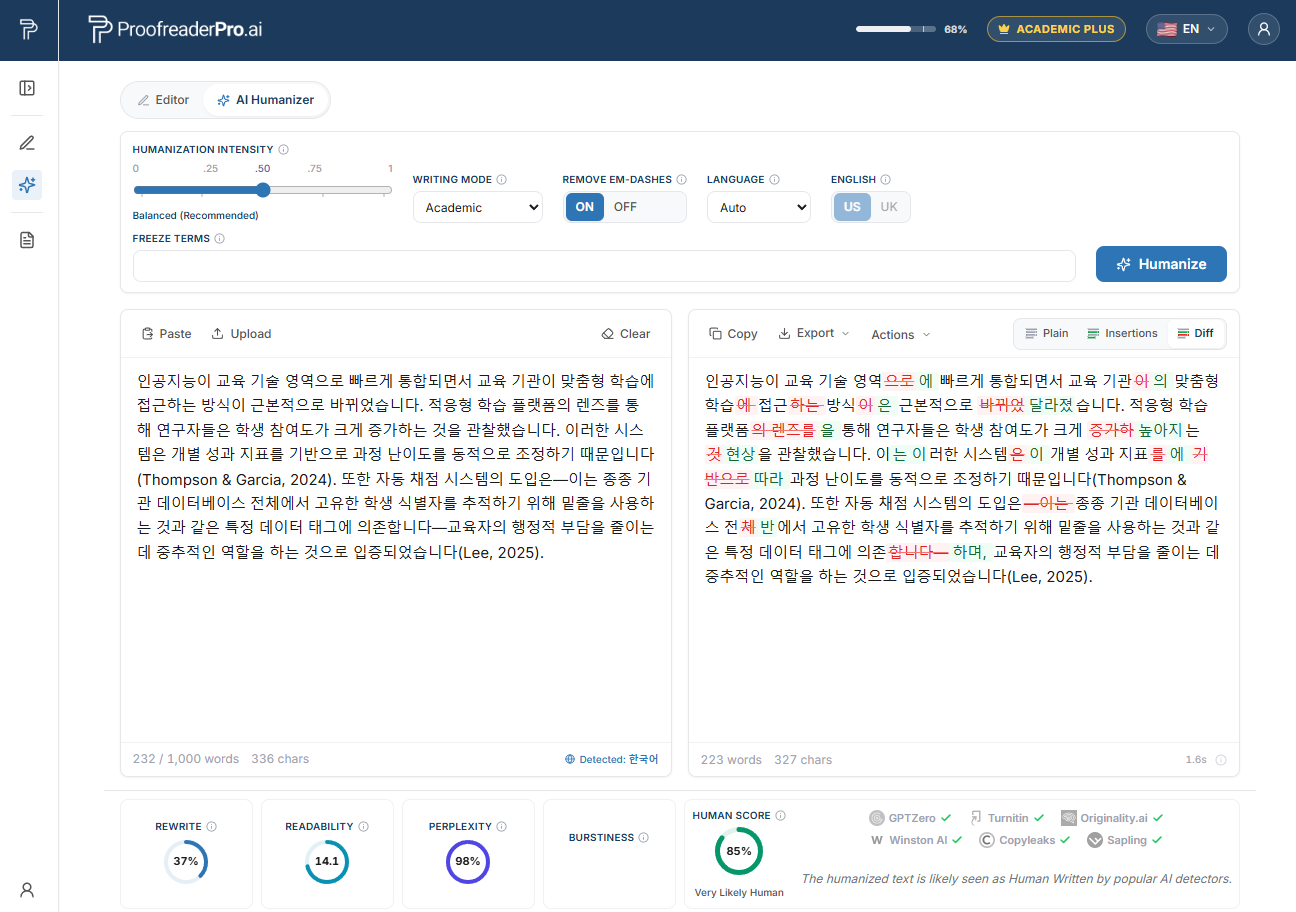
The ProofreaderPro AI Humanizer rewriting Korean academic text. The before and after diff keeps your meaning and citations, and the detector checks confirm a natural, human read.
Why Korean researchers get flagged by AI detectors
In 2023, a Stanford team led by Liang and colleagues published a study in the Cell Press journal Patterns titled "GPT detectors are biased against non-native English writers." They ran human-written TOEFL essays through seven widely used detectors. On average, about 61% of the non-native essays were flagged as AI, compared with about 5% for native English writers. Nearly one in five non-native essays (about 19.8%) was flagged unanimously by every detector. Every one of those essays was written by a person.
The mechanism is called perplexity. Many detectors score how surprising each word choice is to a language model. Careful second-language writers reach for common words and standard, predictable phrasing, which produces low perplexity, which reads as machine text. The very habits that make Korean academic prose clear and correct are the habits these systems were trained to flag. We explain the full mechanism in why AI detectors flag non-native writers.
The cost is not evenly shared. Non-native English speakers already face rejection rates about 2.5 times higher than native speakers, spend about 51% more time writing their papers, and receive about 12.5 times more revision requests tied to language quality. A false AI flag adds one more penalty on top of that load.
The Korean first-language patterns behind false flags
Korean and English differ in deep, structural ways. The constructions below are not errors of carelessness. They are the careful, standard choices a Korean scholar makes, and that standardness is exactly what a perplexity-based detector reads as low surprise.
Article-light phrasing. Korean has no articles. There is no "the," "a," or "an." When a Korean researcher writes "We analyzed effect of treatment on outcome," the sentence is direct and economical. After editing, "We analyzed the effect of the treatment on the outcome" is grammatically standard and, to a detector, entirely predictable.
Subject-object-verb habits. Korean orders clauses subject-object-verb, English subject-verb-object. Korean writers often produce measured, evenly weighted sentences as they map one order onto the other. That even weighting is clear to a reader and low-perplexity to a machine.
Particle-to-preposition mapping. Korean marks grammatical roles with postpositional particles rather than prepositions. Writers settle on safe, textbook choices ("depend on," "associated with," "interested in"), and safe textbook phrasing is precisely what detectors expect.
Number marking. Korean nouns do not inflect for number, so plural marking is applied deliberately and consistently. Consistent, rule-following prose scores as unsurprising.
Reader-responsible structure. Korean academic tradition favors an indirect style in which the reader draws out the main point. Edited into English, this often becomes a careful, hedged, formulaic register. Formulaic reads as low perplexity, even when the underlying argument is original.
None of this is cheating, and none of it should be penalized. A humanizer restores natural variation in rhythm and word choice so that correct Korean-to-English writing is less likely to be misread, while your claims and data stay exactly as you wrote them.
South Korea's AI-detection and Turnitin context
Theses and journal submissions in South Korea are commonly screened with Turnitin or iThenticate for similarity, and detectors increasingly report an AI indicator alongside the similarity score. Graduate schools run manuscripts through these checks before deposit, and many journals run them at submission.
The screening climate is tightening, but so is the caution around it. Turnitin now suppresses AI scores in the 1 to 19% range, showing an asterisk rather than a number, and warns that its score should not be used alone to decide an integrity case. Several universities, including Vanderbilt, Michigan State, and Northwestern, disabled Turnitin's AI detector over false positives and bias against non-native writers. A detector score is a claim to contest, not a verdict.
At the same time, funders and journals increasingly ask authors to disclose how they used AI tools. The right response to both pressures is the same: write your own work, protect it from misreading, and state plainly what tools you used.
Protect your Korean research from false AI flags
Humanize your own AI-assisted draft, keep your meaning and citations, then disclose your AI use. Tested against the major detectors, built for non-native academic English.
Try the Humanizer FreeTop South Korean universities and where AI checks appear
Publication pressure runs through the whole system. BK21 funding and faculty promotion both count SCI and SCIE papers, and every institution below screens theses and manuscripts for similarity and AI indicators before they move forward.
- Seoul National University (서울대학교), Seoul, Korea's leading research institution, strong in biological and earth sciences.
- Korea University (고려대학교), Seoul, strong in law, business, and engineering.
- Yonsei University (연세대학교), Seoul, medicine, engineering, and social sciences.
- KAIST (한국과학기술원), Daejeon, a leader in the physical sciences and chemistry.
- POSTECH (포항공과대학교), Pohang, small and high-impact, home to Korea's only synchrotron facility.
- UNIST (울산과학기술원), Ulsan, the youngest science institute and rising fast.
- DGIST (대구경북과학기술원), Daegu, convergence research in brain science, robotics, and energy.
- Sungkyunkwan University (성균관대학교), Seoul and Suwon, third in Korea by research output.
- Hanyang University (한양대학교), Seoul and Ansan, engineering with strong industry ties.
- Kyung Hee University (경희대학교), Seoul, Korean medicine and space science.
- Pusan National University (부산대학교), Busan, the largest national university outside Seoul.
- Chungnam National University (충남대학교), Daejeon, agriculture and natural sciences.
- Ewha Womans University (이화여자대학교), Seoul, a growing STEM research profile.
- Kyungpook National University (경북대학교), Daegu, electronics, materials, and medical research.
- Chonnam National University (전남대학교), Gwangju, agricultural science and biotechnology.
Whatever your campus, the review step is the same, and so is the risk that careful English draws a false flag.
How the AI humanizer for Korean researchers works
The workflow is clear and simple. Draft your paper, in Korean first if your thinking is clearest there, then translate it into academic English. Proofread the grammar so the mechanics are correct. Then run your own AI-assisted prose through the text humanizer so that careful, low-perplexity writing regains natural variation and is less likely to be misread by a detector. Your meaning, technical terms, and citations stay in place.
In our own testing against the major detectors, the humanizer rewrites AI text into a more natural human form, which lowers the AI signal and improves its odds against tough detectors, while keeping grammar accuracy high on academic text. These are results from testing, not guarantees. Detectors retrain every few months, so no credible tool promises to be undetectable, and none should promise to bypass a check.
The final step is disclosure. State how you used AI tools in the format your institution and target journal require. That combination, careful work plus a clear disclosure, keeps you inside integrity rules while protecting your English from a false positive. For the wider picture across languages, see our multilingual AI humanizer hub, and for the editing side of the same workflow, read academic editing for researchers in South Korea.
Local funding bodies, journals, and AI-disclosure expectations
Funding for research in Korea comes from a handful of sources. First, graduate programs are tied to funding from BK21 FOUR (Brain Korea 21). This is based on the number of SCI and SCIE papers published. The National Research Foundation (한국연구재단) influences how grants are evaluated nationally and also administers the Korea Citation Index (KCI), that tracks over 2,500 local journals. For promotions and grant renewals, international English-language publications have the most weight. This is why there is such pressure to publish cleanly in English.
Korean societies publish a large slate of English-language journals, and each expects manuscript-quality English. Prominent titles include:
- Journal of Korean Medical Science (JKMS), Korean Academy of Medical Sciences
- Bulletin of the Korean Chemical Society (BKCS), Korean Chemical Society, SCIE-indexed
- Nuclear Engineering and Technology, Korean Nuclear Society
- Molecular & Cells, Korean Society for Molecular and Cellular Biology
- Journal of the Korean Physical Society (JKPS), a major physics title
- Korean Journal of Chemical Engineering, Korean Institute of Chemical Engineers
- Korean Circulation Journal, English-language since 1971
- Korean Journal of Radiology, Korean Society of Radiology
More of these journals now ask authors to declare AI assistance at submission. Disclosing early is far safer than being asked about it later. If a detector does flag your careful writing, treat the score as the start of a conversation, not a conviction.
Frequently asked questions
Q: Is using an AI humanizer for Korean researchers a way to cheat Turnitin?
No. The right use is to humanize your own AI-assisted draft so that careful, non-native English is not misread as machine text, while your meaning and citations stay intact. You then disclose your AI use as your institution and journal require. It protects real work, it does not hide fabricated work.
Q: Will the humanizer change my technical terms or citations?
No. The tool preserves your terminology, your numbers, and your references. It varies sentence rhythm and word choice to restore natural human variation, and it removes repetitive cadence, without touching the substance of your argument or your citation list.
Q: Can the humanizer guarantee my paper will pass every AI detector?
No, and you should distrust any tool that promises this. In testing it rewrites AI text into a more natural human form, which lowers the AI signal and improves its odds against tough detectors, but detectors retrain often. We report tested results, never a guarantee of passing or a promise to bypass a check.
Q: I write in Korean first and translate. Does that help or hurt with detectors?
Translating from Korean is a normal, legitimate way to work, and it often produces very standard English that a detector reads as low perplexity. That is exactly the writing a humanizer helps, restoring natural variation so your correct translated prose is less likely to be flagged.
Q: Should I still disclose AI use if I only used it to fix my English?
Yes. Disclose in whatever format your department and target journal specify. A short, short statement about how you used AI tools keeps you inside integrity rules and is far better than leaving a reviewer to guess.
Restore natural variation to careful Korean-to-English writing, preserve meaning and citations, and reduce the risk of a false AI flag.

Moe is an NLP engineer with a PhD in natural language processing. His research covers computational linguistics, text analysis, and machine learning, and it fed directly into the editing and humanization models behind ProofreaderPro. He writes about the part of the process most people never see: how a language model reads a sentence, scores it, and decides what to change.