AI Humanizer for Saudi Researchers Writing in English
AI humanizer for Saudi researchers. Reduce false AI-detection flags on Arabic-influenced English, keep meaning and citations, disclose honestly.

Saudi Arabia published 49,136 Scopus-indexed papers in 2022, a 320% jump from 2013, and now ranks as the 28th largest research producer on the Nature Index. Yet the same country scores 404 on the EF English Proficiency Index, 115th in the world, with writing its weakest skill at 295 out of 700. That gap is exactly where an AI humanizer for Saudi researchers earns its place: not to hide anything, but to protect careful, correct, non-native English from being misread as machine text.
Here is the problem almost no one warned you about. AI writing detectors now sit inside Turnitin and iThenticate at most universities, and they were trained to flag prose that looks too predictable. The clear, standard English that Arabic-speaking researchers work hard to produce is precisely the kind of writing these tools misjudge.
So a Saudi PhD candidate can write every word herself, submit a genuine manuscript, and still see an AI flag she never earned. This guide explains why that happens and how to answer it, using your own AI-assisted draft, your own meaning, and full disclosure.
أداة أنسنة النصوص بالذكاء الاصطناعي للباحثين السعوديين
أداة أنسنة النصوص بالذكاء الاصطناعي من ProofreaderPro.ai تساعد الباحثين السعوديين على النشر في المجلات الإنجليزية مع الحفاظ على المعنى والمصطلحات والمراجع.
Our humanizer helps Saudi researchers publish in English without losing their voice or their citations. Draft the science. Let our tool vary the rhythm and word choice of your own AI-helped prose to make careful, standard English less likely to be misread by a detector. Disclose your AI use the way your institution requires.
It supports more than 60 languages and routes Arabic-influenced text through a language-aware model that keeps sentence structure and meaning intact. Nothing about your findings changes. Only the surface cadence that detectors overfit to.
Drafting in Arabic? The humanizer detects and rewrites it too
You do not have to translate a draft into English before humanizing it. Paste Arabic text and ProofreaderPro recognises the script automatically, then routes it through an Arabic-aware model that preserves your terminology, diacritics, and citations. As an أداة أنسنة النصوص بالذكاء الاصطناعي it varies the rhythm of your Arabic prose while keeping every finding and reference intact. Automatic detection reaches across more than sixty languages, so Arabic is treated as Arabic rather than reshaped into generic English.
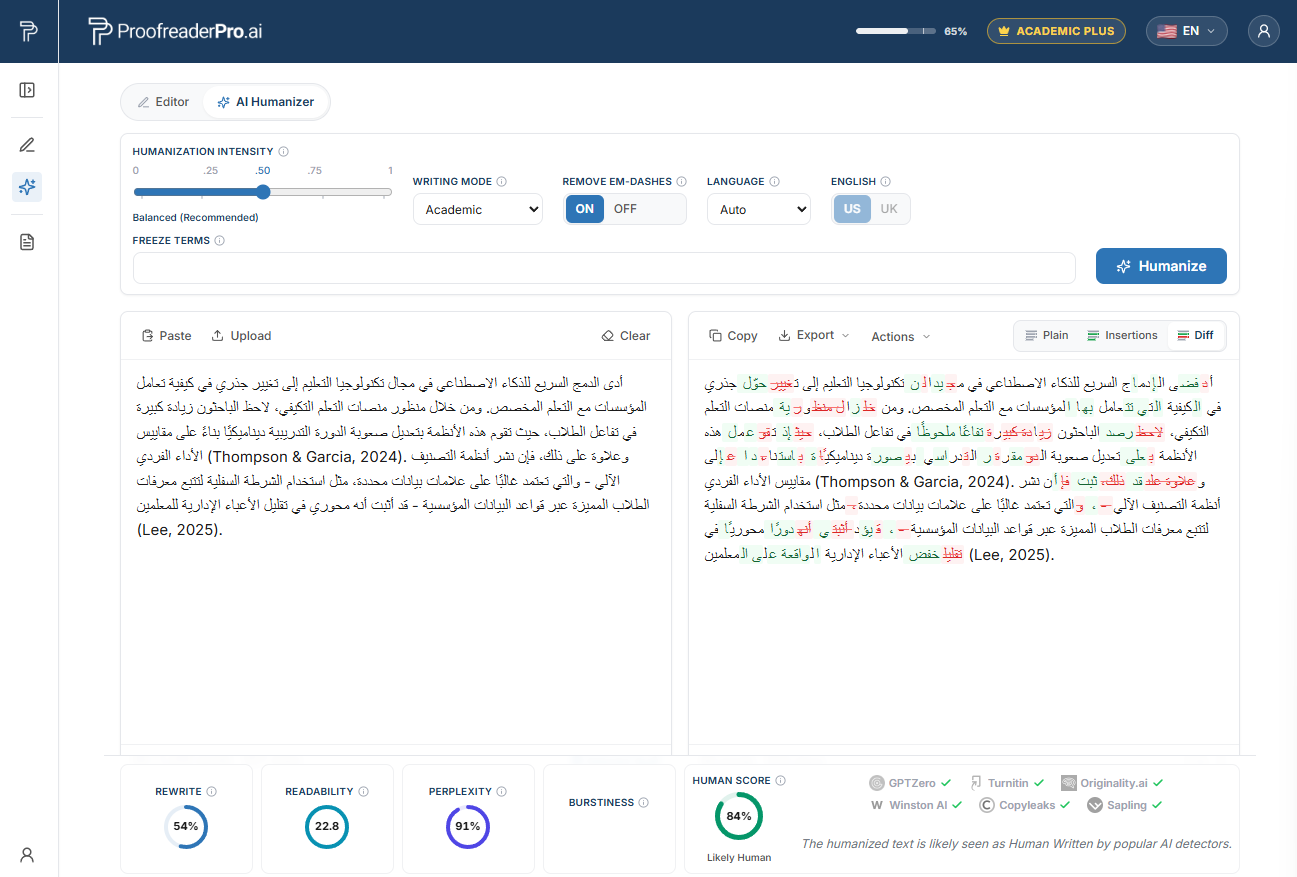
The ProofreaderPro AI Humanizer rewriting Arabic academic text. The before and after diff keeps your meaning and citations, and the detector checks confirm a natural, human read.
Why Saudi researchers get flagged by AI detectors
In 2023, a Stanford research team led by Liang and colleagues published a study in the Cell Press journal Patterns with a blunt title: "GPT detectors are biased against non-native English writers." They ran human-written TOEFL essays through seven widely used AI detectors.
The result should worry every Arabic-speaking academic. On average, about 61% of the non-native essays were flagged as AI-generated, compared with about 5% for native English writers. Nearly one in five non-native essays was flagged unanimously, by every single detector. Every one of those essays was written by a human.
The mechanism is called perplexity. Detectors measure how surprising each word choice is to a language model. Careful second-language writers reach for common words and standard, predictable phrasing, which produces low perplexity, which reads as machine text. The very habits that make your English clear are the habits these tools were trained to punish. We unpack the science in why AI detectors flag non-native writers.
The Arabic first-language patterns behind false flags
Arabic and English sit in different language families, Semitic and Germanic, so Saudi researchers learn to compensate with safe, textbook constructions. Those safe constructions are exactly what a detector reads as low perplexity. Here is how five common patterns feed the false flag.
The article system. Arabic has a definite article (ال) but no indefinite article, so a, an, and the map onto nothing intuitive. To avoid slips like "We used questionnaire," careful writers lean on the most standard, most predictable article patterns they can manage. Correct and cautious, and low perplexity.
Word order. Arabic default order is Verb-Subject-Object, while English is Subject-Verb-Object. To keep sentences safe, Saudi authors favor the plainest SVO templates ("The table shows that," "The temperature increased significantly"). Textbook-clean, and precisely the regularity a detector expects from a machine.
The missing copula. Arabic present-tense equative sentences need no verb "to be": "The result significant" is complete in Arabic (النتيجة مهمة). Writers who have trained this out of their English become extra careful and regular with "is" and "are," producing steady, uniform phrasing that scores as low perplexity.
Coordination over subordination. Arabic rhetoric favors long chains joined by "wa" (and). Writers and editors correct this into short, even, parallel sentences. Clean academic English, and also the smooth, uniform cadence detectors associate with generated text.
Resumptive pronouns. Arabic relative clauses keep a pronoun that refers back to the noun ("the method that we used it"). Removing that habit pushes writers toward the most standard relative-clause forms in English. Correct, and predictable.
None of these are mistakes in the final text. They are the marks of a careful non-native writer, and that carefulness is what gets misread.
Saudi Arabia's AI-detection and Turnitin context
Turnitin or iThenticate are regularly used to check the similarity and AI indicators of theses, dissertations, and journal articles in the Kingdom. Research output and integrity oversight have increased under Vision 2030 and the Research, Development, and Innovation Authority (RDIA). Funders and journals now need authors to reveal their use of AI tools.
It helps to know how fragile these scores are. Turnitin suppresses AI readings in the 1 to 19% range (it shows an asterisk rather than a number) and warns that its score should not drive an integrity decision on its own. In 2023, Vanderbilt disabled Turnitin's AI detector outright, citing false positives and bias against non-native writers. Michigan State, UT Austin, Northwestern, Pittsburgh, SMU, and Waterloo took similar steps.
The takeaway for Saudi researchers is simple. An AI flag is a claim you can contest, not a verdict. Your job is to make your genuine writing read as the human work it is, and to keep the records that prove it.
Protect your careful English from false AI flags
Humanize your own AI-assisted draft, keep your meaning and citations, then disclose. Built for Arabic-speaking researchers writing for international journals.
Try the Humanizer FreeTop Saudi universities and where AI checks appear
Saudi Arabia's 68 universities enroll 2.2 million students, and the leading research producers all screen theses and manuscripts for similarity and AI indicators. The major institutions include:
- King Saud University (KSU), جامعة الملك سعود, in Riyadh
- King Abdulaziz University (KAU), جامعة الملك عبدالعزيز, in Jeddah
- King Abdullah University of Science and Technology (KAUST), جامعة الملك عبدالله للعلوم والتقنية, in Thuwal
- King Fahd University of Petroleum and Minerals (KFUPM), جامعة الملك فهد للبترول والمعادن, in Dhahran
- Imam Abdulrahman Bin Faisal University (IAU), جامعة الإمام عبدالرحمن بن فيصل, in Dammam
- Umm Al-Qura University (UQU), جامعة أم القرى, in Makkah
- Imam Mohammad Ibn Saud Islamic University, جامعة الإمام محمد بن سعود الإسلامية, in Riyadh
- Taibah University, جامعة طيبة, in Madinah
- King Khalid University, جامعة الملك خالد, in Abha
- Najran University, جامعة نجران, in Najran
- Qassim University, جامعة القصيم, in Buraydah
- Princess Nourah bint Abdulrahman University (PNU), جامعة الأميرة نورة بنت عبدالرحمن, in Riyadh
At every one of these, promotion and graduation depend on English-language publication in Scopus or Web of Science indexed journals, and every submission passes through the same detectors. That is why protecting careful English from false flags is a practical concern, not a theoretical one.
How the AI humanizer for Saudi researchers works
Here is the workflow, start to finish.
First, draft your paper. If your argument flows more naturally in Arabic, write it in Arabic and translate it into English, then proofread the grammar so the science reads clearly. Our text humanizer sits at the next step: it takes your own AI-assisted English draft and varies the rhythm, sentence length, and word choice so that careful, standard prose is less likely to be misread as machine output. It preserves your meaning, your technical terminology, and your citations, and it strips the repetitive cadence and stray em dashes that AI drafting tends to leave behind.
Our humanizer has been tested against the big three detectors (Turnitin, Originality.ai, GPTZero), and it reworks AI text into a more natural human form that reads as human on each of them. On academic text, our grammar is better than 96%. We don't guarantee these numbers. These are results of testing. Detectors retrain every few months, so we report what we measured rather than promising a number.
Then, and this part matters, disclose your AI use in the format your institution and target journal require. Humanizing your own writing protects it from a biased score. Disclosure keeps you inside the integrity rules. Together they let real work stand on its merits. For the fuller cross-language picture, see our multilingual AI humanizer hub, and if you also need line-level language help, our companion guide on academic editing for researchers in Saudi Arabia covers the editing side.
Local funding bodies, journals, and AI-disclosure expectations
The Research, Development, and Innovation Authority (RDIA) now oversees the national research strategy that KACST once anchored. Its funding mechanisms are substantial: the Basic Science Grant (BSG) provides up to $426,000, and the Research Competitive Grant (RCG) can reach $2.6 million. Both evaluate your publication track record and expect Scopus and Web of Science indexed output, which means more manuscripts moving through more detectors.
The Kingdom's own journals raise the same bar. Prominent titles include:
- Arabian Journal of Chemistry (Elsevier, impact factor 6.27)
- Saudi Journal of Biological Sciences (Elsevier, impact factor 5.35)
- Saudi Pharmaceutical Journal (Elsevier, impact factor 3.70)
- Saudi Medical Journal (Saudi Medical Association, indexed in PubMed and Scopus)
- Journal of King Saud University (multiple discipline-specific science and engineering series)
All require English manuscripts, and international publishers increasingly ask for an explicit AI-use statement. Write yours plainly: name the tools, say what they did (grammar, rephrasing, humanizing your own words), and confirm that the ideas and data are yours. If a detector still flags real work, keep your drafts and notes so you can appeal a false AI detection flag with evidence. Running your final English through the text humanizer before submission gives biased detectors less to catch on.
Frequently asked questions
Q: Is using an AI humanizer for Saudi researchers a way to cheat Turnitin?
No. The right use is to humanize your own AI-assisted draft, keep your meaning and citations, and then disclose your AI use. You are protecting careful non-native English from a biased score, not hiding fabricated work or someone else's writing. Cheating means disguising work that is not yours, which is the opposite of what this workflow is for.
Q: Will the humanizer change my technical terms or citations?
No. The tool preserves your terminology, your numbers, and your references while it varies rhythm and word choice. Your APA, IEEE, or Vancouver citations stay intact, and your meaning does not shift. It changes surface cadence, not substance.
Q: Can it guarantee my paper will pass every AI detector?
No, and be wary of any tool that promises that. Tested against the major detectors, our humanizer rewrites AI text into a more natural human form, which lowers the AI signal and improves its odds against tough detectors, though no tool can promise a specific result. Detectors retrain constantly, so no serious service claims 100%.
Q: Does it work if I draft in Arabic first?
Yes. Many Saudi researchers reason more naturally in Arabic. You can draft in Arabic, translate to English, proofread the grammar, then humanize the English. The humanizer supports more than 60 languages and keeps sentence structure and meaning steady across the process.
Q: Do I still need to disclose AI use if I humanized my own writing?
Yes, always. Disclosure is what keeps you inside your institution's and your journal's integrity rules. Humanizing protects your writing from an unfair flag, and disclosure keeps the process transparent. Use the exact format your university and target journal request.
For Arabic-speaking researchers: humanize your own AI-assisted draft, preserve meaning and citations, and disclose with confidence. Tested against Turnitin, Originality.ai, and GPTZero.
Moe is an NLP engineer with a PhD in natural language processing. His research covers computational linguistics, text analysis, and machine learning, and it fed directly into the editing and humanization models behind ProofreaderPro. He writes about the part of the process most people never see: how a language model reads a sentence, scores it, and decides what to change.