AI Humanizer for Egyptian Researchers Writing in English
AI humanizer for Egyptian researchers. Reduce false AI-detection flags on Arabic-influenced English, keep meaning and citations, disclose honestly.

In 2021, Egypt published 38,651 papers indexed by Scopus, an increase of 21.6% from the previous year. The country is ranked around 26th globally and first in Africa, beating South Africa to the top spot. According to the Nature Index, Egypt accounts for about 25% of the high-quality research output of the whole Middle East region. Almost all of these papers are written by Arabic-speaking researchers publishing science in a second language.
This is where an AI humanizer for Egyptian researchers comes in. More and more of this writing begins with an AI tool: a first draft from a chatbot, a grammar suggestion, a paraphrased literature review. But the problem isn't the help. The problem is that AI detectors often read careful second-language English as machine-written, and Egyptian authors end up paying for it with desk rejections and integrity flags they didn't deserve.
This guide is about using a humanizer responsibly. You humanize your own AI-helped draft, you keep all citations and results intact, and then you disclose your AI use according to the requirements of your institution and your target journal. That's fairness for real work, not a way to hide anything.
أداة أنسنة الذكاء الاصطناعي للباحثين المصريين
توفر ProofreaderPro.ai أداة أنسنة الذكاء الاصطناعي للباحثين المصريين (الباحثين المصريين) لمساعدتهم على النشر باللغة الإنجليزية مع الحفاظ على المعنى والاقتباسات.
In plain terms: our humanizer helps Arabic-speaking researchers get published in English without having their careful prose misclassified as AI. It preserves your meaning, your technical terms, and your references, and it varies the rhythm and word choice that detectors tend to score against you. You stay the author of every sentence.
Writing in Arabic? It is auto-detected and humanized natively
Many researchers in Egypt draft in Arabic before writing up in English, and the humanizer handles that directly. Paste Arabic text and ProofreaderPro detects the right-to-left script on its own, then processes it through a language-aware model that keeps your terminology and citations exactly as written. أداة أنسنة الذكاء الاصطناعي works on your Arabic draft as naturally as on your English, so there is no need to translate first. The same detection spans more than sixty languages, each humanized in its own register.
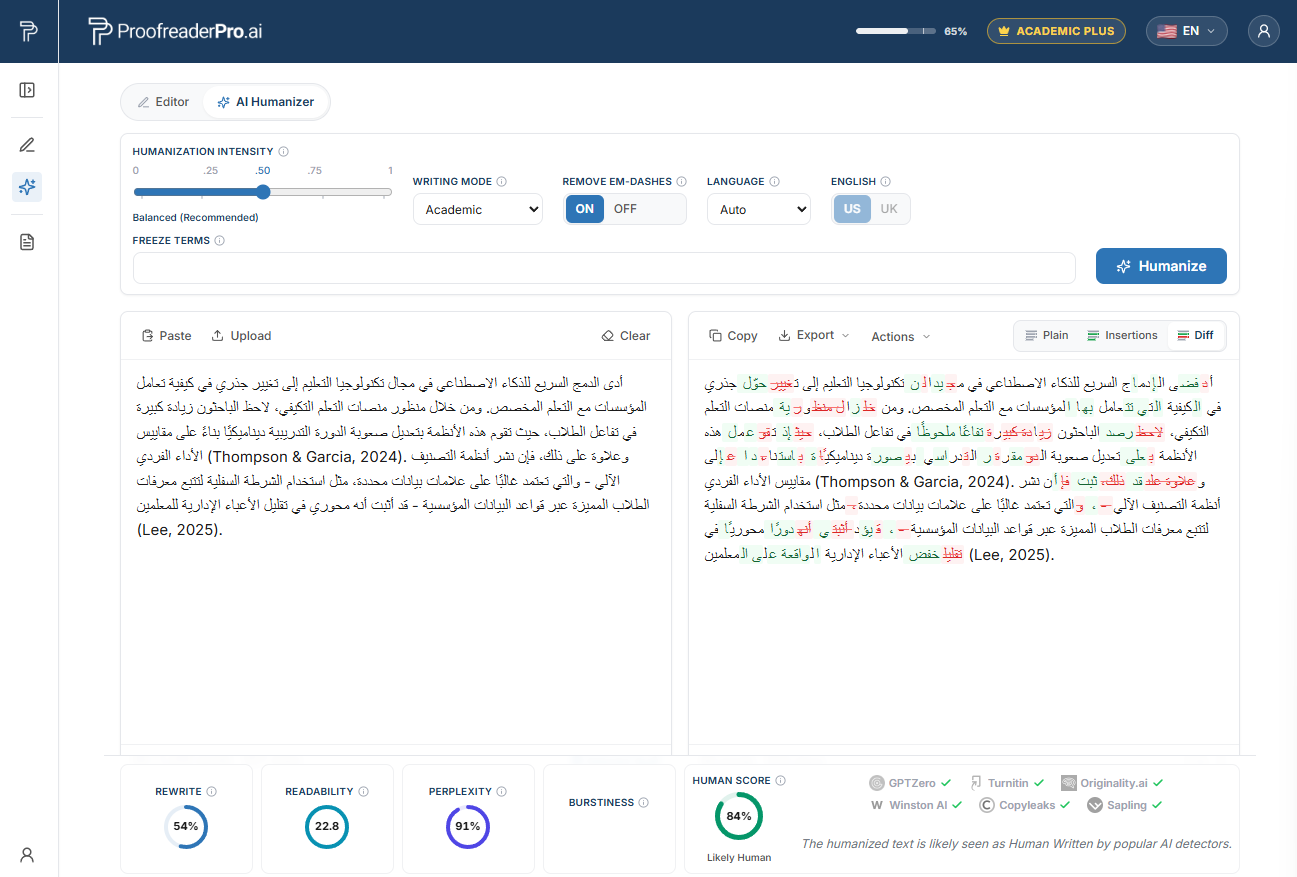
The ProofreaderPro AI Humanizer rewriting Arabic academic text. The before and after diff keeps your meaning and citations, and the detector checks confirm a natural, human read.
Why Egyptian researchers get flagged by AI detectors
The strongest evidence here comes from a 2023 Stanford study by James Zou and colleagues, published in the Cell Press journal Patterns under the title "GPT detectors are biased against non-native English writers." The researchers ran human-written TOEFL essays through seven widely used AI detectors.
On average, about 61% of the non-native essays were flagged as AI-generated, compared with roughly 5% for native English writers. Nearly one in five non-native essays, about 19.8%, was flagged unanimously by every detector in the test. Every single essay had been written by a human.
The mechanism is called perplexity. Many detectors score how surprising each word choice is to a language model. When you write in careful, standard, predictable English, which is exactly what a second-language academic writer is trained to do, your text has low perplexity, and low perplexity reads as machine text. The habits that make Egyptian academic prose clear and correct are the same habits these tools were built to punish. We explain this failure mode in more detail in why AI detectors flag non-native writing.
The Arabic first-language patterns behind false flags
Research shows that about 54% of the errors Arabic-speaking writers make in English are interlingual, caused directly by first-language transfer. Egyptian researchers know this, so they write defensively. They lean on safe, standard, textbook constructions to avoid slipping, and that very carefulness produces the flat, low-perplexity signature a detector misreads as AI. Here is how it happens.
Articles. Arabic has no equivalent of "a" or "an," and its definite article "al-" (ال) behaves differently from English "the." To stay safe, many Egyptian authors settle into a small set of rehearsed noun phrases they know are correct. Predictable phrasing lowers perplexity.
The missing copula. Arabic uses a zero copula in the present tense, so "Ahmed is a teacher" becomes "Ahmed teacher." Researchers who have drilled this rule tend to overcorrect into rigidly uniform "X is Y" sentence frames, and that uniformity looks machine-generated to a detector.
Word order. Arabic is verb-subject-object while English is subject-verb-object. Careful writers correct every clause into the same clean SVO shape, so their paragraphs march in near-identical structures, which is precisely the kind of consistency detectors score as artificial.
Long connected sentences. Arabic prose favors long chains joined by coordinating conjunctions. When an author trims these into short, even, standard English sentences, the result is smooth and correct and also statistically bland, which is what triggers the flag.
None of these are mistakes in the finished text. They are the marks of a writer being disciplined in a second language, and detectors turn that discipline into a false accusation.
Egypt's AI-detection and Turnitin context
Theses and journal submissions in Egypt are commonly screened for both text similarity and AI indicators. The Supreme Council of Universities has required electronic plagiarism checks before submission since the scientometric promotion reforms of 2016, and Egyptian universities routinely run manuscripts and dissertations through Turnitin or iThenticate.
It's worth knowing how contested these AI scores are internationally. In 2023, Vanderbilt University disabled Turnitin's AI-writing detector because of false positives and bias against non-native writers, followed by Michigan State, Northwestern, and others. Turnitin itself now suppresses AI scores in the 1 to 19% range and warns that its number should not be used alone to decide an integrity case. A detector flag is a claim you can contest, not a verdict.
Funders and journals are also moving toward AI-use disclosure rather than AI prohibition. The sensible response to all of this is the same: humanize your own AI-assisted draft so careful writing is less likely to be misread, then state clearly how you used AI.
Protect your careful English from false AI flags
Humanize your own AI-assisted draft, keep every citation and result, then disclose. Built for Arabic-speaking researchers publishing in English.
Try the Humanizer FreeTop Egypt universities and where AI checks appear
Fifteen Egyptian universities appear in the QS World Rankings, out of 79 universities nationwide. These institutions screen theses and manuscripts for similarity and AI indicators, so the false-positive risk lands directly on their researchers and graduate students.
- Cairo University (جامعة القاهرة), Giza, Egypt's largest and oldest modern university and publisher of the Journal of Advanced Research
- American University in Cairo (الجامعة الأمريكية بالقاهرة), an English-medium institution strong in engineering and business
- Ain Shams University (جامعة عين شمس), Cairo, strong in medicine, engineering, and the sciences
- Alexandria University (جامعة الإسكندرية), one of Egypt's largest, strong in medicine and agriculture
- Mansoura University (جامعة المنصورة), known for medicine, urology, and pharmacy
- Assiut University (جامعة أسيوط), the largest university in Upper Egypt
- Zagazig University (جامعة الزقازيق), high output in medicine and veterinary science
- Suez Canal University (جامعة قناة السويس), Ismailia, strong in marine science
- Tanta University (جامعة طنطا), medicine, pharmacy, and science
- Benha University (جامعة بنها), engineering, agriculture, and medicine
- Helwan University (جامعة حلوان), fine arts, engineering, and social work
- Kafrelsheikh University (جامعة كفر الشيخ), agriculture and aquaculture
- Fayoum University (جامعة الفيوم), a growing research base in engineering and sciences
- Beni-Suef University (جامعة بني سويف), science, pharmacy, and engineering
- South Valley University (جامعة جنوب الوادي), Qena, serving Upper Egypt's research community
How the AI humanizer for Egyptian researchers works
The workflow has four steps, and none of them involves faking anything.
First, draft. Write your paper in careful English, or draft in Arabic and translate, whichever is faster for you. If you used a chatbot to help outline or phrase a section, that is fine, and you will disclose it later.
Second, proofread the grammar. Fix the article, copula, and word-order patterns so the science is clean. Our tooling holds grammar accuracy above 96% on academic text, which matters because a genuinely correct manuscript should not be the thing that gets you flagged.
Third, humanize your own AI-assisted prose. The humanizer varies sentence rhythm and word choice and removes the repetitive, low-perplexity cadence that detectors misread, while preserving your meaning, your terminology, and every citation. Tested against the major detectors, our humanizer rewrites AI text into a more natural human form, which lowers the AI signal and improves its odds against tough detectors. Those are results from testing, not guarantees, and detectors retrain every few months, so we never promise a perfect or permanent result. You can run this in the text humanizer directly.
Fourth, disclose. State how you used AI in the format your institution and target journal require. That combination, careful writing plus clear disclosure, keeps you inside the integrity rules while protecting your work from a false flag.
This piece sits inside our multilingual AI humanizer hub, and it pairs with our guide to academic editing for researchers in Egypt if you want the full editing workflow alongside the humanizer.
Local funding bodies, journals, and AI-disclosure expectations
Real infrastructure supports Egypt's research. Grants up to 3,000,000 EGP are awarded to academic projects and up to 8,000,000 EGP to academia-industry projects by the Science, Technology and Innovation Funding Authority (STDF). The Academy of Scientific Research and Technology (ASRT) coordinates national strategy and funds major programs. All Egyptian citizens have free access to Springer Nature, Elsevier, and other publishers through the Egyptian Knowledge Bank.
The journals your promotion depends on hold a hard line on English quality. Egypt publishes over 1,100 scientific journals, but only around 44 are indexed in Scopus, and the flagships are demanding:
- Journal of Advanced Research (Cairo University and Elsevier), Q1, roughly a 5% acceptance rate
- Ain Shams Engineering Journal (Ain Shams University and Elsevier), Q1
- Egyptian Journal of Remote Sensing and Space Science (NARSS and Elsevier), Q1
- Egyptian Journal of Aquatic Research, Web of Science indexed
- Egyptian Journal of Petroleum, the only petroleum journal in the Middle East
- Egyptian Journal of Chemistry, long-running with a broad scope
- Egyptian Informatics Journal (Cairo University), computing and IT
Funders and these journals increasingly ask authors to disclose AI use rather than ban it, so a clear disclosure statement is now part of a professional submission. Keep the text humanizer for the writing itself, and treat disclosure as a normal, expected step rather than a confession.
Frequently asked questions
Q: Is using an AI humanizer for Egyptian researchers considered cheating?
No, when it is used the way we describe. You humanize your own AI-assisted draft to protect careful second-language writing from false flags, you preserve your meaning and citations, and then you disclose your AI use to your institution and journal. Hiding fabricated work would be cheating; making legitimate work read fairly is not.
Q: Will the humanizer keep my citations and technical terms in an Arabic-influenced manuscript?
Yes. The humanizer is built to preserve citations, references, and domain terminology while it varies rhythm and word choice. It adjusts the phrasing patterns that read as low perplexity, not the scientific content, so your results and attributions stay exactly as you wrote them.
Q: Can you guarantee my paper will pass Turnitin or GPTZero?
No, and you should be cautious of anyone who does. Tested against the major detectors, our humanizer rewrites AI text into a more natural human form, which lowers the AI signal and improves its odds against tough detectors, though no tool can promise a specific result. Detectors retrain often, which is why disclosure matters as much as the humanizing.
Q: I write in Arabic first. Does that work with this process?
Yes. You can draft in Arabic, translate to academic English, proofread the grammar, and then humanize the result. The humanizer supports more than 60 languages and routes non-English text through a language-aware model that preserves sentence structure and meaning.
Q: A detector already flagged my human-written paper. What now?
Treat the flag as a claim to contest, not a verdict. The Stanford evidence and the number of universities that have disabled these detectors give you solid ground to appeal, and a clean, well-humanized draft plus a clear AI-use disclosure is your strongest position going forward.
An AI humanizer for Arabic-speaking researchers. Preserve meaning, terminology, and references, reduce false AI flags, then disclose your AI use with confidence.

Moe is an NLP engineer with a PhD in natural language processing. His research covers computational linguistics, text analysis, and machine learning, and it fed directly into the editing and humanization models behind ProofreaderPro. He writes about the part of the process most people never see: how a language model reads a sentence, scores it, and decides what to change.