AI Humanizer for Russian Researchers Writing in English
AI humanizer for Russian researchers. Reduce false AI-detection flags on Russian-influenced English, keep meaning and citations, disclose honestly.

Russia is the seventh largest research producer in the world, with roughly 85,600 Scopus-indexed papers a year in physics, mathematics, chemistry, materials science, and engineering. Much of that work is now drafted with help from AI writing assistants, the same way researchers everywhere use them. And much of it, written by careful non-native speakers of English, is now at risk of being falsely flagged as machine-generated.
An AI humanizer for Russian researchers exists for exactly this problem. Its job is not to disguise work or trick anyone. Its job is to protect genuine, human research from detectors that misread clean, standard second-language English as the output of a language model.
The trap is cruel. The better your English discipline, the more predictable your phrasing becomes, and the more predictable your phrasing, the more likely a detector is to call your human writing "AI." A Russian physicist who has trained for years to write plain, correct English can be penalized for that very training.
Гуманизатор текста ИИ для российских исследователей
ProofreaderPro.ai помогает российским исследователям публиковаться на английском языке. Наш гуманизатор текста ИИ переписывает ваш собственный черновик, сохраняя смысл, терминологию и ссылки, чтобы аккуратная английская проза не читалась как машинный текст.
In plain terms: the humanizer takes an AI-assisted draft that you wrote and adjusts its rhythm and word choice so that careful, standard English is less likely to be misread by a detector. It keeps your meaning, your equations, your terminology, and your citations exactly as they are. It supports more than 60 languages, and non-English text routes through a language-aware model that preserves sentence structure.
This is a tool for your own work, used before you disclose your AI use to your institution and your target journal. It is a fairness tool, not a disguise.
Drafting in Russian? The humanizer detects and processes it directly
Not every draft begins in English, and it does not have to. Paste Russian text and ProofreaderPro recognises the Cyrillic script automatically, then routes it through a Russian-aware model that keeps your terminology, case endings, and citations exactly as written. As a гуманизатор текста ИИ it rewrites your Russian prose directly, so nothing needs to be translated before you humanize. Auto-detection covers more than sixty languages, each rewritten as itself rather than flattened into English.
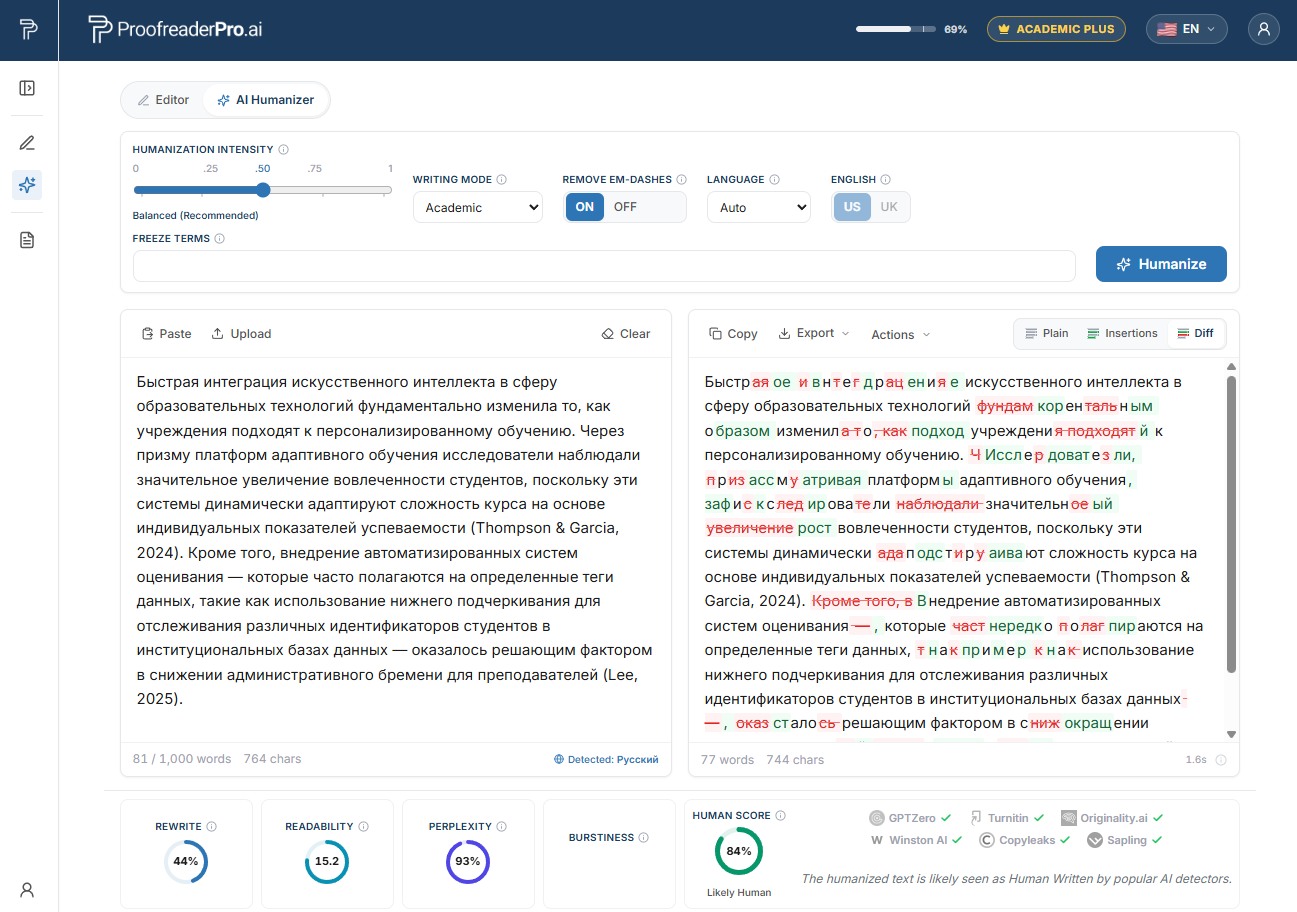
The ProofreaderPro AI Humanizer rewriting Russian academic text. The before and after diff keeps your meaning and citations, and the detector checks confirm a natural, human read.
Why Russian researchers get flagged by AI detectors
The clearest evidence comes from a 2023 Stanford study by Liang and colleagues, published in the Cell Press journal Patterns under the title "GPT detectors are biased against non-native English writers." The researchers ran human-written TOEFL essays through seven widely used AI detectors.
On average, about 61% of the non-native essays were flagged as AI-generated, compared with about 5% for native English writers. Nearly one in five non-native essays, about 19.8%, was unanimously flagged by every single detector. Every one of those essays was written by a human being.
The mechanism is called perplexity. Many detectors score how "surprising" each word choice is to a language model. Careful second-language writers use common words and standard, predictable phrasing, which produces low perplexity, which reads to the detector as machine text. The habits that make Russian researchers' academic English clear and correct are precisely the habits these detectors were trained to punish. We explain this failure mode in more depth in why AI detectors flag non-native writers.
The Russian first-language patterns behind false flags
Russian and English sit in different branches of Indo-European, and the structural distance between them is large. Russian speakers know which features of their English betray a first-language influence, so they train themselves toward the safest, most textbook-standard forms. That discipline is exactly what flattens perplexity. Here is how five well-known interference points turn into low-perplexity, detector-bait prose once they are corrected.
Articles, inserted by the rule. Russian has no articles at all, so writers learn the English article system as a separate discipline and apply it carefully: "the results indicate that the method is effective for the analysis of the samples." Every article lands in its textbook slot. Grammatically clean, and statistically very flat.
The copula, restored everywhere. Russian drops "to be" in the present tense ("metod effektiven"), so trained writers consciously restore it: "the method is effective," "the sample size is sufficient." The correction is right, and it produces the most predictable predicative pattern in English.
Prepositions, normalized to the dictionary. The Russian case system pushes writers toward safe, memorized verb-preposition pairs, "depend on," "consist of," "result in," chosen deliberately to avoid transfer errors. Safe and standard reads as low perplexity.
Aspect and tense, played by the book. Russian marks aspect rather than the twelve English tense-aspect forms, so writers lean on a small set of reliable constructions, the present perfect "we have demonstrated," the simple past "we measured," used carefully and repetitively.
Word order, kept plain. Because Russian marks relations with case endings, careful writers strip their English back to strict subject-verb-object order to avoid unusual constructions. Plain, predictable, and easy for a detector to model.
None of these is an error. They are the marks of a disciplined writer. The humanizer restores natural variation to that disciplined prose so it stops reading as a machine's default output.
Russia's AI-detection and Turnitin context
Dissertations and journal submissions from Russian institutions are commonly screened with Turnitin or iThenticate for both text similarity and AI indicators. A researcher preparing a kandidat nauk or doktor nauk dissertation, or answering reviewers at an international journal, should assume an AI check somewhere in the pipeline.
The pressure to publish in English is structural. The Higher Attestation Commission (HAC, Vysshaya Attestatsionnaya Komissiya) requires that a share of a candidate's articles appear in journals indexed in Web of Science or Scopus before defense, and Project 5-100 built its whole incentive system around international publication metrics. That pushes Russian researchers toward exactly the competitive English-language venues where a false AI flag does the most damage.
It is worth remembering that a detector score is a claim, not a verdict. Vanderbilt disabled Turnitin's AI detector in 2023, citing false positives and bias against non-native writers, and Michigan State, UT Austin, Northwestern, Pittsburgh, SMU, and Waterloo took similar steps. Turnitin itself suppresses scores in the 1 to 19% range and warns that its number should not be used alone for integrity decisions. Funders and journals increasingly ask instead for clear disclosure of AI use, which is a far more defensible standard.
Protect your careful English from a false AI flag
Humanize your own AI-assisted draft, keep every citation and technical term, then disclose your AI use the way HAC and your journal require. Instant results, flat pricing, more than 60 languages.
Try the Humanizer FreeTop Russian universities and where AI checks appear
These institutions all require WoS or Scopus-indexed publications for dissertation defense, promotion, and performance review, and they screen theses and manuscripts for similarity and AI indicators.
- Moskovskii Gosudarstvennyi Universitet (Moscow State University, MGU), Moscow, mathematics, physics, chemistry, and biology.
- Sankt-Peterburgskii Gosudarstvennyi Universitet (St. Petersburg State University, SPbGU), St. Petersburg, mathematics, physics, chemistry, and law.
- Moskovskii Fiziko-Tekhnicheskii Institut (Moscow Institute of Physics and Technology, MIPT), Dolgoprudny, physics, mathematics, and engineering.
- Novosibirskii Gosudarstvennyi Universitet (Novosibirsk State University, NGU), Novosibirsk, physics, mathematics, biology, and geology.
- Natsional'nyi Issledovatel'skii Universitet "Vysshaya Shkola Ekonomiki" (Higher School of Economics, HSE), Moscow, economics, social science, and data science.
- ITMO Universitet (ITMO University), St. Petersburg, information technology, optics, photonics, and computer science.
- Tomskii Gosudarstvennyi Universitet (Tomsk State University, TGU), Tomsk, physics, chemistry, and the natural sciences.
- Kazanskii Federal'nyi Universitet (Kazan Federal University, KFU), Kazan, chemistry, physics, and medicine.
- Ural'skii Federal'nyi Universitet (Ural Federal University, UrFU), Yekaterinburg, metallurgy, materials science, and engineering.
- NITU "MISiS" (National University of Science and Technology MISIS), Moscow, materials science, metallurgy, and nanotechnology.
- Moskovskii Gosudarstvennyi Tekhnicheskii Universitet im. Baumana (Bauman Moscow State Technical University, MGTU), Moscow, mechanical engineering, aerospace, and robotics.
- Natsional'nyi Issledovatel'skii Yadernyi Universitet "MIFI" (National Research Nuclear University MEPhI), Moscow, nuclear physics and high-energy physics.
If you write for any of these institutions, assume your English will be measured twice: once by a reviewer, and once by a detector that does not know you are human.
How the AI humanizer for Russian researchers works
The workflow has four steps, and disclosure is part of it, not an afterthought.
First, draft. Write in English, or draft your argument in Russian where the reasoning flows more naturally and translate it into academic English afterward. Many humanities and social-science researchers think more clearly in Russian first.
Second, proofread the grammar. Fix the articles, the copula, the prepositions, and the tenses so the science is not lost behind language noise. Grammar accuracy on academic text has tested above 96%.
Third, humanize your own AI-assisted prose with the humanizer. It varies rhythm and word choice, breaks up repetitive cadence, and removes stray em dashes, so careful non-native writing is less likely to be misread. Your meaning, technical terminology, and citations are preserved. Tested against the major detectors, the humanizer rewrites AI text into a more natural human form, which lowers the AI signal and improves its odds against tough detectors. These are results from testing, not guarantees, and detectors retrain every few months, so we never promise "100% undetectable" and never frame this as a way to bypass a check.
Fourth, disclose. State your AI use in the format your institution and target journal require. That combination, careful human work plus full disclosure, is what keeps you inside the integrity rules while protecting your writing from a false flag. This humanizer post is the companion to our academic editing guide for researchers in Russia, and it sits inside our broader multilingual AI humanizer hub.
Local funding bodies, journals, and AI-disclosure expectations
Language editing counts as a legitimate research expense under most Russian grant programs, including the Russian Science Foundation (RSF) and the successor programs to the Russian Foundation for Basic Research (RFBR). These grants exist to help you publish in the WoS and Scopus-indexed journals that HAC and university KPIs demand, so the tools that get you there are a reasonable line item. Check your specific grant terms and institutional rules.
Many prominent Russian journals publish in dual Russian-English editions through partnerships with Springer, Pleiades Publishing, and IOP Publishing, and their English-language standards are high:
- Russian Journal of Physical Chemistry A (RAN and Springer), physical chemistry and chemical physics.
- Doklady Mathematics (RAN and Springer), brief communications in mathematics.
- Doklady Physics (RAN and Springer), brief communications in physics.
- Doklady Chemistry (RAN and Springer), brief communications in chemistry.
- Theoretical and Mathematical Physics (Teoreticheskaya i Matematicheskaya Fizika, RAN and Springer), mathematical and theoretical physics.
- Russian Mathematical Surveys (Uspekhi Matematicheskikh Nauk, RAN and IOP Publishing), review articles in mathematics.
Across these venues, the direction of travel is clear: editors increasingly expect a plain statement of how AI tools were used rather than a pretense that they were not. If a flag does land on your paper, treat it as a claim you can contest, and see our guide on how to appeal a false AI detection flag. Getting the disclosure statement right up front is the cleaner path.
Frequently asked questions
Q: Is an AI humanizer for Russian researchers a way to cheat or hide AI use?
No. The tool is meant for your own AI-assisted draft, not someone else's work and not to disguise fabricated results. You humanize your writing so that careful non-native English is not misread as machine text, and then you disclose your AI use in the format your institution and journal require. That is fairness for real work, not concealment.
Q: Will the гуманизатор текста ИИ change my citations or technical terms?
No. The humanizer preserves your meaning, your discipline-specific terminology, and your references exactly as written, including GOST, IEEE, APA, and other citation styles. It varies rhythm and word choice and removes repetitive cadence, but it leaves the substance of your science untouched.
Q: Can you guarantee my paper will pass Turnitin or GPTZero?
No, and you should distrust any tool that claims to. Tested against the major detectors, the humanizer rewrites AI text into a more natural human form, which lowers the AI signal and improves its odds against tough detectors, though no tool can promise a specific result. Detectors retrain every few months, which is exactly why disclosure matters more than any pass rate.
Q: I drafted my paper in Russian. Can the humanizer still help me publish in English?
Yes. You can translate your Russian draft into academic English and then humanize the result, all in one platform. The humanizer supports more than 60 languages and routes non-English text through a language-aware model that keeps your sentence structure and meaning intact.
Q: Do I still need to disclose AI use after I humanize my draft?
Yes, always. Humanizing protects careful writing from a false flag, but it does not replace disclosure. State how you used AI tools in the way your university and target journal require, and keep that statement accurate and specific.
Vary rhythm and word choice across careful Russian-to-English academic prose while preserving meaning, terminology, and references. Tested against the major detectors, built for clear disclosure.

Moe is an NLP engineer with a PhD in natural language processing. His research covers computational linguistics, text analysis, and machine learning, and it fed directly into the editing and humanization models behind ProofreaderPro. He writes about the part of the process most people never see: how a language model reads a sentence, scores it, and decides what to change.