AI Humanizer for German Researchers Writing in English
AI humanizer for German researchers. Reduce false AI-detection flags on German-influenced English, keep meaning and citations, disclose honestly.

Germany publishes roughly 108,800 Scopus-indexed papers a year, the fourth largest research output on the planet, backed by record R&D spending that reached 3.17% of GDP in 2023. More than 400,000 researchers work across its universities, Max Planck Institutes, Fraunhofer Institutes, Helmholtz Centers, and Leibniz Institutes. Almost all of that work is published in English. That is exactly why an AI humanizer for German researchers has become a practical tool rather than a curiosity.
Here is the problem it solves. You draft a paper, maybe with help from ChatGPT or Claude for phrasing, you edit it carefully into clear, standard English, and then a detector at your journal or your graduate school flags it as machine written. The irony is sharp: the more careful and correct your second-language English is, the more likely a detector is to call it AI.
German researchers rank among the most proficient non-native English writers in the world, tenth on the EF English Proficiency Index. Proficiency does not protect you here. The habits that make German-influenced academic prose clean and predictable are the same habits these detectors were trained to score as suspicious.
Ein KI-Humanizer für deutsche Forscherinnen und Forscher
Unser KI-Humanizer hilft deutschen Forscherinnen und Forschern, ihre auf Englisch verfassten Manuskripte natürlicher und flüssiger klingen zu lassen, ohne Bedeutung, Fachbegriffe oder Quellenangaben zu verändern.
Plainly stated: you get to keep your argument, your data, and your citations. What changes is the flow and vocabulary of your own AI-aided work to make thoughtful, conventional writing look less formulaic. It works with over 60 languages. Non-English text flows through a language-aware model that maintains sentence structure.
This is not about disguising anything. It is about giving German-influenced English a fair reading, then disclosing your AI use the way your institution and journal require.
Drafting in German? The humanizer detects and rewrites it directly
You can humanize a German draft without translating it into English first. Paste your text and ProofreaderPro detects the language automatically, then routes it through a German-aware model that keeps compound terms, umlauts, and citations exactly in place. As a KI-Humanizer it varies the rhythm of your German prose while preserving every finding and reference. Automatic detection reaches across more than sixty languages, so German is treated as German rather than reshaped into generic English.
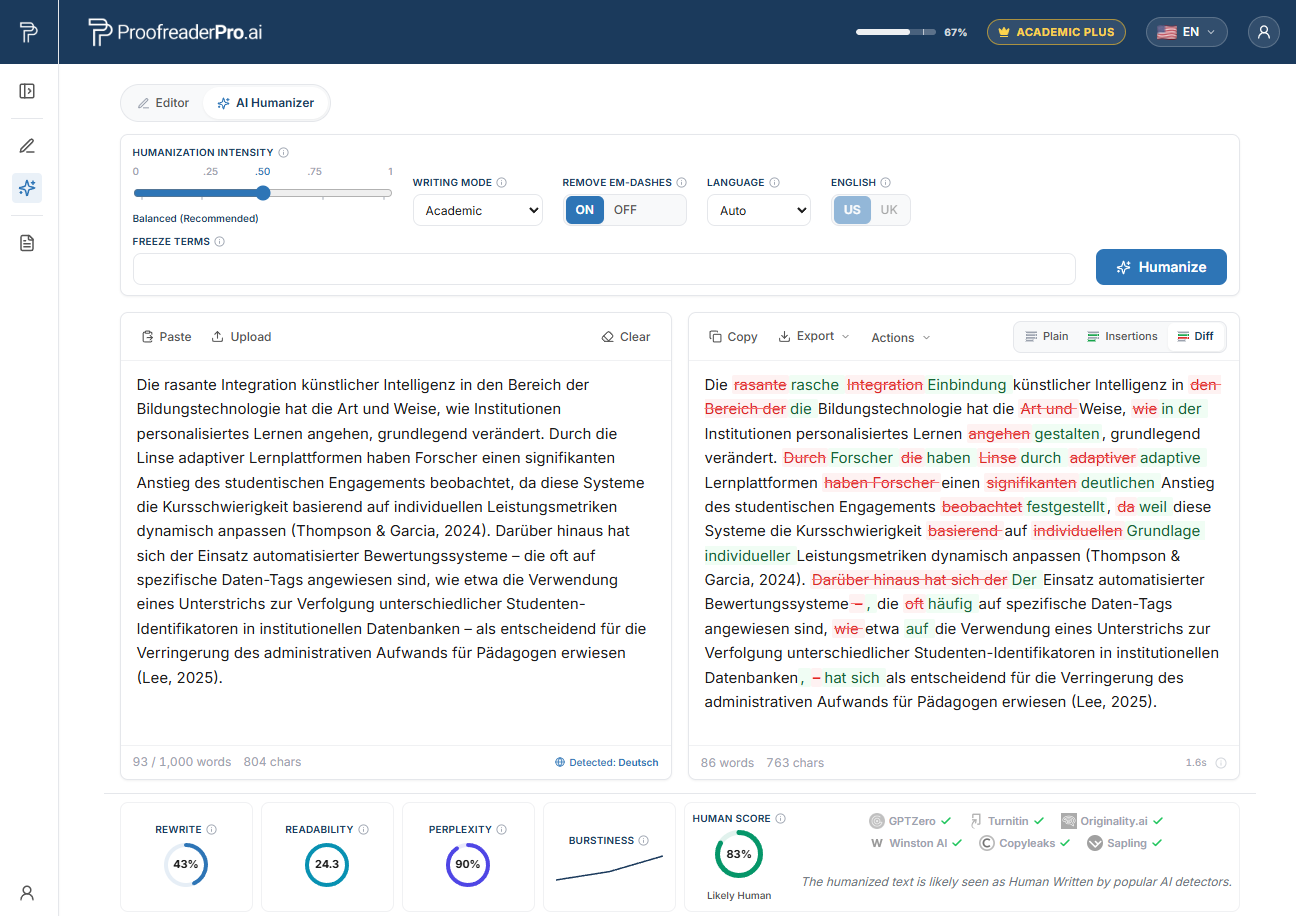
The ProofreaderPro AI Humanizer rewriting German academic text. The before and after diff keeps your meaning and citations, and the detector checks confirm a natural, human read.
Why German researchers get flagged by AI detectors
The clearest evidence comes from a 2023 Stanford study by Liang and colleagues, published in the Cell Press journal Patterns and titled "GPT detectors are biased against non-native English writers." The researchers ran human-written TOEFL essays through seven widely used detectors.
This result should concern anyone who is writing in a second language. About 61% of the non-native essays were on average flagged as AI compared to 5% of the native English writers. About 19.8% of the non-native essays were unanimously flagged by all detectors. Every single essay was written by a human.
The mechanism is a metric called perplexity, which measures how surprising each word choice is to a language model. Careful second-language writers reach for common words and standard, predictable phrasing. That is low perplexity, and low perplexity reads as machine text. The very habits that make your English clear are the habits these tools were trained to flag. We explain this in detail in why AI detectors flag non-native English writers.
The German first-language patterns behind false flags
None of the following is an error. These are correct, careful constructions that German speakers carry into English, and their regularity is exactly what a detector reads as low perplexity.
Standardized sentence openings from V2 habits. German places the finite verb in second position, so writers often front an adverbial phrase and follow a steady pattern: "In this study, we present," "In the following section, we show." Each sentence is correct. Repeated across a paragraph, the uniform cadence looks generated.
Cautious, consistent hedging from modal transfer. German modal verbs (können, sollen, müssen, dürfen) map imperfectly onto English, so researchers tend to hedge in a stable, repeated way. "The results should be interpreted carefully," used the same way each time, is precise and also very predictable to a model.
Dense compound noun phrases. German builds long compounds freely, and that transfers as tightly packed English noun stacks like "temperature measurement error correction factor." Formal and compact, this is standard technical writing, and standard is what detectors score as low perplexity.
Impersonal passive constructions. The German academic tradition favors impersonal forms ("Es wurde festgestellt, dass"), which become "It was found that" in English. Perfectly acceptable, and perfectly regular, which is the whole problem.
False friends handled correctly. Advanced German writers know that "aktuell" means current and "eventuell" means possibly, so they self-correct toward safe, conventional word choices. Safe and conventional is, once again, low perplexity.
Notice the pattern. None of these habits is wrong. Each one is careful. And careful, standardized prose is precisely what a perplexity-based detector misreads as artificial.
Germany's AI-detection and Turnitin context
German universities and journals commonly screen theses and manuscripts for text similarity using Turnitin or iThenticate, and many of those tools now surface an AI-writing indicator alongside the similarity score. Doctoral committees, in particular, take originality checks seriously.
The climate around disclosure is shifting toward openness rather than prohibition. Funders and publishers increasingly ask authors to state whether and how they used AI tools, and to take responsibility for the final text. That is a reasonable expectation, and it is very different from banning assistance.
It is worth remembering that detector scores are contestable. Vanderbilt disabled Turnitin's AI detector in 2023, citing false positives and bias against non-native writers, and Michigan State, UT Austin, Northwestern, Pittsburgh, SMU, and Waterloo took similar steps. Turnitin itself suppresses scores in the 1 to 19% range and warns that its score should not be used alone for integrity decisions. A flag is a claim to examine, not a verdict.
Give your German-influenced English a fair reading
Humanize your own AI-assisted draft, keep every citation and technical term, then disclose your AI use. Tested against Turnitin, Originality.ai, and GPTZero.
Try the Humanizer FreeTop German universities and where AI checks appear
Germany has 11 Universities of Excellence, the nine-member TU9 alliance of technical universities, and the U15 group of research-intensive institutions. All of them expect English-language international publication for the Habilitation and for professorship applications, and all of them screen theses and manuscripts for similarity and AI indicators. The leading research producers include:
- Technische Universität München (TUM), Munich
- Ludwig-Maximilians-Universität München (LMU), Munich
- Ruprecht-Karls-Universität Heidelberg, Heidelberg
- Rheinisch-Westfälische Technische Hochschule Aachen (RWTH Aachen), Aachen
- Humboldt-Universität zu Berlin, Berlin
- Freie Universität Berlin, Berlin
- Albert-Ludwigs-Universität Freiburg, Freiburg
- Georg-August-Universität Göttingen, Göttingen
- Technische Universität Dresden, Dresden
- Karlsruher Institut für Technologie (KIT), Karlsruhe
- Eberhard Karls Universität Tübingen, Tübingen
- Rheinische Friedrich-Wilhelms-Universität Bonn, Bonn
If your thesis or manuscript from any of these institutions is going to face an AI indicator, the goal is not to hide your process. It is to make sure careful second-language writing is not mistaken for machine output, and then to disclose your tools openly.
How the AI humanizer for German researchers works
The workflow has four steps, and it keeps you inside integrity rules.
First, draft. If your reasoning flows more naturally in German, write there and translate into academic English, or draft in English with AI assistance for phrasing. Second, proofread the grammar so the meaning is exact. Third, run your own draft through the humanizer. It varies rhythm and word choice, removes repetitive cadence and stray em dashes, and preserves your meaning, technical terminology, and citations. Fourth, disclose your AI use in the format your institution and target journal require.
We test our humanizer against the major detectors, and it reworks AI text into a more natural human form that reads as human across Turnitin, Originality.ai, and GPTZero. Our grammar accuracy is above 96% on academic text. These are results from testing, not guarantees. Detectors retrain every few months, so we report what we measured and never promise to bypass anything.
You can run a passage through the text humanizer yourself and compare the before and after. This post sits inside our multilingual AI humanizer hub, which links the same workflow for other languages, and it pairs with our guide to academic editing for researchers in Germany if you also want grammar and structure editing.
Local funding bodies, journals, and AI-disclosure expectations
Germany's funding system rewards international publication, which raises the stakes on how your English reads. The DFG (Deutsche Forschungsgemeinschaft) is the primary competitive funder and evaluates impact through publication in high-ranking English-language journals. The Excellence Strategy funds Clusters and Universities of Excellence on international publication metrics. The DAAD (Deutscher Akademischer Austauschdienst) and the Alexander von Humboldt Foundation both fund exchange with publication expectations attached.
Your target journals set the language bar. German-based, English-language titles that reviewers hold to a high standard include:
- Angewandte Chemie International Edition (Wiley)
- Advanced Materials (Wiley)
- European Journal of Immunology (Wiley, for the German Society for Immunology)
- Zeitschrift für Physikalische Chemie (De Gruyter)
- German Economic Review (De Gruyter)
- Journal of Business Economics, formerly Zeitschrift für Betriebswirtschaft (Springer)
Across these funders and publishers, the direction is the same: disclose AI assistance clearly and stand behind your final text. Running your own draft through the humanizer to protect it from a false flag is fully compatible with that expectation, as long as the disclosure follows. If you are ever flagged anyway, treat the score as contestable and respond with evidence of your process.
Frequently asked questions
Q: Is an AI humanizer for German researchers a way to cheat Turnitin?
No. The proper use is to humanize your own AI-assisted draft so that careful, standard German-influenced English is less likely to be misread as machine text. You keep your meaning and citations, and you disclose your AI use as your institution and journal require. That is fairness for real work, not disguise.
Q: Will the KI-Humanizer change my citations or technical terms?
No. The humanizer preserves your references, your terminology, and your data. It varies sentence rhythm and word choice and removes repetitive cadence, but it does not rewrite your findings or touch your citation formatting.
Q: Can you guarantee my paper will pass every AI detector?
No, and you should distrust anyone who does. In testing, our humanizer reworked AI text into a more human form, which lowered the AI signal across the major detectors, but detectors retrain constantly. We report tested results, not guarantees, and we never promise 100% anything.
Q: Do I still need to disclose AI use if I humanize my draft?
Yes. Disclosure is the point, not an afterthought. Humanizing protects careful second-language writing from false flags, and disclosing your AI use in the required format keeps you inside integrity rules at the same time.
Q: Does the humanizer work for other languages besides German and English?
Yes. It supports more than 60 languages and routes non-English text through a language-aware model that preserves sentence structure and meaning, so the same workflow applies whether you draft in German first or write directly in English.
Preserve your meaning, citations, and technical terms while your German-influenced English gets a fair, natural reading. Tested against Turnitin, GPTZero, and Originality.ai, with high grammar accuracy.

Moe is an NLP engineer with a PhD in natural language processing. His research covers computational linguistics, text analysis, and machine learning, and it fed directly into the editing and humanization models behind ProofreaderPro. He writes about the part of the process most people never see: how a language model reads a sentence, scores it, and decides what to change.