AI Humanizer for Iranian Researchers Writing in English
AI humanizer for Iranian researchers. Reduce false AI-detection flags on Persian-influenced English, keep meaning and citations, disclose honestly.

Iran is ranked 17th in the world in terms of output, according to the SCImago index. It publishes over 75,000 papers a year. This is an increase of fifty times since 1997, when there were only around 1,000 papers published per year. And yet Iranian scientists achieved this while being under sanctions, which deny them access to journals, prevent them from paying for publications, and isolate them from much of the world's research infrastructure. Much of the work is written, polished, and submitted in English.
There is an AI humanizer for Iranian researchers, for this single real reason: AI detectors are wrongly thinking that careful, correct, non-native English is machine writing, costing real people credit for real work. A detector flag is not proof of anything. It's a probability score, and for Persian speakers those scores run high.
Most of us now draft with some AI help, an outline here, a smoothed paragraph there, a sentence translated from Persian. That is normal, and when you disclose it, it is legitimate. The trouble is that plain, standard academic English can trip a detector whether or not a tool ever touched it, and second-language writers get flagged more than almost anyone.
انسانیساز هوش مصنوعی برای پژوهشگران ایرانی
انسانیساز هوش مصنوعی به پژوهشگران ایرانی کمک میکند تا نوشتههای انگلیسی خود را طبیعیتر و روانتر کنند، معنا و ارجاعات را حفظ کنند، و مقالات خود را در مجلات بینالمللی منتشر کنند.
In plain terms: our humanizer takes your own English draft and varies its rhythm and word choice so that careful Persian-influenced prose is less likely to be misread as machine text. It keeps your meaning, your technical terms, and your citations in place. You can reach the tool directly through the text humanizer, and it sits inside the same platform as our proofreader and Persian-to-English translator.
This is not a trick to hide AI use. It is a fairness step for real research, followed by clear disclosure. We will come back to that order, because it matters.
Writing in Persian? It is auto-detected and humanized natively
Many Iranian researchers draft in Persian before writing up in English, and the humanizer supports that directly. Paste Persian text and ProofreaderPro recognises the right-to-left script automatically, then processes it through a language-aware model that keeps your terminology and citations exactly as written. انسانیساز هوش مصنوعی works on your Persian draft as naturally as on your English, so nothing has to be translated first. Auto-detection covers more than sixty languages, each rewritten as itself.
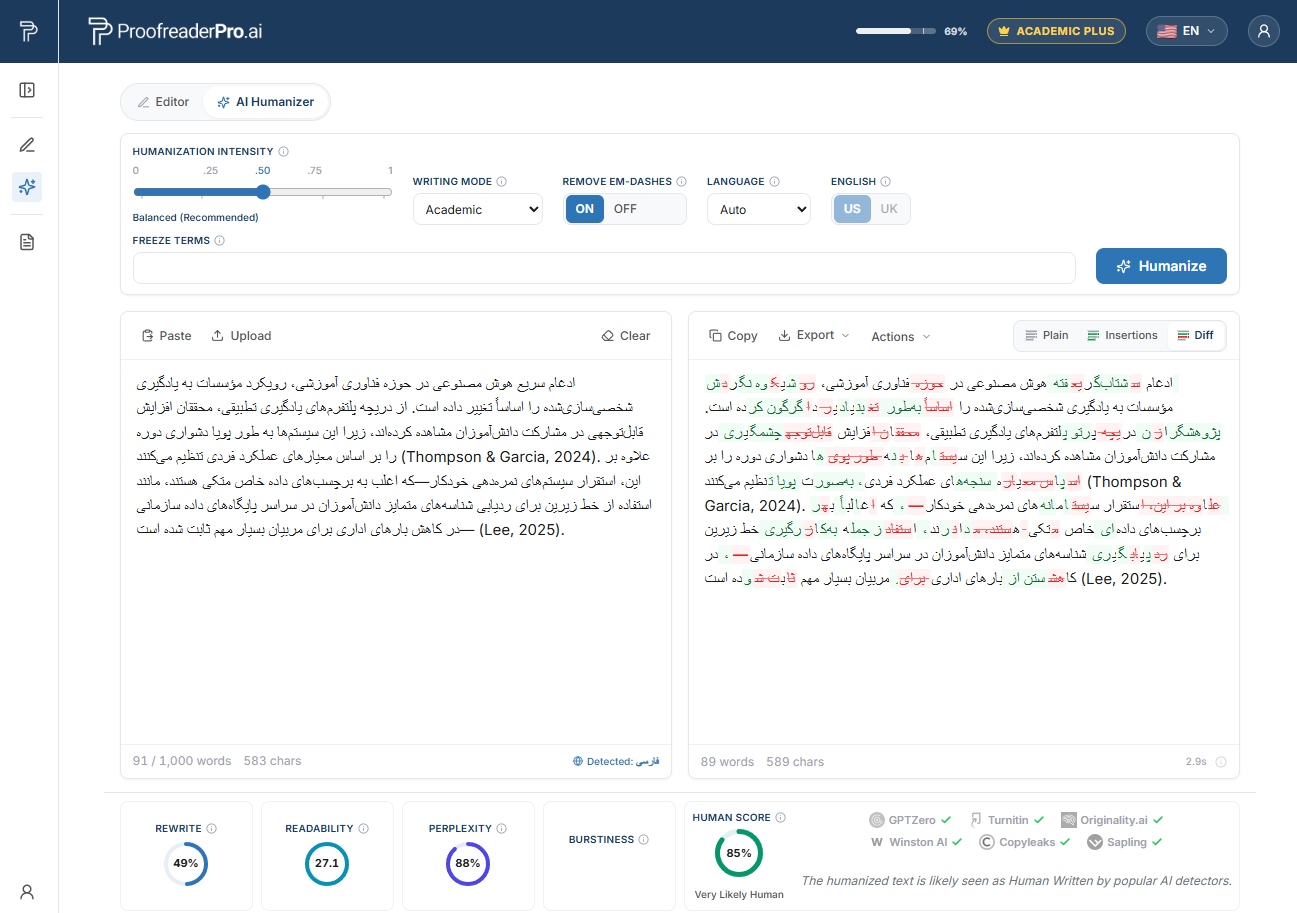
The ProofreaderPro AI Humanizer rewriting Persian academic text. The before and after diff keeps your meaning and citations, and the detector checks confirm a natural, human read.
Why Iranian researchers get flagged by AI detectors
In 2023, a Stanford team led by Weixin Liang published a study in the Cell Press journal Patterns titled "GPT detectors are biased against non-native English writers." They took TOEFL essays, all written by humans, and ran them through seven widely used AI detectors.
On average, about 61% of the non-native essays were flagged as AI-generated, versus about 5% for native English writers. Nearly one in five non-native essays, about 19.8%, was flagged unanimously by every single detector. Every one of those essays was written by a person.
The mechanism is called perplexity. Many detectors score how surprising each word choice is to a language model. When you write in clear, standard academic English, using common words and predictable phrasing, your text has low perplexity, and low perplexity reads as machine text. The very habits that make second-language academic prose clean and correct are the habits these tools were trained to flag. For a fuller explanation of this false-positive problem, see why AI detectors flag non-native writers.
The Persian first-language patterns behind false flags
Persian is structurally distant from English, and the careful corrections a Persian speaker makes to sound formal often produce exactly the flat, standard rhythm a detector reads as synthetic. These are not errors. They are correct, cautious constructions, and that is the problem.
Article discipline. Persian has no direct equivalent of "the," "a," or "an," so Iranian writers who have trained hard on English articles tend to place them in the safest, most textbook way. The result reads as correct and slightly mechanical, which is what low perplexity looks like.
Rebuilt word order. Persian follows Subject-Object-Verb order. To publish in English, you consciously rebuild each sentence into Subject-Verb-Object, and that deliberate, even structure is precisely the smooth cadence detectors associate with generated text.
Safe collocations. Many researchers draft in Persian and translate, then correct phrases like "do a research" into "conduct research." The corrected version is standard and predictable, so it lowers perplexity even as it improves the English.
Deductive reordering. Persian academic style often builds context first and states the claim late. When you flip a paragraph to the English thesis-first pattern, you produce the tidy, front-loaded structure that reads as formulaic to a detector.
Consistent tense and agreement. Persian marks tense and verb agreement differently, so careful writers police their tenses closely. Uniform, error-free tense across a Methods section is good writing, and it is also low-variance, machine-looking text.
None of this means your English is bad. It means your English is careful, and careful non-native prose is what these detectors most often misjudge.
Iran's AI-detection and Turnitin context
Theses and journal submissions from Iran are routinely screened for similarity and, increasingly, for AI indicators, most often through Turnitin or iThenticate. Iranian doctoral students must have at least one ISI (Web of Science) publication to graduate, and faculty promotion depends on indexed output in Web of Science, Scopus, PubMed, or the ISC database, so almost every serious manuscript passes through a screening pipeline at some point.
It's worth being clear about what a flag is and isn't. The bias above has caused some institutions to step back from using AI detectors. For example, Vanderbilt disabled Turnitin's AI detector in 2023 due to false positives and unfairness to non-native writers. Others who did this include Michigan State, UT Austin, Northwestern, Pittsburgh, SMU, and Waterloo. Turnitin suppresses scores in the 1 to 19% range and warns that its score shouldn't be used alone to make an integrity decision.
So a detector percentage is a claim to contest, not a verdict. No student "sued Turnitin and won"; the real disputes were with schools over how a flag was used. Meanwhile funders and journals are moving in the opposite direction from concealment: they increasingly ask you to disclose AI use openly. Those two facts together define the straightforward path, protect careful writing from a false flag, and disclose the help you did use.
Humanize your own AI-assisted draft, keep every citation
Vary the rhythm of careful Persian-influenced English so it is less likely to be misread as machine text. Meaning, terminology, and references stay intact, then you disclose your AI use.
Try the Humanizer FreeTop Iran universities and where AI checks appear
Iran's research universities all require English-language publication for doctoral graduation and faculty advancement, and their graduate schools and libraries screen theses and manuscripts for similarity and AI indicators before submission. The major institutions include:
- University of Tehran (دانشگاه تهران), Tehran, the oldest and highest-ranked, strong across every discipline.
- Sharif University of Technology (دانشگاه صنعتی شریف), Tehran, the leading technical university.
- Amirkabir University of Technology (دانشگاه صنعتی امیرکبیر), Tehran, also known as Tehran Polytechnic.
- Iran University of Science and Technology (دانشگاه علم و صنعت ایران), Tehran.
- Tarbiat Modares University (دانشگاه تربیت مدرس), Tehran, a graduate-only university.
- Shahid Beheshti University (دانشگاه شهید بهشتی), Tehran.
- Tehran University of Medical Sciences (دانشگاه علوم پزشکی تهران), Tehran, the top medical research institution.
- Isfahan University of Technology (دانشگاه صنعتی اصفهان), Isfahan.
- University of Isfahan (دانشگاه اصفهان), Isfahan.
- Ferdowsi University of Mashhad (دانشگاه فردوسی مشهد), Mashhad.
- Shiraz University (دانشگاه شیراز), Shiraz, home of the ISC headquarters.
- University of Tabriz (دانشگاه تبریز), Tabriz, one of the oldest universities.
- K.N. Toosi University of Technology (دانشگاه صنعتی خواجه نصیرالدین طوسی), Tehran.
- Islamic Azad University (دانشگاه آزاد اسلامی), campuses nationwide, the largest system by enrollment.
- Bu-Ali Sina University (دانشگاه بوعلی سینا), Hamedan.
At each of these, the checkpoint is the same: your English manuscript meets a similarity and AI screen, and careful non-native prose is exactly the kind that gets a higher score than it deserves.
How the AI humanizer for Iranian researchers works
The AI humanizer for Iranian researchers is the last step in a workflow, not a shortcut around it. Here is the order we recommend.
If you think more clearly in Persian, then first draft in Persian and translate to academic English. Or draft in English using whatever AI help you use. Second, proofread the grammar so article use, tense, agreement, and prepositions are correct. Third, humanize your own AI-helped prose so that careful, low-variance writing reads with natural human rhythm again, while your meaning, terminology, and citations stay exactly as they were.
On results, we report what we have measured, not what we promise. Tested against the major detectors, our humanizer reworks AI phrasing toward a genuinely human voice, so the AI score drops and the text stands a better chance against strict detectors, while keeping grammar accuracy high on academic text. These are results from testing, not guarantees, and detectors retrain every few months, so no serious tool can claim your work will be "100% undetectable." We do not, and you should distrust anyone who does.
Then disclose. Add the AI-use statement your institution and target journal require. Humanizing protects careful writing from a false flag; disclosure keeps you inside the integrity rules. You need both. Run your draft through the text humanizer, see the whole cluster at our multilingual AI humanizer hub, and if you want the grammar layer handled first, start with academic editing for researchers in Iran.
Local funding bodies, journals, and AI-disclosure expectations
Iran's research is coordinated by MSRT, the Ministry of Science, Research and Technology, which supervises more than 2,500 universities and institutions, and funded in part by INSF, the Iranian National Science Foundation, which works with over 35,000 faculty members and provides grants up to roughly $44,000 for international projects. The ISC, the Islamic Science Citation database headquartered in Shiraz, indexes about 1,800 journals and functions as a third citation database alongside Web of Science and Scopus.
Iran also has 398 Scopus-indexed journals. Prominent titles that publish in English include:
- Scientia Iranica, Sharif University of Technology, engineering and science
- Iranian Journal of Science and Technology, across sciences and engineering series
- Journal of the Iranian Chemical Society, Springer-published and SCIE-indexed
- Iranian Polymer Journal, Springer-published
- Archives of Iranian Medicine, a high-impact medical journal
- Iranian Journal of Public Health, Tehran University of Medical Sciences
- Iranian Journal of Basic Medical Sciences, Mashhad University of Medical Sciences
- Journal of Research in Medical Sciences, Isfahan University of Medical Sciences
Across these outlets, and across the funders that support the work behind them, the expectation is shifting toward open disclosure of AI assistance rather than silence. Write your disclosure statement in the format each journal specifies, and if a submission is ever flagged despite real work, treat the score as contestable. Our guides on the AI-disclosure statement and on appealing a false AI-detection flag walk through both. The text humanizer handles the writing layer; disclosure and, if needed, an appeal handle the rest.
Frequently asked questions
Q: Does the AI humanizer for Iranian researchers hide that I used AI?
No. It rewrites the rhythm of your own AI-assisted draft so careful Persian-influenced English is less likely to be misflagged, while your meaning and citations stay intact. It is meant to be paired with an open AI-use disclosure, not used to conceal anything. Hiding fabricated or borrowed work is not what this tool is for.
Q: Can Iranian researchers access the humanizer despite sanctions?
Yes. The platform is web-based and reachable from Iran, and it does not depend on traditional international banking to get started. There is a free tier so you can test it on a real paragraph before committing anything.
Q: Will the humanizer damage my citations or technical terms?
No. The model is built to preserve references, defined terminology, and the meaning of each sentence. It varies word choice and cadence and removes repetitive patterns, but your factual content and your citation markers remain in place for you to verify.
Q: What pass rates can I actually expect on Turnitin or GPTZero?
In our own testing against the major detectors, the humanizer rewrites AI text into a more natural human form, which lowers the AI signal and improves its odds against tough detectors, while keeping grammar accuracy high. Those are tested results, not guarantees, because detectors change their models regularly. Treat any promise of a perfect, undetectable score as a warning sign.
Q: Does it support Persian-language and mixed drafts?
Yes. The humanizer supports more than 60 languages and routes non-English text through a language-aware model that protects sentence structure and meaning, so you can draft in Persian, translate to academic English, and humanize the result within one workflow.
For Iranian researchers: rebalance careful Persian-influenced prose so it reads naturally, keep your citations and meaning, then disclose your AI use with confidence.
Moe is an NLP engineer with a PhD in natural language processing. His research covers computational linguistics, text analysis, and machine learning, and it fed directly into the editing and humanization models behind ProofreaderPro. He writes about the part of the process most people never see: how a language model reads a sentence, scores it, and decides what to change.