AI Humanizer for French Researchers Writing in English
AI humanizer for French researchers. Reduce false AI-detection flags on French-influenced English, keep meaning and citations, disclose honestly.

France publishes about 62,200 Scopus-indexed papers a year, the eleventh largest research output in the world, backed by roughly 2.2% of GDP and a dense network of universities, grandes ecoles, and national bodies including the CNRS, INSERM, INRIA, and CEA. More than 300,000 researchers keep that engine running, and almost all of them publish in English.
Many now draft with help from ChatGPT, Claude, or a translation tool, then polish the result. An AI humanizer for French researchers exists for exactly that moment: to keep your own meaning and citations intact while making your polished prose less likely to be misread as machine written. That is ordinary academic practice, and the trouble starts only when a detector reads careful, standard English and calls it generated.
The false flag is not a rare accident. Careful second-language English, the kind French researchers work hard to produce, is precisely the kind of writing that detectors most often misjudge.
Un humaniseur de texte IA pour les chercheurs et chercheuses francais
Notre humaniseur de texte IA aide les chercheurs et chercheuses francophones a publier en anglais sans que leur travail soit injustement signale comme genere par une machine. Il preserve votre sens, vos termes techniques et vos citations, tout en variant le rythme et le vocabulaire pour rendre votre prose plus naturelle.
In plain terms, the humanizer works on English you already wrote, or drafted with AI help and then revised. It does not invent findings, and it does not hide the fact that you used AI. It softens the flat, repetitive cadence that detectors latch onto, so your careful writing reads as what it is: the work of a human researcher.
Drafting in French? The humanizer detects and processes it too
Not every draft starts in English, and the humanizer does not require it to. Paste French text and ProofreaderPro identifies the language on its own, then routes it through a French-aware model that keeps accents, terminology, and references in place. As a humaniseur de texte IA it rewrites your French prose directly, so you can humanize before translating rather than after. The same automatic detection spans more than sixty languages, each handled in its own register.
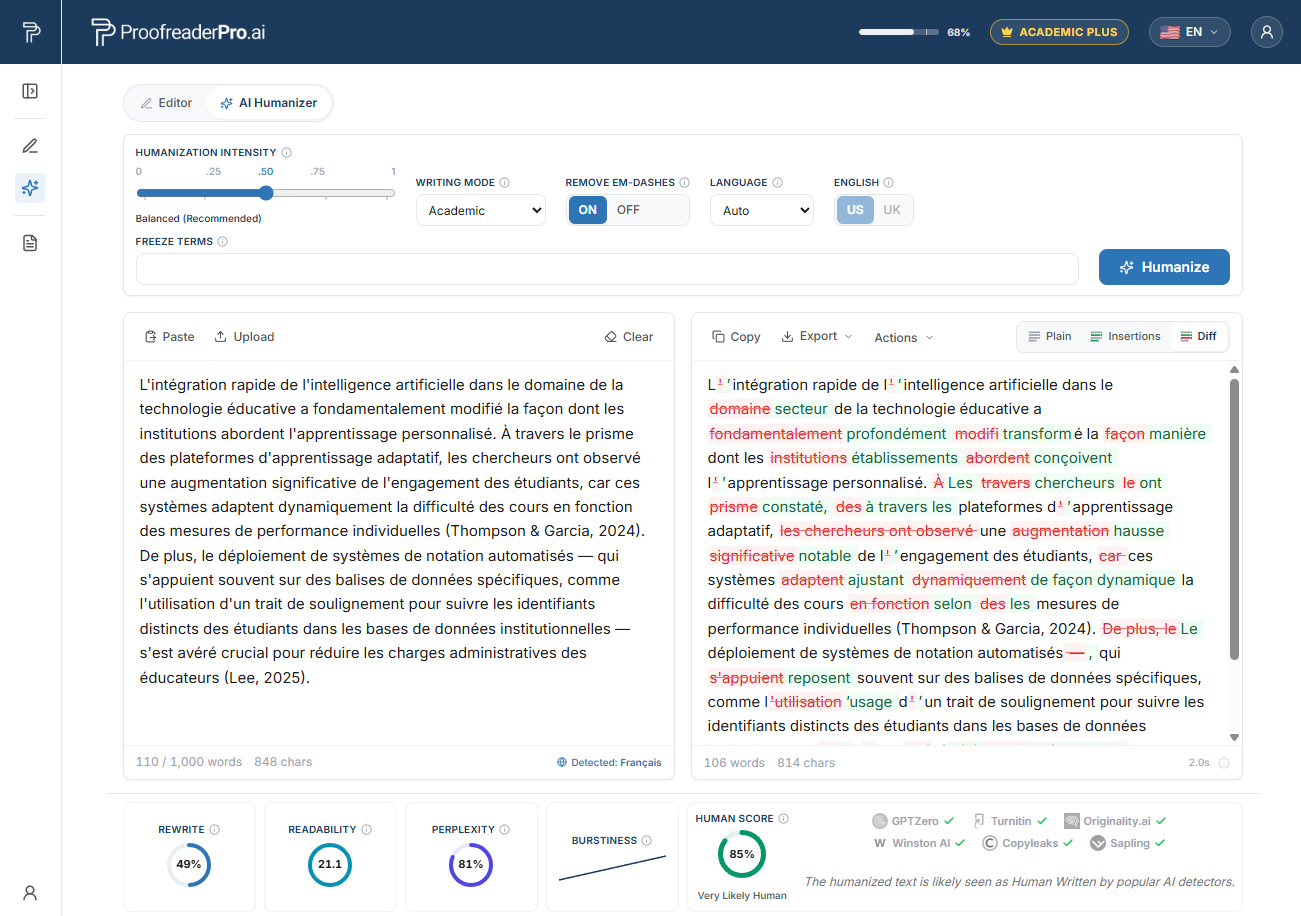
The ProofreaderPro AI Humanizer rewriting French academic text. The before and after diff keeps your meaning and citations, and the detector checks confirm a natural, human read.
Why French researchers get flagged by AI detectors
The clearest evidence comes from a 2023 Stanford study by Liang and colleagues, published in the Cell Press journal Patterns under the title "GPT detectors are biased against non-native English writers." The team ran human-written TOEFL essays through seven widely used detectors.
On average, about 61% of the non-native essays were flagged as AI, against about 5% for native English writers. Nearly one in five non-native essays, about 19.8%, was unanimously flagged by every detector. Every single essay was written by a human.
The mechanism is perplexity. Many detectors score how surprising each word choice is to a language model. Careful second-language writers reach for common words and standard, predictable phrasing, which produces low perplexity, which reads as machine text. The habits that make non-native academic prose clear are the very habits detectors were trained to distrust. We explain the full mechanism in why AI detectors flag non-native writers.
The French first-language patterns behind false flags
French and English share thousands of words and centuries of exchange, so French researchers carry a large passive English vocabulary. To avoid the traps inside that shared lexicon, they write defensively. That defensive caution is good scholarship, and it also drives the low-perplexity cadence a detector reads as generated.
Faux amis push writers toward the safest word. False cognates are the sharpest trap: "actually" is not "actuellement" (currently), "eventually" is not "eventuellement" (possibly), and "experience" is often used for "experiment." Experienced French authors learn to sidestep these by choosing the most common, least risky English word every time. That is exactly the plain vocabulary a detector associates with machine text.
Uncountable nouns invite over-correction. French pluralizes nouns that English keeps singular: "informations," "researches," "equipments," "evidences," "advices." Once corrected, researchers tend to write around the problem with simple, textbook constructions. Predictable is safe for a reviewer and suspicious for a detector.
Article use with abstractions gets drilled flat. French attaches an article to almost every noun ("la science," "le bonheur"), so careful writers train themselves to drop it in English generalizations. The result is clean, rule-perfect phrasing, and rule-perfect phrasing is what a perplexity score reads as automated.
Adverb placement gets standardized. French puts the adverb after the verb ("We analyzed carefully the results"). Authors who have learned the English rule move it to the conventional slot ("We carefully analyzed the results"). Their sentences become smooth and uniform, and uniform cadence lowers perplexity across a whole paragraph.
Prepositions get memorized and applied uniformly. French maps prepositions differently: "consist in," "depend of," "interested to," "responsible of." Careful authors learn the English pairings and apply them with total consistency. Perfectly consistent prose is one more thing that reads as generated.
Long clause chains get chopped short. French academic style favors long sentences with stacked subordinate clauses. Told that Anglophone readers prefer shorter sentences, French researchers often cut their prose into short, even, declarative units. Even sentence length across many sentences is one of the strongest signals a detector uses.
None of these are errors once corrected. They are the marks of a diligent non-native writer, and that diligence is what gets misread.
France's AI-detection and Turnitin context
Most French doctoral schools (ecoles doctorales) and journals screen theses and manuscripts with Turnitin or iThenticate for similarity, and many now surface an AI-writing indicator next to the similarity figure. France's research-integrity climate has tightened in parallel: universities appoint referents integrite scientifique (research integrity officers), and funders and journals increasingly ask authors to state whether they used AI assistance.
None of that makes AI use forbidden. It makes full disclosure the expectation. The risk is not disclosure. The risk is a detector score treated as a verdict when it is only a claim.
That caution is warranted. Vanderbilt disabled Turnitin's AI detector in 2023, citing false positives and bias against non-native writers, and Michigan State, UT Austin, Northwestern, Pittsburgh, SMU, and Waterloo took similar steps. Turnitin itself suppresses scores in the 1 to 19% range, showing an asterisk instead of a number, and warns that its score should not decide an integrity case on its own. A flag is something to contest, not a confession.
Protect your careful English from false AI flags
Humanize your own AI-assisted draft in seconds. Keep your meaning, terminology, and citations, then disclose your AI use the way your journal expects. Built for French researchers publishing in English.
Try the Humanizer FreeTop French universities and where AI checks appear
France runs on universities, grandes ecoles, and national research organizations, and its strongest research producers span all three. Screening theses and manuscripts for similarity and AI indicators is now routine across them.
- Sorbonne Universite (Paris), formed from UPMC and Paris-Sorbonne, strong in mathematics, physics, medicine, and the humanities with deep CNRS collaboration.
- Universite Paris-Saclay (Saclay and Orsay), consistently among the world's top 15 in the Shanghai ranking and host to major national laboratories.
- Universite PSL (Paris Sciences et Lettres) (Paris), a collegiate university grouping ENS, Dauphine, ESPCI, and Mines Paris.
- Universite Paris Cite (Paris), built from Paris Descartes and Paris Diderot, with strong INSERM partnerships in medicine and life sciences.
- Universite Grenoble Alpes (Grenoble), a hub for physics and condensed matter, home to the ESRF and the Institut Laue-Langevin.
- Aix-Marseille Universite (Marseille), France's largest university, with dozens of joint CNRS research units.
- Universite de Strasbourg (Strasbourg), a chemistry and life-sciences powerhouse and member of the League of European Research Universities.
- Universite de Bordeaux (Bordeaux), strong in neuroscience, materials science, and laser physics.
- Universite Claude Bernard Lyon 1 (Lyon), a major research site in chemistry, biology, and physics.
- Ecole Polytechnique (Palaiseau), France's most prestigious science and engineering grande ecole, part of the Institut Polytechnique de Paris.
- Ecole Normale Superieure (ENS) (Paris), an elite grande ecole with extraordinarily high research output per capita, part of PSL.
- Universite Toulouse III - Paul Sabatier (Toulouse), strong in aerospace, astrophysics, and chemistry.
At every one of these institutions, English-language publication drives HDR qualification, promotion to Professeur des Universites, and competitive CNRS recruitment. The higher the stakes on your English, the more a single false AI flag can cost.
How the AI humanizer for French researchers works
The workflow has four steps, and none of them involves hiding your work.
First, draft. Write in English, or draft in French where your reasoning flows and then translate; either way the ideas and the evidence are yours. Second, proofread the grammar, so faux amis, preposition slips, and article errors are gone before anyone reads it. Third, run the AI humanizer on your own AI-assisted English, so the flat, repetitive cadence is broken up while your meaning, terminology, and citations stay exactly as you wrote them. Fourth, disclose your AI use in the format your institution and target journal require.
Tested against the major detectors, our humanizer rewrites AI text into a more natural human form, which lowers the AI signal and improves its odds against tough detectors, while keeping grammar accuracy high on academic text. These are results from testing, not guarantees. Detectors retrain every few months, so no serious tool promises 100% or a permanent bypass. What the tool reliably does is preserve your scholarship while reducing the machine-like patterns that trigger false flags.
This is fairness for real work, not disguise. If you want the evidence behind these false flags across languages, our multilingual AI humanizer hub collects it, and the academic editing guide for researchers in France covers the grammar side in depth.
Local funding bodies, journals, and AI-disclosure expectations
Publication pressure in France runs through its funders and evaluators. The ANR (Agence Nationale de la Recherche) funds competitive projects and judges them on publications in high-ranking English-language journals. The CNRS employs more than 30,000 researchers across over 1,000 laboratories, and its Comite National weighs publication records in every promotion. INSERM, CEA, and CNES researchers publish across international journals as a matter of course. The HCERES evaluates research units every five years, and the CNU handles qualification, both with publication output front and center.
Even French journals need to have papers in English when they're sent abroad. Prominent titles include Comptes Rendus Mathematique, Comptes Rendus Physique, Comptes Rendus Chimie, Comptes Rendus Biologies (Academie des Sciences), Annales de l'Institut Fourier (Grenoble), Annales de l'Institut Henri Poincare (mathematics and theoretical physics), European Physical Journal (co-published with EDP Sciences).
More of these funders and journals now expect a short statement of AI use. Because the humanizer preserves your citations and meaning, that disclosure is simple to write: you used AI assistance and a humanizer to polish your own draft, and the findings are your own. If you need the wording, see our AI disclosure statement guide, and if a flag has already landed, our appeal playbook for a false AI flag walks through the response.
Frequently asked questions
Q: Does an AI humanizer for French researchers help me cheat a detector?
No. The tool is for humanizing your own AI-assisted draft, not for disguising fabricated or borrowed work. It keeps your meaning and citations intact and reduces the low-perplexity patterns that cause false flags. You still disclose your AI use the way your institution and journal require.
Q: Will the humanizer change my citations or technical terms?
No. It preserves your references, your discipline-specific terminology, and the substance of every claim. It varies rhythm and word choice and removes repetitive cadence, so the argument you wrote survives exactly while the machine-like texture eases.
Q: Can it guarantee my paper passes Turnitin or GPTZero?
No credible tool can. In our testing the humanizer rewrites AI text into a more natural human form, which lowers the AI signal and improves its odds against tough detectors, while keeping grammar accuracy high. These are tested results, not promises. Detectors retrain often, so treat any score as a claim you can contest, not a verdict.
Q: I drafted in French and translated to English. Can I still use it?
Yes. Translated academic prose is often especially smooth and standard, which is exactly what detectors misread. Running your translated English through the humanizer restores natural variation while keeping your meaning, and it works across French and more than 60 other languages.
Q: Is using a humanizer allowed under ANR or CNRS integrity rules?
Polishing your own writing and disclosing AI assistance is consistent with standard integrity expectations. The line is honesty: humanize work that is genuinely yours, keep the findings unchanged, and state that you used AI tools when your funder or journal asks. That combination protects careful non-native writing without breaking any rule.
Break the repetitive cadence detectors flag while your citations and technical terms stay intact. Tested against Turnitin, Originality.ai, and GPTZero, and tuned for non-native academic English.

Moe is an NLP engineer with a PhD in natural language processing. His research covers computational linguistics, text analysis, and machine learning, and it fed directly into the editing and humanization models behind ProofreaderPro. He writes about the part of the process most people never see: how a language model reads a sentence, scores it, and decides what to change.