AI Humanizer for Creative Writing: Keep Your Voice
An AI humanizer for creative writing reclaims your authorial voice from flat, generic machine prose so your fiction reads like you. Try it free today.

You asked the model for a scene where your protagonist finally confronts her estranged father, and it gave you something. The beats are all there. The dialog moves. When you read it back, though, you feel a little cold sensation in your chest, because it doesn't sound like anything you would ever write. It sounds like everyone. It sounds like no one.
That gap is the whole problem, and it is why an AI humanizer for creative writing exists. Not to launder machine text into something you can pretend you wrote alone, but to take a draft you shaped and steer it back toward the voice you have spent years building. The ideas can come from anywhere. The rhythm, the diction, the strange little habits that make a sentence yours, those have to come back to you before the page is finished.
Most writers who lean on AI to brainstorm or break a block hit the same wall. The prose is competent and utterly anonymous. The piece is about why that happens, what a humanizer tuned for fiction can actually fix, and how to stay candid with the venues that care how your story was made.
How ProofreaderPro humanizes your novel
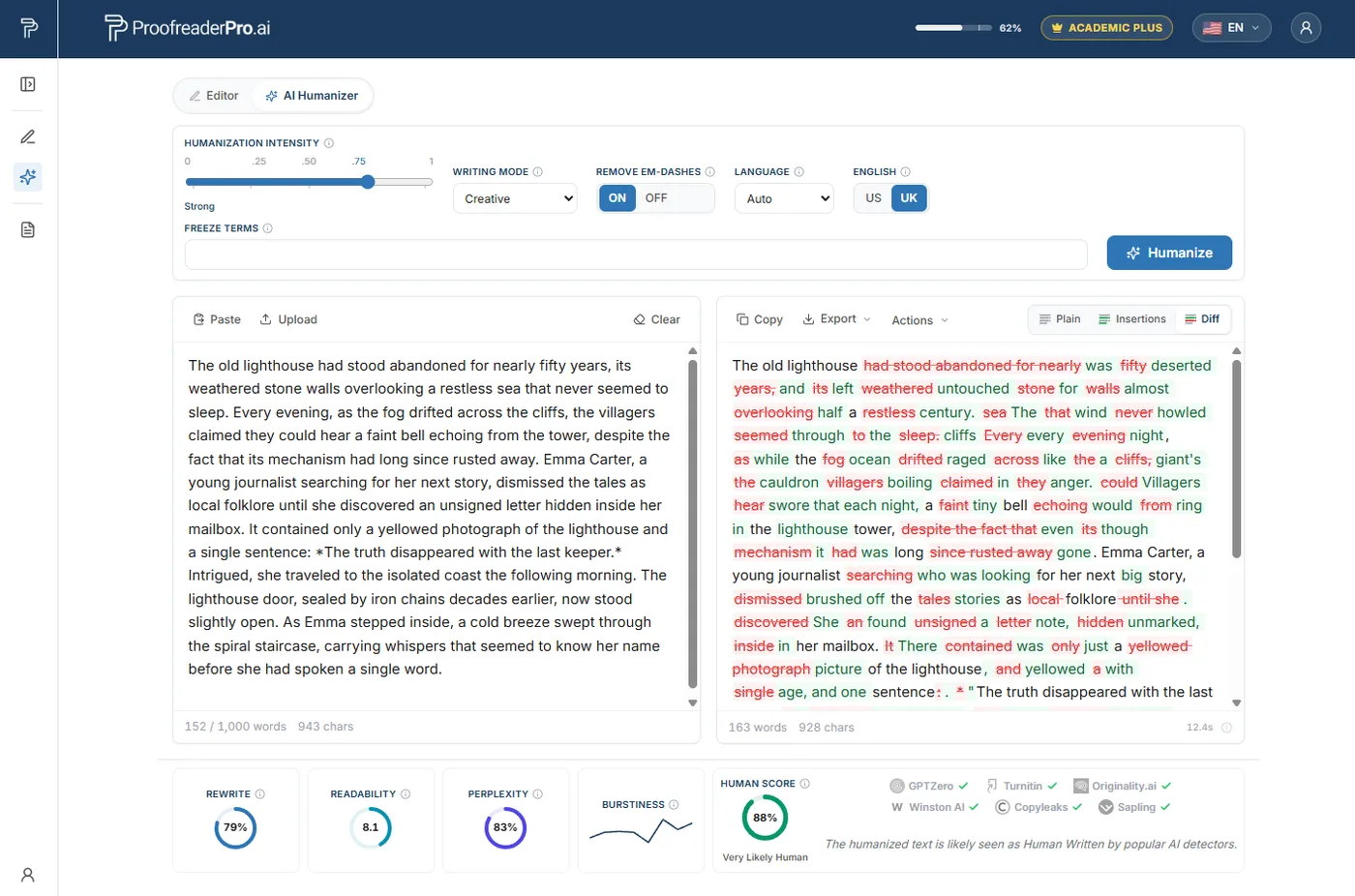
Model prose has a texture you notice once and cannot unsee: sentences of the same length, clauses that balance too neatly, adjectives in tidy pairs, an emotional temperature that never shifts. ProofreaderPro's Creative mode works on that texture first. It breaks the even cadence so a long, winding sentence can land on a short, blunt one, loosens the too-perfect symmetry, and nudges the diction back toward your own habits instead of the safe average a model reaches for.
It can let a character's dialogue sound nothing like the narrator and keep deliberate repetition that a plain grammar tool would want to delete. As it reworks the rhythm, it is built to protect what a story cannot afford to lose, so character names, the timeline, and the metaphor a scene turns on are meant to stay as you wrote them. The result is not a different story. It is your story, with its rhythm and voice handed back.
Why AI fiction reads flat
Model prose has a texture, and once you notice it you cannot unsee it. Every sentence carries roughly the same weight. The clauses balance a little too neatly. Adjectives arrive in tidy pairs, metaphors reach for the nearest familiar image, and the emotional temperature stays even from the first line to the last.
But human writing doesn't work that way. A real voice rushes and stops. It throws out a two-word sentence after a long meandering one. It deliberately repeats a word. It breaks a rule it set three paragraphs earlier. A character speaks in a voice the narrator would never use. Those things aren't mistakes. They're the fingerprint.
AI smooths the fingerprint off. It's trained to predict the most likely next word, so it gravitates towards the average of everything it's read. Which is why it's useful for a first pass and useless as a final one. The result reads clean. Clean isn't the same as alive.
What an AI humanizer for creative writing restores
The point of an AI humanizer for creative writing is not to disguise the text. It is to give the draft back its irregularity, the cadence and register and verbal tics that a model sanded away. A tool built for fiction works on rhythm first: varying sentence length, loosening the too-perfect symmetry, letting some lines run and others land hard and short.
It also protects what you actually wrote. A generic word-spinner swaps synonyms at random and cheerfully mangles a character name, a timeline, or the one metaphor the whole scene turns on. A humanizer built for craft preserves meaning and continuity while it reworks the surface, so your plot survives the edit intact.
This is where ProofreaderPro.ai's Creative mode comes in. The same engine offers dedicated modes for Academic, Corporate, Creative, and Blog writing, and the Creative setting is tuned to leave your intent alone while it restores natural, uneven, human rhythm. If you want the mechanics, our guide on how to humanize AI text walks through the process step by step.
A humanizer is one tool in a longer edit, not a magic wand. It gets you past the anonymous-draft stage faster. The taste, the cuts, the final read-aloud pass, those are still yours.
Word-spinner or craft tool: what actually changes
Not all rewriting is the same, and the difference matters most in fiction, where a single scrambled detail can break a reader's trust. Here is the real contrast.
| What happens to your draft | Generic word-spinner | Creative-mode humanizer |
|---|---|---|
| Sentence rhythm | Stays flat, just reworded | Varied, uneven, closer to speech |
| Character names and facts | Often garbled or swapped | Preserved intact |
| Your diction and register | Replaced with random synonyms | Nudged back toward your voice |
| Key metaphors and images | Frequently flattened | Kept and sharpened |
| Formatting and structure | Sometimes broken | Left as you wrote it |
The takeaway is simple. A spinner changes words. A humanizer changes texture while guarding the things a story cannot afford to lose. That distinction is the whole reason to reach for a purpose-built tool instead of the first free rewriter you find.
Give Your AI Draft Back Its Voice
Run your scene through Creative mode and watch flat, even prose regain rhythm and character. Start on the free tier, no card required.
Try ProofreaderPro.ai FreeThe gatekeeper reality
Here is the part too many AI-writing pitches skip. The venues you might submit to have opinions about machine text, and some of them are strong.
In February 2023, the science-fiction magazine Clarkesworld closed submissions entirely after a flood of AI-generated spam. Where the magazine had historically seen around 25 spam submissions a month, that February it received more than 500, and editor Neil Clarke tied the surge directly to "make money with ChatGPT" schemes circulating online. It reopened weeks later, but the message to writers was blunt: undisclosed machine prose is not welcome, and gatekeepers will react.
NaNoWriMo offers a cautionary tale from the other direction. In late 2024 the organization declined to condemn AI writing and called a blanket anti-AI stance "classist and ableist," their framing, not ours. The backlash was severe. Board members including Daniel Jose Older and Maureen Johnson resigned, a sponsor withdrew, and the organization announced it was shutting down, effective in early 2025. Feelings in the writing community run hot, and being straight about your process is the safest ground to stand on.
Amazon KDP draws a line worth memorizing. Since September 2023 it has capped new title uploads at three per day, and it asks creators to disclose "AI-generated" content, text, images, or translations, to Amazon at upload. The distinction is precise: content that is AI-generated must be disclosed, while AI-assisted work, where you wrote the book and used AI to help edit, does not require disclosure. The disclosure goes to Amazon, not onto a public label on your book.
None of this should scare you off using AI to draft or unstick a scene. It should keep you grounded. Humanizing your own AI-assisted work to make it read in your voice is craft. Passing off fully machine-written text where a venue forbids it is not, and no tool changes that.
How to make AI-written fiction sound like you
Start with your own material. Feed the model your outline, your character notes, a page of your existing prose, so the draft leans toward your patterns from the first word rather than the generic average.
Then humanize with intent, not on autopilot. Run the draft through a Creative-mode humanizer to break the even cadence, then read every changed line aloud. Your ear catches what a screen hides. Keep the substitutions that sound like you, revert the ones that do not, and cut anything that drifts from your character's register.
Do the human passes a tool cannot do. Add the specific sensory detail only you would notice, the line of dialogue that reveals character sideways, the joke that lands because of something three chapters back. If you also want a heavier structural edit, our roundup of the best AI book editors covers tools for the developmental side. And if you are curious how humanizing intersects with getting found online, we cover humanizing AI content for SEO separately.
The goal is not a story that fools a reader about how it was made. It is a story that sounds unmistakably like you wrote it, because in every way that matters, you did.
Frequently asked questions
Q: Can an AI humanizer keep my writing voice?
That is exactly what a good one is built to do. An AI humanizer for creative writing works on rhythm, register, and diction to nudge a flat draft back toward your patterns, and a craft-focused tool preserves your names, facts, and key images instead of scrambling them. It gets you close, then your own read-aloud edit finishes the job.
Q: Will magazines or publishers reject AI-assisted fiction?
Some venues restrict or prohibit AI-generated submissions, and Clarkesworld's 2023 submission freeze after an AI-spam flood shows how sharply gatekeepers can react. Policies vary widely, so read each venue's guidelines and be upfront about your process. Humanizing your own draft to sound like you is craft, but never submit undisclosed machine text where it is barred.
Q: Do I have to disclose AI use on Amazon KDP?
Amazon asks you to disclose "AI-generated" content, text, images, or translations, to Amazon at upload. Work that is only AI-assisted, meaning you wrote it and used AI to help edit, does not require disclosure. The disclosure goes to Amazon, not as a public label on your book.
Q: How do I make AI-written fiction sound like me?
Prime the model with your own outline and prose, humanize the draft to break the even AI cadence, then read every line aloud and keep only what sounds like you. Add the sensory details, character beats, and callbacks a model cannot invent. To learn the whole approach to make AI writing sound human, our humanizer walks you through it.
Restore your authorial rhythm and voice while your plot, names, and images stay exactly as you wrote them.

Moe is an NLP engineer with a PhD in natural language processing. His research covers computational linguistics, text analysis, and machine learning, and it fed directly into the editing and humanization models behind ProofreaderPro. He writes about the part of the process most people never see: how a language model reads a sentence, scores it, and decides what to change.