AI Humanizer for Business Writing: On-Brand, Not Robotic
AI humanizer for business writing turns flat, generic AI drafts into on-brand, trustworthy copy that sounds like your company. See how it works.

You know the feeling when you open a proposal your team drafted with AI and every sentence is technically correct and somehow completely forgettable. The grammar is clean. The structure is tidy. And yet it reads like it could have come from any company in your industry, which is another way of saying it reads like it came from no one at all.
That gap between correct and convincing is exactly where an AI humanizer for business writing earns its keep. Your readers, whether they are prospects, clients, or your own executives, can feel when copy has no pulse. They may not name it, but they trust it less. A polished draft that sounds like a machine quietly tells people your brand does not care enough to sound like itself.
We work with teams shipping reports, proposals, newsletters, web copy, and client emails at volume, and the pattern is consistent. AI gets you to a fast first draft. It rarely gets you to something that sounds like your company and a real human wrote it together. Closing that last stretch is the whole job.
How ProofreaderPro humanizes your corporate report
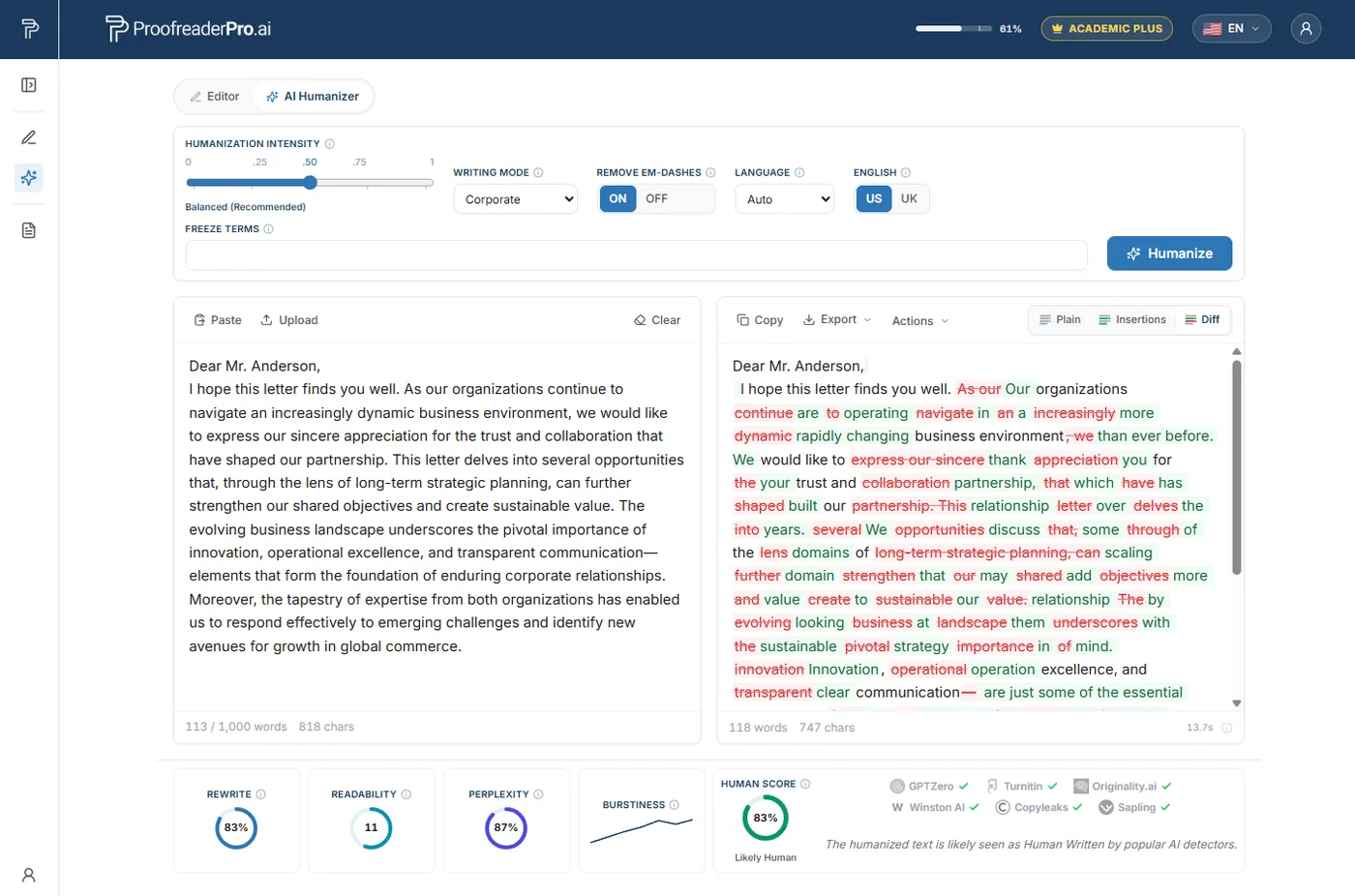
Straight from a model, a business report reads grammatically perfect and completely forgettable, every sentence pitched at the same safe, mid-register beat. ProofreaderPro's Corporate mode targets what makes it sound machine-made. It works to strip the stock phrases that pad AI business writing, the "leverage synergies" and "comprehensive solutions that drive growth," and reach for the concrete claim you actually meant. It varies the rhythm so a proposal stops marching in identical sentences and tunes the tone toward how your company really talks.
The aim is consistency, so a newsletter, a proposal, and a client email start to read as the same brand rather than three different templates. As it reworks the wording, it is designed to leave your substance in place, so figures, product and client names, legal wording, links, and formatting are meant to carry through unchanged. What comes back is a document with a point of view and a person behind it, not a bland corporate hum.
Why generic AI copy quietly erodes brand voice
AI writing tends toward the average. Ask a model for a company update and it produces smooth, evenly weighted sentences, safe transitions, and the same handful of business phrases everyone else's model reaches for. It is inoffensive. It is also invisible.
Brand voice is the opposite of average. It's the unique rhythm, tone, and word choice that makes your copy unmistakably you, whether it's in a landing page or a follow-up email. If everything blends into the bland middle, if all assets begin to sound like they were written by AI, then brand voice gets lost.
The cost is trust. People decide within a few lines whether a piece of writing was made by someone who knows the subject and cares about them, or churned out to fill a slot. Flat, formulaic copy reads as the second kind, even when the underlying thinking is sound. You lose the reader before your argument gets a chance.
What an AI humanizer for business writing actually does
AI humanizer for business writing: a tool that takes a correct but lifeless draft and rewrites its rhythm and register so it sounds like a real person writing in your brand's voice. We're not trying to trick anyone; we're just putting back the human cadence that raw model output strips away.
In practice that means varied sentence length instead of one uniform beat, natural transitions instead of stock connectors, and diction that fits how your company actually talks. ProofreaderPro's AI humanizer runs a dedicated Corporate mode for exactly this register, tuned for the polished, pragmatic tone business content needs rather than an academic or casual one.
A good humanizer is also conservative with your substance. It preserves meaning, keeps your terminology intact, and does not touch your numbers, names, or formatting. That is the difference between reclaiming voice and introducing errors, and it is the line a cheaper tool almost always crosses.
If you want the mechanics of that shift in more depth, our guide on how to make AI writing sound human walks through the specific patterns that read as robotic and how to break them.
Turn flat AI drafts into on-brand business copy
Run your next report, proposal, or newsletter through ProofreaderPro's Corporate humanizer and hear your own voice come back. The free tier lets you test it on real work today.
Try ProofreaderPro.ai FreeA humanizer versus a generic rewriter
Not every rewrite tool is safe for business content. A generic word-spinner swaps synonyms at random, which is how a proposal ends up saying "utilize synergistic paradigms" where you wrote "help teams work together," or how a product name quietly mutates into something that no longer exists.
The distinction that matters for corporate work is whether the tool understands what it must not change. Your figures, your legal language, your client's name, and your links all have to survive the pass untouched. Restoring voice is only useful if the facts arrive intact on the other side.
| What matters | Generic rewriter | Business-mode humanizer |
|---|---|---|
| Sentence rhythm | Randomly reworded | Rebuilt to sound human and on-brand |
| Your terminology | Often swapped for odd synonyms | Preserved |
| Numbers, names, links | Can be garbled | Kept intact |
| Brand register | Ignored | Matched to your tone |
| Formatting | Frequently broken | Retained |
Because it holds meaning steady while it changes cadence, a humanizer that respects your content is safe to run on the things you actually send to clients. We cover this trade-off in detail in our piece on how to humanize AI text without losing meaning, which is the failure mode most rewriters fall into.
Will clients or agencies detect AI in your content?
It is worth being straight about this. Content buyers and agencies do run AI detectors now. Originality.ai, for instance, markets an Enterprise tier built for brands and agencies publishing content at scale, so if you supply copy to clients, assume a detector may see it.
ProofreaderPro's humanizer has been tested against Turnitin, GPTZero, Copyleaks, ZeroGPT, and Originality.ai, with grammar scoring above 96 percent, so it holds up well under that kind of review. We will not tell you it is guaranteed or undetectable, because no serious tool can, and detectors themselves are known to misjudge plenty of genuinely human writing.
More to the point, passing a scan is the wrong goal to fixate on. The reason to humanize AI corporate content is that a real, on-brand voice is what earns reader trust and closes the deal. A detector is just one downstream reader among many. Write for the human first and the scan takes care of itself.
Before and after: the same point, on brand
Consider a line a model might hand you for a services page: "We provide comprehensive solutions designed to optimize your business outcomes and drive sustainable growth." It is grammatical and says almost nothing.
On brand, the same idea might read: "We fix the workflows that are costing your team hours every week, and we stick around to make sure the fix holds." Same promise, but now it sounds like a company with a point of view and a real person behind the keyboard.
That is the entire move. Not more words, not fancier words, just copy that carries a human's rhythm and your company's actual character. Do that consistently across your assets and readers start to recognize you, which is the first thing any brand voice is supposed to accomplish.
Where a humanizer fits your content workflow
Treat the humanizer as one step, not the whole process. AI drafts fast, you add the judgment and the specifics only your team has, and the humanizer smooths the seam so the finished piece reads as one consistent voice. It is a finishing pass, not a substitute for having something to say.
Used that way, it is a straightforward productivity win with no ethics problem attached. You are polishing your own AI-assisted draft to sound like you, not passing off empty content as something it is not. The same discipline applies if you are publishing to rank, where voice is necessary but not sufficient; our take on ranking AI-assisted content for SEO covers what else search visibility actually requires.
Start with your highest-stakes assets, the ones a client or prospect reads first, and let voice consistency spread from there.
Frequently asked questions
Q: Can an AI humanizer keep a consistent brand voice?
Yes, that is its main job for business content. A Corporate-mode humanizer matches your register and rhythm across assets so a newsletter and a proposal sound like the same company, which is what brand voice AI content is meant to protect. It works best when you have a clear sense of how your brand talks so the tool has a target to hit.
Q: Is it acceptable to use AI for business content?
Using AI to draft and then humanizing your own work is a normal, workflow. The line to hold is authenticity: add the real substance only your team has, verify anything the model asserts, and be transparent where a client or platform expects disclosure. The tool is for polish, not for manufacturing empty content.
Q: Will clients or agencies detect AI in our content?
Some run detectors like Originality.ai, so it is a fair concern. ProofreaderPro's humanizer has been tested against major detectors and scores grammar above 96 percent, though we never promise anything is guaranteed to pass. The stronger protection is simply writing content with a genuine, on-brand voice that reads as human because it is doing real work for the reader.
Q: How do I make AI business writing sound professional?
Start with an accurate AI draft, then make AI business writing sound human by varying sentence length, cutting stock phrases, and matching your company's tone, which a Corporate-mode humanizer automates. Keep your facts, names, and figures intact, and give the final piece a human read before it ships.
ProofreaderPro's Corporate humanizer restores brand voice to AI drafts while keeping your facts, terms, and formatting intact.

Moe is an NLP engineer with a PhD in natural language processing. His research covers computational linguistics, text analysis, and machine learning, and it fed directly into the editing and humanization models behind ProofreaderPro. He writes about the part of the process most people never see: how a language model reads a sentence, scores it, and decides what to change.