Best AI Book Editors in 2026: Tools for Authors and Academic Writers
The best AI tools for editing books and long manuscripts. Covers ProofreaderPro.ai, Grammarly, ProWritingAid, and others for 100-300 page documents.

Editing a 250-page manuscript is nothing like editing a 2,000-word blog post. You're dealing with tense consistency across 30 chapters, character name variations that a grammar checker interprets as misspellings, and stylistic choices you made in January that contradict decisions you made in June.
Most AI writing tools were built for short documents - emails, essays, social media posts. When you throw 80,000 words at them, things break. Upload limits cap out. Processing slows to a crawl. The tool forgets the context from chapter 1 by the time it reaches chapter 5.
We tested five AI editing tools on manuscripts ranging from 60,000 to 120,000 words - academic monographs, dissertations, and nonfiction book drafts. Here's which ones can actually handle book-length documents and which ones collapse under the weight.
What book editing actually requires
Before we compare tools, we need to be specific about what editing a book demands that editing a short document doesn't.
Consistency across length. Your protagonist's name is spelled "MacKenzie" in chapter 2 and "Mackenzie" in chapter 14. Your dissertation uses "participants" in the methods section and "subjects" in the discussion. A book editor - human or AI - needs to catch these inconsistencies across tens of thousands of words.
Context retention matters. When an AI tool processes your manuscript in chunks, each chunk is essentially independent. The tool doesn't remember that you defined "CBT" as "cognitive behavioral therapy" on page 12 when it encounters "CBT" on page 187. Long-document editing requires either very large context windows or intelligent chunking strategies.
Structural issues surface at scale. In a 5-page paper, you notice when the argument loops back on itself. In a 300-page manuscript, you might not. A good AI book editor flags structural repetition, inconsistent formatting, and sections that don't logically follow from what came before.
Export format matters more. When your editor returns a 90,000-word document, you need the output in a usable format - tracked changes in Word, not a plain-text blob you have to diff yourself against the original.
AI Book Editing Tools We Tested
We evaluated five AI editing tools on three book-length manuscripts: a 65,000-word academic monograph on environmental policy, a 95,000-word PhD dissertation in computational linguistics, and a 110,000-word nonfiction trade book on urban planning.
1. ProofreaderPro.ai
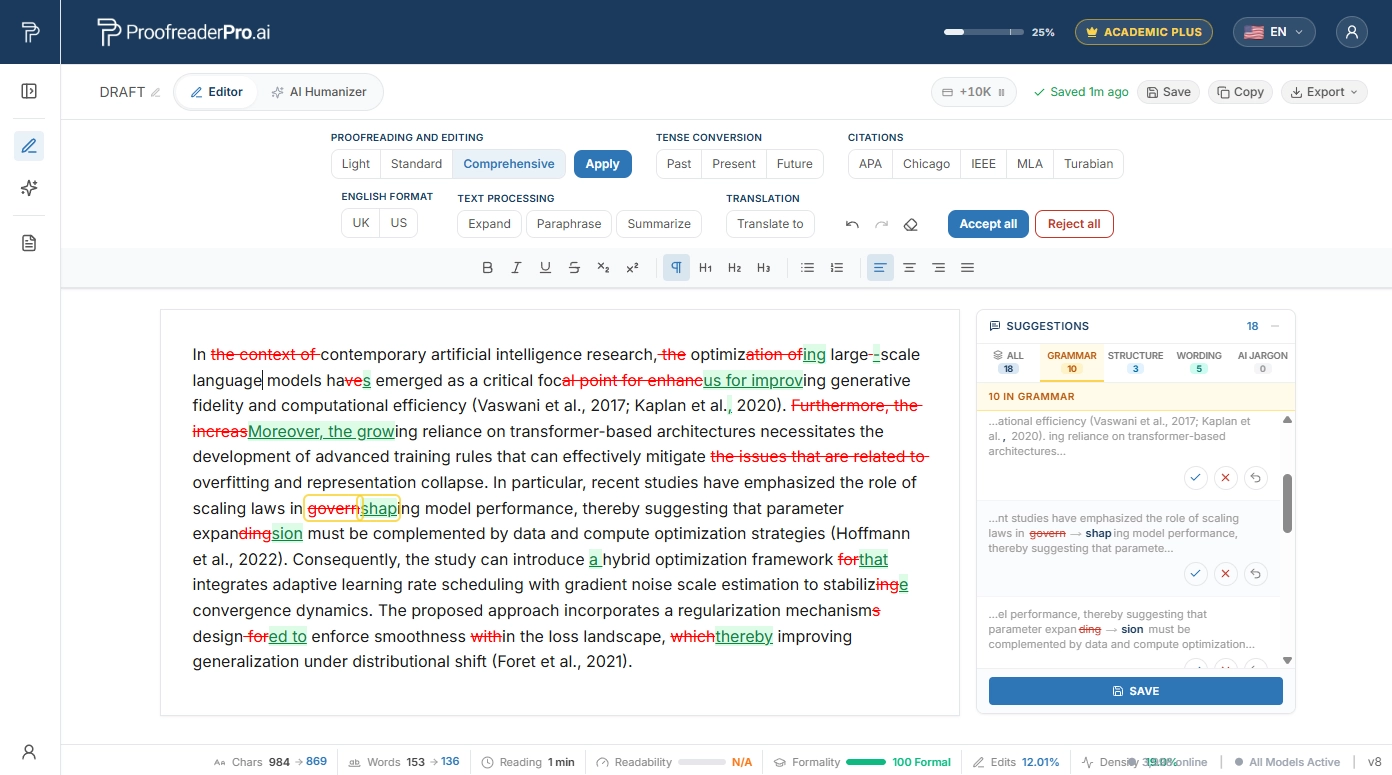
ProofreaderPro.ai handles long documents through intelligent chapter-by-chapter processing. You upload your full manuscript, and the tool maintains a context bridge between sections - keeping track of terminology, abbreviations, and stylistic patterns established earlier in the document.
What worked well. Citation preservation was flawless across all three manuscripts. The environmental policy monograph had 340+ in-text citations - not one was altered or displaced. Tracked changes exported cleanly in .docx format, even for the 110,000-word manuscript. Tense consistency checks caught 23 instances where the dissertation shifted between past and present tense inappropriately.
What could be better. Processing a full 110,000-word manuscript took approximately 45 minutes. That's reasonable for the output quality, but impatient authors might want faster turnaround. The tool doesn't yet offer structural-level feedback (like "this chapter doesn't connect to your thesis argument") - it focuses on sentence and paragraph-level editing.
Best for: Academic monographs, dissertations, theses, and nonfiction books where citation handling and tracked changes are essential. The AI proofreader is purpose-built for this.
2. Grammarly
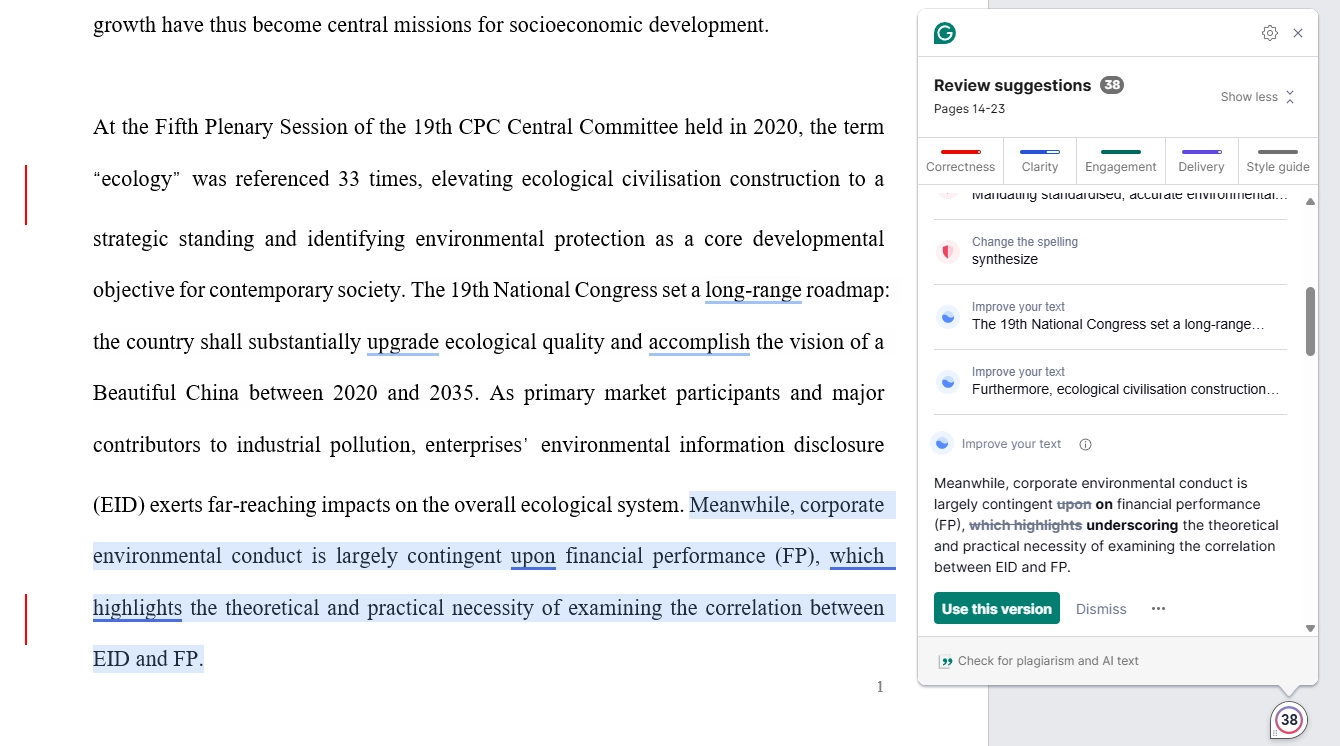
Grammarly processes text through its web editor or desktop app. For long documents, you'll typically paste sections in one at a time - the web editor has a practical limit around 15,000-20,000 words before performance degrades.
What worked well. Grammar and spelling correction was solid on individual chapters. The readability metrics give useful chapter-by-chapter snapshots. The tone detection feature - while not perfect for academic text - flagged sections where the writing shifted noticeably from formal to casual.
What didn't work. No way to process a full manuscript at once. No cross-chapter consistency checking. No citation awareness - Grammarly flagged APA citations as errors consistently. No tracked changes export in any format. For our 95,000-word dissertation, we'd have needed to paste text in five or six batches, losing all cross-section context.
Best for: Chapter-by-chapter editing of non-academic books where citation handling isn't needed and you don't require tracked changes.
3. ProWritingAid
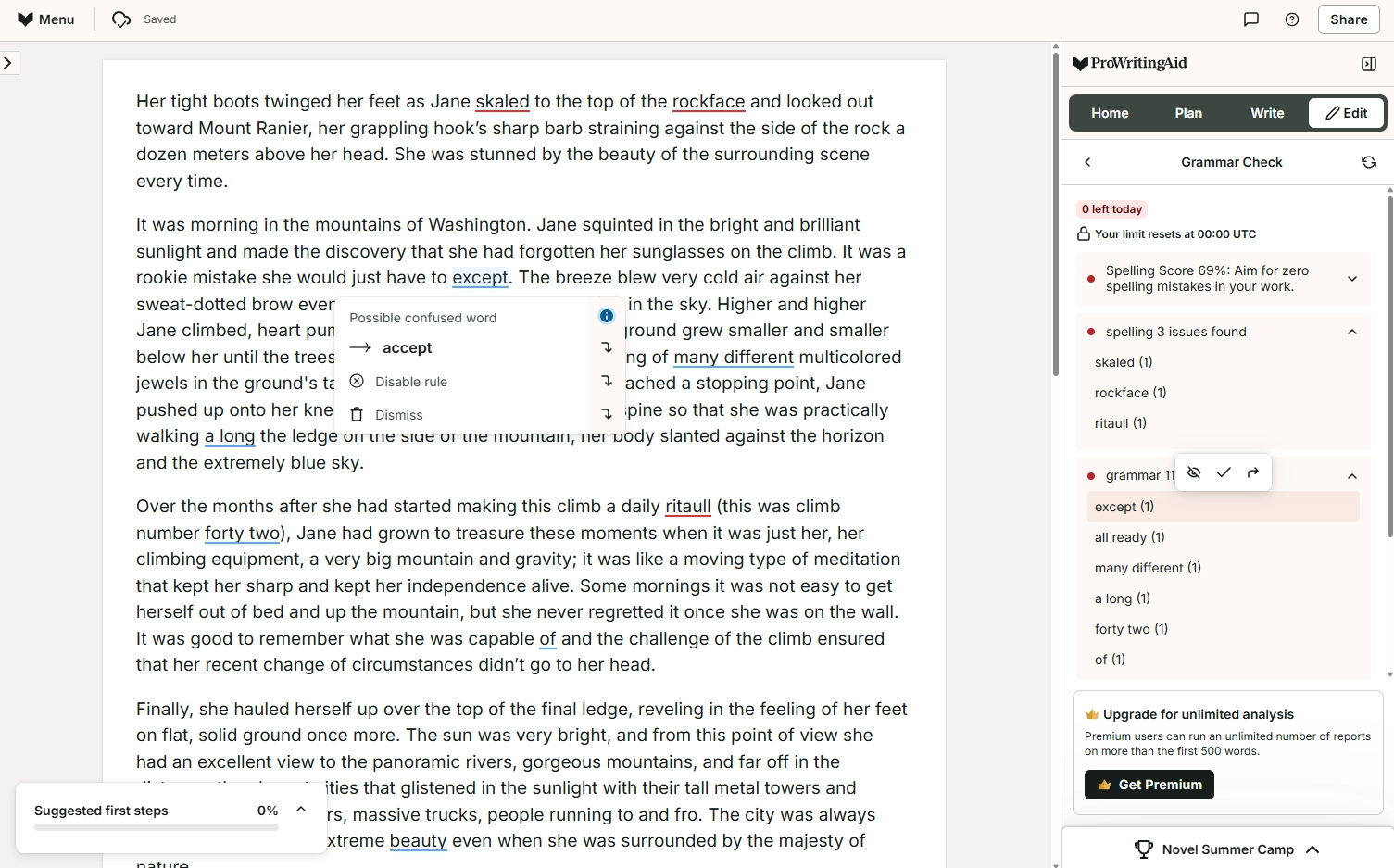
ProWritingAid is the tool most explicitly designed for book authors. It accepts long documents, provides style reports, and integrates with Scrivener - the word processor many book authors use.
What worked well. The style reports are excellent. Overused words, sentence length variation, readability scores, pacing analysis - ProWritingAid generates detailed reports that help you understand patterns across your entire manuscript. The Scrivener integration is a genuine differentiator for fiction and nonfiction authors who use that platform. It handles 100,000+ word documents without the batching problems Grammarly has.
What could be better. Academic-specific features are thin. No citation format awareness. The corrections sometimes push academic prose toward a more casual register - fine for trade nonfiction, problematic for dissertations. No AI humanization. The tracked changes experience is less polished than ProofreaderPro.ai's .docx export.
Best for: Fiction authors and trade nonfiction writers who use Scrivener and want detailed manuscript-level style analysis.
4. Hemingway Editor
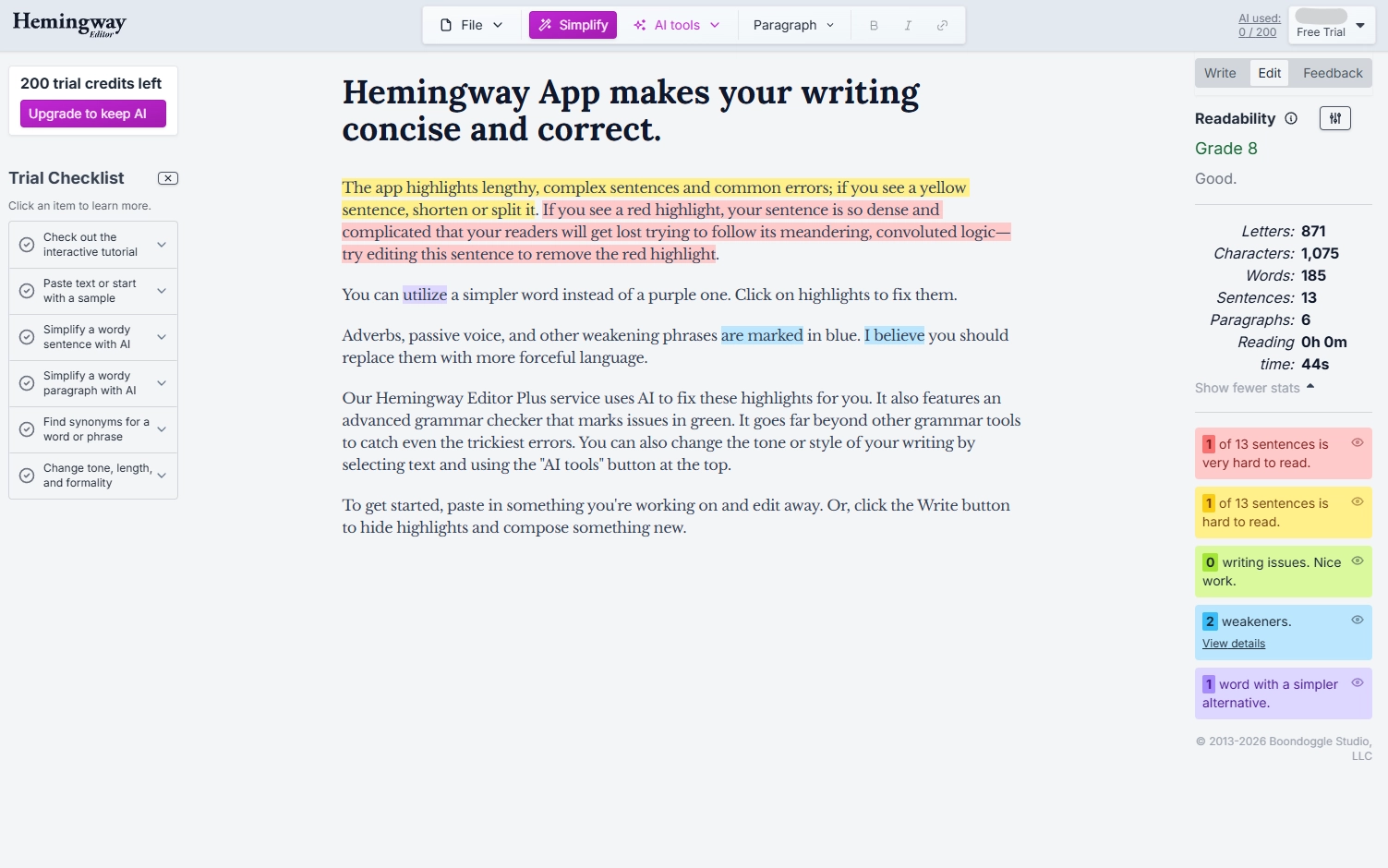
Hemingway's free web version highlights complex sentences, passive voice, and adverb overuse with color coding. The desktop app costs $19.99 one-time.
The verdict: Useful for quick readability scans of individual chapters - you can spot dense passages fast. But Hemingway doesn't correct anything. For a book-length manuscript, it generates thousands of highlights with zero suggested fixes. No tracked changes, no grammar correction, no citation awareness. It's a diagnostic tool, not an editing tool.
5. AutoCrit
AutoCrit is built for fiction authors. It benchmarks your manuscript's pacing, dialogue ratios, and word choice against published books in your chosen genre.
The verdict: Genre benchmarking is genuinely unique and useful for fiction writers. But AutoCrit has zero academic features - no citation handling, no tracked changes, no formal register preservation. The interface feels dated and processing long manuscripts can be slow. Best paired with a separate grammar tool.
Edit Your Full Manuscript with Tracked Changes
Upload your book, thesis, or dissertation. Get back a .docx with every edit tracked. Citation-aware, tense-consistent, and built for long documents.
Try ProofreaderPro.ai FreeAI Book Editor Comparison for Long Manuscripts
| Feature | ProofreaderPro.ai | Grammarly | ProWritingAid | Hemingway | AutoCrit |
|---|---|---|---|---|---|
| Max document length | No practical limit | ~15K-20K words per session | 100K+ words | Paste per chapter | Full manuscript |
| Full manuscript upload | Yes | No (must batch) | Yes | No | Yes |
| Cross-chapter consistency | Yes (context bridging) | No | Partial (style reports) | No | No |
| Citation preservation | APA, MLA, Chicago, IEEE | No | No | No | No |
| Tracked changes (.docx) | Yes | No | Limited | No | No |
| Style reports | Basic | Limited | Detailed | Readability only | Genre benchmarking |
| Scrivener integration | No | No | Yes | No | No |
| AI humanization | Yes | No | No | No | No |
| Academic focus | Primary focus | No | No | No | No |
| Languages | 50+ | English only | English only | English only | English only |
| Price | Free tier; $19-$29/mo | $12-$30/mo | $10/mo (annual) | Free; $19.99 one-time desktop | $30/mo |
Key Takeaways from Testing AI Book Editors
No AI tool replaces a developmental editor. None of the five tools told us "your third chapter undermines chapter two's argument." Structural editing still requires a human. Use AI for the copyedit phase.
Citation handling is the dividing line. Our three manuscripts contained 680+ combined citations. Only ProofreaderPro.ai preserved all of them correctly. Grammarly actively flagged citations as errors. The other tools ignored them entirely.
Tracked changes are non-negotiable. Every academic and publishing workflow expects to see what changed. Only ProofreaderPro.ai delivered tracked changes consistently for book-length documents.
For more tool comparisons, see our roundup of the best AI proofreading tools in 2026.
Our recommendation
For academic books, dissertations, and theses: ProofreaderPro.ai is the clear first choice. Citation preservation, tracked changes export, tense consistency, and multilingual support make it the only tool in this group that's purpose-built for academic manuscripts. Start with the AI proofreader and test it on a chapter before committing to a full manuscript run.
For trade nonfiction: ProWritingAid deserves serious consideration. Its style reports and Scrivener integration are genuinely useful for commercial nonfiction. If you don't need citation handling or tracked changes, ProWritingAid's manuscript-level analysis adds real value.
For fiction: ProWritingAid (for style analysis and Scrivener integration) paired with AutoCrit (for genre benchmarking) covers the most ground. Neither is an academic tool, but fiction writers have different needs.
For any long manuscript on a budget: ProofreaderPro.ai's free tier lets you test the editor on a sample before subscribing at $19 a month. Hemingway's free web version works as a readability scanner alongside it.
Use the paraphrasing tool if sections of your manuscript need rewriting alongside the standard proofreading pass.
Further reading
- ProofreaderPro.ai vs Hemingway Editor
- ProofreaderPro.ai vs Grammarly for Academic Writing
- AI Proofreading Tools for Academic Writing
Frequently asked questions
Q: Can AI really edit a 100,000-word manuscript effectively?
Yes, within limits. AI tools handle sentence-level and paragraph-level editing well at book length. Grammar correction, style consistency, and citation preservation scale reliably. What AI can't do yet is structural editing - evaluating whether your chapters flow logically, whether your argument builds properly, or whether a section should be cut entirely. For a book-length manuscript, we recommend AI editing for the copyedit phase and a human editor for developmental feedback.
Q: How long does it take to AI-edit a full book?
ProofreaderPro.ai took about 45 minutes for our 110,000-word manuscript. ProWritingAid processed a similar document in roughly 30 minutes. Grammarly requires manual batching - realistically 2-3 hours for a full manuscript. The real time savings come during review: accepting tracked changes is far faster than manual editing.
Q: Should I use AI editing before or after sending my manuscript to a human editor?
Before. Run your manuscript through an AI editor first to clean up grammar, spelling, punctuation, and basic style issues. This lets your human editor focus on higher-order concerns - argument structure, narrative flow, clarity of ideas, and discipline-specific feedback. You'll get more value from your human editor when they're not spending time on comma placement.
Q: Which AI book editor works best for non-native English speakers?
ProofreaderPro.ai supports 50+ languages and is trained on ESL error patterns common in academic writing. This makes it the strongest choice for researchers and authors writing books in English as a second language. Other tools in this comparison - Grammarly, ProWritingAid, Hemingway, and AutoCrit - all work in English only and aren't specifically tuned for ESL patterns.
Upload your full manuscript. Get tracked changes across every chapter. Citations preserved, tense checked, style polished.

Dana is a content creator at ProofreaderPro, where she runs the daily blog and writing operations. She writes the articles on how the online editing platform works, and she handles customer messages every day, with a five-star satisfaction score to show for it.