AI Humanizer for Ukrainian Researchers Writing in English
AI humanizer for Ukrainian researchers. Reduce false AI-detection flags on Ukrainian and Russian influenced English, keep meaning and citations, disclose honestly.

Ukraine keeps producing serious science under conditions that would stall most research systems. Physicists, mathematicians, materials scientists, and engineers keep submitting, and national policy keeps pushing everyone toward journals indexed in Web of Science and Scopus. In practice that means one thing: you write in English, whether or not English is the language you think in.
An AI humanizer for Ukrainian researchers exists for exactly this trap. A careful scholar writes clean, standard English, runs the draft through an AI checker, and watches it come back flagged as machine-written. Nothing was faked. The prose was simply too correct. The tool keeps your meaning, terminology, and citations intact while making careful non-native writing read the way a person actually wrote it. Life scientists and clinicians hit the same wall.
Most Ukrainian researchers are bilingual, moving between Ukrainian and Russian, and both languages leave the same kinds of fingerprints on English prose. Those fingerprints are not errors. They are the marks of a writer who learned English through a Slavic grammar, and, ironically, the cleaner you make that English, the more likely a detector is to misread it.
Гуманізація AI-тексту для українських дослідників
Наша гуманізація AI-тексту допомагає українським науковцям упевнено публікуватися англійською, зберігаючи зміст і посилання. Whether your first language is Ukrainian or Russian, the goal is the same: prose that keeps your argument exactly as you meant it, but no longer trips a detector trained mostly on native English.
We built our humanizer for researchers who do real work and simply want it read fairly. You draft the science. The tool varies rhythm and word choice, smooths the cadence that machines fall into, and hands you writing that still says precisely what you said, only in a voice that reads as human.
Writing in Ukrainian? It is auto-detected and humanized natively
Many Ukrainian researchers draft in Ukrainian before writing up in English, and the humanizer handles that directly. Paste Ukrainian text and ProofreaderPro recognises the Cyrillic script and tells it apart from Russian, then processes it through a language-aware model that keeps your terminology and citations exactly as written. Through гуманізація AI-тексту your Ukrainian draft is humanized as readily as your English, with nothing translated first. The same detection spans more than sixty languages, each rewritten in its own voice.
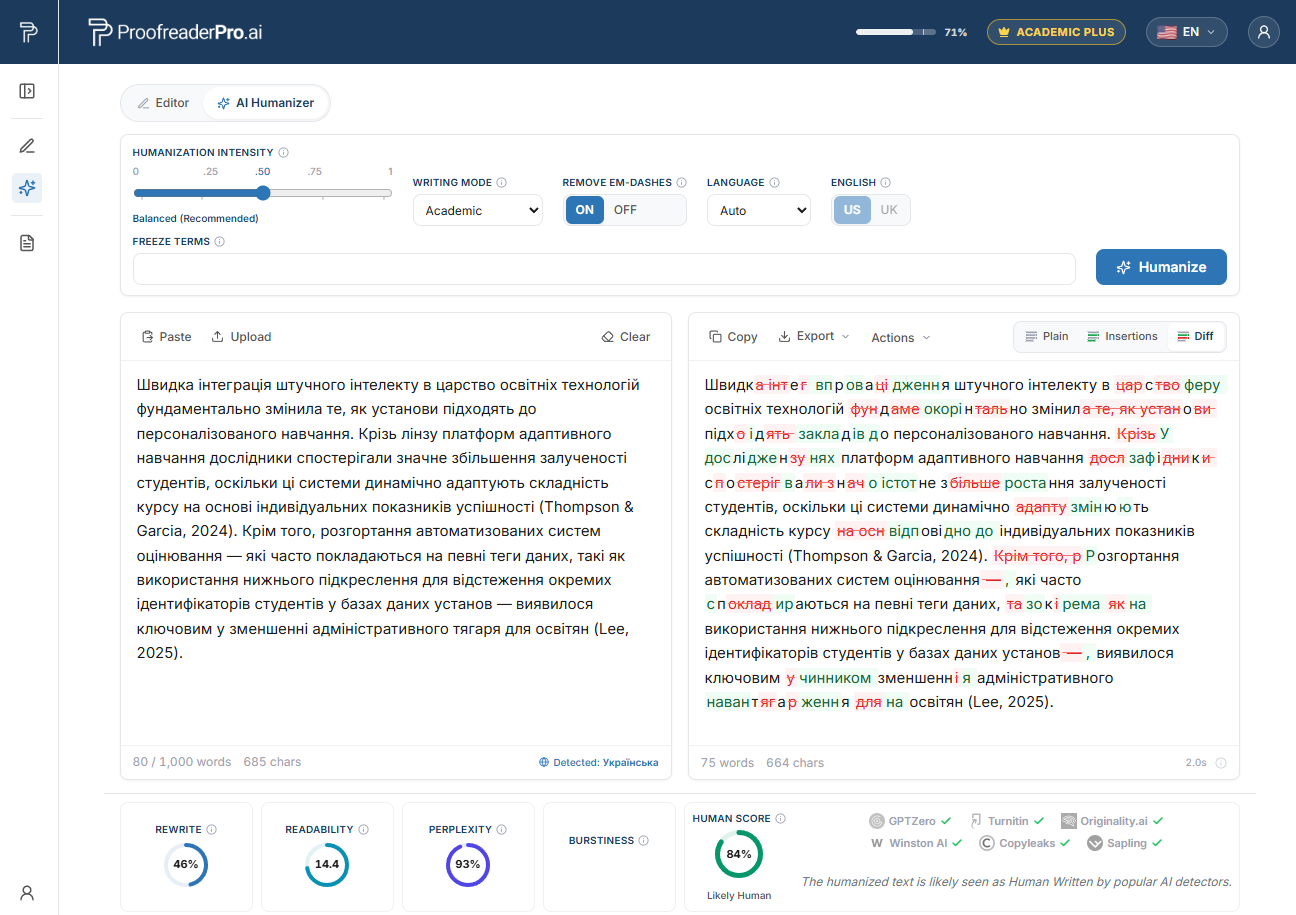
The ProofreaderPro AI Humanizer rewriting Ukrainian academic text. The before and after diff keeps your meaning and citations, and the detector checks confirm a natural, human read.
Why Ukrainian researchers get flagged by AI detectors
The clearest evidence comes from a 2023 Stanford study led by Weixin Liang and colleagues, published in the Cell Press journal Patterns. The team ran human-written TOEFL essays through seven widely used AI detectors. On average, about 61% of the non-native essays were flagged as AI-generated, against roughly 5% for native English writers. Nearly one in five non-native essays, about 19.8%, was flagged unanimously by every detector. Every single essay had been written by a person.
Why does this happen? Many detectors score something called perplexity, which measures how surprising each next word is to a language model. When you write carefully in a second language, you reach for common words and safe, predictable phrasing. That produces low perplexity, and low perplexity is exactly what a detector reads as machine-written. The habits that make Ukrainian-English clear and correct are the same habits these systems were trained to distrust.
So the flag is not a verdict on your honesty. It is a statistical artifact of how the tool works, and we explain the mechanism in more depth in why AI detectors flag non-native writing. Knowing that changes how you should treat a red score: as a claim to contest, not a confession to make.
The Ukrainian and Russian first-language patterns behind false flags
Slavic grammar differs from English in a handful of structural ways, and each one nudges your English toward the flat, predictable register that detectors punish. None of these is a mistake. They are careful constructions, and their very standardness is the problem.
No articles. Neither Ukrainian nor Russian has "the" or "a", so English articles get dropped, added, or reassigned ("result was significant", "we studied the influence of the temperature"). When an editor cleans these up, the corrected sentences become smooth and generic, which reads as low perplexity.
Aspect instead of tense. Slavic grammar is built around perfective and imperfective aspect rather than the English tense system, so the choice between the perfect and the simple past comes out inconsistent. Fixing it tends to produce short, textbook-plain sentences.
Flexible word order. Case endings carry meaning in Ukrainian and Russian, which lets word order move freely. Transferred into English, information structure lands a little oddly, and the safest repair is the most conventional ordering, which is also the most machine-like.
Countable and uncountable nouns. Forms like "informations", "researches", "an equipment", and "evidences" follow naturally from the source languages. Corrected, they collapse into the standard mass-noun phrasing that appears in millions of training examples.
Preposition transfer and the missing auxiliary. Prepositions map differently between the languages, and the English auxiliary "do/does" has no direct equivalent, so both get standardized during editing, again toward the plainest form.
Transliteration. Names and technical terms carried over from Cyrillic get regularized to their conventional English spellings, another small step toward uniformity. Put all of this together and you get clean, correct, low-variance prose: precisely the profile a detector scores as artificial.
Ukraine's AI-detection and Turnitin context
Similarity screening is routine across Ukrainian higher education, and AI screening is arriving on top of it. Many universities run Unicheck, a system that was actually built in Ukraine and is now part of Turnitin, while others use StrikePlagiarism. If you submit a thesis or a manuscript, assume it will pass through one of these before a human reads it closely.
The Ministry of Education and Science (MES) and individual institutions have issued academic-integrity and AI guidance, and the general direction is toward disclosure rather than prohibition. Funders and journals increasingly ask you to say when and how you used AI in preparing a paper.
That climate is manageable if you approach it honestly. The point of humanizing is never to hide AI use or to trick Unicheck. The point is to stop a fairness gap in the tooling from penalizing genuine work, and then to disclose your AI use exactly as your university and target journal require.
Publish your Ukrainian research in fair English
Humanize your own AI-assisted draft, keep your meaning and citations, and disclose your AI use with confidence.
Try the Humanizer FreeTop Ukrainian universities and where AI checks appear
The institutions below screen theses and manuscripts for similarity and increasingly weigh AI indicators. If you work or study at one of these, a similarity and AI check is part of the normal path to a defended thesis or a submitted paper.
- Київський національний університет імені Тараса Шевченка (Taras Shevchenko National University of Kyiv), Kyiv
- Національний технічний університет України «Київський політехнічний інститут імені Ігоря Сікорського» (Igor Sikorsky Kyiv Polytechnic Institute, KPI), Kyiv
- Харківський національний університет імені В. Н. Каразіна (V. N. Karazin Kharkiv National University), Kharkiv
- Львівський національний університет імені Івана Франка (Ivan Franko National University of Lviv), Lviv
- Національний університет «Львівська політехніка» (Lviv Polytechnic National University), Lviv
- Сумський державний університет (Sumy State University), Sumy
- Національний університет «Києво-Могилянська академія» (National University of Kyiv-Mohyla Academy), Kyiv
- Дніпровський національний університет імені Олеся Гончара (Oles Honchar Dnipro National University), Dnipro
Across these universities the workflow is similar: your draft meets an automated check before it meets a committee. Understanding what that check actually measures is what lets you respond to a flag calmly instead of panicking.
How the AI humanizer for Ukrainian researchers works
The honest workflow has four steps, and disclosure is part of it, not an afterthought.
First, draft your science. Many Ukrainian researchers think through the argument in Ukrainian or Russian first, then translate, and that is completely fine. Get the reasoning right before you worry about how it reads.
Second, proofread the grammar so the English is correct and your terminology is consistent. Clean grammar and a natural voice are two different things, and you want both.
Third, run your own AI-assisted prose through the text humanizer. It varies sentence rhythm and word choice, removes the repetitive cadence that machines and heavily-edited second-language text share, and strips stray em dashes, all while preserving your meaning, your technical vocabulary, and every citation. Because our humanizer supports more than 60 languages, non-English text routes through a language-aware model that keeps sentence structure and meaning intact rather than mangling them.
What can you expect from the result? In our own testing, humanizing substantially reduces how often careful, standard non-native English is misread by the major detectors, including Turnitin, Originality.ai, and GPTZero, while your academic meaning stays put. We describe that as what we have seen in testing, not as a promise. Detectors retrain every few months, and no honest tool can claim to be 100% undetectable. Anyone who guarantees otherwise is selling you certainty that does not exist.
Fourth, disclose. Add an AI-use statement in the format your institution and journal require, so your work stays clearly inside integrity rules. This is the whole point: you are protecting real research from a biased tool, not disguising anything. Ukraine is one stop on our multilingual AI humanizer hub, and if your paper needs full language editing as well, our global academic editing hub walks through that side of the process.
Local funding bodies, journals, and AI-disclosure expectations
Ukrainian research is funded and organized through a few central bodies. The National Research Foundation of Ukraine (NRFU, Національний фонд досліджень України) runs competitive grants. The National Academy of Sciences of Ukraine (NAS, НАН України) oversees the national institutes. The Ministry of Education and Science (MES) sets research and publication policy, including the push toward indexed output.
That push is concrete. National policy rewards publication in Web of Science and Scopus-indexed journals, which keeps the pressure to write in English high year after year. When you target those journals, expect similarity screening as a matter of course, and expect a growing number of them to ask for an AI-use disclosure at submission.
Meet that expectation directly. Say what you used, keep the record clean, and let the humanized draft carry your own argument in a natural voice. If you ever receive a flag you believe is wrong, treat it as a claim you can answer with evidence, and reach again for the text humanizer before your next submission rather than after a rejection.
Frequently asked questions
Q: Is using an AI humanizer for Ukrainian researchers considered cheating?
No, not when you use it honestly. You are humanizing your own AI-assisted draft to protect careful non-native writing from a biased detector, not fabricating results or hiding authorship. You keep your meaning and citations, and then you disclose your AI use in the format your university and journal ask for.
Q: Will the humanizer change my technical terms or citations?
No. The tool is built to preserve academic meaning, technical terminology, and every reference exactly as you wrote them. It varies rhythm and word choice around your content, so your methods, your terms, and your citation numbers stay intact.
Q: Does the гуманізація AI-тексту process work for Russian-speaking Ukrainian researchers too?
Yes. Ukrainian and Russian share many grammatical features that leave the same fingerprints on English prose, such as absent articles and aspect-based verbs. The humanizer routes non-English and non-native text through a language-aware model, so it helps regardless of which of the two is your stronger language.
Q: Can any tool guarantee my paper will pass an AI detector?
No, and you should distrust anyone who claims it can. Detectors retrain constantly, and no honest tool can promise to be 100% undetectable. What we can say is that, in our testing, humanizing substantially lowers how often careful non-native English is misread, which is a very different and more honest claim than a guarantee.
Q: What should I do if my thesis gets flagged by Unicheck or Turnitin at my university?
Treat the score as a claim to contest, not a verdict. Keep your drafts and notes as evidence of your process, humanize your own writing so it reads naturally, and disclose your AI use per your institution's policy. A detector flag is the start of a conversation, not the end of one.
A language-aware humanizer that keeps your meaning, terminology, and citations while helping careful non-native prose read as human.

Moe is an NLP engineer with a PhD in natural language processing. His research covers computational linguistics, text analysis, and machine learning, and it fed directly into the editing and humanization models behind ProofreaderPro. He writes about the part of the process most people never see: how a language model reads a sentence, scores it, and decides what to change.