AI Humanizer for Swiss Researchers Writing in English
AI humanizer for Swiss researchers. Reduce false AI-detection flags on German and French influenced English, keep meaning and citations, disclose honestly.

Switzerland runs one of the densest research economies on earth. Measured per head of population, few countries publish more or attract more citations, and the ETH domain sits near the top of almost every ranking that matters. Nearly all of that work reaches print in English, whether the author's first language is German, French, Italian, or Romansh.
That is precisely where a modern problem starts. An AI humanizer for Swiss researchers exists because careful, standard English written by a German or French speaker is increasingly misread as machine output by automated detectors. The sentences are human. The software disagrees, and a disagreement like that can stall a submission before a single reviewer reads a word.
Picture a postdoc at the Universität Bern drafting a methods section in clear, textbook English. Nothing is copied. Nothing is fabricated. A detector still returns an "AI-generated" score, and now the burden falls on the researcher to prove a negative. This guide is about fixing that unfairness honestly, without hiding real AI use.
KI-Text humanisieren: so publizieren Schweizer Forschende sicher auf Englisch
Unser Humanizer hilft Forschenden an der ETH, der EPFL und überall dazwischen, ihre englischen Manuskripte natürlich klingen zu lassen, ohne dass Bedeutung oder Quellen verloren gehen. Pour les chercheurs romands, l'objectif est identique: humaniser un texte IA tout en gardant le sens et les références intacts.
Put plainly, whether you write in Standard German in Zürich or in French in Lausanne, the tool varies the rhythm of your English so that careful second-language prose is less likely to be mistaken for a machine. Your technical terms and your citations stay exactly as you set them, and the argument you built stays yours.
Drafting in German, French, or Italian? The humanizer detects each one
Swiss research is written across several languages, and the humanizer detects whichever one you paste. Give it German, French, or Italian and ProofreaderPro identifies the language automatically, then routes it through a language-aware model that keeps your terminology and citations exactly in place. Through KI-Text humanisieren your German draft is humanized as readily as your English, with nothing translated first. The same automatic detection spans more than sixty languages, each rewritten in its own register.
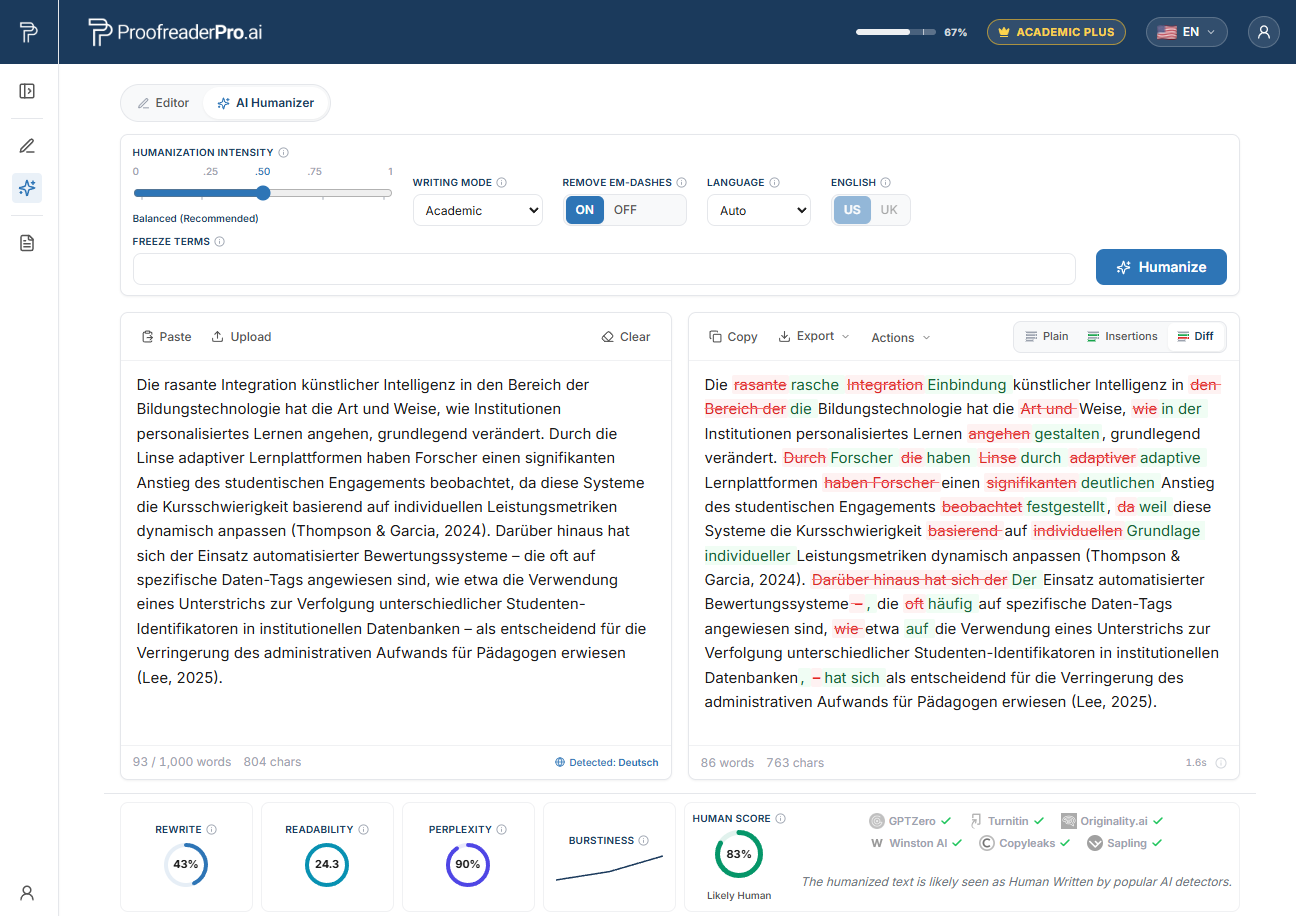
The ProofreaderPro AI Humanizer rewriting German academic text. The before and after diff keeps your meaning and citations, and the detector checks confirm a natural, human read.
Why Swiss researchers get flagged by AI detectors
The clearest evidence comes from a 2023 Stanford study by Liang and colleagues, published in the Cell Press journal Patterns under the title "GPT detectors are biased against non-native English writers." The team ran human-written TOEFL essays through seven widely used detectors and looked at what came back.
The results should worry anyone writing English as a second or third language. On average about 61% of the non-native essays were flagged as AI, against roughly 5% for native English writers. Nearly one in five, about 19.8%, was flagged unanimously by every detector in the set. Every one of those essays had been written by a person.
Why does it happen? Most detectors score something called perplexity, a measure of how surprising each next word is to a language model. Writers who reach for common vocabulary and standard, predictable phrasing produce low-perplexity text, and low perplexity is exactly what these systems read as machine-written. The habits that make Swiss English clear and correct are the same habits that trip the detector. We unpack the mechanism in more detail in why AI detectors flag non-native writers.
The German and French first-language patterns behind false flags
Swiss English carries traces of the writer's first language, and those traces are correct, careful, and standard. That is the cruel part. Standardness is what a detector reads as low perplexity, so the very fluency you worked for can count against you.
German speakers often import false friends that are grammatically fine but statistically flat. "Aktuell" becomes "actual" when the writer means current; "eventuell" turns into "eventually" when the sense is possibly; "also" arrives meaning so or thus; "bekommen" drifts toward "become" instead of receive. Each choice is deliberate and consistent, and consistency reads as predictable.
Then there is sentence structure. German word order pushes constructions like "Therefore is the effect stronger," and the language's fondness for long noun compounds and nominalisation carries into English as dense, orderly phrasing. A German writer may also reach for "since" where English wants "for" to mark duration. None of this is an error of thought. It is simply regular, and regularity looks mechanical to the software.
French speakers meet their own false friends. "Actuel" slips in for current, "éventuellement" for possibly, "sensible" for sensitive, and "important" often stands in for large; some write "assist to" where they mean attend. Careful and standard again, which is the whole trap.
French academic style also favours long periodic sentences with stacked relative clauses, heavy nominalisation, frequent "which," and turns like "permit to" and "in the case where." English reviewers read this as dense prose. A detector reads its evenness as low perplexity. The writing is human. Its rhythm is just too tidy for the machine's taste.
Protect your careful English from a false flag
Humanize your own AI-assisted draft, keep every citation and technical term intact, then disclose your AI use with confidence.
Try the Humanizer FreeSwitzerland's AI-detection and Turnitin context
Screening is routine here. Theses and journal submissions across Swiss institutions commonly pass through Turnitin or iThenticate for similarity, and AI indicators increasingly sit alongside those similarity scores. A researcher in Basel or Geneva should assume some automated check will run at some point.
The institutional mood is thoughtful rather than punitive. ETH Zürich, EPFL, and other universities have published generative-AI guidance for students and staff, and the direction of travel is disclosure rather than prohibition. Funders and journals are asking, more and more often, that authors state where and how they used AI tools. Treat a detector score as a claim you can address, not a verdict you have to accept.
Top Swiss universities and where AI checks appear
The same screening logic applies right across the Swiss system. These institutions all check theses and manuscripts for similarity and, increasingly, for AI indicators:
- ETH Zürich (Eidgenössische Technische Hochschule Zürich), in Zürich
- EPFL (École polytechnique fédérale de Lausanne), in Lausanne
- Universität Zürich (UZH), in Zürich
- Université de Genève (UNIGE), in Geneva
- Universität Basel, in Basel
- Universität Bern, in Bern
- Université de Lausanne (UNIL), in Lausanne
- Université de Fribourg / Universität Freiburg, in Fribourg
- Università della Svizzera italiana (USI), in Lugano
- Universität St. Gallen (HSG), in St. Gallen
- Universität Luzern, in Lucerne
- Université de Neuchâtel, in Neuchâtel
Across the German-speaking north and east and the French-speaking west, the pattern holds. Careful non-native English is the norm, and careful non-native English is exactly what gets misread.
How the AI humanizer for Swiss researchers works
Here is the honest workflow behind the AI humanizer for Swiss researchers, step by step. Start wherever you write best. Many researchers draft in their first language, in German or in French, and then translate; others write directly in English with AI assistance. Either way, the raw draft is yours, and it should stay that way.
Next, fix the grammar and terminology so the science is exact. Then run your own AI-assisted prose through the humanizer. It varies sentence length and word choice, breaks up repetitive cadence, and clears out the mechanical rhythm and stray em dashes that both reviewers and detectors notice, while keeping your meaning, your technical vocabulary, and every citation in place. You can try the humanizer free on a single section before you commit to a full pass.
What can you expect? In our own testing, the humanizer substantially reduces how often careful, standard non-native English is misread by the major detectors, Turnitin, Originality.ai, GPTZero and the rest, while preserving academic meaning. We describe that as what we have seen, not as a promise. Detectors retrain every few months, and no honest tool can promise to be 100% undetectable.
The last step is not optional: disclose. State your AI use in the format your institution and target journal require. Humanising your own writing and then disclosing it is the combination that keeps you inside the integrity rules while protecting real work from a false flag. The tool sits within our broader global academic editing hub, and it is one spoke of the multilingual AI humanizer hub that covers dozens of languages.
Local funding bodies, journals, and AI-disclosure expectations
Swiss research runs on well-known machinery. The SNSF (Swiss National Science Foundation; Schweizerischer Nationalfonds, SNF; Fonds national suisse, FNS) is the main public funder, Innosuisse backs innovation and applied projects, and Swiss groups win a notable share of European Research Council grants. The SNSF also mandates open access, so your work is meant to be read as widely as possible.
That publishing reality shapes where you submit. Researchers here aim for Web of Science and Scopus-indexed journals and were early adopters of open access under Plan S. Similarity screening with Turnitin or iThenticate is standard at the submission stage too, which is one more reason to have your English read naturally.
Disclosure expectations are rising in step with the tools. Funders and journals increasingly ask authors to state how they used AI, so keep a short, honest record of what you used and where. If you want ready-made wording, our AI disclosure statement templates give you a starting point. And if a flag does land on human work, treat it as contestable and prepare a calm, evidenced response rather than a panicked rewrite.
Frequently asked questions
Q: Is using an AI humanizer for Swiss researchers considered cheating?
No, not when you use it honestly. You are humanising your own AI-assisted draft to protect careful English from a false flag, not fabricating results or hiding your method. The rule that keeps you safe is disclosure: state your AI use the way your institution and journal require.
Q: Will the humanizer change my citations or technical terms?
No. It preserves your references, numbers, and domain terminology, and only varies rhythm and word choice so the prose reads naturally. Your methods stay your methods, and your bibliography is left alone.
Q: Can you guarantee my paper will pass an AI detector?
No, and be wary of anyone who claims otherwise. Detectors are retrained regularly, so no honest tool can promise to be 100% undetectable. What we can say is that, in our testing, humanised writing is misread far less often while its meaning stays intact.
Q: Does it work for both German and French speakers?
Yes. The humanizer is language-aware and supports more than 60 languages, so whether your first language is German, French, Italian, or Romansh, it works from your English draft while respecting the structure you intended.
Q: I wrote the paper myself in careful English. Why was it flagged?
Because detectors score perplexity, and careful, standard second-language English is low-perplexity by nature. The Stanford findings show human essays flagged at high rates purely for reading as predictable. A flag is a statistical guess about your style, not proof of misconduct.
Language-aware humanizing for Swiss researchers writing in English: it preserves meaning, terminology, and citations while smoothing the even rhythm that detectors misread.

Moe is an NLP engineer with a PhD in natural language processing. His research covers computational linguistics, text analysis, and machine learning, and it fed directly into the editing and humanization models behind ProofreaderPro. He writes about the part of the process most people never see: how a language model reads a sentence, scores it, and decides what to change.