AI Humanizer for Swedish Researchers Writing in English
AI humanizer for Swedish researchers. Reduce false AI-detection flags on Swedish-influenced English, keep meaning and citations, disclose honestly.

Sweden runs on English. Doctoral theses at Karolinska Institutet are written and defended in it, papers from Lund and Uppsala are drafted in it, and the country sits near the top of the EF English Proficiency Index year after year. So when a Swedish PhD student learns that an AI detector has flagged a chapter she wrote herself, the reaction is usually plain disbelief.
That reaction is fair. An AI humanizer for Swedish researchers exists because careful, standard, fluent Swedish-English is exactly the kind of prose these detectors misread. Excellent English does not protect you. Sometimes it is the problem.
The mechanism is uncomfortable once you see it. Detectors reward surprising word choices and penalize predictable ones. Writers trained to be clear, to use common words and clean sentence structure, produce low-perplexity text, and low perplexity is precisely what a detector scores as machine-written.
Så kan svenska forskare humanisera AI-text för publicering på engelska
Vår humanizer hjälper svenska forskare att humanisera AI-text i egna utkast, så att korrekt och välskriven svensk engelska inte felaktigt flaggas som maskingenererad, samtidigt som betydelse, terminologi och källhänvisningar bevaras.
In plain English: the tool takes your own AI-assisted draft and varies its rhythm and word choice so that clean Swedish-English is less likely to be misread by the major detectors. It keeps your citations, your technical vocabulary, and your argument intact. It does not write your paper for you, and it is not built to hide anything.
Writing in Swedish? It is auto-detected and humanized natively
Swedish researchers often draft in their first language before moving into English, and the humanizer supports that. Paste Swedish text and ProofreaderPro detects the language on its own, then processes it through a Swedish-aware model that keeps the å, ä, and ö, your terminology, and your citations exactly in place. To humanisera AI-text you can start from your Swedish draft, which is rewritten as readily as your English. The same detection spans more than sixty languages, each humanized in its own voice.
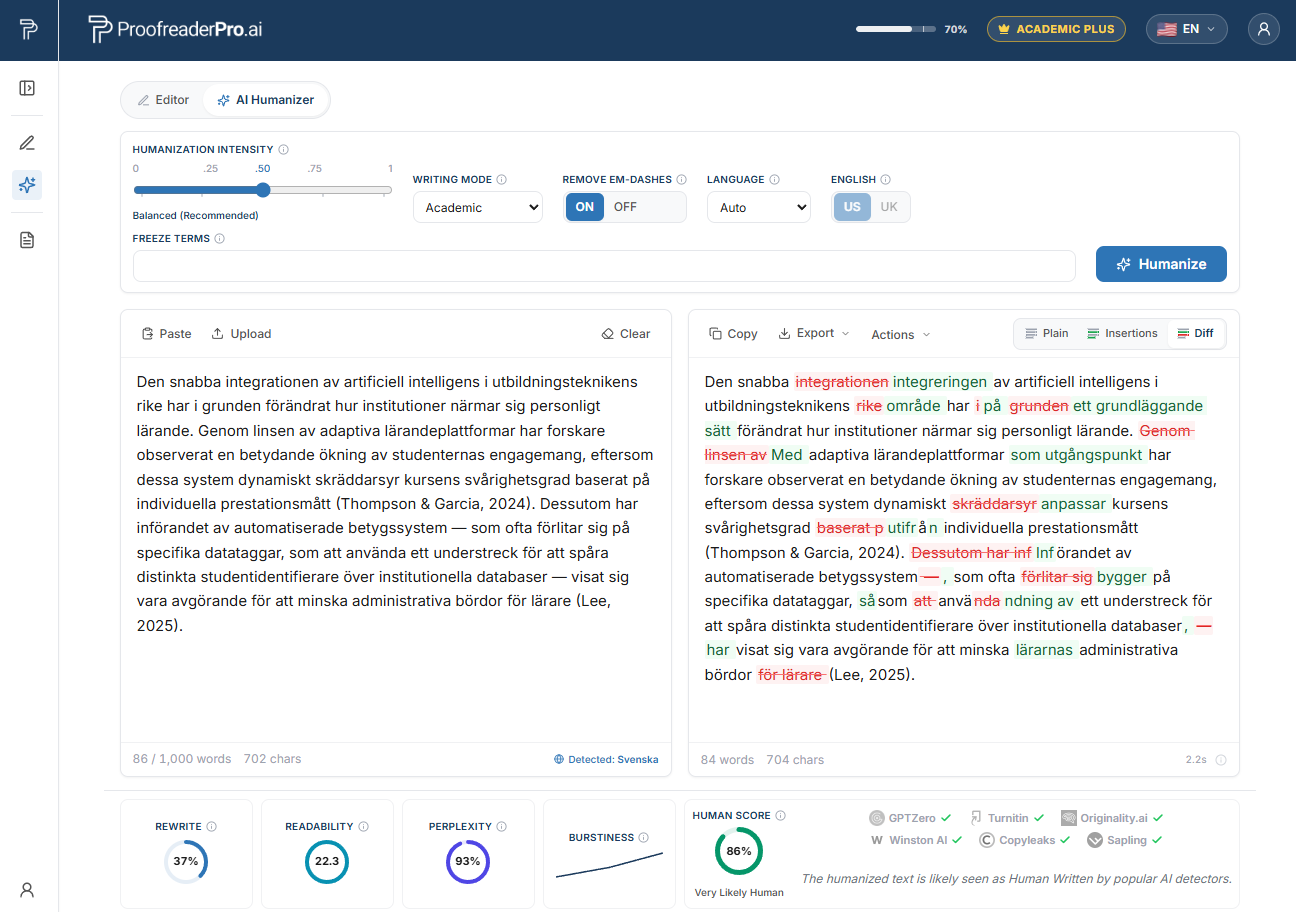
The ProofreaderPro AI Humanizer rewriting Swedish academic text. The before and after diff keeps your meaning and citations, and the detector checks confirm a natural, human read.
Why Swedish researchers get flagged by AI detectors
Start with the study that put numbers on the problem. In 2023, a Stanford team led by Liang and colleagues published "GPT detectors are biased against non-native English writers" in the Cell Press journal Patterns. They took human-written TOEFL essays and ran them through seven widely used detectors.
The results were stark. On average about 61% of the non-native essays were flagged as AI, against roughly 5% for native English writers. Nearly one in five non-native essays, about 19.8%, was flagged unanimously by every detector in the panel. Every single essay had been written by a person.
Why does this happen? Many detectors score perplexity, a measure of how surprising each next word is to a language model. A careful second-language writer reaches for the common word and the standard construction, which is good writing, but it also produces predictable, low-perplexity text. The very habits that make Swedish-English clear are the habits these systems were trained to flag. We walk through the mechanism in more detail in why AI detectors flag non-native English.
The stakes are not abstract. Non-native researchers already face rejection rates about 2.5 times higher than native speakers, spend about 51% more time writing their papers, and field far more revision requests about language quality. A false AI flag lands on top of a barrier that is already steep.
The Swedish first-language patterns behind false flags
Swedish academic English has a recognizable shape, and none of it is wrong. These are correct, careful, standard constructions. Their standardness is the trap, because standard reads as low perplexity to a detector.
False friends are the classic tell. "Aktuell" means current or relevant, not "actual"; "eventuellt" means possibly, not "eventually"; "kontrollera" means to check, not "to control". A Swedish author who writes "we controlled the temperature" to mean "we checked it" is using precise, deliberate vocabulary, the kind a model predicts easily.
Word order carries over too. Swedish is a verb-second language, so the finite verb wants the second slot. That habit produces measured, slightly formal sentences, and after correction ("Therefore the model is robust") the evenness that remains is read by a detector as machine cadence.
Then there are articles. Swedish marks definiteness with a suffix rather than a separate word, so English articles get dropped or doubled: "the research show", "result was significant". Once a proofreader cleans these up they come out regular and tidy, and regular is exactly what scores as low perplexity.
A few smaller tells show up constantly: "since" used for "for" with durations, heavy use of compound nouns and the word "respective", and an understated register that some reviewers misread as flat. Each choice is defensible on its own. Together they make prose that is smooth, even, and easy for a model to anticipate.
Sweden's AI-detection and Turnitin context
Theses and manuscripts in Sweden are screened as a matter of routine. Similarity checking is standard practice across the sector, and many Swedish universities historically relied on the homegrown Urkund and Ouriginal systems, which are now part of Turnitin. AI indicators increasingly sit alongside similarity scores in the same reports.
Guidance is catching up. The Association of Swedish Higher Education Institutions (SUHF) and individual universities have issued generative-AI guidance, and funders and journals ask more and more often for a clear statement of how AI was used. The direction of travel is toward disclosure, not prohibition.
One thing worth remembering: a detector score is a claim, not a verdict. Turnitin itself suppresses low-range scores rather than showing a number, and it warns that its score should not be used alone to decide integrity cases. Several universities abroad, Vanderbilt among them, disabled the AI detector entirely over false positives and bias against non-native writers. A flag is something to contest, not a confession.
Protect your Swedish-English before you submit
Humanize your own AI-assisted draft, keep your citations and meaning, then disclose your AI use. Try it on a single paragraph of your thesis and see the difference.
Try the Humanizer FreeTop Swedish universities and where AI checks appear
The same screening tools appear across Sweden's leading institutions, from medical schools to technical universities:
- Karolinska Institutet (KI), Stockholm (medicine)
- Uppsala universitet, Uppsala
- Lunds universitet, Lund
- Kungliga Tekniska högskolan (KTH), Stockholm
- Stockholms universitet (SU), Stockholm
- Göteborgs universitet (GU), Gothenburg
- Chalmers tekniska högskola, Gothenburg
- Linköpings universitet (LiU), Linköping
- Umeå universitet, Umeå
- Sveriges lantbruksuniversitet (SLU), Uppsala
- Örebro universitet, Örebro
- Linnéuniversitetet, Växjö and Kalmar
Every one of these screens theses and manuscripts for similarity, and increasingly weighs AI indicators in the same workflow. The point is not that any of them is hostile. It is that a false flag can land on careful work at any of them, so the sensible move is to protect your own writing before you submit it.
How the AI humanizer for Swedish researchers works
The workflow is honest and simple, and it starts with your own draft.
Write first. Many Swedish researchers draft in Swedish, where the thinking is fastest, then translate, while others draft straight into English. Either way, the words and the argument are yours.
Proofread the grammar. Clean up the false friends, the dropped articles, the verb-second carryover. Our AI proofreader fixes the mechanics without flattening your meaning, and once the grammar is solid you move on to the humanizer.
Then humanize your own AI-assisted prose. This is where the AI humanizer for Swedish researchers varies rhythm and word choice, breaks up the even cadence, and removes the repetitive patterns and stray em dashes that trip detectors. In our own testing, this substantially reduces how often careful, standard Swedish-English is misread by the major detectors (Turnitin, Originality.ai, GPTZero and similar), while preserving your meaning, terminology, and citations. We describe this as what we have seen in testing, not a promise. Detectors retrain every few months, and no honest tool can claim to be 100% undetectable.
Non-English drafts are handled too. The humanizer supports more than 60 languages and routes non-English text through a language-aware model that keeps sentence structure and meaning intact, which matters if you humanize a Swedish draft before translating. This post is one node in our multilingual AI humanizer hub, and it sits alongside the global academic editing hub for full-manuscript work.
Then disclose. Humanizing your own writing is not the same as hiding it. State how you used AI in the format your department and target journal require, and you stay squarely inside the integrity rules while protecting your work from a false flag.
Local funding bodies, journals, and AI-disclosure expectations
Sweden's funders increasingly expect transparency about AI use. Vetenskapsrådet (the Swedish Research Council, VR) is the main public funder, and the Knut and Alice Wallenberg Foundation (KAW) is a major private one. Forte (health, working life, welfare), Formas (environment and agriculture), and Vinnova (innovation) fund their own domains, Swedish groups regularly win ERC grants, and open access is required across the board.
On the publishing side, Swedish researchers target Web of Science and Scopus-indexed journals and register output in SwePub. Those journals ask more and more often for an explicit note on AI assistance. A short, honest disclosure now belongs in a normal methods or acknowledgements section, and getting it right is easier than most people expect. See our guide to writing an AI disclosure statement, and if a flag does land despite clean, disclosed work, the appeal playbook walks through how to respond.
The through-line here is fairness. You did the research, you wrote the paper, and a perplexity score should not be allowed to override that.
Frequently asked questions
Q: Will an AI humanizer help if my English is already very good?
Often yes, and that is the counterintuitive part. Detectors flag low-perplexity text, and polished, standard Swedish-English is low perplexity by nature. The humanizer varies your rhythm and phrasing so clean writing is less likely to be misread, without changing what you actually said.
Q: Is it against the rules to humanise AI-text in my own thesis?
Humanizing your own draft and then disclosing your AI use is not against the rules at most institutions. What the rules care about is passing off fabricated or undisclosed work as your own. When you keep your meaning and citations and state clearly how you used AI, you stay inside the integrity framework.
Q: Can any tool guarantee my paper passes Turnitin or GPTZero?
No, and be wary of anyone who says otherwise. Detectors change their models every few months, so no honest tool can promise a result or claim to be 100% undetectable. What we can say is that in our testing the humanizer meaningfully reduces false flags on careful non-native prose, which is different from a guarantee.
Q: Does the humanizer change my citations or technical terms?
No. It is built to preserve citations, technical terminology, and the substance of your argument while it adjusts rhythm and word choice. Your reference list, your equations, and your domain vocabulary stay as you wrote them.
Q: I drafted in Swedish first. Does that matter?
Not a problem. The humanizer supports more than 60 languages and processes non-English text with a language-aware model that protects sentence structure and meaning, so you can work in Swedish and translate, or humanize after translating into English.
Reduce false AI flags on careful non-native prose while keeping your meaning, terminology, and citations. Built for researchers publishing in English.

Moe is an NLP engineer with a PhD in natural language processing. His research covers computational linguistics, text analysis, and machine learning, and it fed directly into the editing and humanization models behind ProofreaderPro. He writes about the part of the process most people never see: how a language model reads a sentence, scores it, and decides what to change.