AI Humanizer for Dutch Researchers Writing in English
AI humanizer for Dutch researchers. Reduce false AI-detection flags on Dutch-influenced English, keep meaning and citations, disclose honestly.

The Netherlands publishes more high-impact research per capita than almost any country on earth, and nearly all of it appears in English. Dutch academics rank at or near the top of the EF English Proficiency Index every year, so a manuscript from Amsterdam or Delft usually arrives clean, precise, and grammatically textbook. Then an AI detector reads that same clean prose and returns a high "AI-generated" probability, and a careful researcher who wrote every word by hand is suddenly asked to explain herself. That specific problem is what an AI humanizer for Dutch researchers is built to address.
Here is the uncomfortable irony. The better your English, the more standard and predictable your phrasing tends to be, and predictable phrasing is exactly what current detectors score as machine writing. Strong Dutch English does not protect a paper from a false flag. In some ways it invites one.
This guide explains why that happens, which Dutch first-language habits trigger it, how similarity and AI screening actually work at Dutch universities, and how to protect your own writing honestly: humanize the AI-assisted draft you already wrote, keep your meaning and citations intact, then disclose your AI use the way your institution and journal require.
AI-tekst humaniseren voor Nederlandse onderzoekers die in het Engels publiceren
Onze humanizer helpt Nederlandse onderzoekers hun Engelstalige manuscripten publiceren zonder dat zorgvuldig, correct proza ten onrechte als machinetekst wordt aangemerkt. Het doel van AI-tekst humaniseren is eenvoudig: de betekenis, terminologie en bronvermeldingen blijven intact, terwijl het ritme en de woordkeuze natuurlijker worden.
In plain English: the humanizer works on the draft you have already written or drafted with AI help. It varies sentence rhythm, breaks up repetitive cadence, and removes the tells that trip a detector, without touching your argument, your data, or your references. For non-English text it routes through a language-aware model that preserves structure and meaning across more than sixty languages.
Writing in Dutch? It is auto-detected and humanized directly
You do not have to translate a draft into English before humanizing it. Paste Dutch text and ProofreaderPro detects the language on its own, then routes it through a Dutch-aware model that keeps your terminology, compound words, and citations exactly as written. This is AI-tekst humaniseren applied to your first language: your Dutch draft is humanized as readily as your English. The same detection spans more than sixty languages, so Dutch is rewritten as Dutch rather than flattened into English.
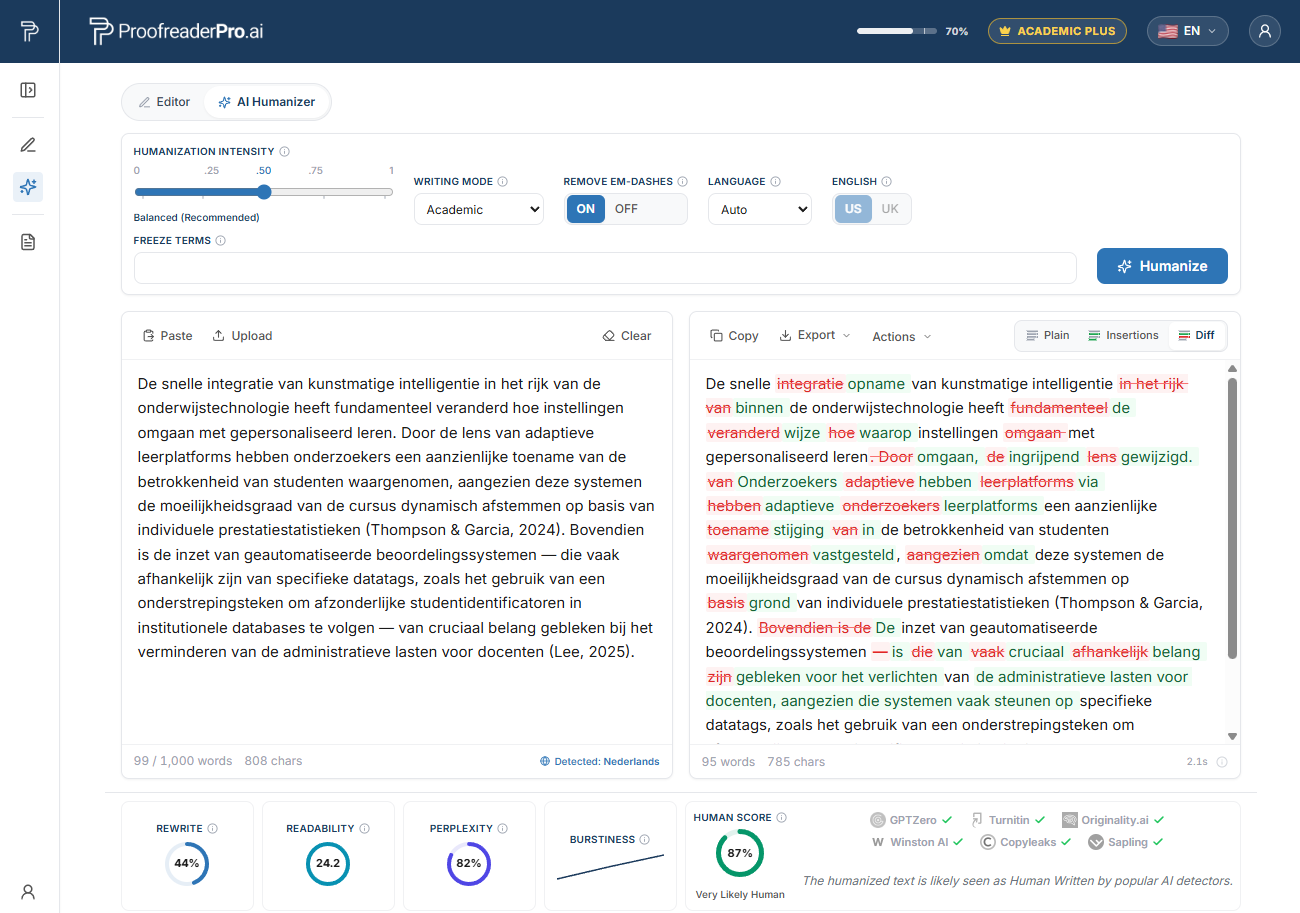
The ProofreaderPro AI Humanizer rewriting Dutch academic text. The before and after diff keeps your meaning and citations, and the detector checks confirm a natural, human read.
Why Dutch researchers get flagged by AI detectors
In 2023, a Stanford team led by Weixin Liang published a study in the Cell Press journal Patterns with a blunt title: "GPT detectors are biased against non-native English writers." They ran human-written TOEFL essays through seven widely used AI detectors. On average, about 61% of the non-native essays were flagged as AI-generated. For essays by native English speakers, the figure was about 5%. Nearly one in five non-native essays, roughly 19.8%, was flagged unanimously by every single detector. A human wrote every one of them.
The mechanism is worth understanding, because it explains why fluency is no shield. Most detectors score something called perplexity, a measure of how surprising each word choice is to a language model. Writing that uses common words in standard, expected combinations scores low perplexity, and low perplexity reads as machine text. Careful academic writers, especially those working in a second language, gravitate toward clear, conventional phrasing precisely because it is safe and correct. The habits that make your prose readable are the habits detectors were trained to punish.
Dutch researchers sit in an awkward spot here. English proficiency in the Netherlands is exceptional, which means Dutch academic English is often cleaner and more standardized than the average native draft. That polish reduces perplexity further. We wrote a fuller explainer on this dynamic in why AI detectors flag non-native writers, and it applies with unusual force to Dutch work.
The Dutch first-language patterns behind false flags
None of the patterns below are errors. They are correct, careful, standard constructions, and that standardness is exactly what a detector reads as low-perplexity, machine-like text. A few examples show how Dutch habits shape English prose.
Dutch and English share a lot of vocabulary, which produces reliable false friends. "Actueel" means current, not "actual"; "eventueel" means possibly, not "eventually"; "controleren" means to check, not "to control". A Dutch researcher who has learned to avoid these traps often writes with a deliberate, careful precision that flattens variation. The result is consistent and correct, and consistency is a perplexity signal.
Word order is another quiet tell. Dutch places the finite verb second in a clause, so an adverb-fronted sentence can surface in English as "Therefore is the result significant" or "In this study investigate we the effect." Most Dutch authors correct this before submission, but the correction produces the kind of tidy, canonical sentence structure that detectors associate with generated text.
Then there are the articles. Dutch allows definite articles before generic and abstract nouns, so drafts carry constructions like "the research shows," "the society," or "the nature of the problem," where English would drop the article. These feel formal and precise. They also read as very regular.
Two more habits round it out. Dutch favors heavy noun phrases and nominalization, stacking constructions such as "the realisation of the implementation of," and it leans on discourse markers like "namely" (namelijk) and "respectively" (respectievelijk), often with a direct, blunt register that reviewers sometimes read as terse. Every one of these is grammatically fine. Together they build the smooth, low-surprise texture that a detector scores against you.
Protect your own writing, honestly
Humanize your AI-assisted draft while keeping your meaning, terminology, and citations intact, then disclose your AI use the way your journal asks.
Try the Humanizer FreeThe Netherlands' AI-detection and Turnitin context
Dutch theses and journal submissions are routinely screened for similarity, most often with Turnitin or iThenticate, and institutions increasingly weigh AI indicators alongside the older plagiarism checks. This is now a normal part of the submission pipeline rather than an exception.
The Universities of the Netherlands (UNL) and individual institutions have issued generative-AI guidance, and the general direction is clear: AI tools are permitted for many tasks, but their use should be disclosed rather than hidden. Funders and journals are moving the same way, asking authors to state where and how AI assisted their work.
It is worth remembering how much weight a detector score actually carries. Turnitin suppresses AI scores in the 1 to 19% range and warns that its number should not be used alone to make an integrity decision. Several major institutions have stepped further back: Vanderbilt disabled Turnitin's AI detector in 2023, citing false positives and bias against non-native writers, and Michigan State, Northwestern, and the University of Pittsburgh took comparable steps. A detection flag is a claim you can contest, not a verdict handed down.
Top Dutch universities and where AI checks appear
Screening happens across the Dutch system. The following institutions all check theses and manuscripts for similarity, commonly with Turnitin or iThenticate, and increasingly factor in AI indicators:
- Universiteit van Amsterdam (UvA), Amsterdam
- Universiteit Utrecht, Utrecht
- Universiteit Leiden, Leiden
- Technische Universiteit Delft (TU Delft), Delft
- Erasmus Universiteit Rotterdam (EUR), Rotterdam
- Rijksuniversiteit Groningen (RUG), Groningen
- Wageningen University & Research (WUR), Wageningen
- Radboud Universiteit, Nijmegen
- Vrije Universiteit Amsterdam (VU), Amsterdam
- Technische Universiteit Eindhoven (TU/e), Eindhoven
- Universiteit Twente (UT), Enschede
- Universiteit Maastricht (UM), Maastricht
- Tilburg University, Tilburg
If you are defending a dissertation at Leiden or submitting from a WUR lab, your document will pass through this kind of check. Knowing that in advance changes how you prepare the final draft.
How the AI humanizer for Dutch researchers works
The honest workflow has three steps, and disclosure is part of it, not an afterthought.
First, draft. Write in English, or write in Dutch and translate, using AI assistance if that speeds your thinking. There is nothing wrong with an AI-assisted first draft as long as the argument, the analysis, and the evidence are genuinely yours.
Second, proofread and humanize. Run your grammar clean, then pass the draft through the AI humanizer. It varies sentence length, breaks the repetitive cadence that signals machine text, and strips stray formatting tics, while leaving your meaning, your technical vocabulary, and every citation exactly where you put them. In our own testing, this substantially reduces how often careful, standard non-native English is misread by the major detectors such as Turnitin, Originality.ai, and GPTZero, while preserving academic meaning and grammar. We frame that as what we have seen in testing, not as a promise. Detectors retrain every few months, and no honest tool can claim to be 100% undetectable. Anyone who guarantees it is selling you something.
Third, disclose. State your AI use in the format your supervisor, your institution, and your target journal require. That is the whole point. The goal is not to hide AI or to trick a similarity checker; it is to keep careful, correct writing from being misread, and to stay squarely inside the integrity rules while you do.
This spoke sits inside our multilingual AI humanizer hub, which covers the same workflow for researchers writing from dozens of language backgrounds. If your bigger need is line-level language editing rather than detection fairness, our global academic editing hub is the better starting point.
Local funding bodies, journals, and AI-disclosure expectations
Dutch competitive funding runs largely through NWO (Nederlandse Organisatie voor Wetenschappelijk Onderzoek, the Dutch Research Council), including its Talent programme grants Veni, Vidi, and Vici. Health and medical work is funded through ZonMw, and the KNAW (Koninklijke Nederlandse Akademie van Wetenschappen, the Royal Netherlands Academy of Arts and Sciences) sits at the center of the national research community. Dutch groups also win a large share of European Research Council (ERC) grants, and open-access publishing under Plan S is mandated for NWO-funded output.
On the publishing side, Dutch researchers target Web of Science and Scopus-indexed journals, deposit output in institutional repositories, and use the national infrastructure coordinated through SURF and the universities. Across funders and journals, the expectation around AI is converging on the same principle: disclose your use, do not conceal it. Keeping a short, honest record of where AI assisted your drafting makes that disclosure straightforward when a grant report or a submission form asks for it. If you are ever flagged despite writing your own paper, our guide on appealing a false AI detection flag walks through how to respond.
Frequently asked questions
Q: Does using an AI humanizer on my paper count as cheating?
Not when you use it the way we describe. You are humanizing your own AI-assisted draft, keeping your argument, data, and citations intact, and then disclosing your AI use to your institution and journal. That is the opposite of hiding something. The problem it solves is a technical one, careful writing being misread as machine text, not an integrity one.
Q: My English is genuinely excellent. Why would a detector flag my work at all?
Because detectors do not measure whether writing is good; they measure how predictable it is. Strong, standard, second-language English tends to be very consistent, and that consistency produces the low perplexity that detectors associate with AI text. The Stanford study found human-written non-native essays flagged far more often than native ones, which is the pattern many fluent Dutch researchers run into.
Q: Can the humanizer guarantee I will pass Turnitin or GPTZero?
No, and you should be wary of any tool that says it can. Detectors change their models every few months, so no honest product can promise a specific result or claim to be 100% undetectable. What we can say is that, in our testing, the humanizer substantially reduces how often careful non-native prose is misflagged, while leaving your meaning and citations untouched.
Q: Will humanizing change my citations, terminology, or data?
No. The humanizer is built to preserve technical terms, reference markers, and the substance of your argument. It adjusts rhythm and word choice to sound more natural, not the facts, the numbers, or the sources you cite. You should still read the result before you submit, as you would with any edit.
Q: I write in Dutch first and translate. Does that still work?
Yes. You can draft in Dutch, translate, and then humanize the English version. The tool routes non-English and translated text through a language-aware model that keeps sentence structure and meaning stable, so the workflow fits the way many Dutch researchers actually write.
Reduce false AI flags on careful non-native English while keeping your meaning, terminology, and citations intact. Free to try, built for researchers.

Moe is an NLP engineer with a PhD in natural language processing. His research covers computational linguistics, text analysis, and machine learning, and it fed directly into the editing and humanization models behind ProofreaderPro. He writes about the part of the process most people never see: how a language model reads a sentence, scores it, and decides what to change.