AI Humanizer for Turkish Researchers Writing in English
AI humanizer for Turkish researchers. Reduce false AI-detection flags on Turkish-influenced English, keep meaning and citations, disclose honestly.

Turkey produces nearly 100,000 Web of Science indexed papers each year, written by roughly 200,000 academics across 208 universities. Almost all of that output has to appear in English, because YOK, the Council of Higher Education, ties faculty promotion directly to Scopus and Web of Science publication records. An AI humanizer for Turkish researchers exists for one real reason: careful, correct English written by a second-language author is increasingly misread as machine text by AI detectors, and that misreading can stall a paper a human actually wrote.
The pressure is structural. The associate professorship (docentlik) examination scores SCI-indexed articles at up to 30 points each, and researchers who do not publish in English-language international journals do not advance. So Turkish academics write in English constantly, often with the help of tools like ChatGPT to speed up a first draft.
Here is the trap. When you write in clear, standard, textbook English, or when you polish an AI-assisted draft, a detector can flag the result as machine-generated. The flag is often wrong. This guide explains why that happens to Turkish authors specifically, and how to protect your own work without hiding anything.
Türk Araştırmacılar İçin Yapay Zeka İnsanlaştırıcı
Bu yapay zeka insanlaştırıcı, Türk araştırmacıların İngilizce yayın yapmasına yardımcı olmak için tasarlandı. Amaç kopya çekmek değil, kendi metninizi doğal bir ritme kavuşturmak ve haksız yapay zeka bayraklarına karşı korumaktır.
In plain terms: the humanizer helps Turkish researchers publish in English by rewriting your own AI-assisted prose so it reads with natural variation, while your meaning, terminology, and citations stay exactly where you put them. It is a fairness tool for real work, not a way to disguise fabricated writing.
Drafting in Turkish? The humanizer detects and rewrites it directly
You can humanize a Turkish draft without translating it into English first. Paste your text and ProofreaderPro detects the language automatically, then routes it through a Turkish-aware model that respects the dotted and dotless letters, suffixes, and citations in your writing. As a yapay zeka insanlaştırıcı it varies the rhythm of your Turkish prose while keeping every term and reference intact. Automatic detection reaches across more than sixty languages, so Turkish is handled as Turkish.
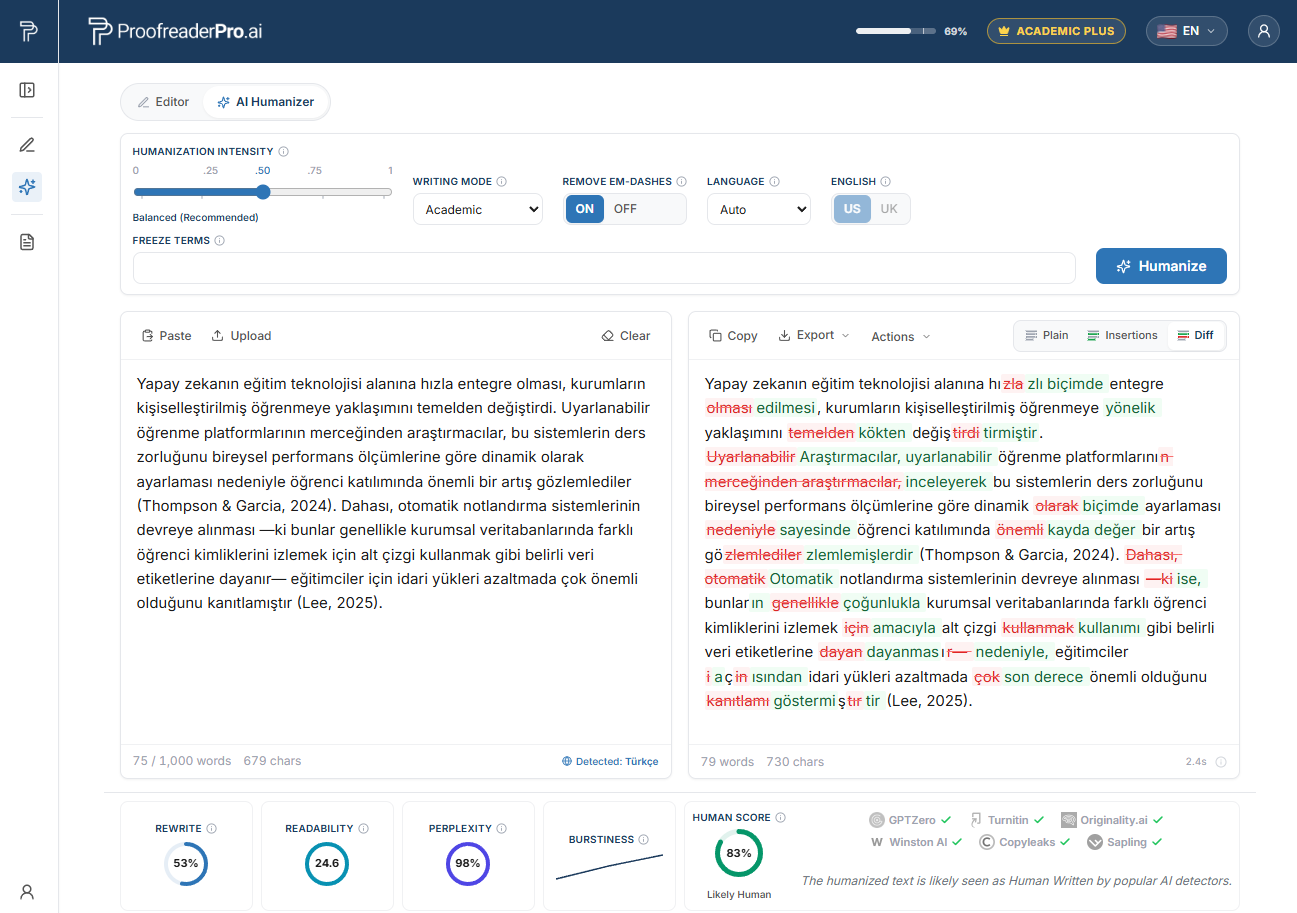
The ProofreaderPro AI Humanizer rewriting Turkish academic text. The before and after diff keeps your meaning and citations, and the detector checks confirm a natural, human read.
Why Turkish researchers get flagged by AI detectors
The clearest evidence comes from a 2023 Stanford study by Liang and colleagues, published in the Cell Press journal Patterns under the title "GPT detectors are biased against non-native English writers." The team ran human-written TOEFL essays through seven widely used detectors.
The result should worry anyone writing in a second language. About 61% of the non-native essays were flagged as AI on average, compared to about 5% for native English writers. Almost one in five non-native essays (about 19.8%) was flagged unanimously by all detectors. Every single essay was written by a human.
The mechanism is called perplexity. Many detectors score how surprising each word choice is to a language model. Careful second-language writers use common words and standard, predictable phrasing, which produces low perplexity, which reads as machine text. The habits that make Turkish researchers' English clear and correct are the exact habits detectors were trained to flag. We explain this failure mode in more depth in why AI detectors flag non-native writers.
The Turkish first-language patterns behind false flags
Turkish is agglutinative, with no article system, postpositions instead of prepositions, and subject-object-verb word order. When a Turkish author writes careful English, the corrections they have trained themselves to make often push their prose toward the flat, standardized register that detectors punish. These are not errors. They are the marks of a disciplined second-language writer.
Article discipline reads as flatness. Turkish has no definite article and only an indefinite one ("bir"). Turkish authors learn to insert "the" and "a/an" deliberately and consistently, so their article usage becomes textbook-regular. That very regularity lowers perplexity.
Preposition caution flattens rhythm. Turkish uses postpositional suffixes, so authors overcorrect toward the safest, most standard prepositions ("related to," "depend on," "interested in") rather than idiomatic variation. Safe and standard is exactly what a detector reads as predictable.
Restructured word order becomes uniform. Turkish places the verb at the end and relative clauses before the noun. To sound natural in English, authors rebuild every sentence into clean subject-verb-object order. Uniform, well-behaved syntax across a whole paper looks statistically machine-like.
Copula and verb precision. Turkish handles "to be" differently, and both "do" and "make" translate to "yapmak." Authors who have drilled these distinctions produce consistent, careful verb choices, another low-variation signal.
Simplified noun handling. Turkish pluralizes freely, so authors learn to police uncountable nouns hard, avoiding "informations" or "equipments." The result is cautious, standard usage with little surprise in it.
Untangled clauses. Turkish agglutination packs dense meaning into long structures, so careful authors break these into short, clean English sentences. Short and clean is readable, and it is also low perplexity.
Turkey's AI-detection and Turnitin context
Theses and journal submissions in Turkey are commonly screened with Turnitin or iThenticate for similarity, and increasingly for AI indicators. Turkish universities have used similarity checking for years as part of thesis approval, and AI signals are now folded into the same workflow.
It helps to know how contested these AI scores are. In 2023, Vanderbilt disabled Turnitin's AI detector because of false positives and bias against non-native writers. The same was done by Michigan State, UT Austin, Northwestern, Pittsburgh, SMU, and Waterloo. Turnitin itself suppresses scores in the 1 to 19% range, showing an asterisk rather than a number, and warns that its score shouldn't be used alone for integrity decisions.
This is a claim to contest, not a verdict. No student has "sued Turnitin and won." The real disputes were with schools over how a flag was used. A practical lesson for a Turkish author: Reduce the chance of a false flag on your own genuine writing. Disclose your tool use clearly so there is nothing to dispute.
Protect your English from false AI flags
Humanize your own AI-assisted draft so careful Turkish-to-English writing reads naturally, with citations and meaning preserved. Then disclose and submit with confidence.
Try the Humanizer FreeTop Turkey universities and where AI checks appear
These are among Turkey's leading research institutions, all of which require English-language publication for faculty advancement under YOK regulations, and all of which screen theses and manuscripts for similarity and AI signals.
- Middle East Technical University / Orta Doğu Teknik Üniversitesi (ODTÜ), Ankara. Turkey's highest-ranked institution globally, strong in engineering, natural sciences, and architecture.
- Istanbul Technical University / İstanbul Teknik Üniversitesi (İTÜ), Istanbul. Among the world's top for engineering and technology, and one of Turkey's oldest technical universities.
- Boğaziçi University / Boğaziçi Üniversitesi, Istanbul. English-medium instruction, strong in engineering, sciences, and social sciences.
- Hacettepe University / Hacettepe Üniversitesi, Ankara. Medicine, health sciences, and engineering, and one of Turkey's largest research universities.
- Istanbul University / İstanbul Üniversitesi, Istanbul. Turkey's oldest university, with broad coverage across all fields.
- Ankara University / Ankara Üniversitesi, Ankara. Strong in law, medicine, and social sciences.
- Gazi University / Gazi Üniversitesi, Ankara. Education, engineering, and health sciences.
- Ege University / Ege Üniversitesi, Izmir. Agriculture, medicine, and natural sciences.
- Koç University / Koç Üniversitesi, Istanbul. A research-intensive private institution with a strong interdisciplinary science profile.
- Sabancı University / Sabancı Üniversitesi, Istanbul. Engineering, natural sciences, and social sciences, with a strong international profile.
- Bilkent University / İhsan Doğramacı Bilkent Üniversitesi, Ankara. Turkey's first private university, known for nanotechnology and materials science.
Across all of these, 23 Turkish universities appear in the QS Europe top 500. The common thread is that a thesis or manuscript passes through a similarity and AI screen before it is accepted, so protecting careful writing from false flags matters at every one of them.
How the AI humanizer for Turkish researchers works
The workflow is clear and simple, and it keeps you inside your institution's rules.
First, draft. You can write in Turkish and translate to academic English, or draft directly in English with AI assistance. Thinking in your native language first often produces a clearer argument.
Second, proofread the grammar so the article usage, prepositions, and word order are correct. Correct English is the goal, not the problem.
Third, run your own AI-assisted prose through the text humanizer. It varies rhythm and word choice and removes repetitive cadence and stray em dashes, so that careful, low-perplexity second-language writing is less likely to be misread. Your meaning, your technical terminology, and every citation stay intact. The tool routes non-English text through a language-aware model that preserves sentence structure and meaning across more than 60 languages, including Turkish.
Here is what testing shows, stated plainly. Tested against the major detectors, our humanizer reworks AI phrasing toward a genuinely human voice, so the AI score drops and the text stands a better chance against strict detectors, while keeping grammar accuracy high on academic text. These are results from testing, not guarantees. Detectors retrain every few months, so no credible tool promises "100% undetectable" or a guaranteed way to bypass detection.
Fourth, and this step is not optional, disclose your AI use in the format your institution and target journal require. Humanizing your own draft and then disclosing is what keeps you inside integrity rules while protecting your work from a false flag. This mirrors the human editing path described in academic editing for researchers in Turkey, and it sits inside the broader multilingual AI humanizer hub that covers this approach language by language.
Local funding bodies, journals, and AI-disclosure expectations
Turkey's research funding and evaluation run through a few central bodies. YOK sets minimum publication requirements for graduate programs. The docentlik title is administered nationally by the Inter-University Council (UAK). TUBITAK's UBYT program provides direct financial incentives for publishing in international indexed journals, and TUBITAK ULAKBIM manages the TRDizin national indexing platform, with DergiPark providing hosting infrastructure.
TUBITAK also publishes 11 diamond open-access journals, all Scopus-indexed. Prominent titles include the Turkish Journal of Medical Sciences, the Turkish Journal of Chemistry, the Turkish Journal of Mathematics, the Turkish Journal of Physics, the Turkish Journal of Biology, the Turkish Journal of Earth Sciences, the Turkish Journal of Electrical Engineering and Computer Sciences, and the Turkish Journal of Agriculture and Forestry. All of them, along with the wider TRDizin ecosystem, expect English manuscripts or English abstracts at minimum.
Funders and journals increasingly ask authors to state whether and how they used AI tools. The safe posture is to humanize your own draft for clarity and fairness, then write a short, accurate disclosure. If a flag still appears on genuine work, treat it as contestable and respond with your drafts and your disclosure rather than panic.
Frequently asked questions
Q: Is using an AI humanizer for Turkish researchers considered cheating?
No, not when you use it responsibly. You are humanizing your own AI-assisted draft, preserving your meaning and citations, and then disclosing your AI use the way your institution and journal require. That is a fairness step for real work, not a way to hide fabricated writing.
Q: Will the humanizer guarantee my paper passes Turnitin or GPTZero?
No serious tool can guarantee that, and you should distrust any that claims to. In testing against the major detectors, our humanizer rewrites AI text into a more natural human form, which lowers the AI signal and improves its odds against tough detectors, but detectors retrain every few months. We report tested results, never a promise of 100% undetectable output.
Q: Why does my careful academic English get flagged as AI in the first place?
Because many detectors score perplexity, meaning how predictable your word choices are. Turkish authors who write clean, standard, textbook English produce low-perplexity prose, which reads as machine-generated. The Stanford study found about 61% of human-written non-native essays were flagged, versus about 5% for native writers.
Q: Does the humanizer keep my citations and technical terms intact?
Yes. The tool varies rhythm and word choice and removes repetitive cadence, but it preserves your meaning, your discipline-specific terminology, and every citation. It is built to protect the substance of your argument while smoothing the surface that detectors misjudge.
Q: I write in Turkish first. Can I still use this workflow?
Yes. Draft your argument in Turkish, translate it to academic English, proofread the grammar, then humanize the English output. The humanizer is language-aware and preserves sentence structure across more than 60 languages, so this pipeline works well for authors who reason most clearly in Turkish.
Rewrite your own AI-assisted Turkish-to-English draft for natural rhythm, with citations, terminology, and meaning preserved. Tested against the major detectors, full disclosure encouraged.

Moe is an NLP engineer with a PhD in natural language processing. His research covers computational linguistics, text analysis, and machine learning, and it fed directly into the editing and humanization models behind ProofreaderPro. He writes about the part of the process most people never see: how a language model reads a sentence, scores it, and decides what to change.