AI Humanizer for Filipino Researchers Writing in English
AI humanizer for Filipino researchers. Reduce false AI-detection flags on Filipino-influenced English, keep meaning and citations, disclose honestly.

The Philippines is a fast-growing research nation, ranking roughly 50th to 60th in the world for scientific output with publications rising about 13.43% a year. Nearly 2,000 higher education institutions serve 3.8 million students, one of the largest systems in Asia. Filipino scholars write and publish in English, and most do so fluently, since English is an official language of instruction here.
So why would anyone need an AI humanizer for Filipino researchers? Because careful, standard academic English, the kind a well-trained Filipino writer produces, is increasingly misread by AI detectors as machine-written. The tools that scan theses and journal submissions do not measure honesty. They measure how predictable your sentences are, and predictable is exactly what a disciplined second-language writer aims for.
That mismatch is the whole story of this page. Your English is not the problem. The way detectors score it is.
Humanizer ng tekstong AI para sa mga mananaliksik na Pilipino
Tinutulungan ng aming humanizer ng tekstong AI ang mga mananaliksik na Pilipino na mailathala sa mga internasyonal na journal na nakasulat sa Ingles, nang hindi nawawala ang kahulugan, terminong teknikal, at mga sanggunian ng inyong pananaliksik.
In plain terms: our humanizer helps you take an AI-assisted English draft and make it read the way a person actually writes, so that careful non-native prose is less likely to be misflagged. It varies rhythm and word choice, trims repetitive cadence, and keeps your citations and technical terms exactly where you put them.
It is built for real research written by real researchers, not for disguising work that is not yours. You can try the text humanizer on a single paragraph before you trust it with a chapter.
Drafting in Filipino? The humanizer detects and processes it too
Filipino researchers often draft in Filipino before moving into academic English, and the humanizer supports that directly. Paste Filipino text and ProofreaderPro detects the language on its own, then routes it through a language-aware model that keeps your terminology and citations exactly in place. As a humanizer ng tekstong AI it works on your Filipino draft as readily as on your English, so you can humanize before you translate. The same detection covers more than sixty languages, each rewritten as itself.
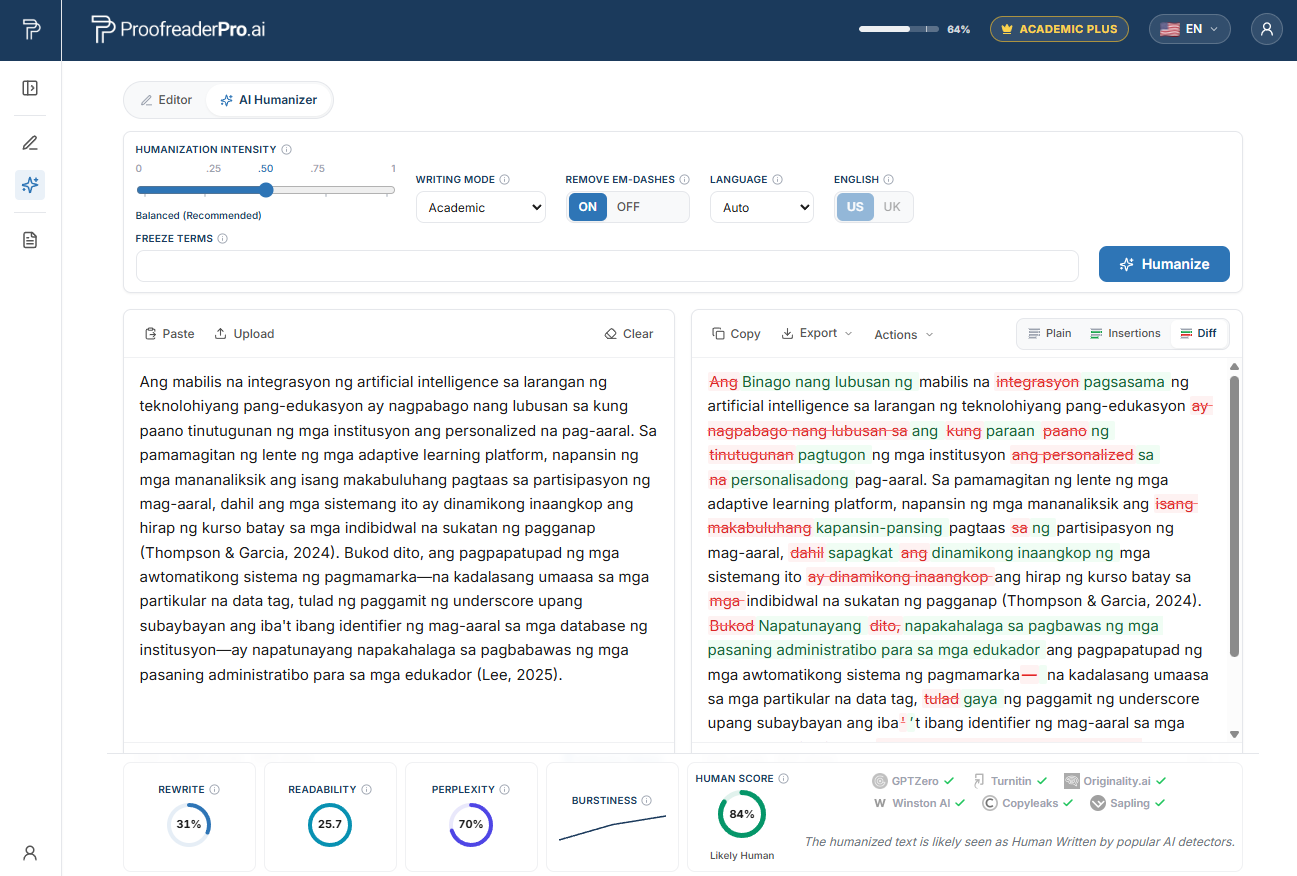
The ProofreaderPro AI Humanizer rewriting Filipino academic text. The before and after diff keeps your meaning and citations, and the detector checks confirm a natural, human read.
Why Filipino researchers get flagged by AI detectors
In 2023, a Stanford team led by Liang and colleagues published a study in the Cell Press journal Patterns titled "GPT detectors are biased against non-native English writers." They ran human-written TOEFL essays through seven widely used detectors. On average, about 61% of the non-native essays were flagged as AI, versus about 5% for native English writers. Nearly one in five non-native essays was flagged unanimously by every detector. Every single essay was written by a human.
It's called perplexity. The detector measures how surprising each word choice is to a language model. If you write with common words in standard, predictable phrases, your perplexity will be low. Low perplexity is read as machine text. These tools were trained to punish the very habits that make non-native academic prose clear.
That is not a fringe complaint. It is why so many careful Filipino manuscripts come back with an AI flag the author cannot explain. We break down the research in detail in why AI detectors flag non-native writers.
The Filipino first-language patterns behind false flags
Filipino researchers sit in an unusual position. English is official and used daily, so baseline fluency is high. But specific transfer patterns from Filipino (Tagalog), Cebuano, Ilocano, and Hiligaynon surface in formal writing, and to manage them, careful writers reach for the safest, most standard English form. That safety is precisely what lowers perplexity. Here is how it happens.
Article discipline. Philippine languages have no direct equivalent of "a," "an," or "the." Filipino uses markers like "ang" and "ng" that do not map onto English articles. Knowing articles are a trap, careful writers drill the canonical pattern and apply it everywhere: "the results showed that the concentration increased." Correct and clear, and also flat, uniform, and highly predictable, which is a low-perplexity signal.
The safe preposition. In Filipino, "sa" covers the range of at, in, on, to, for, and from. To avoid slips, writers select the neutral, dictionary-standard preposition for each context. Those high-frequency, low-surprise choices are exactly what a detector expects a model to produce.
Textbook agreement. Filipino verbs do not inflect for number the way English verbs do. So careful writers apply the rule book strictly: "the data show," "each participant was," "the analysis of the samples shows." Strict, rule-perfect agreement reads as smooth and machine-like.
Pronoun neutrality. Filipino uses one third-person pronoun, "siya," for both he and she. To avoid an accidental gender switch, writers often restructure into steady neutral forms: "the researcher," "the participant," "they." Repeated neutral noun phrases read as low-variety and even.
Tense consistency. Filipino marks aspect (completed, ongoing, contemplated) rather than tense. To stay safe, writers adopt the standard conventions, simple past in the methods and present for established findings, and hold them rigidly. Consistency is good writing, and it is also the even predictability a detector flags.
Plain word order. Filipino's default order is Verb-Subject-Object, the reverse of English. Careful writers convert everything to plain Subject-Verb-Object. Canonical sentence order is the most probable structure a model can predict, so it scores as low perplexity.
None of these are errors once corrected. They are the fingerprints of a disciplined writer. The cruel irony is that discipline is what the detector misreads.
The Philippines' AI-detection and Turnitin context
Turnitin or iThenticate is often used to check for similarity as well as indications of AI in theses and journal articles submitted in the Philippines. Under CHED Memorandum Order No. 15, Series of 2019, the "no publication, no graduation" policy means that graduate students must publish or have a manuscript accepted before they finish. Many thesis chapters will be checked for similarity well before a journal ever sees them.
It's worth keeping perspective on what a detector score means. Vanderbilt disabled Turnitin's AI detector in 2023, citing false positives and bias against non-native writers, and Michigan State, UT Austin, Northwestern, Pittsburgh, SMU, and Waterloo took similar steps. Turnitin itself suppresses scores in the 1 to 19% range and warns that its number should not be the sole basis for an integrity decision. A flag is a claim to examine, not a verdict.
At the same time, funders and journals are moving toward requiring AI-use disclosure. The right response to both pressures is the same: write your own work, make careful prose read naturally, and disclose the AI help you used.
Protect your careful English from a false AI flag
Humanize your own AI-assisted draft so standard, non-native prose reads naturally, with your meaning, terminology, and citations preserved. Then disclose your AI use the way your journal asks.
Try the Humanizer FreeTop Philippine universities and where AI checks appear
These institutions produce much of the country's indexed research, and their graduate schools and journals screen theses and manuscripts for similarity and AI indicators.
- University of the Philippines Diliman (UP Diliman), Quezon City, the flagship campus of the UP System.
- University of the Philippines Los Banos (UPLB), Laguna, the leading agricultural and life sciences university.
- University of the Philippines Manila (UP Manila), the health sciences campus and a top producer of medical research.
- De La Salle University (DLSU), Manila, the highest-ranked private university in the country.
- Ateneo de Manila University, Quezon City, strong in social sciences, environmental science, and public policy.
- University of Santo Tomas (UST), Manila, founded in 1611 and the oldest existing university in Asia.
- Mapua University, Manila, an engineering-focused private university.
- Mindanao State University, Iligan Institute of Technology (MSU-IIT), Iligan City, the leading research university in Mindanao.
- Silliman University, Dumaguete City, known for marine biology and environmental science.
- Central Luzon State University (CLSU), Nueva Ecija, the country's premier agricultural university.
- University of San Carlos (USC), Cebu City, the leading research university in the Visayas.
- Polytechnic University of the Philippines (PUP), Manila, the largest state university by enrollment.
Wherever your thesis or manuscript is checked, the goal is the same: make sure a careful, human-written paper is read as one.
How the AI humanizer for Filipino researchers works
The AI humanizer for Filipino researchers is not a trick, and it is not a way to hide anything. It is a step in a workflow.
First, draft your paper. If your reasoning flows more naturally in Filipino, write it there first and translate into English, or draft in English with the help of an AI assistant. Second, proofread the grammar so the mechanics are right. You can pair this with our academic editing for Filipino researchers guide, which covers the same L1 patterns from the editing side.
Third, run your own draft through the text humanizer. It varies sentence rhythm and word choice, removes the repetitive cadence and stray machine punctuation that detectors latch onto, and preserves your meaning, technical terminology, and every citation. In our own testing against the major detectors, the humanizer rewrites AI text into a more natural human form, which lowers the AI signal and improves its odds against tough detectors, while keeping grammar accuracy high on academic text. These are results from testing, not guarantees. Detectors retrain every few months, so we report what we measured rather than a promise.
Fourth, disclose. State the AI help you used in the format your institution and target journal require. That combination, careful human work plus a natural-reading final draft plus full disclosure, keeps you inside integrity rules while protecting your writing from a false flag. For more country guides, see the multilingual AI humanizer hub.
Local funding bodies, journals, and AI-disclosure expectations
Philippine research funding comes with publication expectations, and increasingly with disclosure ones. The Commission on Higher Education (CHED) drives the "no publication, no graduation" mandate. The Department of Science and Technology (DOST) funds projects across universities and evaluates them on Scopus-indexed and Web of Science-indexed outputs, through councils including the Philippine Council for Industry, Energy, and Emerging Technology Research and Development (PCIEERD) and the Philippine Council for Health Research and Development (PCHRD). The National Research Council of the Philippines (NRCP) offers grants of up to PHP 20,000 for publication-related expenses, which recognizes language and publication support as a legitimate research cost.
The country now has more than 200 Scopus-indexed journals, and target venues include:
- Philippine Journal of Science, the flagship multidisciplinary journal, published for well over a century.
- Acta Medica Philippina, the journal of the UP Manila National Institutes of Health.
- Philippine Agricultural Scientist, published by UPLB.
- Philippine Journal of Nursing, the country's leading nursing research journal.
- Asia Pacific Journal of Education, covering educational research in the region.
- Philippine Political Science Journal, indexed in Scopus.
Whether you submit to a Philippine journal or an international one indexed in Scopus or Web of Science, expect the manuscript to be screened, and expect to be asked, sooner or later, how you used AI. A clear AI-disclosure statement settles the question before a reviewer has to raise it.
Frequently asked questions
Q: Does using an AI humanizer for Filipino researchers count as cheating?
No, not when you use it responsibly. The point is to humanize your own AI-assisted draft so that careful, standard English is not misread as machine text, while your meaning and citations stay intact. You still disclose your AI use in the format your institution and journal require. That is fairness for real work, not disguise.
Q: Will the humanizer guarantee my paper passes Turnitin or GPTZero?
No. We report tested results, not guarantees. In our testing the humanizer rewrites AI text into a more natural human form, which lowers the AI signal and improves its odds against tough detectors, but detectors retrain often, and no tool can promise a permanent pass. Treat any single detector score as a claim to examine, not a final verdict.
Q: Why does my careful English get flagged when it is grammatically correct?
Because detectors score predictability, not correctness. A Stanford study found about 61% of human-written non-native essays flagged as AI, versus about 5% for native writers. When Filipino writers use safe articles, standard prepositions, and textbook agreement to avoid L1 slips, that very standardness reads as low perplexity, which detectors misread as machine-generated.
Q: Will humanizing change my citations or technical terms?
No. The humanizer preserves your citations, terminology, and the meaning of every sentence. It varies rhythm and word choice and removes repetitive cadence and stray machine punctuation. Your references and discipline-specific terms stay exactly as you wrote them.
Q: Can I write in Filipino first and still use this?
Yes. Many researchers reason more naturally in Filipino or a regional language, draft there, then translate into English before proofreading and humanizing. The humanizer supports more than 60 languages, and a language-aware model keeps your sentence structure and meaning intact through the process.
Make careful, non-native academic English read naturally, with citations and meaning preserved. Tested against the major detectors, built for clear disclosure.

Moe is an NLP engineer with a PhD in natural language processing. His research covers computational linguistics, text analysis, and machine learning, and it fed directly into the editing and humanization models behind ProofreaderPro. He writes about the part of the process most people never see: how a language model reads a sentence, scores it, and decides what to change.