AI Humanizer for Thai Researchers Writing in English
AI humanizer for Thai researchers. Reduce false AI-detection flags on Thai-influenced English, keep meaning and citations, disclose honestly.

Thailand is a serious publisher of research. With 194 universities and some 130,000 researchers, it stands about 43rd in the world in terms of production (Chulalongkorn University and Mahidol University account for much of this). But it falls into the "Very Low Proficiency" bracket of the EF English Proficiency Index. Its writing score of 363 is the lowest among the top research publishers in Asia. This is exactly where an AI humanizer for Thai researchers earns its place.
Here is the problem few people name. Thai academics increasingly draft with ChatGPT, Claude, and other assistants to get past that writing gap. Then a Turnitin or GPTZero AI indicator flags the result, and the careful, correct English a Thai scholar worked hard to produce gets read as machine text. Sometimes the flag fires even when no AI touched the page at all.
We built our humanizer for that unfair moment. Not to hide AI use, but to protect real work from a detector that misreads non-native writing. You humanize your own AI-assisted draft, keep your meaning and your citations, and then disclose your AI use the way your journal and university need.
เครื่องมือทำให้ข้อความ AI เป็นธรรมชาติสำหรับนักวิจัยไทย
Our humanizer helps Thai researchers (นักวิจัยไทย) publish in English by making AI-assisted academic prose read naturally while it keeps your argument, technical terms, and references intact. The เครื่องมือทำให้ข้อความ AI เป็นธรรมชาติ routes Thai-influenced English through a language-aware model that preserves sentence structure and meaning rather than flattening it.
For a researcher at Chulalongkorn, Mahidol, or Chiang Mai, that means the version you submit still sounds like you. It varies rhythm and word choice, strips the repetitive cadence detectors latch onto, and removes stray em dashes, without touching your data, your findings, or your sources.
Drafting in Thai? The humanizer detects and processes it too
Thai has no spaces between words, and the humanizer still detects and counts it correctly. Paste Thai text and ProofreaderPro recognises the script automatically, then routes it through a language-aware model that keeps your terminology and citations exactly as written. As a เครื่องมือทำให้ข้อความ AI เป็นธรรมชาติ it rewrites your Thai prose directly, so you can humanize before you translate. The same detection covers more than sixty languages, each handled in its own script.
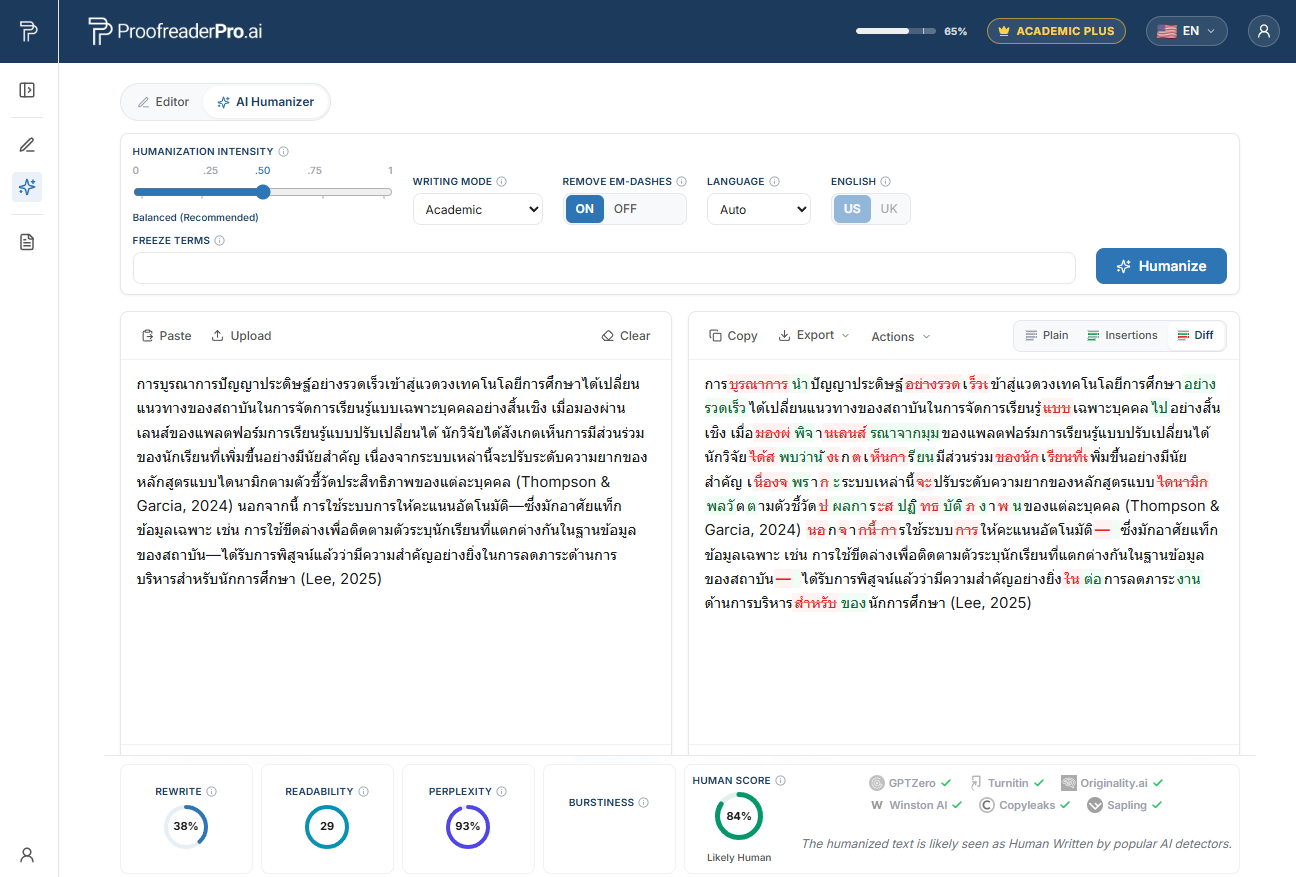
The ProofreaderPro AI Humanizer rewriting Thai academic text. The before and after diff keeps your meaning and citations, and the detector checks confirm a natural, human read.
Why Thai researchers get flagged by AI detectors
The bias is measured, not hypothetical. In 2023, a Stanford team led by Weixin Liang published "GPT detectors are biased against non-native English writers" in the Cell Press journal Patterns. They ran human-written TOEFL essays through seven widely used detectors.
On average, about 61% of the non-native essays were flagged as AI, against about 5% for native English writers. Nearly one in five non-native essays (about 19.8%) was flagged unanimously by every detector. Every one of those essays was written by a human.
The mechanism is perplexity. Many detectors score how surprising each word choice is to a language model. Careful second-language writers reach for common words and standard, predictable phrasing, which produces low perplexity, which a detector reads as machine text. The very habits that make Thai academic English clear and correct are the habits these tools were trained to flag. We walk through the full mechanism in why AI detectors flag non-native writers.
The Thai first-language patterns behind false flags
Thai is a Kra-Dai language with no verb conjugation, no articles, no plural inflection, and pro-drop syntax. When Thai scholars write careful English, they compensate with steady, standard constructions. Those constructions are correct. They are also low perplexity, which is exactly what trips a detector.
Steady, uniform tense. Thai marks time with context and small particles (จะ for future, แล้ว for completion), so the verb form itself never changes. Writing English, Thai researchers learn to hold one tense across a methods section and keep it regular. That consistency reads as careful scholarship to a reviewer and as predictable, machine-like output to a detector.
Explicit, textbook article use. Thai has no "a," "an," or "the." To avoid the omissions their first language invites, Thai writers apply article rules deliberately and uniformly: "The result shows that the method is effective." Rule-following, low-surprise phrasing is precisely the pattern detectors score as AI.
Standard subject-first sentences. Thai often places the topic first, so writers correct toward plain subject-verb-object English to stay safe. Clean, canonical sentence order is clear to a reader and, to a detector, highly predictable.
Common, safe word choice. Because one Thai word such as ศึกษา (sueksa) covers "study," "examine," and "investigate," careful writers pick the most standard English term and reuse it. Repeated high-frequency vocabulary lowers perplexity further.
Consistent plural and subject marking. Thai does not mark number on nouns (หนังสือ means both "book" and "books"), and it can drop subjects, so scholars overcorrect into fully explicit, regular English: every plural marked, every subject stated. Correct, complete, uniform. Also, to a detector, flat.
None of these is an error. They are the marks of a disciplined non-native writer, and they are why a detector misreads genuine Thai work.
Thailand's AI-detection and Turnitin context
Theses and journal submissions from Thai institutions are commonly screened for text similarity with Turnitin or iThenticate, and those tools now surface AI indicators alongside the similarity score. Thai graduate schools and international journals both rely on them.
It helps to know what the vendors themselves say. Turnitin suppresses AI scores in the low 1 to 19% range (showing an asterisk rather than a number) and warns that its score shouldn't be the sole basis for an integrity decision. Several universities have gone further: Vanderbilt disabled Turnitin's AI detector in 2023 over false positives and bias against non-native writers, and Michigan State, UT Austin, Northwestern, Pittsburgh, SMU, and Waterloo took similar steps.
The takeaway for a Thai researcher is practical. A detector flag is a claim you can contest, not a verdict. Meanwhile funders and journals increasingly ask you to disclose AI use, so the right path (humanize your own draft, then disclose) is also the safe one.
Protect your Thai research from false AI flags
Humanize your own AI-assisted draft, keep your meaning and citations, then disclose. Tested against Turnitin, Originality.ai, and GPTZero, not a promise to bypass anything.
Try the Humanizer FreeTop Thailand universities and where AI checks appear
Research output concentrates in a small set of elite institutions, and every one of them screens theses and manuscripts for similarity and AI before submission or graduation:
- Chulalongkorn University (จุฬาลงกรณ์มหาวิทยาลัย), Bangkok, the country's highest-ranked university, strong across medicine, engineering, science, and social sciences.
- Mahidol University (มหาวิทยาลัยมหิดล), Bangkok and Nakhon Pathom, ranked first in Thailand for research impact and a leader in biomedical research and public health.
- Chiang Mai University (มหาวิทยาลัยเชียงใหม่), Chiang Mai, the premier university of the north, strong in agriculture, science, engineering, and medicine.
- Kasetsart University (มหาวิทยาลัยเกษตรศาสตร์), Bangkok, leading in agriculture, forestry, fisheries, and food science.
- Khon Kaen University (มหาวิทยาลัยขอนแก่น), Khon Kaen, the primary research institution of the Isan region.
- Prince of Songkla University (มหาวิทยาลัยสงขลานครินทร์), Hat Yai, the premier university of the south, with multiple campuses across the southern provinces.
- Thammasat University (มหาวิทยาลัยธรรมศาสตร์), Bangkok, strong in social sciences, economics, law, and public health.
- King Mongkut's University of Technology Thonburi (KMUTT, มหาวิทยาลัยเทคโนโลยีพระจอมเกล้าธนบุรี), Bangkok, a top technical university in energy, biotechnology, and engineering.
- Suranaree University of Technology (มหาวิทยาลัยเทคโนโลยีสุรนารี), Nakhon Ratchasima, known for engineering, science, and industry collaboration.
- Naresuan University (มหาวิทยาลัยนเรศวร), Phitsanulok, strong in health sciences, science, and engineering.
- Mae Fah Luang University (มหาวิทยาลัยแม่ฟ้าหลวง), Chiang Rai, with a distinctive international orientation and growing work in health and food science.
- Silpakorn University (มหาวิทยาลัยศิลปากร), Bangkok and Nakhon Pathom, expanding from fine arts into science, engineering, and pharmacy.
Promotion to Associate Professor (รองศาสตราจารย์) and full Professor (ศาสตราจารย์) at these universities requires Scopus or Web of Science publications, which keeps the pressure to submit in polished English high, and keeps AI screening a routine part of the workflow.
How the AI humanizer for Thai researchers works
The workflow is clear and simple, and it keeps you inside the rules.
First, draft. If you reason more clearly in Thai, write in Thai and translate, or draft in English with an AI assistant to get past the blank page. Second, proofread the grammar so tense, articles, and plurals are right; our editing tools test above 96% grammar accuracy on academic text. Third, humanize your own AI-assisted prose with our text humanizer so that careful, low-perplexity non-native writing is less likely to be misread, with your meaning, technical terminology, and citations preserved.
About results, stated plainly. Our humanizer is tested against the major detectors. It reworks AI text into a more natural human form that reads as human across Turnitin, Originality.ai, and GPTZero. Those are results from testing, not guarantees. Detectors retrain every few months, so we never promise "100% undetectable" or a way to bypass anything.
Fourth, and this step is not optional: disclose your AI use in the format your institution and target journal require. Humanizing your own work protects it from a false flag; disclosure keeps you fully inside integrity rules. Done together, they are fair, not evasive. This is the same approach we take across the multilingual AI humanizer hub, and it pairs naturally with academic editing for Thai researchers when your draft needs structural help before you humanize.
Local funding bodies, journals, and AI-disclosure expectations
Thailand's funding system rewards international publication, which raises the stakes on every submission. The National Research Council of Thailand (NRCT) sets national research policy and ties competitive grants to indexed output. Thailand Science Research and Innovation (TSRI), established in 2019, coordinates funding through Program Management Units that track publications as key indicators. The National Science and Technology Development Agency (NSTDA) funds applied research with clear expectations for international dissemination. The Royal Golden Jubilee (RGJ) PhD Programme requires each scholar to publish, with at least one paper in a Web of Science indexed journal.
Domestic English-language journals raise the same bar. ThaiJO (Thai Journals Online) hosts roughly 900 titles, and prominent English venues include ScienceAsia (Science Society of Thailand, indexed in Scopus and SCIE), the Songklanakarin Journal of Science and Technology (Prince of Songkla University), the Chiang Mai Journal of Science (Chiang Mai University), the Engineering Journal (Chulalongkorn University), the Asian Pacific Journal of Allergy and Immunology (indexed in SCIE), and the Thai Journal of Veterinary Medicine.
Across these funders and journals, AI-use disclosure is moving from courtesy to expectation. Neither NRCT nor a Scopus-indexed journal wants hidden AI; they want full disclosure and clean, original work. Humanizing your own draft and then disclosing satisfies both. You can keep the humanizer in your workflow without ever crossing an integrity line.
Frequently asked questions
Q: Does the AI humanizer for Thai researchers guarantee my paper passes Turnitin?
No, and be wary of any tool that says it does. Tested against the major detectors, our humanizer rewrites AI text into a more natural human form, which lowers the AI signal and improves its odds against tough detectors, though no tool can guarantee a specific result. Detectors retrain often, so we report what we measured and never promise "100% undetectable."
Q: Will humanizing change my citations, data, or technical terms?
No. The humanizer preserves your meaning, your technical terminology, and your references (APA, IEEE, and the rest). It varies rhythm and word choice and removes repetitive cadence, so your findings and your sources stay exactly as you wrote them.
Q: Is this cheating, or hiding that I used AI?
Neither. You humanize your own AI-assisted draft, not someone else's work, and you keep the real substance. Then you disclose your AI use in the format your university and journal require. That combination protects careful non-native writing from a false flag while keeping you fully inside integrity rules.
Q: Why does my careful English get flagged when I did not use AI at all?
Because detectors score perplexity, meaning how predictable your wording is. Thai scholars write standard, low-surprise English to avoid first-language errors, and that very correctness reads as machine text. A 2023 Stanford study found about 61% of human-written non-native essays flagged, versus about 5% for native writers.
Q: Can I write in Thai first and still use this?
Yes. Many Thai researchers reason more clearly in Thai, draft there, translate to English, proofread the grammar, and then humanize the result. The meaning you built in Thai carries through, and the English version reads naturally rather than machine-flat.
Humanize your own AI-assisted academic draft, keep meaning and citations, and disclose with confidence. Tested against Turnitin, Originality.ai, and GPTZero.

Moe is an NLP engineer with a PhD in natural language processing. His research covers computational linguistics, text analysis, and machine learning, and it fed directly into the editing and humanization models behind ProofreaderPro. He writes about the part of the process most people never see: how a language model reads a sentence, scores it, and decides what to change.