AI Humanizer for Romanian Researchers Writing in English
AI humanizer for Romanian researchers. Reduce false AI-detection flags on Romanian-influenced English, keep meaning and citations, disclose honestly.

Romania publishes serious science. Its mathematicians, computer scientists, physicists, and chemists place work in Web of Science and Scopus journals every year, and the national promotion standards set by CNATDCU keep that pressure constant: without indexed publications, there is no advancement. Nearly all of that research is drafted in Romanian and written up in English.
Here is the problem that an AI humanizer for Romanian researchers is built to solve. When you write careful, standard academic English as a second language, an AI detector can misread it as machine-generated. Your grammar is clean. Your phrasing is predictable. And predictable is precisely what these tools were trained to flag.
That is not a rare glitch. It is a structural bias, and it lands hardest on exactly the researchers who worked the longest to write clear, correct English.
Cum ajută umanizarea textului AI cercetătorii români
Umanizarea textului AI îi ajută pe cercetătorii români să publice în limba engleză fără ca scrisul lor atent și corect să fie confundat cu text generat de o mașină. Meaning, terminology, and citations stay exactly where you put them.
The idea is simple and honest. You keep writing rigorous English. A humanizer varies the rhythm and word choice so your prose no longer trips a detector that was tuned to punish predictability. Nothing about your argument, your data, or your references changes.
You can humanize Romanian directly, not only your English
You do not have to translate a draft into English before humanizing it. Paste text written in Romanian and ProofreaderPro detects the language automatically, then routes it through a Romanian-aware model that respects the diacritics, grammar, and academic register of the original. Your meaning, technical terms, and citations stay intact, so umanizarea textului AI works on your first-language writing just as it does on your English. The humanizer handles more than sixty languages this way, detecting each one on its own and rewriting it as itself rather than flattening it into generic English.
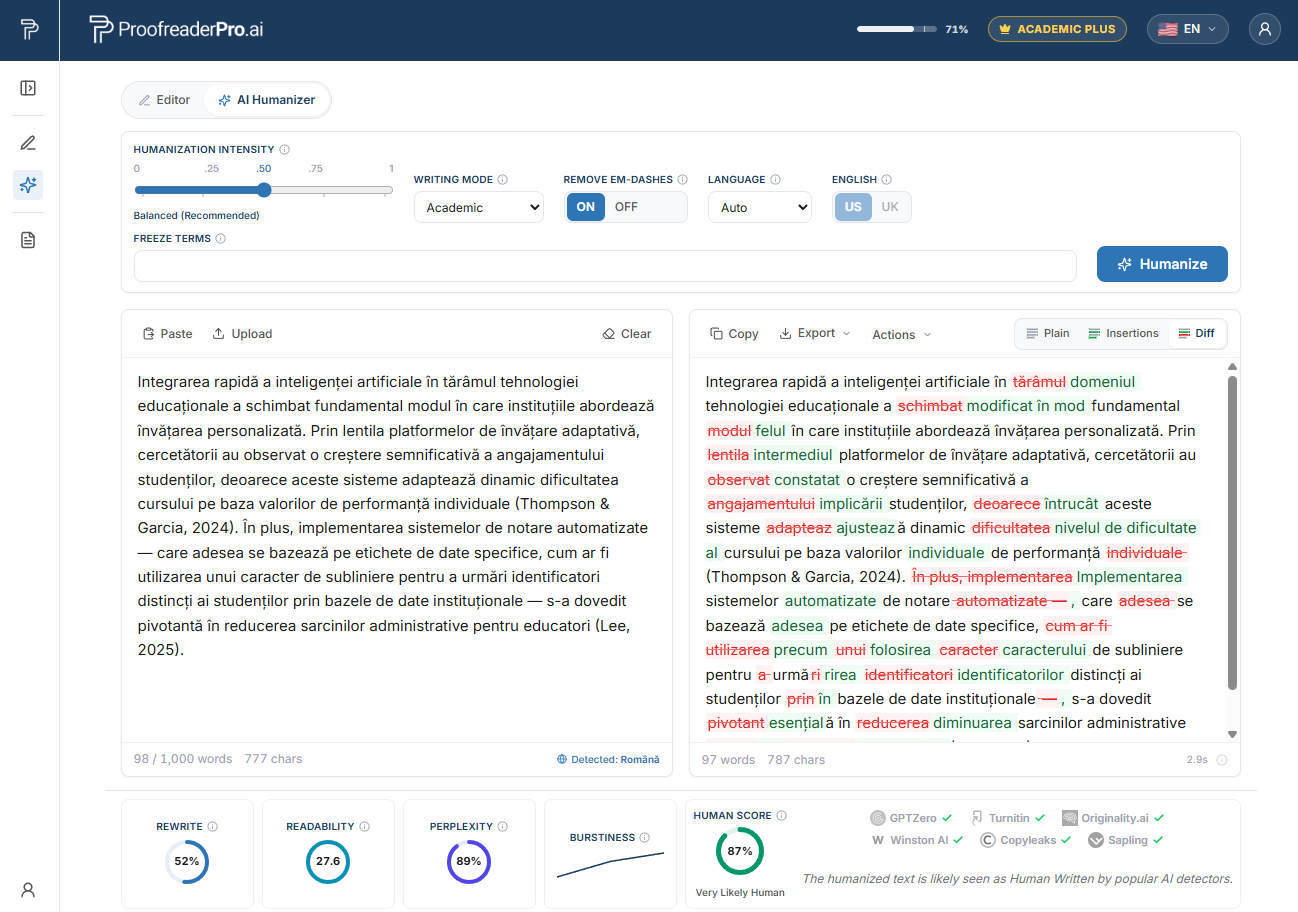
The ProofreaderPro AI Humanizer rewriting Romanian academic text. The before and after diff keeps your meaning and citations, and the detector checks confirm a natural, human read.
Why Romanian researchers get flagged by AI detectors
In 2023, researchers at Stanford led by Weixin Liang published a study in the Cell Press journal Patterns with a blunt title: "GPT detectors are biased against non-native English writers." They took TOEFL essays written entirely by humans and ran them through seven widely used AI detectors.
The results should worry anyone publishing in a second language. On average, about 61% of the non-native essays were flagged as AI-written, compared with roughly 5% for essays by native English speakers. Nearly one in five non-native essays, about 19.8%, was flagged unanimously by every single detector. Every one of those essays was written by a person.
The mechanism is a measure called perplexity, which scores how surprising each word choice is to a language model. Second-language writers tend to reach for common words and standard, safe constructions, so their perplexity is low. Low perplexity reads as machine text. The very habits that make Romanian-English clear and correct are the habits these tools learned to distrust. We unpack the mechanism in detail in why AI detectors flag non-native writers.
The Romanian first-language patterns behind false flags
Romanian is a Romance language in the Latin alphabet, close enough to English to feel familiar and different enough to leave fingerprints. None of the patterns below are errors. They are correct, careful, standard choices, and that standardness is what a detector reads as low perplexity.
False friends give your prose a recognisable shape. In Romanian, actual means current, eventual means possible, a realiza means to achieve or carry out, sensibil means sensitive, and a pretinde means to claim. A careful writer who has learned to steer around these traps often lands on the same safe, textbook English word every time, which flattens variety in a way detectors notice.
The definite article behaves differently. Romanian attaches the article to the end of the noun rather than placing a separate word in front, so English "the" is easy to drop or misplace. Writers who overcorrect produce very regular article usage, another uniform signal.
Sentences run long and subordinate-heavy. Romanian academic prose favours layered clauses and the subjunctive, and reviewers sometimes read the translated version as dense. Dense, tightly structured sentences also happen to look statistically smooth to a detector.
Prepositions transfer straight across. Constructions like "depend of" or "different of" follow the Romanian pattern, and a heavy reliance on "which" to open relative clauses adds a predictable cadence.
Nominalisation piles up. Turning verbs into heavy noun phrases is normal in formal Romanian and normal in formal English, but stacked together it produces the kind of even, abstract rhythm that scores as machine-like.
Put those together and you get prose that is accurate, professional, and, to an AI detector, suspiciously smooth.
Romania's AI-detection and Turnitin context
Similarity screening is routine across Romanian higher education. Doctoral theses and journal submissions are commonly checked with Turnitin or comparable systems, and many of those platforms now attach an AI-writing indicator alongside the traditional similarity score.
Universities have issued their own generative-AI guidance, and the direction of travel is clear: funders and journals increasingly ask authors to disclose how they used AI tools. That is a reasonable request, and it is very different from banning AI outright.
The honest position is the one worth holding. Use AI to help draft or polish your own work, keep every claim and citation truthful, then disclose that use in the format your institution and target journal require. A detector score is a claim to contest, not a verdict, and no responsible reviewer should treat a single number as proof of misconduct.
Protect your Romanian-English research from false AI flags
Humanize your own careful academic draft, keep every citation and technical term, then disclose your AI use with confidence.
Try the Humanizer FreeTop Romanian universities and where AI checks appear
These are the institutions where Romanian research is written, defended, and screened. Each one runs theses and manuscripts through similarity systems, and each increasingly weighs AI indicators in that same review.
- Universitatea din București (University of Bucharest), Bucharest
- Universitatea Babeș-Bolyai (Babeș-Bolyai University), Cluj-Napoca
- Universitatea Politehnica din București (Politehnica University of Bucharest), Bucharest
- Universitatea Alexandru Ioan Cuza din Iași, Iași
- Universitatea de Vest din Timișoara (West University of Timișoara), Timișoara
- Universitatea de Medicină și Farmacie Carol Davila, Bucharest
- Universitatea Tehnică din Cluj-Napoca (Technical University of Cluj-Napoca), Cluj-Napoca
- Universitatea Transilvania din Brașov (Transilvania University of Brașov), Brașov
- Academia de Studii Economice din București (Bucharest University of Economic Studies, ASE), Bucharest
- Universitatea din Craiova (University of Craiova), Craiova
A flag from any of these systems is the start of a conversation, not the end of one. What you want is prose that never invites the conversation in the first place, because it reads unmistakably like the careful human writing it already is.
How the AI humanizer for Romanian researchers works
The workflow is honest, and it fits how you already write. Here is how the AI humanizer for Romanian researchers works in practice.
Draft your paper. If it helps to think first in Romanian, do that, then translate and write it up in English, or use an AI assistant to get a first draft moving. Fix the grammar and terminology so the science is exact. Then run your own English through the text humanizer, which varies sentence length and word choice, smooths out the uniform cadence that detectors punish, and quietly strips the stray em dashes and repetitive phrasing that give machine drafts away.
Meaning, technical vocabulary, and citations are preserved. Non-English text routes through a language-aware model that respects sentence structure, so a Romanian-inflected passage does not come out mangled. In our own testing, this substantially reduces how often careful, standard non-native English is misread by the major detectors, including Turnitin, Originality.ai, and GPTZero, while leaving the academic content intact.
We describe that as what we have seen, not as a promise. Detectors retrain every few months, and no honest tool can claim to be 100% undetectable. What we can say is that clear human prose, made a little more varied, is much harder to mistake for a machine. This spoke is part of our multilingual AI humanizer hub, and it sits alongside our global academic editing hub for the full editing picture.
The last step is not optional. Once your draft reads naturally, disclose your AI use the way your institution and journal ask. Humanizing your own work protects it from a biased flag. Disclosure keeps you squarely inside the rules.
Local funding bodies, journals, and AI-disclosure expectations
Romanian competitive grants are administered largely through UEFISCDI, the Executive Agency for Higher Education, Research, Development and Innovation Funding. Research evaluation policy is set by CNCS, the National Council for Scientific Research, and Academia Română, the Romanian Academy, runs a network of national institutes. Above all of it sits CNATDCU, whose minimum promotion standards reward output in indexed journals.
That indexing pressure points everyone toward the same targets: Web of Science and Scopus journals, where reviewers are exacting about language and where an AI flag can stall a submission before the science is even read.
Expect AI-disclosure requests to keep spreading across grant reports and journal submission systems. The safe habit is to treat disclosure as normal practice rather than an admission. Say plainly which tools helped you write, keep your data and citations honest, and let a clean, human-sounding manuscript speak for the work. When you run your draft through the humanizer, you are defending accurate writing, not disguising anything.
Frequently asked questions
Q: Does the AI humanizer for Romanian researchers change my citations or technical terms?
No. The humanizer preserves your meaning, your terminology, and every citation exactly as written. It varies rhythm and word choice across the surrounding prose, so your references and specialist vocabulary stay intact while the writing reads more naturally.
Q: Can any humanizer guarantee my paper will pass an AI detector?
No honest tool can promise that, and you should distrust any that does. Detectors retrain every few months, so no result can be guaranteed and nothing can be called 100% undetectable. What we can say is that in our testing, varying careful non-native prose substantially lowers how often it is misread by the major detectors.
Q: Is using umanizarea textului AI on my own draft considered cheating?
Not when you do it honestly. You are polishing your own AI-assisted work, keeping every claim and citation truthful, and then disclosing your AI use the way your university and journal require. That is fairness for genuine work, not a way to hide anything.
Q: Why does my correct English get flagged as AI in the first place?
Because detectors score predictability, and careful second-language writing is highly predictable. The Stanford study found human-written non-native essays flagged as AI far more often than native ones. Clean, standard Romanian-English reads as low perplexity, which these tools treat as a machine signal.
Q: Do Romanian universities actually screen for AI?
Yes, in a general sense. Similarity checking with Turnitin or comparable systems is routine, and many of those platforms now show an AI-writing indicator too. A flag is a claim to review, not a verdict, so it is worth making sure your prose never invites the question.
Keep your meaning, terminology, and citations. Vary the rhythm that trips detectors, then disclose your AI use with confidence.

Moe is an NLP engineer with a PhD in natural language processing. His research covers computational linguistics, text analysis, and machine learning, and it fed directly into the editing and humanization models behind ProofreaderPro. He writes about the part of the process most people never see: how a language model reads a sentence, scores it, and decides what to change.