AI Humanizer for Portuguese Researchers Writing in English
AI humanizer for Portuguese researchers. Reduce false AI-detection flags on Portuguese-influenced English, keep meaning and citations, disclose honestly.

Portugal publishes far above its size. Over the past two decades its output in the marine sciences, materials, health, and engineering has grown quickly, and most of that work reaches the world in English, written by people who think and draft in European Portuguese. The incentives are plain. Careers and research-unit funding turn on placing papers in Web of Science and Scopus-indexed journals, so there is constant pressure to write for high-impact English venues.
Here is the problem an AI humanizer for Portuguese researchers is built to solve. When a careful second-language writer produces clean, standard English, an AI detector often reads that very clarity as machine text and flags the manuscript. The writing is human. The software disagrees, and one false flag can stall a submission or start an uncomfortable integrity conversation with a supervisor or editor.
That gap between what you actually wrote and what a detector reports is not your failing, and you can close it without hiding anything. The honest path is simple: polish your own draft, keep every citation and every technical term intact, then disclose your AI use the way your university and your target journal ask. This guide explains why Portuguese-English gets misread, and what to do about it.
Um humanizador de texto de IA para investigadores portugueses
Se escreve em português e publica em inglês, um humanizador de texto de IA ajuda os investigadores portugueses a soar naturais na página sem perderem o rigor, o significado ou as citações do seu trabalho.
In plain terms: our text humanizer takes your own English draft and varies its rhythm and word choice so that careful Portuguese-English is less likely to be misread by an automated detector. It does not rewrite your findings, invent sources, or change your argument. It works on prose you already wrote or drafted with AI assistance, and it keeps your references where you put them.
The aim is fairness, not disguise. Your science is real. The point is to stop a pattern-matching tool from mistaking your clear English for a machine.
Drafting in European Portuguese? The humanizer detects and rewrites it
You can humanize a Portuguese draft without translating it into English first. Paste your text and ProofreaderPro detects the language automatically, then routes it through a Portuguese-aware model that keeps accents, terminology, and citations in place. As a humanizador de texto de IA it varies the rhythm of your European Portuguese prose while preserving every finding and reference. Automatic detection reaches across more than sixty languages, so Portuguese is treated as Portuguese rather than reshaped into English.
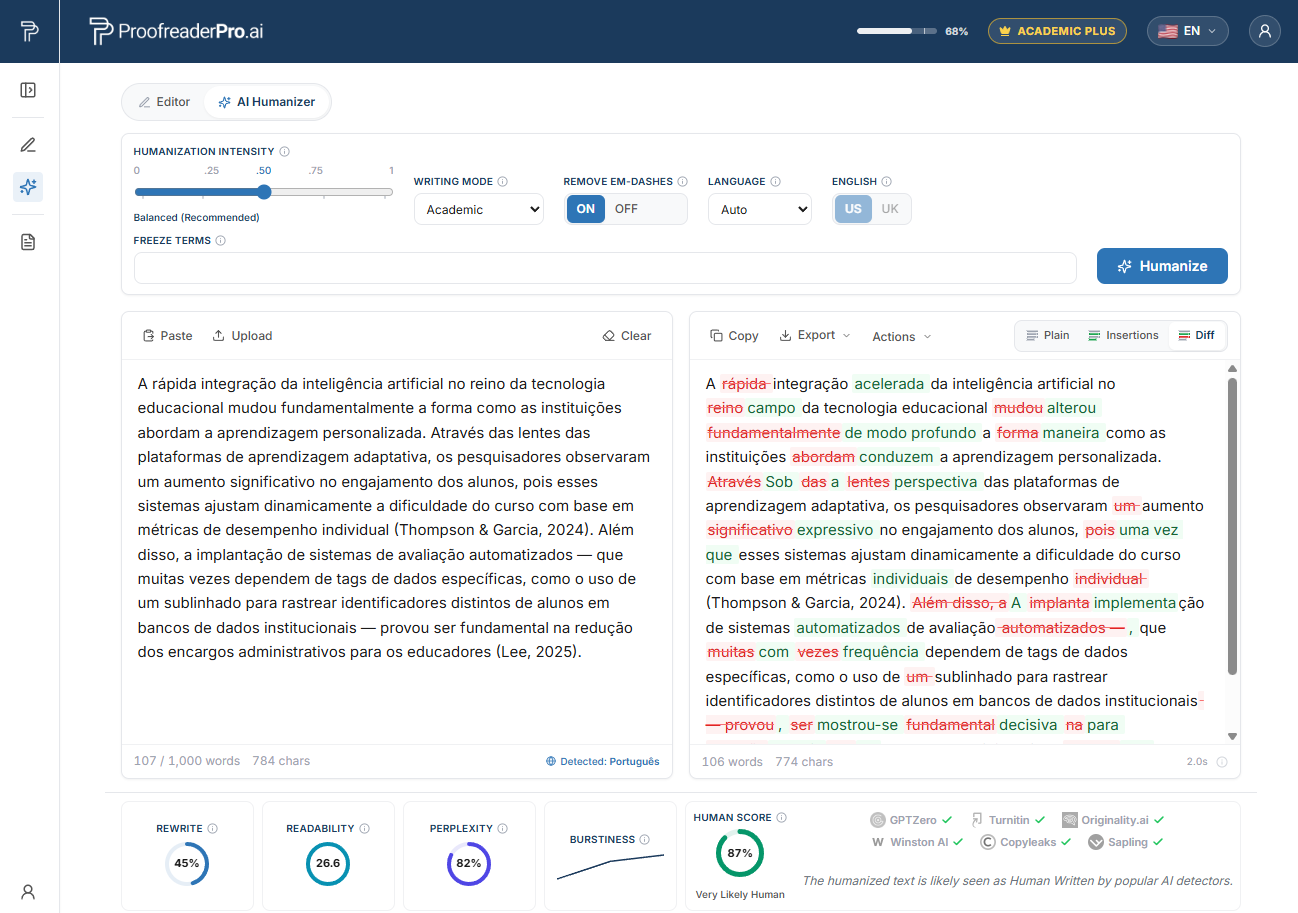
The ProofreaderPro AI Humanizer rewriting Portuguese academic text. The before and after diff keeps your meaning and citations, and the detector checks confirm a natural, human read.
Why Portuguese researchers get flagged by AI detectors
The clearest evidence comes from a 2023 Stanford study by Liang and colleagues, published in the Cell Press journal Patterns under the blunt title "GPT detectors are biased against non-native English writers." The team ran human-written TOEFL essays through seven widely used detectors. On average about 61% of the non-native essays were flagged as AI, against roughly 5% for native English writers. Nearly one in five non-native essays, about 19.8%, was flagged unanimously by every detector. Every one of those essays was written by a person.
Why does this happen? Many detectors score something called perplexity, a measure of how surprising each next word is to a language model. Writers working in a second language reach for common, safe vocabulary and standard, predictable phrasing. That produces low perplexity, and low perplexity is exactly what these systems learned to read as machine-generated. The habits that make Portuguese-English clear and correct are the same habits a detector treats as suspicious. We unpack the mechanism in detail in why AI detectors flag non-native writers.
The stakes are not abstract. Non-native English speakers already face rejection rates around 2.5 times higher than native speakers, spend about 51% more time writing their papers and roughly 91% more time reading in English, and receive about 12.5 times more revision requests tied to language quality. Fewer than 7% of journals accept non-English submissions. A false AI flag lands on top of all of that.
The Portuguese first-language patterns behind false flags
None of the constructions below are errors in the ordinary sense. They are careful, standard choices shaped by European Portuguese, and their very standardness is what a detector reads as low perplexity.
False friends. Portuguese and English share a huge Latin vocabulary, which quietly nudges word choice. A Portuguese writer may use "actual" for current, "eventual" for possible, "pretend" where "intend" was meant (pretender), "assist" for attend (assistir a), or "realize" for carry out (realizar). Even where the word lands correctly, the pull toward these safe cognates flattens the prose into predictable, low-surprise phrasing.
Article overuse with generic nouns. Portuguese places a definite article before abstract and generic nouns, so "a ciência" and "a sociedade" travel into English as "the science" and "the society" in places where English simply drops the article. It is grammatical and consistent, and consistency of this kind reads as machine-smooth.
Long, subordinate-heavy sentences. Romance academic style favours long periodic sentences, with stacked relative clauses that hold several ideas before the main verb arrives. English reviewers often call this dense, and a detector sees a steady, even cadence rather than the uneven rhythm of a native drafter.
Preposition transfer. Portuguese prepositions map onto English by habit: "depend of" from depender de, "consist in" from consistir em, "different of" instead of different from. These are small, systematic substitutions, and systematic is precisely what a perplexity model rewards with a low score.
Nominalisation and "which" overuse. A preference for noun-heavy phrasing, plus "which" as a general connector and "the same" (o mesmo) standing in as a pronoun for "it", produces measured, formal sentences that are easy to parse and, to a detector, easy to mistake for generated text.
Stop clean Portuguese-English from being misread
Humanize your own AI-assisted draft, keep every citation and technical term, then disclose your AI use. Careful writing should not be mistaken for a machine.
Try the Humanizer FreePortugal's AI-detection and Turnitin context
Theses and journal submissions from Portugal are routinely screened. Similarity checking with Turnitin or iThenticate is standard practice at universities and journals, and AI indicators are increasingly weighed alongside the older plagiarism report. If you are submitting a thesis at a Portuguese institution or a manuscript to an indexed journal, assume some form of automated screening will touch your text.
The integrity climate is developing in a responsible direction rather than a punitive one. FCT and individual universities have issued guidance on responsible AI use, and funders and journals increasingly ask authors to state how AI tools were involved. The workable position is disclosure, not silence. When you can explain what you used and show that the substance is yours, a detector flag becomes a claim you can answer rather than a verdict you have to accept.
It helps to remember how the detector vendors themselves talk about their tools. Turnitin suppresses AI scores in the 1 to 19% range, showing an asterisk rather than a hard number, and warns that its score should not be used on its own to decide an integrity case. Several universities have gone further and switched their AI detector off. That does not make detection irrelevant, but it does mean a flag is the start of a conversation, not the end of one.
Top Portuguese universities and where AI checks appear
The institutions below screen theses and manuscripts for similarity, commonly with Turnitin or iThenticate, and increasingly weigh AI indicators as part of the same review:
- Universidade de Lisboa (ULisboa), Lisbon
- Universidade do Porto (UPorto), Porto
- Universidade de Coimbra (UC), Coimbra
- Universidade NOVA de Lisboa (NOVA), Lisbon
- Universidade de Aveiro (UA), Aveiro
- Universidade do Minho (UMinho), Braga and Guimarães
- Instituto Superior Técnico (IST), Lisbon, part of ULisboa
- Universidade de Évora, Évora
- ISCTE, Instituto Universitário de Lisboa (ISCTE-IUL), Lisbon
- Universidade da Beira Interior (UBI), Covilhã
- Universidade do Algarve, Faro
Whichever of these you write for, the screening logic is the same. A tool scores your prose, and clean Portuguese-English can score in a way that misrepresents careful human work. Knowing that in advance is half the battle.
How the AI humanizer for Portuguese researchers works
The honest workflow has four steps, and disclosure is part of it, not an afterthought.
First, draft. Write in English, or draft in European Portuguese and translate, whichever gets your reasoning down most clearly. Using an AI assistant to help produce a first pass is fine; what matters is that the argument, the data, and the conclusions are yours.
Second, proofread the grammar and terminology so the science is precise. Getting the false friends and prepositions right matters for a reader regardless of any detector.
Third, humanize your own draft. Paste your English into our text humanizer. It varies sentence rhythm and word choice, breaks up the uniform cadence that reads as low perplexity, and removes tics like repetitive phrasing and stray em dashes, while preserving your meaning, your technical terms, and your citations. Non-English text routes through a language-aware model that keeps sentence structure and meaning intact, and the humanizer supports more than sixty languages, so a Portuguese draft is handled with the same care as an English one.
What can you expect from that step? In our own testing, humanizing a careful, standard non-native draft substantially reduces how often the major detectors (Turnitin, Originality.ai, GPTZero and similar) misread it as machine-written, while the meaning and grammar stay put. We describe that as what we have seen in testing, not as a guarantee. Detectors retrain every few months, so no honest tool can promise that any text will read as 100% undetectable, and you should be wary of any product that claims otherwise.
Fourth, disclose. State your AI use in the format your institution and target journal require. For a broader view of this workflow across languages, see our multilingual AI humanizer hub, and if you also want a human editing pass, our global academic editing hub explains how proofreading and humanizing fit together.
Local funding bodies, journals, and AI-disclosure expectations
The main national funder is FCT (Fundação para a Ciência e a Tecnologia), which backs research and fellowships and runs the Ciência ID researcher identifier. Portuguese groups also win European Research Council (ERC) grants, and open access under Plan S applies to FCT-funded work, so a large share of Portuguese output is published openly and read widely.
On the publishing side, the target is almost always a Web of Science or Scopus-indexed journal, with a copy deposited in the national open-access repository RCAAP. Across those venues, AI-disclosure expectations are tightening. Editors increasingly ask authors to describe how AI tools were used in drafting or editing, and funders are moving the same way.
Read that trend as an opportunity rather than a threat. A short, honest disclosure line protects you: it separates legitimate language help from misconduct, and it means a detector flag can be met with a straightforward account of what you did. Humanizing your own writing and disclosing it are two halves of the same fair process.
Frequently asked questions
Q: Is using an AI humanizer for Portuguese researchers considered cheating?
No, as long as you are polishing your own work and you disclose it. You are not fabricating results or passing off someone else's writing. You are making careful Portuguese-English read naturally so it is not misjudged, then telling your institution and journal how AI was involved. That is a fairness step, not a way to hide anything.
Q: Will a humanizer keep my citations and technical terminology intact?
Yes. The humanizer varies rhythm and word choice but preserves your meaning, your references, and field-specific terms. Your reference list and in-text citations stay where you placed them, and specialised vocabulary is left alone rather than swapped for looser synonyms.
Q: Can any tool guarantee my text will pass an AI detector?
No, and you should distrust any that claims to. Detectors are retrained regularly, so no honest tool can promise a specific pass rate or that writing is 100% undetectable. What a good humanizer can do, and what we have seen in our testing, is substantially lower how often careful non-native prose is misflagged, while keeping your work accurate.
Q: Why does my clear English get flagged when it is entirely my own writing?
Because many detectors score perplexity, which rewards surprising word choices and penalises safe, standard ones. Second-language writers tend to use common vocabulary and predictable phrasing, which produces low perplexity. The Stanford study found human-written non-native essays flagged at far higher rates than native ones, so a flag often reflects your writing style, not machine authorship.
Q: Does the humanizer work with European Portuguese as well as English?
Yes. You can draft in European Portuguese and the language-aware model preserves your sentence structure and meaning, and the same care applies once you move into English. The tool supports more than sixty languages, so a Portuguese-first workflow is fully supported end to end.
Turn careful Portuguese-English into prose that reads naturally, with your meaning, citations, and terminology preserved. Then disclose your AI use with confidence.

Moe is an NLP engineer with a PhD in natural language processing. His research covers computational linguistics, text analysis, and machine learning, and it fed directly into the editing and humanization models behind ProofreaderPro. He writes about the part of the process most people never see: how a language model reads a sentence, scores it, and decides what to change.