AI Humanizer for Brazilian Researchers Writing in English
AI humanizer for Brazilian researchers. Reduce false AI-detection flags on Portuguese-influenced English, keep meaning and citations, disclose honestly.

Brazil is the tenth largest producer of scientific publications in the world. Its labs publish more than 70,000 Scopus indexed papers a year, growing faster than the global average, and the University of São Paulo alone accounts for about a quarter of that national output. More than three quarters of those articles are openly accessible, ahead of the United States, Canada, and Japan.
There is a catch. Only about a third of Brazilian researchers report full English proficiency, and just 44% rate their own writing as good. An AI humanizer for Brazilian researchers exists for exactly this gap. It rewrites your own AI-assisted draft so that careful, non-native English reads naturally, while your meaning, technical terms, and citations stay exactly where you put them.
The problem it solves is not plagiarism. It is a false accusation. AI detectors increasingly flag clean, correct, second-language academic prose as machine written, even when a human wrote every word. For a researcher under CAPES Qualis pressure, one bad flag on a good manuscript can mean a desk rejection or an integrity question you never earned.
Humanizador de texto de IA para pesquisadores brasileiros
O ProofreaderPro.ai oferece um humanizador de texto de IA para pesquisadores brasileiros que precisam publicar em inglês acadêmico. A ferramenta reescreve o seu rascunho assistido por IA para soar natural, preservando o sentido, a terminologia técnica e as suas citações.
In plain terms: you keep writing the way you always have, in Portuguese first if that helps, then in English. The humanizer smooths the rhythm of the final draft so a detector is less likely to misread your careful phrasing as a machine's. It does not invent claims, it does not touch your data, and it never asks you to hide that you used AI.
That last point matters. The workflow is to humanize your own work and then disclose the AI help you used. We will come back to disclosure, because it is what keeps this inside every integrity rule that CAPES, your university, and your target journal set.
Also humanize your Brazilian Portuguese directly
You do not have to move into English before humanizing your work. Paste a passage in Portuguese and ProofreaderPro detects the language automatically, then routes it through a Portuguese-aware model that keeps accents, terminology, and citations exactly as written. As a humanizador de texto de IA it works on your Brazilian Portuguese draft just as it does on your English, preserving meaning while the phrasing reads naturally. Detection covers more than sixty languages, so Portuguese is rewritten as Portuguese, not flattened into English.
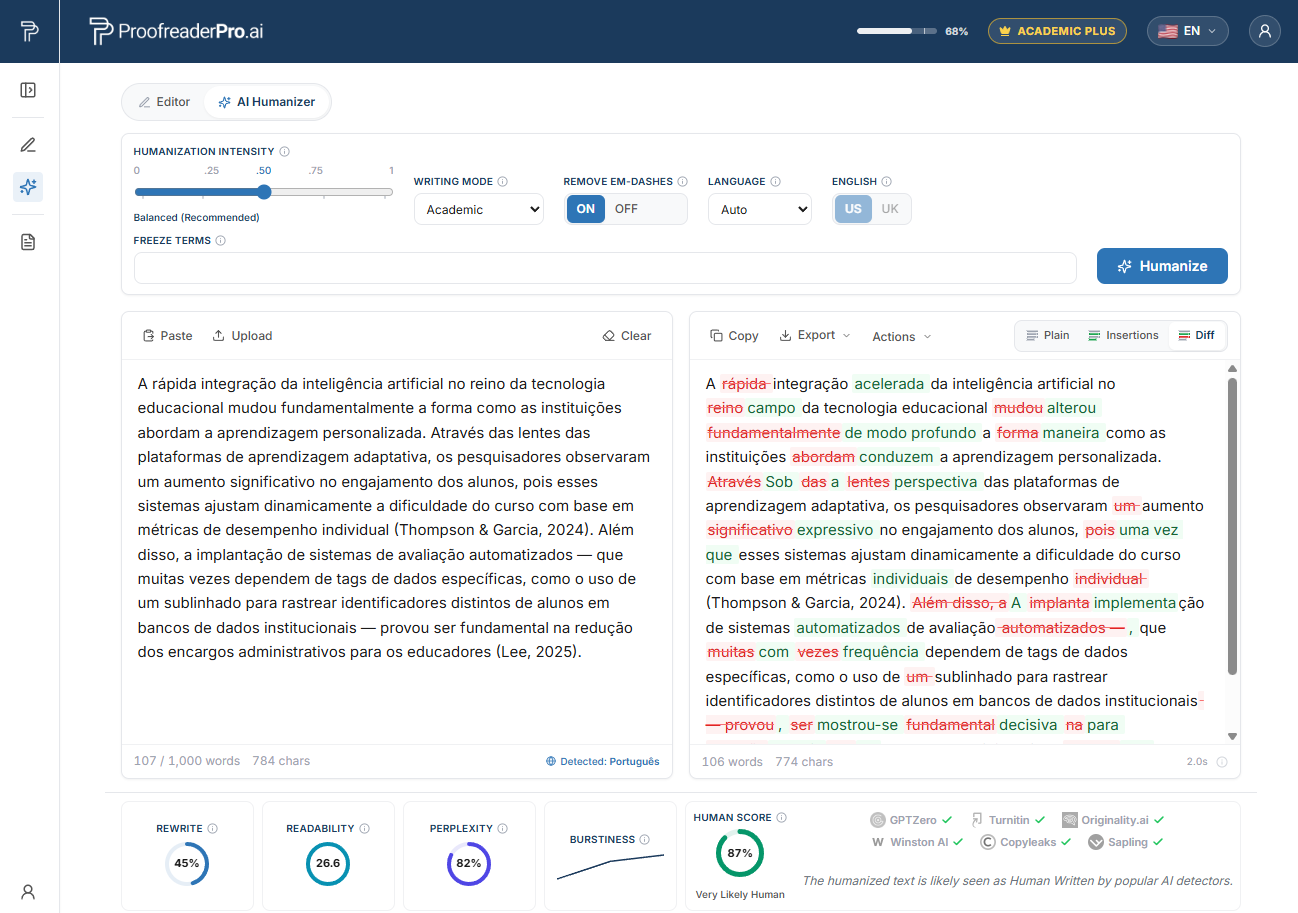
The ProofreaderPro AI Humanizer rewriting Portuguese academic text. The before and after diff keeps your meaning and citations, and the detector checks confirm a natural, human read.
Why Brazilian researchers get flagged by AI detectors
In 2023, a Stanford team led by Weixin Liang published a study in the Cell Press journal Patterns with a blunt title: "GPT detectors are biased against non-native English writers." They ran human-written TOEFL essays through seven widely used detectors.
The result should worry anyone publishing in a second language. On average, about 61% of the non-native essays were flagged as AI, against roughly 5% for native English writers. Nearly one in five non-native essays was unanimously flagged by every detector in the set. A human wrote every single one.
The mechanism explains why. Most detectors score "perplexity," a measure of how surprising each word choice is to a language model. Careful second-language writers reach for common words and standard, predictable phrasing, which is exactly what good academic writing is supposed to do. Low perplexity reads as machine text to the detector. The habits that make Brazilian academic English clear are the very habits these tools were trained to punish. We unpack this in detail in why AI detectors flag non-native writers.
The Portuguese first-language patterns behind false flags
Portuguese and English share Latin roots, and that closeness produces a set of consistent, predictable constructions in Brazilian academic English. None of them are errors of thought. They are careful, standard choices, and that very standardness is what a detector reads as low perplexity.
Articles. Portuguese uses definite articles more broadly ("O Brasil é um país grande" becomes "The Brazil is a big country"), and indefinite articles get dropped where English wants them. A writer who has drilled these rules produces very regular article patterns, which reads as predictable to a model.
False cognates. "Atual" means current, not "actual." "Realizar" means to accomplish, not "to realize." "Eventualmente" means occasionally, not "eventually." A careful writer who has learned to correct these lands on the safe, expected English word every time, and that consistency looks machine made.
Dropped subject pronouns. Portuguese is a pro-drop language, so "Was observed that" slips in for "It was observed that" across methods and results. Once corrected, the repaired sentences follow a very standard template.
Present perfect. Portuguese has no direct equivalent, so "I live here since 2010" appears instead of "I have lived here since 2010." The corrected form is textbook regular, which is precisely the pattern detectors flag.
Prepositions and word order. Direct translation gives "depend of" for "depend on," and Portuguese adjective order can resurface under cognitive load. Careful researchers scrub these out, and the clean result is smooth, even, and low in surprise.
Each of these is a sign of disciplined writing, not weak writing. The humanizer restores natural variation to that disciplined prose so a detector stops mistaking care for automation.
Brazil's AI-detection and Turnitin context
Theses and journal submissions in Brazil are routinely screened. Graduate programs and publishers commonly run manuscripts through Turnitin or iThenticate for similarity, and those tools now surface AI indicators alongside the familiar similarity score. A CAPES-evaluated program has every reason to check.
It helps to know the limits of these tools. Turnitin suppresses AI scores in the 1 to 19% range, showing an asterisk rather than a number, and warns that its score should not be used on its own to decide an integrity case. Several universities have gone further: Vanderbilt disabled Turnitin's AI detector in 2023, citing false positives and bias against non-native writers, and Michigan State, the University of Texas at Austin, Northwestern, Pittsburgh, SMU, and Waterloo took similar steps.
The takeaway is not that detectors are worthless. It is that a detector score is a claim you can contest, not a verdict. Meanwhile, funders and journals increasingly ask you to disclose AI use, which is a far more reliable path than hoping a flag never fires.
Humanize your own AI-assisted draft, keep your citations
Rewrite careful non-native English so it reads naturally, preserve every citation and technical term, then disclose your AI use with confidence. Built for Brazilian researchers under CAPES Qualis pressure.
Try the Humanizer FreeTop Brazilian universities and where AI checks appear
Thirty-five Brazilian institutions appear in the QS 2025 rankings, and all of them expect English-language publications for faculty advancement under CAPES criteria. These are among the universities where theses and manuscripts are screened for similarity and AI:
- Universidade de São Paulo (USP), São Paulo, which produces about a quarter of the country's research output.
- Universidade Estadual de Campinas (Unicamp), Campinas, strong in chemistry, physics, and engineering.
- Universidade Federal do Rio de Janeiro (UFRJ), Rio de Janeiro.
- Universidade Federal do Rio Grande do Sul (UFRGS), Porto Alegre, one of the top three by research output.
- Universidade Federal de Minas Gerais (UFMG), Belo Horizonte.
- Universidade Estadual Paulista (UNESP), multi-campus across São Paulo state.
- Universidade Federal de Santa Catarina (UFSC), Florianópolis.
- Universidade Federal do Paraná (UFPR), Curitiba.
- Universidade de Brasília (UnB), Brasília.
- Universidade Federal de São Carlos (UFSCar), São Carlos.
- Universidade Federal de Pernambuco (UFPE), Recife.
- Pontifícia Universidade Católica do Rio de Janeiro (PUC-Rio), a leading private research university.
- Universidade Federal de São Paulo (Unifesp), São Paulo, focused on medicine and health sciences.
- Universidade Federal do Ceará (UFC), Fortaleza.
- Universidade Federal da Bahia (UFBA), Salvador.
At every one of these, the same risk applies: a careful English manuscript from a Portuguese speaker can draw an AI flag it does not deserve.
How the AI humanizer for Brazilian researchers works
Here is the workflow, start to finish. First, draft your paper the way that lets you think best, which for many Brazilian researchers means writing the argument in Portuguese and then translating it into academic English. Second, proofread the grammar so the article errors, false cognates, and present perfect slips are gone. Third, run the clean draft through the humanizer so your careful non-native prose regains natural variation and is less likely to be misread by a detector.
The text humanizer preserves your meaning, your technical terminology, and every citation. It varies sentence rhythm and word choice, removes the repetitive cadence that detectors latch onto, and clears out the stray machine artifacts that clean AI drafts leave behind. Because it routes non-English influenced text through a language-aware model, it keeps Portuguese-shaped sentence structure readable rather than flattening it.
Tested against the major detectors, our humanizer reworks AI phrasing toward a genuinely human voice, so the AI score drops and the text stands a better chance against strict detectors, while keeping grammar accuracy high on academic text. Those are results from testing, not guarantees. Detectors retrain every few months, so no serious tool can promise permanent, perfect invisibility. What you get is a fair chance for careful work to read as the human work it is.
Then comes the step that makes all of this legitimate: disclose. State your AI use in the format your institution and target journal require. Humanizing your own draft and then declaring the assistance is not hiding anything. It is protecting good non-native writing while staying fully inside the rules. This post sits inside our multilingual AI humanizer hub, and it pairs with our guide to academic editing for researchers in Brazil for the grammar side of the same workflow.
Local funding bodies, journals, and AI-disclosure expectations
Brazil's research is steered by three bodies you already answer to. CAPES (Coordenação de Aperfeiçoamento de Pessoal de Nível Superior) evaluates every graduate program through the Qualis system, and most PhD programs require at least a B1 Qualis publication before defense, with top programs demanding A1 or A2. CNPq (Conselho Nacional de Desenvolvimento Científico e Tecnológico) weighs international publication records when it awards productivity scholarships. FAPESP (Fundação de Amparo à Pesquisa do Estado de São Paulo), the largest state research foundation, expects funded work to land in high-impact international journals. Language editing has long been a recognized, allowable research expense under these bodies, so check your specific grant terms.
The pressure points at English. Whether you submit to a Brazilian journal indexed in Scopus or to an international one, language quality decides desk rejections. Consider the range of venues Brazilian researchers target:
- Memórias do Instituto Oswaldo Cruz, tropical medicine, one of the oldest scientific journals in the Americas.
- Clinics (São Paulo), general medicine, highly cited.
- Cadernos de Saúde Pública, public health, published by Fiocruz.
- Revista de Saúde Pública, public health, published by USP.
- Brazilian Journal of Medical and Biological Research, biomedical sciences.
- Journal of the Brazilian Chemical Society, all areas of chemistry.
- Arquivos Brasileiros de Cardiologia, the best-ranked Latin American cardiology journal.
- Brazilian Journal of Physics, published by Springer.
More of these journals now ask authors to declare AI assistance in the submission. That is good news for you. A clear disclosure, paired with a humanized draft that reads as your own careful work, is far stronger than crossing your fingers over a detector score you cannot control.
Frequently asked questions
Q: Is using an AI humanizer for Brazilian researchers considered cheating?
No, as long as you humanize your own AI-assisted draft and then disclose the assistance. The tool does not fabricate results or hide plagiarism. It restores natural rhythm to careful non-native English so a detector is less likely to misread it, and disclosure keeps you inside your institution's and journal's rules.
Q: Will the humanizer change my citations or technical terms?
No. It preserves your citations, references, and discipline-specific terminology exactly. It varies sentence rhythm and word choice, so your meaning and your sources stay intact while the prose reads more naturally.
Q: Can I write in Portuguese first and still use the humanizer?
Yes. Many Brazilian researchers draft the argument in Portuguese, translate it into academic English, proofread the grammar, and then humanize the clean English draft. The humanizer routes non-English influenced text through a language-aware model that keeps your structure readable.
Q: What pass rates has the humanizer reached on detectors?
Tested against the major detectors, it rewrites AI text into a more natural human form, which lowers the AI signal and improves its odds against tough detectors, while keeping grammar accuracy high. These are testing results, not guarantees, because detectors retrain often, so no credible tool can promise permanent results.
Q: A detector flagged my human-written paper. What does that actually mean?
It means the tool assigned a probability, not a verdict. Non-native academic prose is flagged far more often than native writing, and several universities have limited or disabled these detectors over exactly that bias. A flag is a claim you can contest, ideally with your drafts, notes, and a clear AI-disclosure statement.
Rewrite AI-assisted, non-native English so it reads naturally while preserving meaning, terminology, and citations. Tested against Turnitin, Originality.ai, and GPTZero. Built for Brazilian researchers.

Moe is an NLP engineer with a PhD in natural language processing. His research covers computational linguistics, text analysis, and machine learning, and it fed directly into the editing and humanization models behind ProofreaderPro. He writes about the part of the process most people never see: how a language model reads a sentence, scores it, and decides what to change.