AI Humanizer for Polish Researchers Writing in English
AI humanizer for Polish researchers. Reduce false AI-detection flags on Polish-influenced English, keep meaning and citations, disclose honestly.

Poland produces between 75,000 and 80,000 Scopus-indexed papers a year, which makes it the largest research producer in Central and Eastern Europe by a wide margin. Much of that output now starts the same way it does in every other research system: a first draft written with help from ChatGPT, Claude, or a similar assistant, then revised by hand into a finished manuscript.
That workflow creates a new risk. An AI humanizer for Polish researchers exists because the same careful, standard English that a Polish scientist works hard to produce is often what AI detectors misread as machine writing. A paper can report strong methods and clear results and still be flagged, not for what it says, but for how evenly and predictably it reads.
The stakes are real. Non-native English authors already face rejection rates about 2.5 times higher than native speakers, spend about 51% more time writing their papers, and receive about 12.5 times more language-related revision requests. A false AI flag adds one more obstacle to a group that's already working harder for the same result. This guide explains why it happens to Polish authors specifically, and how to protect your own writing without hiding anything.
Humanizator tekstu AI dla polskich naukowcow
ProofreaderPro.ai dziala jako humanizator tekstu AI dla polskich naukowcow (polscy naukowcy i badacze), ktory pomaga publikowac po angielsku i zmniejsza ryzyko falszywych oznaczen przez detektory, zachowujac znaczenie, terminologie i cytowania.
In plain terms: if you drafted part of your manuscript with an AI assistant and now want that prose to read as your own careful voice, the humanizer rewrites the rhythm and word choice while keeping your argument, your technical terms, and your references exactly where you put them. It supports more than 60 languages, and Polish-influenced English routes through a language-aware model that preserves sentence structure rather than flattening it.
This is a tool for your own work. It is not a way to disguise fabricated results or to pass off someone else's writing. The goal is fairness for real research that happens to be written by a non-native speaker.
Writing in Polish? It is auto-detected and humanized directly
Polish researchers often draft in their first language before moving into English, and the humanizer supports that. Paste Polish text and ProofreaderPro detects the language on its own, then processes it through a Polish-aware model that keeps diacritics, terminology, and citations exactly in place. As a humanizator tekstu AI it runs on your Polish draft as readily as on your English, so you can humanize before you translate. The same detection spans more than sixty languages, each rewritten in its own voice.
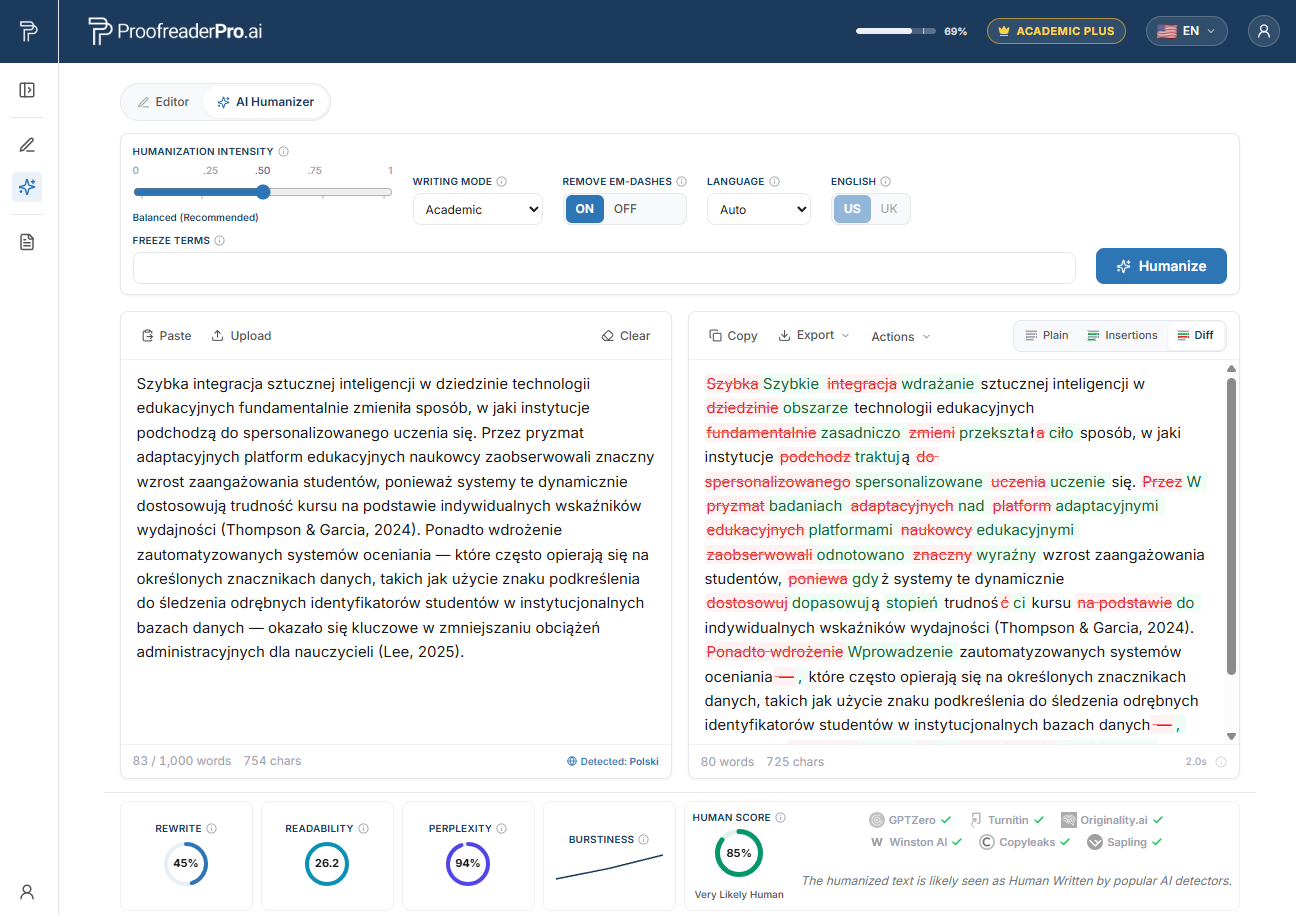
The ProofreaderPro AI Humanizer rewriting Polish academic text. The before and after diff keeps your meaning and citations, and the detector checks confirm a natural, human read.
Why Polish researchers get flagged by AI detectors
The clearest evidence comes from a 2023 Stanford study by Liang and colleagues. The study appears in the Cell Press journal Patterns and is titled "GPT detectors are biased against non-native English writers." The researchers fed seven detectors with human-written TOEFL essays. About 61% of the non-native essays were tagged as AI (about 5% for native writers). About 19.8% of the non-native essays were flagged by all detectors. All those essays were written by people.
The mechanism is worth understanding because it explains the unfairness. Many detectors score something called perplexity, a measure of how surprising each word choice is to a language model. Writing full of common words and standard, predictable phrasing scores low. Low perplexity reads as machine text. The habits that make careful second-language academic prose clear and correct are the very habits these detectors were trained to treat as suspicious. We cover this in depth in why AI detectors flag non-native writing.
For Polish authors, the result is a strange penalty. You learn English precisely, you write conservatively to avoid mistakes, and that discipline is what pushes your text into the detector's danger zone.
The Polish first-language patterns behind false flags
Polish and English belong to separate branches of the Indo-European family tree, Slavic and Germanic, respectively. These differences in structure affect how Polish authors write English. The interesting part is that Polish authors' careful strategies to bridge these differences often lead to standard, low-perplexity writing. Here are the main patterns, reframed for detection fairness.
Articles. Polish has no articles at all, no equivalent of "a," "an," or "the." Because article use is the hardest feature to master and the easiest place to slip, careful Polish writers tend to apply textbook article rules with great consistency. That consistency is correct, but it is also predictable, and predictable phrasing is what a perplexity score rewards with a lower number.
Prepositions. Polish expresses with seven grammatical cases what English handles with prepositions. To avoid transfer errors like "depend from" or "consist from," experienced authors lean on the safest, most standard verb and preposition pairings they know. Safe and standard is exactly the register that reads as machine-smooth.
Tense and aspect. Polish organizes verbs around a perfective and imperfective distinction and has only three tenses, while English has twelve tense-aspect combinations. Rather than gamble on the present perfect or a progressive form, many Polish writers choose the plainest tense that carries the meaning. Clean, plain tense usage across a whole paper is correct and also very even, and evenness is what detectors flag.
Word order. Polish allows relatively free word order because case endings carry the grammar. Writing in English, careful authors often retreat to strict subject-verb-object order to stay safe. Uniform sentence structure is grammatically ideal and, unfortunately, statistically flat.
Spelling and phonology. Polish phonology creates specific near-misses in English, such as "v" and "w" or "were" and "where." Authors who know this proofread aggressively for these pairs, which removes the small idiosyncrasies that a human editor would leave in and a detector would read as human.
None of these are errors of intelligence or effort. They are the marks of a disciplined non-native writer, and that discipline is what the detector misreads.
Poland's AI-detection and Turnitin context
Polish academia takes text integrity seriously. In Poland, bachelor's and master's theses are submitted to the national system for plagiarism detection called Jednolity System Antyplagiatowy (JSA). Most Polish universities and journals use Turnitin or iThenticate for similarity detection on doctoral theses and articles submitted for publication. These days, many of these tools report an AI indicator in addition to the similarity score.
It helps to know what that indicator is and is not. A detector score is a probability, not a verdict. Turnitin itself suppresses scores in the low range with an asterisk rather than a number and warns that the figure should not be used alone to decide an integrity case. Several universities have gone further: Vanderbilt disabled Turnitin's AI detector in 2023 over false positives and bias against non-native writers, and Michigan State, UT Austin, Northwestern, Pittsburgh, SMU, and Waterloo took comparable steps.
Poland's 2018 higher education reform (Ustawa 2.0) tightened evaluation and kept publication metrics central, so the pressure to publish in English is high and the screening around it is real. The right response is not to hide your process. It is to write cleanly, humanize your own AI-assisted prose so it is less likely to be misread, and disclose your AI use in the way your institution and journal require.
Protect your careful English from a false AI flag
Humanize your own AI-assisted draft so Polish-influenced academic prose reads as your voice, not a machine's. Meaning, terminology, and citations preserved. Then disclose your AI use the way your journal requires.
Try the Humanizer FreeTop Polish universities and where AI checks appear
The following institutions lead Polish research output, and all of them screen theses and manuscripts for similarity and, increasingly, AI indicators. Native-language names are kept.
- Uniwersytet Warszawski (University of Warsaw), Warsaw, the country's largest and highest-ranked university.
- Uniwersytet Jagiellonski (Jagiellonian University), Krakow, founded in 1364 and one of the oldest in Europe.
- Akademia Gorniczo-Hutnicza (AGH University of Krakow), Krakow, the leading technical school for materials, energy, and IT.
- Politechnika Warszawska (Warsaw University of Technology), Warsaw, the flagship technical university.
- Uniwersytet im. Adama Mickiewicza (Adam Mickiewicz University), Poznan, strong in physics, chemistry, and biology.
- Politechnika Gdanska (Gdansk University of Technology), Gdansk, engineering, nanotechnology, and marine sciences.
- Uniwersytet Wroclawski (University of Wroclaw), Wroclaw, chemistry, physics, and astronomy.
- Uniwersytet Mikolaja Kopernika (Nicolaus Copernicus University), Torun, physics, astronomy, and medicine.
- Uniwersytet Lodzki (University of Lodz), Lodz, economics, management, and natural sciences.
- Warszawski Uniwersytet Medyczny (Medical University of Warsaw), Warsaw, the top medical research producer.
- Politechnika Slaska (Silesian University of Technology), Gliwice, engineering, materials, and energy.
- Szkola Glowna Handlowa (Warsaw School of Economics), Warsaw, the leading economics and business university.
Researchers at every one of these institutions, from doktorant to profesor, prepare English-language manuscripts under the same detection tools, which is why a fair humanization step matters across disciplines rather than in one field.
How the AI humanizer for Polish researchers works
The AI humanizer for Polish researchers is one step in a workflow, not a shortcut around it. The full sequence looks like this.
First, draft. Write your paper in English, or draft the reasoning in Polish where it flows more naturally and then translate. Second, proofread the grammar so the article, preposition, and tense patterns above are actually correct. Third, humanize your own AI-assisted prose with our text humanizer, which varies rhythm and word choice, breaks up repetitive cadence, and removes the flat evenness that detectors misread, while keeping your meaning, your terminology, and every citation intact.
Here is what the testing shows, stated plainly. Tested against the major detectors, the humanizer rewrites AI text into a more natural human form, which lowers the AI signal and improves its odds against tough detectors, while keeping grammar accuracy high on academic text. Those are results from testing, not guarantees. No responsible tool can promise you will be undetectable, because detectors retrain every few months, and we do not frame this as a way to bypass anything.
The final step is the one that keeps you safe: disclose. State your AI use in the format your institution and target journal require. Humanizing your own work and disclosing it are not in tension. Together they protect careful non-native writing from a false flag while keeping you fully inside integrity rules. If your needs are more about correctness than detection, the academic editing guide for researchers in Poland covers the proofreading side, and this post sits inside our broader multilingual AI humanizer hub for other languages and countries.
Local funding bodies, journals, and AI-disclosure expectations
Poland's competitive funding runs through the NCN (Narodowe Centrum Nauki / National Science Centre), whose OPUS, SONATA, and PRELUDIUM programs reward publication in high-impact international English-language journals, and the NAWA (Narodowa Agencja Wymiany Akademickiej / Polish National Agency for Academic Exchange), which funds mobility with explicit expectations for English-language output. Above both sits the Ministry of Education and Science point system, which assigns journals 20 to 200 points and ties those points to evaluations, funding, and promotion to profesor titles.
That incentive structure pushes Polish authors toward exactly the high-visibility venues where AI screening is most active. Prominent outlets that ask for clean English manuscripts include:
- Acta Physica Polonica A (Polish Academy of Sciences, general physics)
- Acta Physica Polonica B (Jagiellonian University, particle and nuclear physics)
- Open Mathematics (formerly Central European Journal of Mathematics)
- Archives of Metallurgy and Materials (Polish Academy of Sciences)
- Bulletin of the Polish Academy of Sciences: Technical Sciences
- Studia Mathematica (Polish Academy of Sciences, founded in 1929)
Funders and journals increasingly ask authors to state how AI tools were used. Treat that as an opportunity rather than a threat: a clear disclosure line paired with humanized, accurate prose is far stronger than silence. If a detector flag lands on work you know is your own, our text humanizer and a documented disclosure statement give you the record you need to respond calmly.
Frequently asked questions
Q: Is using an AI humanizer for Polish researchers considered cheating?
Not when you use it the right way. You humanize your own AI-assisted draft, keep your meaning and citations intact, and then disclose your AI use in the format your institution and journal require. That combination keeps you inside integrity rules. It becomes a problem only if you try to disguise fabricated work or pass off writing that is not yours, which is never what this tool is for.
Q: Does the humanizer work on Polish-influenced English, or only text written by ChatGPT?
Both. It handles AI-assisted drafts and also polishes the flat, standard cadence that careful Polish authors often produce naturally, since that low-perplexity evenness is what detectors misread. Non-English text routes through a language-aware model that preserves sentence structure and meaning rather than rewriting your argument.
Q: Can you guarantee my paper will pass Turnitin or GPTZero?
No, and be cautious of any tool that says it can. Tested against the major detectors, our humanizer rewrites AI text into a more natural human form, which lowers the AI signal and improves its odds against tough detectors, while keeping grammar accuracy high. Those are testing results, not promises, because detectors retrain regularly.
Q: Will humanizing change my technical terminology or citations?
No. The humanizer varies rhythm and word choice and removes repetitive patterns, but it preserves your discipline-specific terms, numbers, and references. Your APA, IEEE, or other citations stay exactly where you placed them.
Q: What should I do if my genuine paper is flagged as AI?
Stay calm and treat the score as a claim to contest, not a verdict. A detector figure is a probability, and even Turnitin warns it should not decide an integrity case on its own. Keep your drafts, humanize your own prose, disclose your AI use, and be ready to show your writing history if asked.
For Polish authors publishing in English: rewrite flat, AI-flagged prose into your own natural voice while keeping meaning, terminology, and citations intact. Tested against Turnitin, Originality.ai, and GPTZero.

Moe is an NLP engineer with a PhD in natural language processing. His research covers computational linguistics, text analysis, and machine learning, and it fed directly into the editing and humanization models behind ProofreaderPro. He writes about the part of the process most people never see: how a language model reads a sentence, scores it, and decides what to change.