AI Humanizer for Pakistani Researchers Writing in English
AI humanizer for Pakistani researchers. Reduce false AI-detection flags on Urdu-influenced English, keep meaning and citations, disclose honestly.

Pakistan ranks 43rd on the Nature Index, and its 262 universities now publish a growing stream of Scopus-indexed research. Much of this work, whether in labs in Islamabad or Karachi, is now written with the assistance of ChatGPT, Claude, and other AI assistants. That part is ordinary. The problem is what happens next.
An AI humanizer for Pakistani researchers exists to fix a specific unfairness: AI detectors routinely flag careful, correct English written by non-native scholars as machine-generated, even when the ideas, data, and citations are entirely the author's own. A researcher at Quaid-i-Azam University can write a clean methodology section by hand, run it through a detector before submission, and watch it come back marked "likely AI." Nothing was faked. The English was simply too standard.
Pakistan scores 493 on the EF English Proficiency Index, ranking 67th globally in the "Moderate Proficiency" band. English is an official language and the medium of instruction at most universities, yet the gap between instructional English and publication-ready academic English is wide. That gap, and the low-perplexity prose it produces, is exactly what a humanizer is built to protect.
An AI humanizer for Pakistani researchers writing in English (پاکستانی محققین کے لیے اے آئی ہیومنائزر)
اے آئی ہیومنائزر پاکستانی محققین کی مدد کرتا ہے کہ وہ اپنی تحقیق کو بین الاقوامی جرائد میں شائع کر سکیں۔ Our humanizer helps Pakistani researchers (پاکستانی محققین) publish in English by reworking their own AI-assisted drafts so that careful, standard second-language writing is less likely to be misread as machine text.
Our text humanizer keeps your meaning, your technical terminology, and your citations (APA, MLA, Chicago, IEEE) intact. It varies rhythm and word choice, removes the repetitive cadence that detectors are tuned to catch, and strips stray em dashes. It supports more than 60 languages, so Urdu-influenced academic prose can be smoothed into natural English without losing the argument underneath.
Writing in Urdu? It is auto-detected and humanized natively
Many researchers in Pakistan draft in Urdu before writing up in English, and the humanizer handles that directly. Paste Urdu text and ProofreaderPro recognises the right-to-left script automatically, then processes it through a language-aware model that keeps your terminology and citations exactly as written. اے آئی ہیومنائزر works on your Urdu draft as naturally as on your English, so there is no need to translate first. Auto-detection spans more than sixty languages, each humanized in its own register.
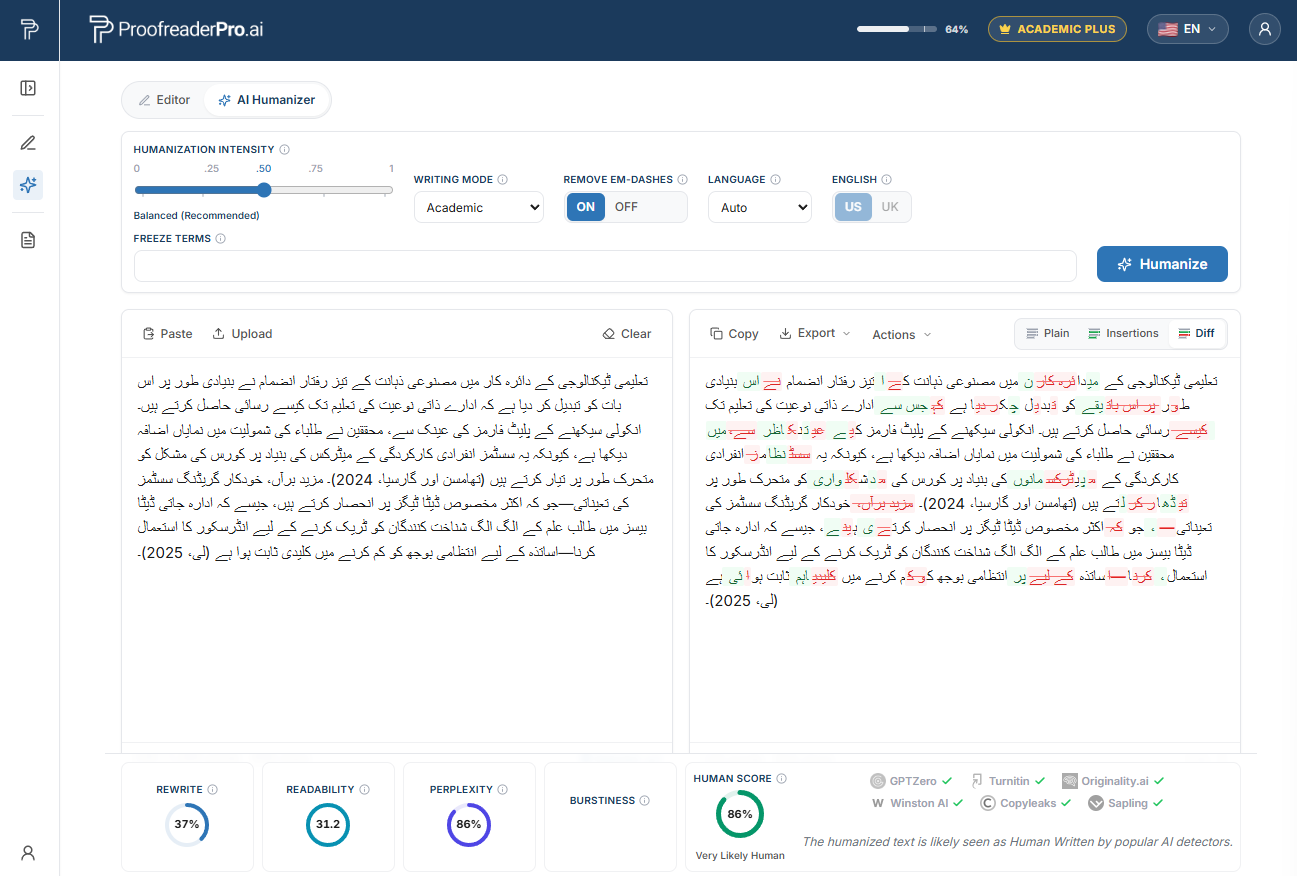
The ProofreaderPro AI Humanizer rewriting Urdu academic text. The before and after diff keeps your meaning and citations, and the detector checks confirm a natural, human read.
Why Pakistani researchers get flagged by AI detectors
In 2023, a Stanford research team led by Liang and colleagues published a study in the Cell Press journal Patterns titled "GPT detectors are biased against non-native English writers." They ran human-written TOEFL essays through seven widely used AI detectors. On average, about 61% of the non-native essays were flagged as AI, compared with about 5% for native English writers. Nearly one in five non-native essays (about 19.8%) was flagged unanimously by every detector. Every single essay was written by a human.
This is known as perplexity. Many of these tools rank how surprising each word choice is to a language model. A skilled second-language writer tries to use common words and conventional, predictable phrases. This creates low perplexity, which appears like machine text. The tools were trained to detect exactly the same habits that make Pakistani academic prose clear and correct.
This is why a detector score is a claim to contest, not a verdict. Several institutions have already stepped back from these tools. Vanderbilt disabled Turnitin's AI detector in 2023, citing false positives and bias against non-native writers, and Michigan State, UT Austin, Northwestern, Pittsburgh, SMU, and Waterloo took similar steps. Turnitin itself suppresses scores in the 1 to 19% range and warns that its number should not be used alone for integrity decisions. We explain the full picture in why AI detectors flag non-native writers.
The Urdu first-language patterns behind false flags
Urdu, the national language of Pakistan, belongs to the Indo-Aryan family and differs from English in its grammatical architecture. Alongside Urdu, researchers draw on Punjabi, Sindhi, Pashto, and Balochi, and the transfer patterns from these languages are correct, careful constructions once smoothed into English. That standardness is precisely what a detector reads as low perplexity. Here are the patterns most likely to produce a false flag.
Article handling. Urdu has no definite or indefinite article system, no direct equivalent of "the," "a," or "an." When Pakistani writers correct for this, they tend to produce very regular, textbook article usage. Over 70% of Pakistani researchers report difficulty in this area, and the careful, rule-following corrections they apply read as flat and predictable to a detector.
Word order. Urdu follows Subject-Object-Verb order ("Maine kitab parhi" translates literally as "I book read"), the reverse of English. Advanced writers correct this into clean, canonical English SVO sentences. Clean and canonical is exactly what scores as machine-like.
Prepositions. Urdu uses postpositions placed after the noun, and their semantic ranges do not line up with English prepositions. Writers compensate by leaning on the safest, most common prepositional choices, which lowers lexical surprise across the whole paragraph.
Tense consistency. English layers simple, progressive, perfect, and perfect progressive forms across past, present, and future in a way Urdu does not. Pakistani researchers who master the conventions (past tense for methods, present tense for established findings) tend to apply them with unusual regularity, and that regularity registers as a statistical pattern.
Subject-verb agreement. Urdu verbs agree with the subject in gender and number, but the pattern differs from English. Careful writers double-check agreement across long academic sentences, producing very uniform structures that a perplexity model treats as suspicious.
None of these are errors once corrected. They are markers of disciplined, standard English, and that is the injustice the humanizer is designed to address.
Pakistan's AI-detection and Turnitin context
Theses and journal submissions across Pakistan are commonly screened with Turnitin or iThenticate for similarity, and AI indicators increasingly sit alongside those similarity scores. For most Pakistani doctoral candidates, a Turnitin report is a routine checkpoint on the way to a degree, not an unusual event.
The pressure to publish is intense. Research features in the Higher Education Commission (HEC)'s university ranking criteria to the tune of 41%. HEC's Tenure Track System puts a premium on sustained international publication as a means for career survival. W-category journals, those indexed in the Journal Citation Reports with impact factors, have the highest weight. With only 33 Pakistani journals indexed in the Web of Science, researchers must overwhelmingly publish abroad, where native-level English is the assumed standard.
The disclosure climate is shifting in parallel. Funders, universities, and journals increasingly ask authors to state how AI tools were used in preparing a manuscript. The sensible response to that trend is not to hide AI assistance but to use it responsibly and declare it. A humanizer fits inside that expectation, not around it.
Protect your own writing from a false AI flag
Humanize your AI-assisted draft while keeping your meaning, terminology, and citations intact. Built for careful non-native academic English, then disclosed the way your journal requires.
Try the Humanizer FreeTop Pakistan universities and where AI checks appear
Pakistan's 262 universities range from heavy research producers to teaching-focused institutions. The following leaders all operate under HEC's tenure track and W-category requirements, and all screen theses and manuscripts for similarity and AI indicators.
- Quaid-i-Azam University (QAU), Islamabad. Pakistan's top-ranked research university, strong in physics, chemistry, biology, and earth sciences.
- National University of Sciences and Technology (NUST), Islamabad. Leading in electrical engineering, computer science, and mechanical engineering.
- University of the Punjab, Lahore. The largest and oldest university in Pakistan (established 1882), with a broad research portfolio.
- Lahore University of Management Sciences (LUMS), Lahore. Pakistan's premier private research university, strong in economics, business, and computer science.
- University of Agriculture Faisalabad (UAF), Faisalabad. The top agricultural research university, strong in crop and veterinary sciences.
- COMSATS University Islamabad, multiple campuses. Strong output in computer science, pharmacy, and environmental sciences.
- Pakistan Institute of Engineering and Applied Sciences (PIEAS), Islamabad. An elite institution focused on nuclear and systems engineering and applied physics.
- University of Engineering and Technology (UET), Lahore. Pakistan's oldest engineering university, strong in civil, mechanical, and electrical research.
- University of Peshawar, Peshawar. The leading research university in Khyber Pakhtunkhwa, strong in geology and chemistry.
- Aga Khan University, Karachi. Pakistan's leading medical research university, recognized in clinical medicine, nursing, and public health.
- University of Karachi, Karachi. One of the largest universities in the country, strong in marine science, pharmacology, and chemistry.
- International Islamic University Islamabad (IIUI), Islamabad. Notable in Islamic studies, law, and social sciences, with growing output in the natural sciences.
At each of these institutions, a graduate student or faculty member can produce genuinely original work and still meet an AI flag at the screening stage. That is the moment the workflow below is built for.
How the AI humanizer for Pakistani researchers works
The AI humanizer for Pakistani researchers is the last step in a workflow, not a shortcut around integrity. Here is the sequence we recommend.
First, draft. If your reasoning flows more naturally in Urdu, write there and translate into English, or draft directly in English with an AI assistant. Either way, the ideas and the evidence are yours.
Second, proofread the grammar. Fix the article, preposition, tense, and agreement patterns that Urdu transfer produces, so the science reads cleanly. Our grammar accuracy on academic text tests above 96%.
Third, humanize your own AI-assisted prose. The text humanizer varies sentence rhythm and word choice and removes the repetitive cadence that detectors key on, while preserving your meaning, your terminology, and every citation. Tested against the major detectors, it rewrites AI text into a more natural human form, which lowers the AI signal and improves its odds against tough detectors. These are results from testing, not guarantees. Detectors retrain every few months, so we never promise perfect, permanent invisibility and we never frame this as a way to slip past a check.
Fourth, disclose. State how you used AI in the format your institution and target journal require. That combination, careful writing plus clear disclosure, keeps you inside the rules while protecting standard non-native English from a false flag.
This humanizer post has an editing companion. If your manuscript needs correction before it needs humanizing, start with academic editing for Pakistani researchers. For the full country cluster, see the multilingual AI humanizer hub.
Local funding bodies, journals, and AI-disclosure expectations
Most researchers in Pakistan work under the auspices of the Higher Education Commission (HEC), which is the main funding and framework body. The HEC has a Tenure Track System and W-category list, which list publications that can be used for promotions, tenure, and PhD completion. In general, language editing is considered an accepted research cost under HEC grant frameworks. Check your specific grant terms, but a humanizer subscription usually sits within eligible academic-writing support.
Several Pakistani journals have earned real international standing, and their editorial expectations around English quality and AI disclosure are rising in step with global norms:
- Pakistan Veterinary Journal, Pakistan's highest-impact title with a Q1 ranking.
- Pakistan Journal of Medical Sciences (PJMS), covering clinical medicine, surgery, and public health.
- Pakistan Journal of Botany, one of the oldest botanical journals in Asia.
- Journal of the Pakistan Medical Association (JPMA), established in 1953 and the oldest medical journal in the country.
- Pakistan Journal of Pharmaceutical Sciences, covering pharmaceutical research and drug development.
- Pakistan Journal of Agricultural Sciences, covering research relevant to South Asian farming systems.
Whether you submit to these journals or to Web of Science titles abroad, the same principle holds. Editors increasingly expect a short, quick note on how AI was used. Write it, and let your English be judged on its substance rather than its perplexity score.
Frequently asked questions
Q: Does an AI humanizer for Pakistani researchers count as cheating?
No, as long as you humanize your own AI-assisted draft and then disclose that AI was used. The purpose is to protect careful, original non-native writing from being misread as machine text, not to disguise fabricated work or claim someone else's writing. Keeping your meaning and citations intact and declaring your AI use is what keeps you inside institutional and journal rules.
Q: Will the humanizer change my citations or technical terms?
No. The humanizer preserves your references (APA, MLA, Chicago, IEEE) and your discipline-specific terminology. It varies rhythm and word choice and removes repetitive cadence, but it does not touch the substance of your argument or your sources.
Q: Can it guarantee my paper will pass Turnitin or GPTZero?
No, and you should distrust any tool that promises this. Tested against the major detectors, our humanizer rewrites AI text into a more natural human form, which lowers the AI signal and improves its odds against tough detectors, though no tool can guarantee a specific result. Detectors retrain often, so no credible service can promise a fixed pass rate.
Q: Does it work on Urdu-influenced English?
Yes. The humanizer supports more than 60 languages and routes non-English and heavily Urdu-influenced text through a language-aware model that preserves sentence structure and meaning while smoothing it into natural academic English.
Q: What should I do if a detector still flags my genuine work?
Treat the score as a claim to contest, not a verdict. Keep your drafts and notes, disclose your actual AI use openly, and be ready to explain your writing process. A single detector number is not proof of misconduct, and many institutions now say it should not be used alone.
Rework your own AI-assisted, Urdu-influenced English so it reads naturally to editors and reviewers, with citations, terminology, and meaning preserved. Tested against major detectors, then disclosed openly.

Moe is an NLP engineer with a PhD in natural language processing. His research covers computational linguistics, text analysis, and machine learning, and it fed directly into the editing and humanization models behind ProofreaderPro. He writes about the part of the process most people never see: how a language model reads a sentence, scores it, and decides what to change.