AI Humanizer for Moroccan Researchers Writing in English
AI humanizer for Moroccan researchers. Reduce false AI-detection flags on Arabic and French influenced English, keep meaning and citations, disclose honestly.

Morocco published roughly 9,154 Scopus-indexed papers in 2023, ranking around 52nd in the world, and its output keeps climbing as the Kingdom reforms higher education and funds new research infrastructure. Around 27,800 doctoral students now work across public and private universities, and between 90% and 100% of the country's prioritized publications appear in English. French, once the default language of Moroccan science, has fallen to roughly 5% of that output.
The change poses a challenge, which is why we created an AI humanizer for Moroccan researchers. This tool is not about obscuring machine writing. It's about protecting careful English written by academics who often learned the language third, after Arabic and French, from detectors that misread standard second-language prose as machine text.
Most Moroccan researchers are Arabic and French bilinguals writing in a third language. When an AI detector scans that prose, it does not see the years of effort behind it. It sees safe, predictable phrasing and returns a score that can stall a thesis defense or a journal submission. This guide explains why that happens, and how to fix it plainly, without pretending the AI help never existed.
أداة أنسنة النصوص بالذكاء الاصطناعي للباحثين المغاربة (Humaniseur de texte IA pour chercheurs marocains)
Our humanizer helps Moroccan researchers publish in English while keeping their meaning, their citations, and their technical vocabulary intact. It also works from Arabic and French drafts, routing non-English text through a language-aware model that preserves sentence structure across more than 60 languages. You draft where your reasoning flows most naturally, then move to publication-ready academic English.
The goal is fairness, not disguise. You do the research and you write the argument. Use our tool to vary your rhythm and word choice, so careful, standard academic English is less likely to be misread by a detector. Then you disclose your AI use the way your university and target journal need.
Writing in Arabic or French? It is auto-detected and humanized natively
Researchers in Morocco frequently draft in Arabic before writing up in English or French, and the humanizer handles that directly. Paste Arabic text and ProofreaderPro detects the right-to-left script on its own, then processes it through a language-aware model that keeps your terminology and citations exactly as written. أداة أنسنة النصوص بالذكاء الاصطناعي works on your Arabic draft as naturally as on your English, so there is no need to translate first. And because detection spans more than sixty languages, a French draft is recognised and humanized just as readily.
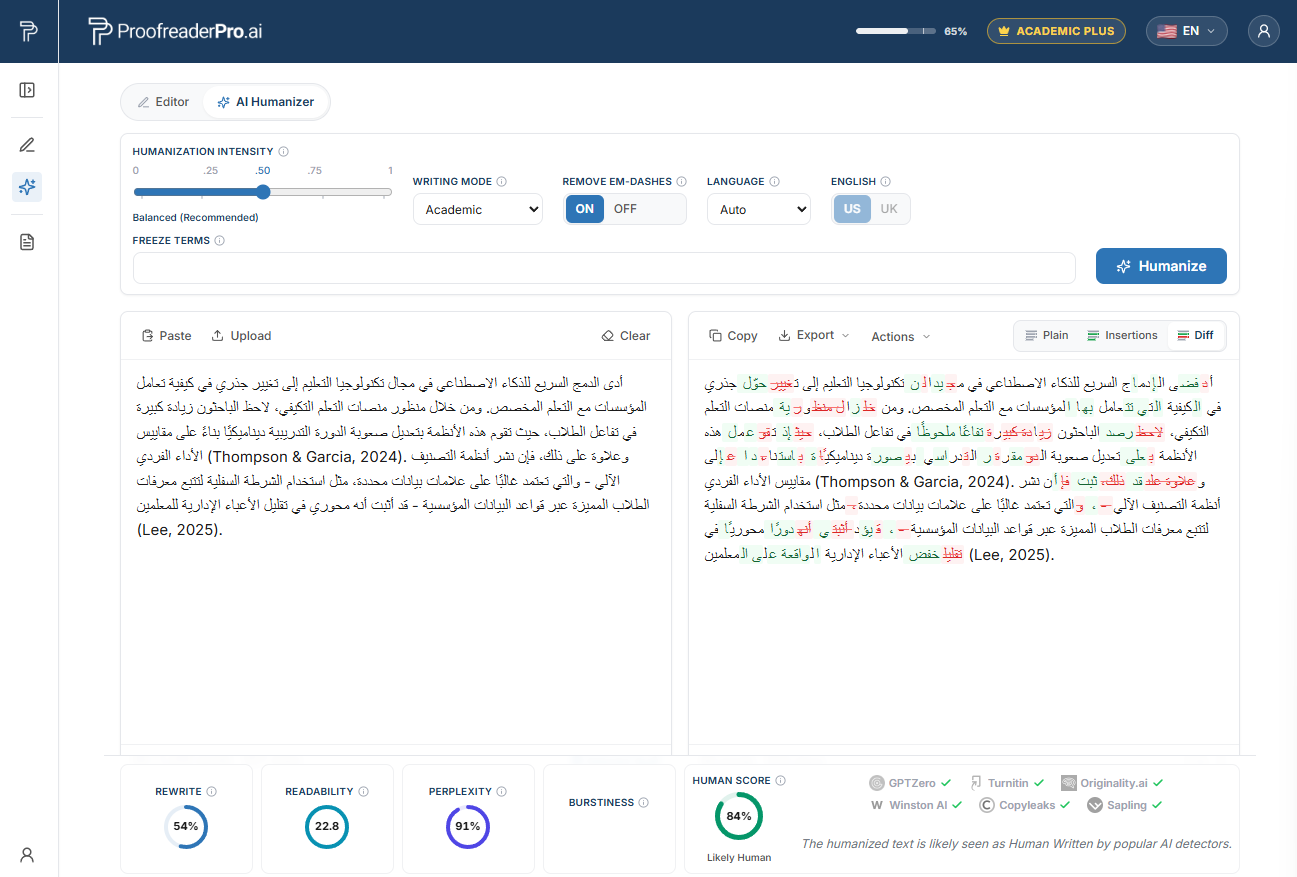
The ProofreaderPro AI Humanizer rewriting Arabic academic text. The before and after diff keeps your meaning and citations, and the detector checks confirm a natural, human read.
Why Moroccan researchers get flagged by AI detectors
In 2023, Stanford researchers led by Liang and colleagues published a study in the Cell Press journal Patterns titled "GPT detectors are biased against non-native English writers." They ran human-written TOEFL essays through seven widely used detectors. On average, about 61% of the non-native essays were flagged as AI, versus about 5% for native English writers. Nearly one in five non-native essays, about 19.8%, was unanimously flagged by every detector. Every single essay was written by a human.
The mechanism is perplexity. Many detectors score how surprising each word choice is to a language model. A careful second-language writer reaches for common words and standard, predictable phrasing, which produces low perplexity, which reads as machine text. For a Moroccan researcher writing in a third language, the very habits that make the prose clear and correct are the habits detectors were trained to punish. We explain the research in more depth in why AI detectors flag non-native writers.
The Arabic and French first-language patterns behind false flags
Moroccan academic English carries interference from Arabic, from French, and often from Darija too. The paradox is that once these patterns are cleaned up, the corrected prose becomes so standard and predictable that a detector reads it as low-perplexity machine output. Here are the patterns behind that convergence.
Article usage from Arabic. Arabic has a definite article but no indefinite one, so writers overuse "the" with abstract nouns and drop "a" before count nouns ("We used questionnaire"). Editing this into perfectly standard English article usage is correct, and that textbook regularity is exactly what a detector reads as machine-like.
Syntactic transfer from French. French pushes adjectives after nouns ("the results obtained" for "the obtained results") and shapes preposition choice ("consist in" for "consist of"). When these settle into the safest standard forms, the sentence becomes clean, formal, and low in surprise.
Faux amis between French and English. "Actuellement" means currently, not actually. "Eventuellement" means possibly, not eventually. "Sensible" in French means sensitive. Careful writers learn to reach for the safe, expected English word every time, which flattens variety and lowers perplexity.
VSO word order from Arabic. Arabic defaults to verb, subject, object, so a sentence like "Shows the analysis that" is corrected to "The analysis shows that." The corrected version is standard, formulaic academic English of the kind detectors see constantly.
Copula omission from Arabic. Arabic present-tense sentences drop "to be" ("The result significant"). The fix is a fully standard subject-verb-complement structure, correct and unremarkable, and that lack of surprise is what the detector counts against you.
None of these are mistakes in the finished paper. They are careful corrections toward standard English, and standard English is precisely what low-perplexity scoring treats as suspect.
Morocco's AI-detection and Turnitin context
Theses and journal submissions in Morocco are commonly screened for similarity with Turnitin or iThenticate, and AI indicators increasingly sit alongside those similarity reports. As Moroccan universities tie promotion and doctoral progress to Scopus and Web of Science publication, more manuscripts pass through these checks before they reach a reviewer.
It helps to keep the detector in perspective. Several Western universities, including Vanderbilt, disabled Turnitin's AI indicator in 2023, citing false positives and bias against non-native writers. Turnitin itself suppresses low scores and warns that its number should not decide an integrity case on its own. A detector score is a claim you can contest, not a verdict. At the same time, funders and journals increasingly ask authors to disclose how they used AI, which is the natural counterpart to protecting your prose: you make careful writing readable as human work, and you say plainly where AI assisted.
Protect your careful English from unfair AI flags
Humanize your own AI-assisted draft while keeping your meaning, terminology, and citations intact. Works from Arabic and French drafts too, then you disclose your AI use openly.
Try the Humanizer FreeTop Morocco universities and where AI checks appear
Morocco's university system has expanded quickly, and these institutions screen theses and manuscripts for similarity and AI before submission or defense.
- Mohammed V University / جامعة محمد الخامس, Rabat. The flagship, with over 100,000 students and strength across sciences, medicine, and law.
- Hassan II University / جامعة الحسن الثاني, Casablanca. Operates 123 research laboratories with strong industry partnerships.
- Cadi Ayyad University / جامعة القاضي عياض, Marrakech. Sciences, medicine, and engineering with growing regional output.
- Sidi Mohamed Ben Abdellah University / جامعة سيدي محمد بن عبد الله, Fez. One of the country's most productive research universities in sciences and engineering.
- Ibn Tofail University / جامعة ابن طفيل, Kenitra. Sciences and humanities with increasing international publication.
- Mohammed VI Polytechnic University (UM6P) / جامعة محمد السادس متعددة التخصصات التقنية, Benguerir. Founded with $1 billion from the OCP Foundation and modeled on international standards, strong in agriculture, mining, materials science, and sustainability.
- Ibn Zohr University / جامعة ابن زهر, Agadir. Sciences, humanities, and law, and the major research institution in southern Morocco.
- Moulay Ismail University / جامعة مولاي إسماعيل, Meknes. Sciences, engineering, and humanities with growing Scopus-indexed output.
- Abdelmalek Essaadi University / جامعة عبد المالك السعدي, Tetouan. Sciences and engineering in the north, with expanding international collaborations.
- Mohammed Premier University / جامعة محمد الأول, Oujda. Sciences, law, and humanities, and the leading institution in eastern Morocco.
Across all of them, the move from French to English publication is happening now, which is exactly when careful writers most need protection from unfair flags.
How the AI humanizer for Moroccan researchers works
The workflow has three steps, and none of them involves faking authorship.
First, draft. Write in English, or draft in Arabic or French where your reasoning flows and translate into academic English afterward. Second, proofread the grammar so article usage, adjective order, faux amis, and copulas are correct. You can pair this with our full academic editing for Moroccan researchers guide, which covers the triple-interference patterns in detail.
Third, run your own AI-assisted draft through the AI text humanizer. It varies sentence rhythm and word choice, breaks up repetitive cadence, and removes stray formatting artifacts, all while preserving your meaning, your terminology, and every citation. Careful non-native prose becomes less likely to be misread as machine output.
Tested against the major detectors, the humanizer rewrites AI text into a more natural human form, which lowers the AI signal and improves its odds against tough detectors, while keeping grammar accuracy high on academic text. These are results from testing, not guarantees. Detectors retrain every few months, so no credible tool promises a permanent result or claims to make your work undetectable.
Then disclose. State your AI use in the format your institution and target journal require. That combination, careful writing plus clear disclosure, keeps you inside integrity rules while shielding real work from false flags. This post is one spoke of our multilingual AI humanizer hub, which links the same workflow for researchers writing from other first languages.
Local funding bodies, journals, and AI-disclosure expectations
Morocco funds research through a small set of powerful bodies, and each ties money to internationally indexed, English-language output. The Centre National pour la Recherche Scientifique et Technique (CNRST) coordinates national research and awards roughly 200 doctoral scholarships a year, with evaluation weighted toward Scopus and Web of Science listings. The OCP Foundation, backed by the country's phosphate industry, has committed MAD 1 billion to research and education and funded UM6P with $1 billion, carrying explicit expectations for high-impact English publication. A World Bank $300 million loan for higher education reform further ties institutional performance to indexed international journals.
Morocco's own journal ecosystem is small but growing, and it reflects the same shift toward English. Prominent titles include the Moroccan Journal of Chemistry, the Moroccan Journal of Pure and Applied Analysis, the International Journal of Innovation and Applied Studies, and the Journal Marocain des Sciences Medicales, the last of which is itself transitioning from French to English publication.
Whether your funding comes from CNRST, the OCP Foundation, or a World Bank-backed program, the expectation is the same: publish in indexed English-language journals, and disclose AI assistance when you use it. If you are unsure how to word that statement, our guide to writing an AI disclosure statement for your manuscript gives ready templates.
Frequently asked questions
Q: Is using an AI humanizer for Moroccan researchers considered cheating?
No, not when you use it properly. You humanize your own AI-assisted draft to protect careful writing from false flags, you keep your meaning and citations, and you disclose your AI use the way your institution and journal require. The problem is disguising fabricated or copied work, which is a different thing entirely.
Q: Will the humanizer work on my Arabic or French draft?
Yes. The tool supports more than 60 languages and routes non-English text through a language-aware model that preserves sentence structure and meaning. Many Moroccan researchers draft in Arabic or French, translate into academic English, then humanize the English version so it reads naturally.
Q: Can it really get my paper past Turnitin?
Tested against the major detectors, the humanizer rewrites AI text into a more natural human form, which lowers the AI signal and improves its odds against tough detectors. Those are test results, not guarantees, and detectors retrain often. No serious tool promises a permanent pass or claims your work will be undetectable.
Q: Why do detectors flag careful non-native English in the first place?
Detectors score perplexity, meaning how surprising your word choices are to a language model. Careful third-language writers use common words and standard phrasing, which produces low perplexity, which reads as machine text. A 2023 Stanford study found about 61% of human-written non-native essays were flagged, versus about 5% for native writers.
Q: Does the humanizer change my citations or technical terms?
No. It preserves your citations, your discipline-specific terminology, and your meaning while varying rhythm and word choice. You should still review every change before submitting, which the tracked output makes straightforward.
Vary rhythm and word choice, keep your meaning and citations, and give careful Arabic and French influenced prose a fair reading before you disclose your AI use.
Moe is an NLP engineer with a PhD in natural language processing. His research covers computational linguistics, text analysis, and machine learning, and it fed directly into the editing and humanization models behind ProofreaderPro. He writes about the part of the process most people never see: how a language model reads a sentence, scores it, and decides what to change.